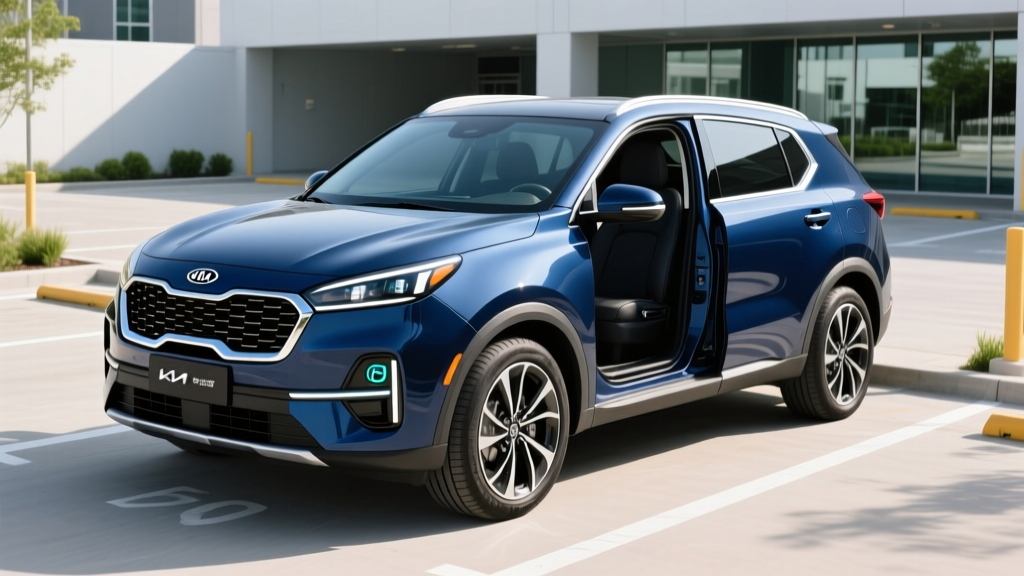
The fifth-generation Kia Sportage returned for 2023 with a complete redesign and two electrified options: a conventional hybrid (HEV) and a plug-in hybrid (PHEV). If you're researching the 2023 Kia Sportage Hybrid MPG figures, you'll find two very different efficiency stories depending on which powertrain you choose. The HEV delivers strong combined fuel economy with zero plug-in hassle, while the PHEV offers up to 34 miles of electric-only driving before the gas engine takes over. Below, we break down every number that matters — EPA ratings, real-world expectations, battery specs, warranty coverage, and federal tax credit eligibility.
HEV vs PHEV: Which 2023 Sportage Hybrid Are We Talking About?
Kia sells two distinct electrified Sportage models, and confusing them is the most common mistake shoppers make. Here's the fundamental difference:
Sportage Hybrid (HEV)
- No plug required — the battery recharges via regenerative braking and the gas engine
- Small 1.49 kWh lithium-ion battery (not user-serviceable for EV driving)
- Electric motor assists the engine; cannot drive on electricity alone at meaningful speeds
- Refuels only at gas stations
Sportage Plug-In Hybrid (PHEV)
- Must plug in to access electric-only range — otherwise functions as a less-efficient HEV
- Larger 13.7 kWh lithium-ion battery pack
- Can drive up to 34 miles on electricity alone before the engine engages
- Charges via Level 1 (120V) or Level 2 (240V); no DC fast charging
Both models share the same 1.6-liter turbocharged four-cylinder engine paired with an electric motor and a 6-speed automatic transmission (not a CVT). Both come standard with all-wheel drive. But their efficiency, pricing, and daily-driving experiences diverge significantly.
2023 Kia Sportage Hybrid MPG: EPA Ratings Breakdown
According to fueleconomy.gov, the EPA rates the conventional Sportage Hybrid as follows:
| Model | City MPG | Highway MPG | Combined MPG |
|---|---|---|---|
| Sportage HEV AWD | 38 | 38 | 38 |
| Sportage PHEV AWD (gas only, battery depleted) | 35 | 36 | 35 |
| Sportage PHEV AWD (MPGe, electric + gas combined) | 84 MPGe combined | ||
A few things stand out. First, the HEV's perfectly balanced 38/38/38 split is unusual — most hybrids skew higher in city driving because regenerative braking recovers energy in stop-and-go traffic. The Sportage HEV's turbocharged engine and AWD system keep highway efficiency competitive, but you won't see the dramatic city-mpg advantage that models like the Toyota RAV4 Hybrid (41 city / 38 highway) deliver.
Second, when the PHEV's battery is fully depleted and it operates purely as a hybrid, it returns 35 MPG combined — 3 MPG less than the HEV. That's the weight penalty of carrying the larger 13.7 kWh battery pack without the benefit of electric propulsion. This is why PHEVs only make financial sense if you can charge regularly.
Real-World MPG: What Owners Actually Report
EPA numbers are a baseline, not a guarantee. In real-world driving, the Sportage HEV tends to perform close to its sticker in mixed suburban use. On pure highway trips at 70-75 mph, expect 34-36 MPG — the turbocharged engine works harder at sustained speed than a naturally aspirated Atkinson-cycle hybrid would. In cold weather (below 30°F), the engine runs more frequently to provide cabin heat, dropping observed economy to roughly 32-34 MPG until the powertrain warms up.
For the PHEV, real-world electric-only range hovers around 28-32 miles in moderate temperatures with gentle driving. Highway speeds and cold weather can reduce that to 22-25 miles before the engine kicks in. Once the battery is depleted, 33-35 MPG is typical for mixed driving.
Powertrain Specs: What's Under the Hood
| Specification | Sportage HEV | Sportage PHEV |
|---|---|---|
| Engine | 1.6L turbo I4 | 1.6L turbo I4 |
| Engine Output | 178 hp / 195 lb-ft | 178 hp / 195 lb-ft |
| Electric Motor | 44 kW (59 hp) | 66.9 kW (90 hp) |
| Combined System Output | 226 hp / 258 lb-ft | 261 hp / 258 lb-ft |
| Transmission | 6-speed automatic | 6-speed automatic |
| Drivetrain | AWD (standard) | AWD (standard) |
| Battery Capacity | 1.49 kWh | 13.7 kWh |
| 0-60 mph (est.) | ~7.5 sec | ~7.0 sec |
| Towing Capacity | 2,000 lbs | 2,000 lbs |
The PHEV's larger electric motor (90 hp vs. 59 hp) gives it a meaningful power advantage — 261 combined horsepower versus 226. That extra torque is noticeable in passing maneuvers and initial acceleration from a stop, even if 0-60 times aren't sports-car territory. Both models use Kia's 6-speed automatic rather than a CVT, which means more natural-feeling acceleration without the rubber-band drone common in Toyota and Honda hybrids.
PHEV Electric Range, Charging & Battery Details
The Sportage PHEV's headline number is 34 miles of EPA-rated electric-only range. That covers most daily commutes and errands without burning a drop of gasoline — provided you plug in. Total combined range (electric + full gas tank) reaches approximately 430 miles.
Charging the 13.7 kWh battery is straightforward but slow by EV standards:
| Charging Level | Power (kW) | Time (0-100%) | Notes |
|---|---|---|---|
| Level 1 (120V household outlet) | ~1.4 kW | ~10-11 hours | Overnight from a standard plug; sufficient for daily top-ups |
| Level 2 (240V home/public charger) | ~3.3 kW (onboard charger limit) | ~3.5-4 hours | Requires J1772 connector; typical home wallbox setup |
| DC Fast Charging | Not supported — the Sportage PHEV cannot use CCS or CHAdeMO DC fast chargers | ||
The 3.3 kW onboard charger is the PHEV's biggest limitation. Even at a public Level 2 station capable of 7.2 or 11.5 kW, the Sportage PHEV will only accept 3.3 kW. That means a full charge always takes around 3.5 hours minimum, regardless of the charger's capability. For context, the Toyota RAV4 Prime charges at up to 6.6 kW, cutting its Level 2 time roughly in half.
That said, most PHEV owners charge overnight at home on Level 1 or Level 2 and start each morning with a full battery. The slow onboard charger only matters if you're trying to top up midday at a public station.
Pricing, Trims & Federal Tax Credit Eligibility
At launch, the 2023 Sportage HEV started at $28,490 (LX trim, including destination), while the PHEV began at $39,090 (X-Line). Fully loaded, the PHEV X-Line Prestige reaches approximately $44,590.
Federal Tax Credit: What You Need to Know
Under current IRS §30D Clean Vehicle Credit rules:
- Sportage HEV: Does NOT qualify for the federal EV tax credit. Conventional hybrids are ineligible — the credit applies only to BEVs and PHEVs with at least 7 kWh of battery capacity.
- Sportage PHEV: May qualify for up to $7,500, but eligibility depends on multiple factors that change frequently:
- — Buyer income caps: $150,000 single / $225,000 head of household / $300,000 joint filers
- — MSRP cap: $80,000 for SUVs (the Sportage PHEV clears this easily)
- — Battery component and critical mineral sourcing requirements (phased in progressively — check current-year IRS guidance)
- — Point-of-sale transfer option available at participating dealers, reducing your purchase price directly
- — Kia manufactures the Sportage in South Korea; vehicles must undergo final assembly in North America to qualify. Verify VIN eligibility at fueleconomy.gov before purchasing.
Always confirm credit eligibility with a tax professional before relying on it in your purchase decision. Rules and sourcing requirements update regularly.
Battery Warranty, Reliability & Replacement Cost
Kia Hybrid Battery Warranty Coverage
- Hybrid battery: 10 years / 100,000 miles (whichever comes first)
- Hybrid system components (motor, inverter, converter): 10 years / 100,000 miles
- Limited vehicle warranty: 5 years / 60,000 miles bumper-to-bumper
- Powertrain warranty: 10 years / 100,000 miles
Kia's 10-year hybrid battery warranty is among the best in the segment, matching Hyundai and exceeding Toyota's 8-year/100,000-mile coverage. The warranty covers battery capacity loss below a manufacturer-defined threshold (typically around 70% of original capacity).
Regarding reliability: the 2023 Sportage is still relatively new, so long-term data is limited. However, Kia's 1.6L turbo hybrid powertrain has been in use across multiple models (Sorento Hybrid, Tucson Hybrid via corporate sibling Hyundai) since 2021, and early reports have been generally positive. The 6-speed automatic avoids the reliability questions that surround some CVT designs.
If the hybrid battery does need replacement outside of warranty, expect a cost between $2,000 and $4,000 for the HEV's small 1.49 kWh pack, and $5,000 to $8,000 for the PHEV's larger 13.7 kWh pack (parts and labor). These figures are estimates based on current hybrid battery replacement pricing across the industry — exact costs depend on the dealer and regional labor rates. In practice, modern lithium-ion hybrid batteries rarely fail catastrophically; gradual capacity loss over 150,000+ miles is the more common scenario, and many hybrid batteries outlast the vehicles they're installed in.
Who Should Choose the Sportage HEV, PHEV, or a Full EV?
Choose the Sportage HEV If:
- You cannot charge at home or work (apartment, street parking, no garage access)
- You want better fuel economy without changing any habits — just fill up with gas
- Your budget tops out around $35,000-$37,000
- You drive a mix of city and highway and want a consistent 36-40 MPG
Choose the Sportage PHEV If:
- You have reliable Level 1 or Level 2 charging at home
- Your daily commute is under 30 miles round-trip (you'll rarely use gas on weekdays)
- You want EV-like daily driving but need gas-engine range for road trips
- You qualify for the federal tax credit, narrowing the price gap with the HEV
Choose a Full EV (BEV) Instead If:
- You have home charging and rarely drive more than 250 miles in a single day
- You want to eliminate oil changes, spark plugs, and exhaust-system maintenance entirely
- You want maximum federal tax credit value and lower per-mile fueling cost
- You're considering models like the Hyundai Ioniq 5, Tesla Model Y, or Kia EV6
Sportage HEV — Pros
- 38 MPG combined without any lifestyle changes
- AWD standard on every trim
- 10-year/100,000-mile hybrid battery warranty
- Spacious interior with class-leading rear legroom
- Natural-feeling 6-speed automatic (no CVT drone)
Sportage HEV — Cons
- Highway MPG doesn't exceed city MPG (unusual for a hybrid)
- Turbo engine requires premium fuel for maximum output
- 226 hp is adequate, not quick, for a compact SUV
Sportage PHEV — Pros
- 34 miles electric-only range covers most commutes
- 261 hp — the most powerful Sportage variant
- Potential $7,500 federal tax credit (verify eligibility)
- AWD standard; 430+ miles total range
Sportage PHEV — Cons
- Only 3.3 kW onboard charging — slow Level 2 refill
- No DC fast charging capability
- 35 MPG as a hybrid (battery depleted) is worse than the HEV
- ~$10,600 price premium over the HEV before incentives
- Final assembly in South Korea may disqualify from federal credit
Frequently Asked Questions
How many MPG does the 2023 Kia Sportage Hybrid get?
The conventional Sportage HEV is EPA-rated at 38 MPG city, 38 highway, and 38 combined. The Sportage PHEV returns 84 MPGe when operating on its combined electric and gas charge, and 35 MPG combined once the battery is depleted and it runs as a conventional hybrid.
How far can the Sportage PHEV go on electric power alone?
The EPA rates the Sportage PHEV at 34 miles of electric-only range. In real-world conditions — particularly at highway speeds or in cold weather — expect 25-32 miles before the gas engine engages. Total range with a full tank and full battery is approximately 430 miles.
Does the 2023 Sportage Hybrid qualify for a federal tax credit?
The conventional HEV does not qualify for any federal tax credit. The PHEV may qualify for up to $7,500 under the IRS §30D Clean Vehicle Credit, but eligibility depends on your income, the vehicle's battery sourcing compliance, and final assembly location. Because the Sportage is assembled in South Korea, confirm VIN-level eligibility at fueleconomy.gov and consult a tax professional before purchase.
Is the Sportage Hybrid reliable, and what does battery replacement cost?
Long-term data is still building for the 2023 redesign, but Kia's 1.6T hybrid powertrain has been in service since 2021 with generally positive results. The hybrid battery is covered by a 10-year/100,000-mile warranty. Out-of-warranty replacement would likely cost $2,000-$4,000 for the HEV battery and $5,000-$8,000 for the PHEV battery, though catastrophic failures are rare in modern lithium-ion hybrid packs.
Do I need to plug in the Sportage Hybrid?
No. The conventional Sportage HEV never needs to be plugged in — its small battery recharges automatically through regenerative braking and the gas engine. Only the Sportage PHEV requires plug-in charging to access its 34-mile electric range. If you don't plug in the PHEV, it functions as a heavier, slightly less efficient hybrid.
How does the Sportage Hybrid compare to the Toyota RAV4 Hybrid?
The RAV4 Hybrid is EPA-rated at 41 city / 38 highway / 40 combined — beating the Sportage HEV by 2 MPG combined. The RAV4 also uses a CVT, which some drivers find less engaging than the Sportage's 6-speed automatic. The RAV4 Prime PHEV offers 42 miles of electric range and 6.6 kW Level 2 charging, outperforming the Sportage PHEV on both metrics. However, the Sportage offers more rear-seat legroom and a longer standard warranty.