Quick Verdict: A Practical Hybrid Compact SUV With a Cabin Punching Above Its Weight
The 2023 Kia Sportage Hybrid remains one of the most compelling entries in the compact hybrid SUV segment — not just for its 38 MPG EPA combined rating, but for an interior that genuinely rivals vehicles costing $10,000 more. Now that we're in 2026, used and certified pre-owned examples are flooding the market at attractive prices, making this a strong candidate for buyers who want hybrid efficiency without the plug-in lifestyle or full-EV commitment.
This guide covers everything a research-driven buyer needs: the HEV vs. PHEV powertrain split, exact EPA and real-world MPG figures, the 2023 Kia Sportage Hybrid interior dimensions and technology, battery warranty specifics, and whether this model fits your daily driving pattern better than a full EV or a conventional gas vehicle.
HEV vs. PHEV: Which 2023 Sportage Hybrid Is Which?
Kia offered the 2023 Sportage in two distinct electrified variants. Confusing them is the most common buyer mistake in this segment.
| Attribute | Sportage Hybrid (HEV) | Sportage Plug-In Hybrid (PHEV) |
|---|---|---|
| Plug-in required? | No — self-charging via engine and regen | Yes — plug in to access electric-only range |
| Battery capacity | 1.49 kWh (small buffer) | 13.8 kWh usable |
| Electric-only range | Less than 1 mile at low speed | 34 miles (EPA) |
| EPA combined MPG / MPGe | 38 MPG combined (43 city / 34 hwy) | 84 MPGe combined (35 MPG gas-only) |
| Total range | ~430 miles | ~430 miles (34 electric + ~396 gas) |
| Combined horsepower | 226 hp | 261 hp |
| Drivetrain | AWD standard | AWD standard |
| DC fast charging | N/A | No — Level 2 AC only (~3.3 kW onboard charger) |
| Level 2 charge time (0–100%) | N/A | ~3 hours 45 minutes at 3.3 kW |
The conventional HEV uses its small battery to assist the gas engine and capture energy from regenerative braking. You never plug it in. The PHEV adds a substantially larger battery and a more powerful electric motor, giving you 34 miles of pure electric driving before the gas engine engages — enough for most commutes without burning a drop of fuel, provided you charge at home or work.
Fuel Economy Breakdown: EPA Numbers vs. Real-World MPG
| Powertrain | City | Highway | Combined |
|---|---|---|---|
| Sportage HEV (AWD) | 43 MPG | 34 MPG | 38 MPG |
| Sportage PHEV (gas-only mode) | 36 MPG | 35 MPG | 35 MPG |
| Sportage PHEV (with charge) | 84 MPGe combined | ||
| Gas-only Sportage (AWD, baseline) | 23 MPG | 28 MPG | 25 MPG |
Source: EPA Fuel Economy
Real-world expectation: The HEV's 43 MPG city rating is one of the areas where Kia's hybrid system genuinely shines. In stop-and-go urban driving, regenerative braking and electric-motor assist work hardest, and many owners report matching or slightly exceeding the city figure. Highway driving is a different story — at sustained 70–80 MPH speeds, expect 30–33 MPG rather than the 34 EPA sticker. Cold weather (below 35°F) typically drops combined fuel economy by 5–10% as the engine runs more frequently for cabin heat and battery warmup.
For the PHEV, the 34-mile electric range assumes moderate temperatures and mixed driving. In winter, expect 26–29 miles before the engine fires. If your commute is under 30 miles round-trip and you charge nightly, you may go weeks without visiting a gas station.
2023 Kia Sportage Hybrid Interior: Dimensions, Tech, and Comfort
The 2023 model year introduced the fifth-generation Sportage on an entirely new platform, and the interior is where the generation leap is most obvious. The cabin is noticeably larger than the outgoing model and loaded with technology that was previously reserved for luxury compacts.
| Interior Spec | Measurement |
|---|---|
| Front headroom | 40.0 inches |
| Front legroom | 41.4 inches |
| Rear headroom | 39.0 inches |
| Rear legroom | 41.3 inches |
| Cargo volume (behind rear seats) | 39.5 cu ft (HEV) / 36.4 cu ft (PHEV) |
| Cargo volume (seats folded) | 73.7 cu ft (HEV) / 70.5 cu ft (PHEV) |
| Infotainment screen | 12.3-inch touchscreen (standard on hybrid trims) |
| Digital instrument cluster | 12.3-inch fully digital |
| Wireless Apple CarPlay / Android Auto | Yes (with base 12.3" screen); wired with nav-equipped system |
| USB ports | 2 front (USB-C), 2 rear (USB-C) |
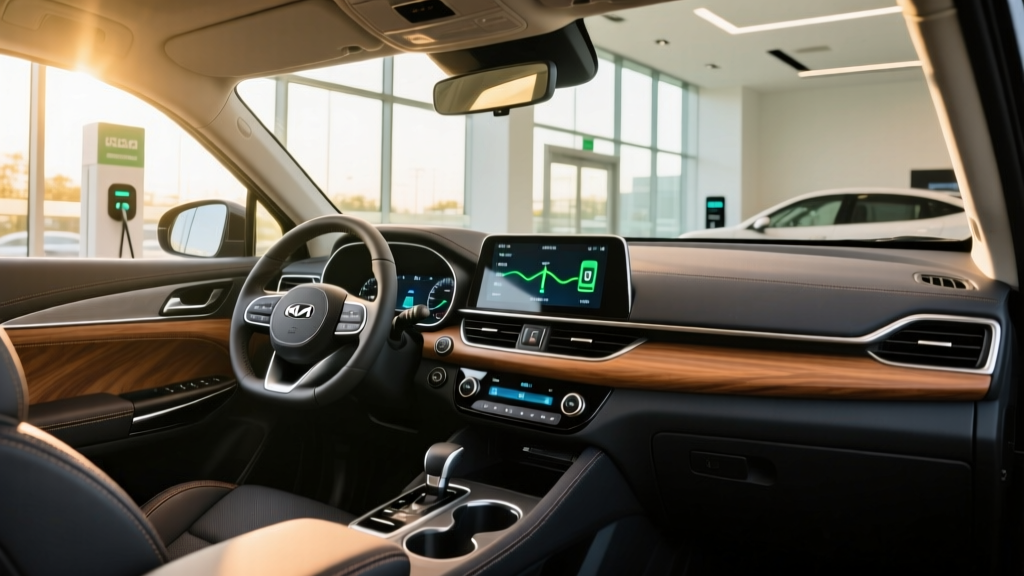
The dual 12.3-inch curved panoramic display dominates the dashboard and gives the 2023 Kia Sportage Hybrid interior a premium, modern feel. Lower trims (LX, S) use a conventional layout, but the EX and above receive the full curved screen treatment. Material quality on EX and SX-Prestige trims includes synthetic leather (Sofino), heated and ventilated front seats, a heated steering wheel, and a Harman Kardon premium audio system on the top SX-Prestige.
The PHEV sacrifices about 3 cubic feet of cargo space compared to the HEV due to the larger battery pack positioned under the cargo floor. For most buyers, the difference is negligible — 36.4 cu ft still swallows a week's worth of groceries or two large suitcases with room to spare.
Powertrain and Performance Specs
| Specification | HEV | PHEV |
|---|---|---|
| Engine | 1.6L turbocharged 4-cylinder | 1.6L turbocharged 4-cylinder |
| Engine output | 178 hp / 195 lb-ft | 178 hp / 195 lb-ft |
| Electric motor output | 44 kW (59 hp) / 195 lb-ft | 72 kW (97 hp) / 224 lb-ft |
| Combined system output | 226 hp / 258 lb-ft | 261 hp / 258 lb-ft |
| Transmission | 6-speed automatic | 6-speed automatic |
| 0–60 MPH (est.) | ~7.4 seconds | ~6.7 seconds |
| Towing capacity | 2,000 lbs | 2,000 lbs |
The turbocharged 1.6L engine paired with the electric motor provides responsive acceleration that feels significantly quicker than the 25 MPG gas-only Sportage. The HEV's 226 combined horsepower is competitive with the Toyota RAV4 Hybrid (219 hp) and notably more than the Honda CR-V Hybrid (204 hp). The PHEV's 261 hp makes it one of the quicker vehicles in its class when the battery is charged.
Pricing, Trims, and Tax Credit Eligibility
Original MSRP for the 2023 Sportage Hybrid ranged from approximately $28,590 (LX) to $37,790 (SX-Prestige), including destination. The PHEV started at $39,990 (X-Line) and topped out at $44,290 (X-Line Prestige).
As a used or CPO purchase in 2026, HEV examples typically trade between $20,000 and $29,000 depending on trim and mileage, while PHEV models range from $27,000 to $36,000.
Federal Tax Credit Status
New purchase (2023): The Sportage PHEV was eligible for a partial federal tax credit under IRS §30D when purchased new, though the exact amount depended on critical-mineral and battery-component sourcing requirements that shifted throughout 2023. The HEV did not qualify for §30D (conventional hybrids are excluded).
Used purchase (2026): Under the Used Clean Vehicle Credit (§25E), a qualifying used PHEV purchased from a dealer for $25,000 or less may be eligible for up to $4,000 (30% of sale price, capped at $4,000). Income limits apply: $75,000 single / $112,500 head of household / $150,000 joint filers. The vehicle must be at least two model years old (2023 qualifies in 2026), and the sale must be through a licensed dealer. Verify current rules with a tax professional before relying on this credit.
Battery Warranty, Reliability, and Replacement Costs
Hybrid battery longevity is the single most common concern among first-time hybrid buyers, and Kia addresses it with one of the strongest warranties in the industry.
| Coverage | Term |
|---|---|
| Hybrid battery (HEV and PHEV) | 10 years / 100,000 miles (original owner) |
| Hybrid battery (subsequent owners) | Varies — typically transfers at reduced terms; verify with Kia |
| Hybrid system components | 10 years / 100,000 miles |
| Basic vehicle warranty | 5 years / 60,000 miles |
| Powertrain warranty | 10 years / 100,000 miles |
The 1.49 kWh battery in the HEV is a lithium-ion pack that operates within a narrow state-of-charge window — Kia's battery management system rarely lets it charge above ~60% or drop below ~40%, which dramatically extends cycle life. Most Toyota and Kia hybrid batteries from the past decade show less than 10% capacity degradation at 150,000 miles.
The PHEV's 13.8 kWh battery undergoes deeper cycles but is still engineered for longevity. Kia warrants it to retain at least 70% of original capacity for 10 years/100,000 miles. If it falls below that threshold within the warranty period, Kia replaces or refurbishes it at no cost.
Out-of-warranty replacement cost: Based on current parts pricing and industry data, a Sportage HEV battery replacement runs approximately $2,500–$4,000 including labor. The PHEV battery is larger and more expensive: $5,000–$8,000. These figures are estimates; actual costs depend on dealer pricing and whether refurbished units are available. For context, most hybrid batteries outlast 200,000 miles before requiring service.
The 2023 Sportage received strong safety marks, earning an IIHS Top Safety Pick rating when equipped with specific headlights, and a 5-Star overall rating from NHTSA.
Who Should Choose the Sportage Hybrid vs. a Full EV or Gas Car?
Sportage HEV Pros
- 38 MPG combined with no plug-in requirement
- 43 MPG city excels in stop-and-go traffic
- Spacious 2023 Kia Sportage Hybrid interior with dual 12.3" screens
- AWD standard — strong value vs. RAV4 Hybrid
- 226 hp provides confident highway merging
- 10-year/100,000-mile hybrid battery warranty
Sportage HEV Cons
- Highway MPG drops to ~30–33 at 75+ MPH
- No electric-only driving mode of meaningful distance
- Cold-weather MPG penalty of 5–10%
- Used PHEV eligibility for §25E credit requires sub-$25,000 price
- Infotainment can lag on base non-navigation system
Decision Framework
Choose the Sportage HEV if: You want hybrid efficiency without changing your fueling habits, you drive a mix of city and highway miles, and you don't have reliable access to home or workplace charging. It's the simplest path to 38 MPG.
Choose the Sportage PHEV if: Your daily commute is under 34 miles round-trip, you can install a Level 2 charger at home, and you want to drive mostly on electricity during the week while retaining gas-engine range for road trips. The potential $4,000 used-EV credit makes CPO examples particularly attractive in 2026.
Choose a full EV instead if: You have home charging, your daily driving is under 250 miles, you want zero tailpipe emissions, and you're ready to eliminate oil changes, spark plugs, and transmission fluid. Vehicles like the Hyundai Ioniq 5 or Tesla Model Y offer 300+ miles of range but require a charging commitment.
Stick with the gas Sportage if: Your budget is strictly under $22,000, you drive fewer than 8,000 miles per year (where hybrid fuel savings don't offset the higher purchase price within a reasonable timeframe), or you primarily drive highway miles where the hybrid advantage narrows.
Frequently Asked Questions
How many MPG does the 2023 Kia Sportage Hybrid get?
The HEV achieves 43 MPG city, 34 MPG highway, and 38 MPG combined per the EPA. Real-world city driving often matches or slightly exceeds the 43 MPG figure thanks to regenerative braking, while sustained highway speeds above 70 MPH typically yield 30–33 MPG.
How far can the Sportage PHEV go on electric only?
The EPA rates the 2023 Sportage PHEV at 34 miles of electric-only range. In mild weather with moderate acceleration, you may see 32–36 miles. In cold weather (below 35°F), expect 26–29 miles due to cabin heating demands and reduced battery efficiency.
Does the 2023 Sportage Hybrid qualify for any tax credit?
The conventional HEV does not qualify for any federal tax credit. The PHEV, when purchased new in 2023, was eligible for a partial §30D credit depending on battery sourcing. As a used purchase in 2026, the PHEV may qualify for the §25E Used Clean Vehicle Credit of up to $4,000 if the sale price is $25,000 or less, purchased through a dealer, and buyer income falls within IRS limits. Consult a tax professional for your specific situation.
Is the 2023 Sportage Hybrid reliable, and what does battery replacement cost?
Kia's hybrid system has proven reliable across multiple model years, and the 10-year/100,000-mile hybrid battery warranty provides strong protection. Out-of-warranty replacement costs are approximately $2,500–$4,000 for the HEV battery and $5,000–$8,000 for the PHEV battery, though most hybrid batteries exceed 200,000 miles without failure.
Does the conventional hybrid need to be plugged in?
No. The Sportage HEV charges its small battery entirely through regenerative braking and the gas engine. You fuel it like any conventional vehicle. Only the PHEV variant requires plug-in charging to access its 34-mile electric range.
Can the Sportage PHEV DC fast charge?
No. The 2023 Sportage PHEV is limited to Level 2 AC charging at a maximum rate of 3.3 kW, which replenishes the 13.8 kWh battery in approximately 3 hours and 45 minutes. A standard 120V household outlet (Level 1) takes roughly 11 hours for a full charge.