Quick Verdict: A Practical Bridge Between Gas and Electric
The 2023 Hyundai Tucson Plug-In Hybrid occupies a specific niche: buyers who want electric-only commuting most days but need the flexibility of a gas engine for longer road trips. With an EPA-rated 33 miles of electric range, 261 combined horsepower, and a starting MSRP around $36,900, it competes directly with the Toyota RAV4 Prime and Ford Escape PHEV. But does its real-world efficiency match the sticker, and is it still worth considering in 2026 as newer model years arrive?
This guide breaks down every spec that matters — from battery chemistry and charging times to the federal tax credit rules that affect your wallet — so you can decide if the Tucson PHEV fits your driving pattern.
HEV vs. PHEV: Understanding the Tucson Hybrid Lineup
Hyundai sells the Tucson in three powertrain flavors for the 2023 model year, and confusing them is easy. Here's the distinction:
| Feature | Tucson Hybrid (HEV) | Tucson Plug-In Hybrid (PHEV) |
|---|---|---|
| Plug-in charging required? | No — self-charging via regen & engine | Yes — plug in to access electric-only range |
| Battery capacity | 1.49 kWh | 13.8 kWh (usable ~10.4 kWh) |
| Electric-only driving | Not practical (short low-speed assist only) | EPA 33 miles at up to ~75 mph |
| Combined horsepower | 226 hp | 261 hp |
| EPA fuel economy | 37 MPG combined | 80 MPGe (elec+gas) / 35 MPG (gas-only) |
| Drivetrain | AWD standard | AWD standard |
| Starting MSRP (2023) | ~$31,350 | ~$36,900 |
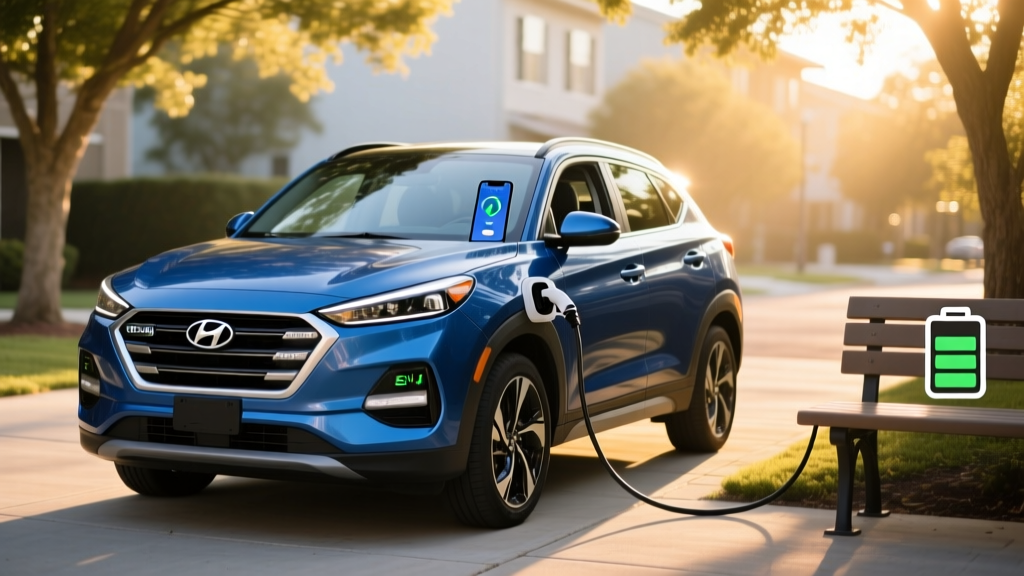
The conventional HEV never plugs in — it recovers energy through regenerative braking and the gasoline engine to keep its small battery charged. The PHEV's larger 13.8 kWh battery lets you drive substantial distances on electricity alone before the 1.6-liter turbocharged engine kicks in. If you can charge at home and your commute is under 30 miles round-trip, the PHEV will burn almost no gasoline on weekdays.
Electric Range, MPGe, and Gas-Only MPG
The EPA rates the 2023 Tucson PHEV at 33 miles of all-electric range and 80 MPGe when operating in blended electric-gas mode. Once the battery is depleted, the vehicle functions as a conventional hybrid, earning an EPA-estimated 35 MPG combined.
| Metric | EPA Rating | Real-World Expectation |
|---|---|---|
| Electric-only range | 33 miles | 28–31 mi (highway); 33–36 mi (city, mild weather) |
| MPGe (blended elec+gas) | 80 MPGe | Varies with charge frequency; 70–85 typical |
| Gas-only MPG (city) | 33 MPG | 32–36 MPG (hybrids often beat EPA in stop-and-go) |
| Gas-only MPG (highway) | 37 MPG | 33–35 MPG (aerodynamic drag reduces efficiency at 70+ mph) |
| Gas-only MPG (combined) | 35 MPG | 33–37 MPG depending on driving mix |
| Total combined range | ~430 miles | ~390–440 miles (13.7-gal tank + battery) |
Powertrain Specs: What Moves the Tucson PHEV
| Specification | 2023 Tucson PHEV |
|---|---|
| Engine | 1.6L turbocharged 4-cylinder (178 hp / 195 lb-ft) |
| Electric motor | Permanent-magnet synchronous (90 hp / 224 lb-ft) |
| Combined system output | 261 hp / 258 lb-ft |
| Transmission | 6-speed automatic |
| Drivetrain | AWD (HTRAC electronic) |
| 0–60 mph | ~7.1 seconds |
| Battery capacity (gross / usable) | 13.8 kWh / ~10.4 kWh |
| Battery chemistry | NMC (nickel-manganese-cobalt) lithium-ion |
| Towing capacity | 2,000 lbs |
| Cargo volume (behind rear seats) | 38.7 cu ft |
The combined 261 hp makes the Tucson PHEV the most powerful variant in the Tucson lineup — noticeably quicker than the HEV's 226 hp and the gas-only model's 187 hp. The electric motor's instant torque (available from 0 RPM) gives it strong off-the-line acceleration, and the 6-speed automatic avoids the rubber-band feel that CVTs in some competing hybrids produce.
Charging: Times, Connectors, and Home Setup
One important limitation: the 2023 Tucson PHEV does not support DC fast charging. This is typical for most PHEVs (the RAV4 Prime is a rare exception with optional DC capability). All charging occurs via AC, using a J1772 connector.
| Charging Level | Power (kW) | Time (0–100%) | Setup |
|---|---|---|---|
| Level 1 (120V household outlet) | ~1.4 kW | ~8–9 hours | Standard outlet; included portable cord |
| Level 2 (240V home/public station) | ~3.3 kW (onboard charger limit) | ~3.5–4 hours | Requires Level 2 EVSE; 16A+ circuit |
The onboard charger caps at 3.3 kW, meaning even if you plug into a 7.2 kW or 11.5 kW Level 2 station, the Tucson PHEV will only draw 3.3 kW. A full charge still completes in under 4 hours, which is practical for overnight top-ups. Most PHEV owners charge nightly on Level 2 and start each morning with a full battery.
Home charging cost: At the US average electricity rate of ~$0.16/kWh, fully recharging the ~10.4 kWh usable battery costs roughly $1.66 — compared to about $4.50+ for the equivalent gasoline to cover 33 miles at 35 MPG and $3.50/gal fuel.
Pricing, Trims, and Federal Tax Credit Eligibility
The 2023 Tucson PHEV was offered in two trims:
- SEL Convenience: ~$36,900 MSRP (destination included)
- Limited: ~$40,600 MSRP
As a 2023 model purchased new in 2023, the Tucson PHEV was eligible for a partial federal tax credit under IRS §30D rules at that time. However, if you're shopping for one in 2026 — whether as remaining new inventory or a used purchase — the credit landscape has changed significantly:
- New vehicles (2026 rules): The full §30D credit of up to $7,500 requires meeting critical-mineral sourcing and battery-component manufacturing thresholds that shift annually. The Tucson PHEV's eligibility depends on its current battery supply chain compliance — verify on the IRS qualified vehicles list.
- Used vehicles: A separate credit (up to $4,000 or 30% of sale price, whichever is lower) may apply to used PHEVs purchased from a dealer, subject to buyer income caps ($75K single / $150K joint) and a sale-price cap of $25,000.
- MSRP cap: For new SUVs/PHEVs, the vehicle MSRP must not exceed $80,000 — both Tucson PHEV trims clear this easily.
- Buyer income cap (new): AGI must not exceed $150K (single) or $300K (joint) for new-vehicle credits.
- Point-of-sale transfer: As of 2024+, you can transfer the credit to the dealer at purchase for an immediate price reduction rather than waiting to claim it on your tax return.
Always confirm eligibility with a tax professional before purchase — rules shift, and battery sourcing compliance changes model year to model year.
Battery Longevity, Warranty, and Replacement Costs
Real-world degradation data: PHEV batteries experience less stress than full BEV batteries because the usable window is smaller (the system maintains a buffer at both the top and bottom of the state-of-charge range). Most Tucson PHEV owners report negligible range loss over the first 3–4 years. Industry data from similar NMC PHEV packs suggests 5–10% capacity loss over 8–10 years under normal use.
Out-of-warranty replacement cost: If the high-voltage battery requires replacement after the 10-year/100,000-mile warranty expires, expect a dealer-installed pack to cost between $4,000 and $7,000 including labor, based on current Hyundai parts pricing. Third-party hybrid battery rebuild services may offer lower-cost options in the $2,500–$4,000 range.
Reliability: The Tucson PHEV's powertrain has proven solid since the nameplate's 2022 introduction. Hyundai's hybrid system is less complex than some competitors — the 6-speed automatic is a conventional design rather than a power-split device, reducing potential failure points. NHTSA records show no major safety recalls specific to the PHEV powertrain as of early 2026.
Who Should Choose the Tucson PHEV — and Who Shouldn't
Choose the Tucson PHEV if:
- Your daily round-trip commute is 30 miles or less and you can charge at home overnight
- You take regular road trips where EV charging infrastructure is sparse or unreliable
- You want AWD and a compact SUV form factor without range anxiety
- You want 261 hp of combined output — more than most competitors offer
- You don't want to rely on public charging networks at all
Choose a full BEV instead if:
- You have reliable home charging and your daily driving rarely exceeds 200 miles
- You want to eliminate oil changes, spark plugs, and exhaust-system maintenance entirely
- You drive enough annual miles that the fuel savings of a BEV offset its higher upfront cost
Choose the Tucson HEV (conventional hybrid) instead if:
- You cannot charge at home (apartment, street parking, no garage)
- Your commute is mostly highway driving where the PHEV's electric advantage diminishes
- You want a lower purchase price (~$5,500 less than the PHEV) and don't need electric-only mode
- 33 mi electric range covers most commutes gas-free
- 261 hp — quickest Tucson variant
- 10-year/100,000-mi battery warranty
- AWD standard across all trims
- 35 MPG gas-only is strong for an AWD SUV
- Comfortable, well-equipped interior
- No DC fast charging capability
- 3.3 kW onboard charger limits Level 2 speed
- ~$5,500 premium over the HEV variant
- Cargo space slightly reduced vs. gas model (battery packaging)
- Electric range drops noticeably in cold weather
- Federal tax credit eligibility varies by year and sourcing rules
How It Compares: Tucson PHEV vs. Key Rivals
The Tucson PHEV competes in a tight segment. Here's how the numbers stack up against the two most common cross-shops, based on 2023 model-year EPA data from fueleconomy.gov:
| Spec | 2023 Tucson PHEV | 2023 RAV4 Prime | 2023 Escape PHEV |
|---|---|---|---|
| EPA electric range | 33 mi | 42 mi | 37 mi |
| Combined HP | 261 hp | 302 hp | 210 hp |
| Gas-only MPG (combined) | 35 MPG | 38 MPG | 40 MPG |
| AWD | Standard | Standard | FWD only |
| DC fast charge | No | Optional (trim dependent) | No |
| 0–60 mph | ~7.1 sec | ~5.7 sec | ~8.0 sec |
| Starting MSRP | ~$36,900 | ~$43,300 | ~$39,500 |
| Battery warranty | 10 yr / 100K mi | 10 yr / 150K mi (CA states) or 8 yr / 100K mi | 8 yr / 100K mi |
The RAV4 Prime offers superior electric range and acceleration but commands a significant price premium and has faced chronic availability issues. The Escape PHEV delivers better gas-only MPG but lacks AWD. The Tucson PHEV splits the difference: adequate electric range, strong power, AWD, and a competitive price.
Frequently Asked Questions
How many MPG does the 2023 Hyundai Tucson Plug-In Hybrid get?
The EPA rates it at 80 MPGe when operating with a charged battery (blended electric and gasoline), and 35 MPG combined (33 city / 37 highway) once the battery is depleted and it operates as a conventional hybrid. In real-world city driving, many owners report exceeding the EPA gas-only estimate thanks to frequent regenerative braking, sometimes seeing 36–38 MPG in stop-and-go traffic.
How far can the Tucson PHEV go on electric only?
The EPA rates it at 33 miles of all-electric range. In real-world conditions, expect 28–31 miles on the highway and 33–36 miles in city driving during mild weather. In cold temperatures (below 32°F), the electric range drops to approximately 25–27 miles due to cabin heating demands and reduced battery efficiency.
Hybrid vs. PHEV vs. full EV — which is right for me?
A conventional hybrid (HEV) is best if you can't charge at home and want better MPG without changing your habits. A PHEV like the Tucson Plug-In Hybrid is ideal if you can charge at home, commute under ~33 miles daily, but still take longer road trips without planning charging stops. A full EV (BEV) makes the most sense if you have home charging, drive under 250 miles daily, and want to eliminate gasoline entirely while minimizing maintenance.
Is the Tucson PHEV reliable, and what does a battery replacement cost?
Hyundai's hybrid powertrain has proven reliable since its introduction. The high-voltage battery is covered by a 10-year/100,000-mile warranty with a 70% capacity retention guarantee. Out-of-warranty battery replacement costs approximately $4,000–$7,000 at a dealer, or $2,500–$4,000 through independent hybrid-battery specialists. For context, most PHEV batteries show only 5–10% degradation over a decade of use.
Does the 2023 Tucson PHEV qualify for a federal tax credit?
Tax credit eligibility depends on when and how you purchase. For new-vehicle purchases, the §30D credit (up to $7,500) requires the vehicle to meet battery-sourcing and critical-mineral thresholds that change annually — check the IRS qualified vehicles list for current status. For used purchases, a separate credit of up to $4,000 may apply, subject to buyer income limits and a $25,000 sale-price cap. Always verify with a tax professional before relying on credit eligibility in your purchase decision.
Can I DC fast charge the Tucson PHEV?
No. The 2023 Tucson PHEV supports only AC charging via a J1772 connector, at a maximum rate of 3.3 kW. A full Level 2 charge takes approximately 3.5–4 hours. DC fast charging is not available on this model — a common limitation among PHEVs in this class.
What happens if I never plug it in?
The Tucson PHEV will operate as a conventional hybrid, achieving around 35 MPG combined. You won't damage anything by never plugging in, but you'll miss the entire value proposition of the PHEV premium. If you can't charge regularly, the less-expensive Tucson HEV is the smarter purchase.