Quick Verdict: The 2023 Honda Hybrid Lineup at a Glance
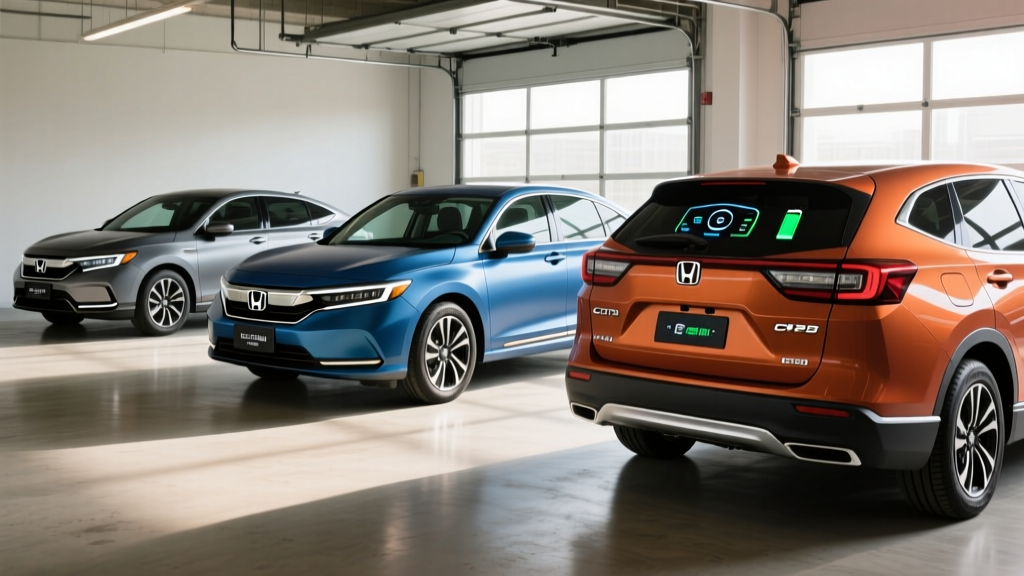
Honda's 2023 hybrid strategy centers on two core models—the Accord Hybrid and CR-V Hybrid—both using the brand's proven two-motor e:HEV system. There is no plug-in hybrid (PHEV) option in Honda's US lineup for 2023, meaning every Honda hybrid is a conventional HEV that never needs to be plugged in. For buyers who want the efficiency boost of electrification without the complexity of home charging or range planning, this is a deliberate and practical choice.
The 2023 Accord Hybrid delivers up to 48 MPG city, while the CR-V Hybrid achieves up to 43 MPG city. Both use a 2.0-liter Atkinson-cycle four-cylinder paired with two electric motors, producing combined outputs between 204 and 207 horsepower. Pricing starts around $28,000 for the CR-V Hybrid and $32,990 for the Accord Hybrid—competitive against the Toyota Camry Hybrid and RAV4 Hybrid benchmarks.
HEV vs. PHEV: What Honda Offers (and Doesn't)
Conventional Hybrid (HEV) — Honda's 2023 Approach
- No plug required. The battery recharges through regenerative braking and the gasoline engine.
- Self-sustaining: You fuel up at any gas station; there's no electric-only range to manage.
- Battery size: Small (typically 1.0–1.3 kWh usable), optimized for assist rather than standalone propulsion.
- Best for: Drivers without home charging access, apartment dwellers, or those who want simplicity.
Plug-In Hybrid (PHEV) — Not in Honda's 2023 US Lineup
- Requires plugging in to access electric-only driving (typically 25–45 miles).
- Larger battery (12–18 kWh) and often DC fast-charge capable.
- May qualify for the federal §30D tax credit (up to $7,500) if battery sourcing and income requirements are met.
- Best for: Drivers with home Level 2 charging who want short EV commutes plus gas-engine road-trip range.
Honda discontinued the Clarity Plug-In Hybrid after the 2021 model year, leaving Toyota (RAV4 Prime, Prius Prime) and Hyundai/Kia (Tucson PHEV, Sportage PHEV) as the dominant PHEV players. If you specifically need plug-in capability, Honda's 2023 lineup won't serve you—but its conventional hybrids are among the most refined in the segment.
2023 Honda Accord Hybrid: MPG, Specs & Trims
The 2023 Accord Hybrid uses Honda's fourth-generation two-motor hybrid system, which pairs a 2.0-liter Atkinson-cycle inline-four with two electric motors. One motor drives the wheels; the second acts as a generator. At highway speeds, a lock-up clutch connects the engine directly to the drivetrain for efficiency. Combined output is 204 horsepower and 247 lb-ft of torque—enough for confident merging and passing.
| 2023 Accord Hybrid Trim | City MPG | Highway MPG | Combined MPG | MSRP |
|---|---|---|---|---|
| Sport Hybrid | 46 | 41 | 44 | $32,990 |
| EX-L Hybrid | 51 | 44 | 48 | $34,635 |
| Sport-L Hybrid | 46 | 41 | 44 | $34,970 |
| Touring Hybrid | 46 | 41 | 44 | $38,390 |
Source: EPA Fuel Economy
Real-World MPG vs. EPA Estimates
The Accord Hybrid's EPA ratings are achieved on controlled test cycles, but real-world results vary by driving pattern. In city and suburban driving, many owners report exceeding the EPA city figure—often seeing 50–54 MPG on the trip computer. This is because hybrids thrive in stop-and-go traffic, where regenerative braking recovers energy that a gas car wastes as heat.
Highway driving tells a different story. At sustained 75–80 mph, expect 38–42 MPG, slightly below the EPA highway sticker. Cold weather (below 30°F) reduces efficiency by roughly 5–10% as the engine runs more frequently to heat the cabin and maintain battery temperature. On a 400-mile highway road trip in winter conditions, plan for roughly 36–39 MPG.
Powertrain and Battery Specs
| Specification | 2023 Accord Hybrid |
|---|---|
| Engine | 2.0L Atkinson-cycle I-4 |
| Combined Horsepower | 204 hp |
| Combined Torque | 247 lb-ft |
| Hybrid Battery | ~1.3 kWh lithium-ion |
| Transmission | e-CVT (direct drive) |
| 0–60 mph | ~7.1 seconds |
| Fuel Tank | 12.8 gallons |
| Total Range | ~560–615 miles |
2023 Honda CR-V Hybrid: MPG, Specs & Trims
The redesigned 2023 CR-V Hybrid shares the same fourth-generation two-motor system as the Accord but is tuned for the SUV's higher weight and different aerodynamics. Combined output is 204 hp and 247 lb-ft. The hybrid powertrain is standard on the Sport, Sport-L, and Sport Touring trims—Honda made the strategic decision to reserve the hybrid system for upper trims rather than offering it across the entire range.
| 2023 CR-V Hybrid Trim | City MPG | Highway MPG | Combined MPG | MSRP |
|---|---|---|---|---|
| Sport Hybrid (FWD) | 43 | 36 | 40 | $32,990 |
| Sport Hybrid (AWD) | 40 | 34 | 37 | $34,490 |
| Sport-L Hybrid (FWD) | 43 | 36 | 40 | $35,295 |
| Sport-L Hybrid (AWD) | 40 | 34 | 37 | $36,795 |
| Sport Touring Hybrid (AWD std) | 40 | 34 | 37 | $39,845 |
Source: EPA Fuel Economy
Real-World Efficiency for the CR-V Hybrid
The CR-V Hybrid's real-world behavior mirrors the Accord's pattern: city MPG often exceeds EPA estimates, while highway and cold-weather driving reduce them. Owners in warm climates with mixed city/suburban commutes commonly report 42–46 MPG. Highway-only trips at 70+ mph drop to 32–35 MPG, particularly with AWD engaged. Towing is limited to 1,000 pounds—adequate for a small trailer but not a boat or camper.
AWD models use a rear-mounted electric motor that engages automatically when front-wheel slip is detected. This system adds roughly 3 MPG of penalty versus FWD but provides genuine traction benefits in rain and light snow.
Battery Warranty, Reliability, and Replacement Cost
Honda Hybrid Battery Warranty
- Coverage: 8 years / 100,000 miles (10 years / 150,000 miles in CARB states including CA, CT, ME, MA, NJ, NY, OR, RI, VT, WA)
- What's covered: Hybrid battery pack, hybrid control module, and related powertrain components
- Capacity threshold: Honda warrants against defects and abnormal loss of capacity, though unlike full EVs, there's no published minimum SoH percentage trigger
How Long Do Honda Hybrid Batteries Last?
Honda's hybrid battery packs are designed to last the life of the vehicle under normal use. Real-world data from earlier-generation Accord and Civic Hybrids shows most original batteries reaching 150,000–200,000+ miles before any significant degradation. The lithium-ion cells in the 2023 models are more energy-dense and thermally managed than earlier nickel-metal-hydride packs, suggesting equal or better longevity.
If replacement is needed out of warranty, expect $2,000–$4,000 for a new OEM hybrid battery pack (parts and labor). Refurbished or aftermarket options can reduce this to $1,200–$2,500. This is far less than a full EV battery replacement ($8,000–$20,000+) because the hybrid battery is small—roughly 1.3 kWh versus 60–100 kWh in a BEV.
Overall Reliability
Honda's hybrid system is among the most proven in the industry, with over two decades of real-world deployment since the original 2000 Insight. The e-CVT design eliminates the traditional transmission entirely—there are no gears, belts, or clutches to wear out in the hybrid drive system. According to reliability tracking from Consumer Reports and J.D. Power, the Accord and CR-V Hybrid consistently score above average for their respective segments. The IIHS named the 2023 Accord a Top Safety Pick+.
Tax Credits and Incentives for 2023 Honda Hybrids
Here's the straightforward answer: conventional hybrids (HEVs) do not qualify for the federal §30D clean vehicle tax credit. The IRS §30D credit applies only to plug-in electric vehicles—battery-electric vehicles (BEVs) and plug-in hybrids (PHEVs) with a minimum battery capacity of 7 kWh.
Since Honda's 2023 hybrid lineup consists entirely of conventional HEVs with ~1.3 kWh batteries, none qualify. This is a significant consideration if you were counting on the up-to-$7,500 federal credit to offset purchase cost.
What Incentives ARE Available?
- State-level hybrid rebates: A handful of states offer modest incentives ($500–$1,500) for conventional hybrids, though these are increasingly rare as states redirect funds to BEVs and PHEVs.
- Employer or utility incentives: Some utility companies and employers offer rebates for any electrified vehicle, including HEVs. Check with your HR department or local utility.
- Lower fuel cost: The real financial incentive is at the pump. At $3.50/gallon and 15,000 miles/year, the Accord Hybrid (48 MPG combined) saves approximately $650/year versus a comparable gas-only midsize sedan getting 30 MPG combined.
Who Should Choose a 2023 Honda Hybrid vs. a Full EV or Gas Car?
Choose the 2023 Honda Hybrid If:
- You don't have access to home or workplace Level 2 charging
- You regularly drive 400+ miles without stopping (road trips, rural routes)
- You live in an apartment or condo where installing a charger isn't feasible
- You want to reduce fuel costs without changing your refueling habits
- You're in a region with extreme cold that significantly reduces EV range
Choose a Full EV (BEV) Instead If:
- You have home Level 2 charging and a daily commute under 60 miles
- You want to qualify for the $7,500 federal §30D tax credit (income and sourcing rules apply)
- You prioritize zero tailpipe emissions and lower maintenance costs
- You're considering models like the Tesla Model 3, Hyundai Ioniq 6, or Chevrolet Equinox EV
Choose a PHEV Instead If:
- You want 25–45 miles of electric-only commuting AND gas-engine road-trip flexibility
- You have home charging and want to maximize electric driving
- Look at the Toyota RAV4 Prime (42 mi electric, 38 MPG hybrid), Prius Prime (44 mi electric), or Hyundai Tucson PHEV (33 mi electric)
Stick With a Gas Car If:
- You drive fewer than 8,000 miles per year (hybrid fuel savings won't offset the price premium)
- You're buying a vehicle you plan to keep under 3 years
Pros
- Excellent city MPG that often exceeds EPA estimates
- No charging infrastructure needed—fill up at any gas station
- Strong 8-year/100,000-mile hybrid battery warranty (10/150k in CARB states)
- Smooth, linear acceleration from electric motor torque
- Proven reliability with 20+ years of Honda hybrid development
- Competitive pricing versus Toyota and Hyundai hybrid alternatives
Cons
- No PHEV option—can't drive on electric-only power for commutes
- No federal tax credit eligibility for conventional HEVs
- AWD CR-V Hybrid loses 3 MPG versus FWD
- Hybrid system reserved for upper trims, raising the entry price
- Highway MPG falls short of EPA estimates at sustained high speeds
- 1,000-lb towing limit on CR-V Hybrid is restrictive
Frequently Asked Questions
How many MPG does the 2023 Honda Accord Hybrid get?
The EPA rates the Accord Hybrid EX-L at 51 city / 44 highway / 48 combined MPG. Sport, Sport-L, and Touring trims are rated at 46/41/44 MPG due to larger wheels and additional equipment. Real-world city driving often yields 50–54 MPG, while highway cruising at 75+ mph typically returns 38–42 MPG.
How many MPG does the 2023 Honda CR-V Hybrid get?
FWD CR-V Hybrid models are rated at 43 city / 36 highway / 40 combined. AWD models drop to 40/34/37. Real-world city results often exceed 42 MPG, while highway-only driving returns 32–35 MPG.
Does the 2023 Honda CR-V Hybrid have a plug-in version?
No. Honda does not offer a plug-in hybrid CR-V in the US market. All 2023 CR-V Hybrids are conventional HEVs that recharge their small battery through regenerative braking and the gasoline engine. If you need a compact SUV PHEV, consider the Toyota RAV4 Prime, Hyundai Tucson PHEV, or Kia Sportage PHEV.
Do I need to plug in a Honda Hybrid?
No. Honda's 2023 hybrids are conventional HEVs, not plug-in hybrids. You never plug them in. The hybrid battery charges automatically through regenerative braking and the engine. You simply fill up with gasoline as you would with any car.
Is the 2023 Honda Hybrid reliable, and what does battery replacement cost?
Honda's hybrid system has over two decades of proven reliability. The hybrid battery is covered for 8 years/100,000 miles (10 years/150,000 miles in CARB states). Most original batteries last 150,000–200,000+ miles. Out-of-warranty replacement costs $2,000–$4,000 for a new OEM pack, or $1,200–$2,500 for a refurbished unit.
Does the 2023 Honda Hybrid qualify for any tax credit?
No. The federal §30D clean vehicle tax credit applies only to plug-in vehicles (BEVs and PHEVs). Honda's 2023 hybrids are conventional HEVs and do not qualify. Some states or utilities may offer small rebates for hybrids, but these vary by jurisdiction—check your state energy office or utility provider for current programs.
Hybrid vs. PHEV vs. full EV—which should I choose?
A conventional hybrid (HEV) is best if you lack home charging, drive long distances frequently, or want zero lifestyle change. A PHEV suits you if you have home charging and want 25–45 miles of electric commuting with gas-engine backup. A full EV (BEV) is ideal if you have home Level 2 charging, a predictable daily commute, and want to maximize fuel savings and minimize emissions while qualifying for federal tax credits.
How does the Honda hybrid system work?
Honda's two-motor e:HEV system uses one electric motor to drive the wheels and a second motor as a generator. At low speeds and during acceleration, the car runs primarily on electric power drawn from the hybrid battery. The gasoline engine acts mainly as a generator to recharge the battery. At steady highway speeds, a lock-up clutch directly connects the engine to the wheels for maximum efficiency. This eliminates the traditional transmission and provides smooth, linear acceleration.