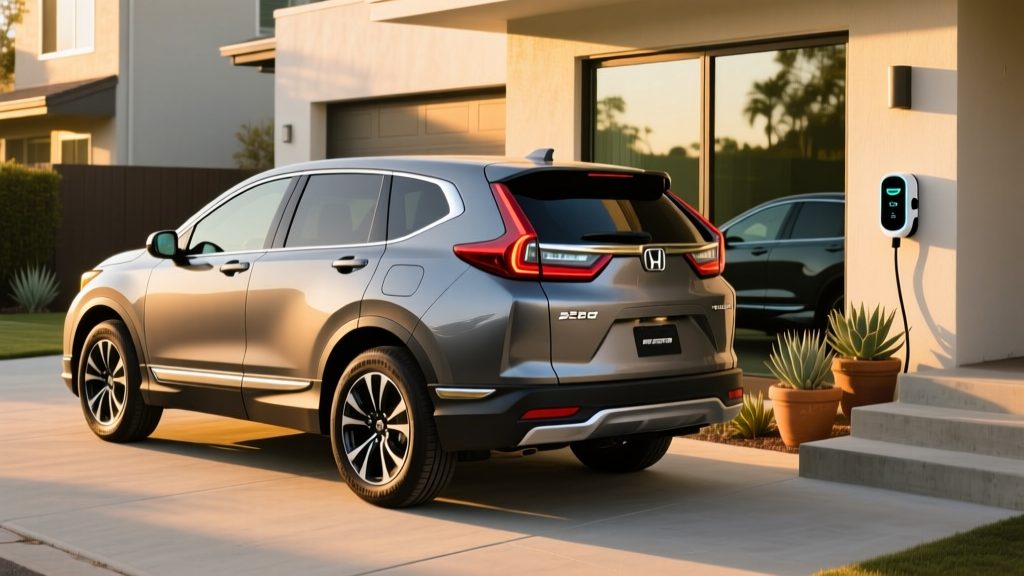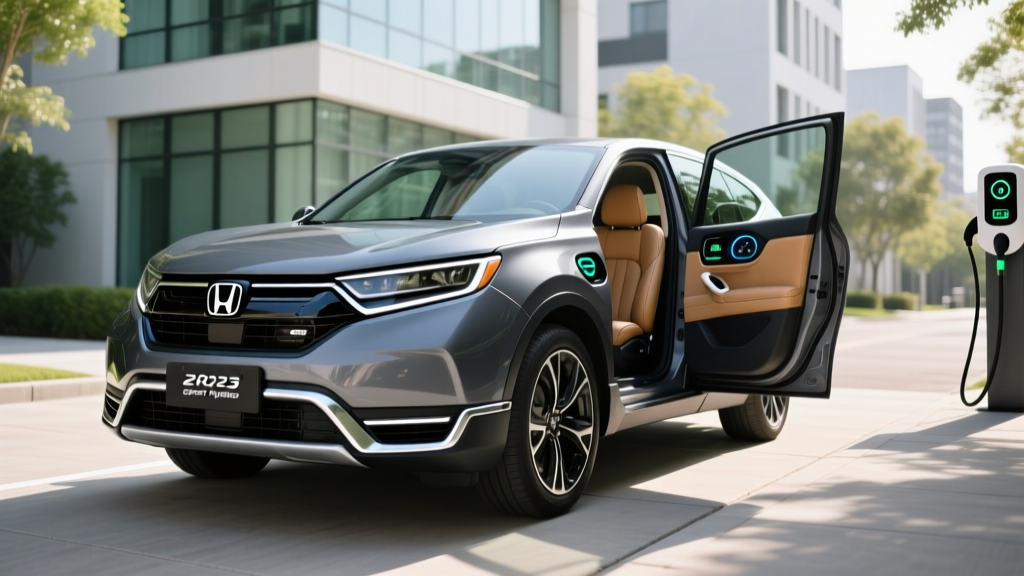
The 2023 Honda CR-V Sport Hybrid sits at the intersection of practicality and efficiency in the compact SUV segment. As the sixth-generation CR-V debuted for the 2023 model year, Honda doubled down on its two-motor hybrid system, offering it across multiple trims including the Sport, Sport Touring, and the newly introduced Sport-L. If you're cross-shopping this model in 2026 — whether on the used market or comparing it against current hybrid and EV alternatives — understanding its exact specs, real-world fuel economy, and long-term ownership costs is essential.
This guide covers everything from EPA MPG figures and powertrain details to battery warranty coverage, tax-credit eligibility, and whether this conventional hybrid (HEV) or a plug-in alternative better fits your driving needs.
HEV vs. PHEV: What the CR-V Sport Hybrid Actually Is
Conventional Hybrid (HEV) — The 2023 Honda CR-V Sport Hybrid is a self-charging hybrid. It uses a small lithium-ion battery that charges through regenerative braking and the gasoline engine. You never plug it in. It cannot drive on electric power alone for meaningful distances. Its advantage is simplicity: no charging infrastructure needed, lower upfront cost, and seamless operation.
Plug-in Hybrid (PHEV) — A PHEV like the Toyota RAV4 Prime or Hyundai Tucson PHEV carries a larger battery (typically 15–20 kWh) that you plug in to charge, offering 30–42 miles of electric-only range before the gas engine engages. PHEVs cost more upfront and require access to charging to realize their efficiency benefits.
The CR-V Sport Hybrid is an HEV. Honda does not currently offer a plug-in hybrid version of the CR-V in the U.S. market. If you need electric-only commuting capability, you'll need to look at competing PHEVs or a full battery-electric vehicle (BEV).
Fuel Economy: EPA Ratings and Real-World MPG
The 2023 CR-V Sport Hybrid pairs a 2.0-liter Atkinson-cycle four-cylinder engine with Honda's fourth-generation two-motor hybrid system. The EPA rates it as follows:
| Drivetrain | City MPG | Highway MPG | Combined MPG |
|---|---|---|---|
| FWD (Sport, Sport-L) | 43 | 36 | 40 |
| AWD (Sport Touring) | 40 | 34 | 37 |
Source: EPA Fuel Economy
Real-World MPG: What Owners Actually See
Hybrid vehicles frequently exceed their EPA city ratings in stop-and-go driving because regenerative braking recovers energy that a conventional car wastes as heat. However, highway driving is where hybrids lose their edge — the electric motor assists less at sustained speeds, and aerodynamic drag dominates.
Based on owner-reported data and independent testing:
- City driving: Expect 40–45 MPG (FWD), often exceeding the EPA's 43 MPG estimate in warm climates with moderate traffic
- Highway driving (70+ mph): Expect 32–35 MPG — slightly below the EPA highway figure, which is tested at lower average speeds
- Cold weather impact: In sub-40°F conditions, expect a 5–10% reduction in combined MPG as the engine runs more frequently to provide cabin heat and maintain battery temperature
- Combined real-world: Most owners report 36–41 MPG in mixed driving for the FWD trims
At 40 MPG combined and $3.50/gallon regular unleaded (2026 national average), the CR-V Sport Hybrid costs approximately $0.088 per mile in fuel — roughly 40% less than the non-hybrid CR-V's ~$0.14/mile at 28 MPG combined.
Powertrain Specs: Engine, Motors, and Performance
| Specification | Detail |
|---|---|
| Engine | 2.0L Atkinson-cycle inline-4 |
| Engine Output | 145 hp @ 6,100 rpm / 138 lb-ft torque |
| Electric Motors | Two-motor hybrid system (drive + generator) |
| Drive Motor Output | 181 hp / 247 lb-ft torque |
| Combined System Output | 204 hp / 247 lb-ft torque |
| Transmission | Direct-drive (no traditional transmission or CVT belts) |
| 0-60 mph | ~7.6 seconds (FWD), ~7.8 seconds (AWD) |
| Drivetrain (Sport, Sport-L) | Front-wheel drive |
| Drivetrain (Sport Touring) | Real Time AWD (mechanical rear axle engagement) |
| Towing Capacity | 1,000 lbs (all hybrid trims) |
| Fuel Tank | 15.3 gallons |
| Total Range | ~612 miles (FWD at 40 MPG combined) |
Honda's hybrid system operates primarily as a series hybrid at low speeds — the engine acts as a generator while the electric drive motor propels the wheels. At highway speeds, a lockup clutch mechanically connects the engine directly to the wheels for efficiency. This means the CR-V Sport Hybrid delivers smooth, electric-motor-like acceleration from a stop (the drive motor's 247 lb-ft is available instantly) while maintaining highway efficiency.
Battery Warranty, Lifespan, and Replacement Cost
Honda Hybrid Battery Coverage
- Warranty: 8 years / 100,000 miles (10 years / 150,000 miles in California and states adopting CARB emissions standards)
- Battery type: Lithium-ion (approximately 1.1 kWh usable capacity)
- Warranty trigger: Honda covers the hybrid battery if it fails to hold a minimum charge threshold or exhibits a defect during the warranty period
How Long Will the Hybrid Battery Last?
Honda's fourth-generation hybrid system uses a relatively small lithium-ion pack that is never deeply discharged or charged to full capacity — the battery management system maintains a narrow state-of-charge window (roughly 40–80%) to minimize degradation. This is fundamentally different from a BEV or PHEV battery that cycles through wider ranges.
Based on long-term data from Honda's hybrid lineup (Insight, Accord Hybrid, CR-V Hybrid):
- Most hybrid batteries last 150,000–200,000+ miles before significant degradation
- Capacity loss is gradual — you'll notice slightly reduced electric-only assist at low speeds before any major drivability change
- The 2023 model year benefits from improved cell chemistry and thermal management over earlier Honda hybrids
Battery Replacement Cost
If the hybrid battery fails outside warranty, replacement costs typically range from $2,000 to $4,000 for the battery pack itself, plus $500–$1,000 in labor at a dealership. Third-party refurbished battery options are emerging in 2026 at roughly $1,500–$2,500 installed. The small battery size in an HEV makes replacement far less expensive than a BEV or PHEV battery swap, which can exceed $10,000–$20,000.
Pricing, Trims, and Tax Credit Eligibility
For the 2023 model year, the CR-V Sport Hybrid was offered in three trims:
| Trim | Original MSRP (2023) | Drivetrain | Key Features |
|---|---|---|---|
| Sport Hybrid | $32,990 | FWD | 18" wheels, Apple CarPlay/Android Auto, Honda Sensing suite |
| Sport-L Hybrid | $35,590 | FWD | Leather-trimmed seats, power liftgate, wireless CarPlay |
| Sport Touring Hybrid | $38,690 | AWD | BOSE audio, heated rear seats, navigation, hands-free liftgate |
Federal Tax Credit: Does the CR-V Sport Hybrid Qualify?
No. The 2023 Honda CR-V Sport Hybrid does not qualify for the federal §30D Clean Vehicle Credit. Under current IRS rules, only plug-in electric vehicles (BEVs and PHEVs) with a battery capacity of at least 7 kWh are eligible. Conventional hybrids (HEVs) like the CR-V Sport Hybrid are excluded from the §30D credit regardless of price or buyer income.
Some states and local utilities offer rebates for conventional hybrids, but these vary widely by jurisdiction. Check your state's energy office or utility provider for current programs.
Used CR-V Sport Hybrid Pricing in 2026
On the used market in early 2026, expect to pay approximately:
- Sport Hybrid FWD: $25,000–$28,000 (30,000–50,000 miles)
- Sport-L Hybrid FWD: $27,500–$31,000
- Sport Touring Hybrid AWD: $30,000–$34,000
The used EV tax credit (§25E) also does not apply to conventional hybrids — it is limited to plug-in vehicles.
CR-V Sport Hybrid vs. PHEV vs. Full EV: Which Fits You?
Choose the CR-V Sport Hybrid (HEV) if:
- You don't have access to home or workplace charging
- You want a lower purchase price ($25K–$34K used) vs. a PHEV or EV
- Your driving is mostly city/suburban where the hybrid system excels
- You want zero behavior change — no plugging in, no range planning
- You regularly take long road trips and don't want to rely on public charging
Choose a PHEV (e.g., Toyota RAV4 Prime) if:
- You can install a Level 2 charger at home
- Your daily commute is under 40 miles (covering most trips on electricity)
- You want to reduce fuel consumption to near-zero for daily driving
- You're willing to pay a premium ($42,000+ new) for electric-only capability
Choose a Full EV (e.g., Hyundai Ioniq 5, Tesla Model Y) if:
- You have reliable home Level 2 charging
- Your daily driving is under 250 miles and you can plan road-trip charging
- You want to eliminate fuel costs entirely and minimize maintenance
- You qualify for the $7,500 federal tax credit (subject to income, MSRP, and battery sourcing rules)
Five-Year Cost Comparison: HEV vs. Gas vs. EV
| Vehicle Type | Purchase Price (approx.) | 5-Year Fuel Cost* | 5-Year Maintenance | Estimated 5-Year Total |
|---|---|---|---|---|
| CR-V Sport Hybrid (HEV) | $28,000 (used) | $5,250 | $2,500 | $35,750 |
| CR-V EX-L (Gas, AWD) | $26,000 (used) | $8,750 | $3,000 | $37,750 |
| Hyundai Ioniq 5 SEL (BEV) | $35,000 (used, after credit) | $2,700 | $1,200 | $38,900 |
*Based on 15,000 miles/year, $3.50/gal gas, $0.14/kWh electricity. Individual costs vary by region and driving pattern.
The hybrid's advantage is clear for buyers who cannot access home charging: it delivers meaningful fuel savings over the gas model without the infrastructure requirements or upfront cost of a BEV.
Reliability, Safety, and Ownership Notes
The sixth-generation CR-V earned strong safety credentials. The IIHS named it a Top Safety Pick+ when equipped with specific headlights, and NHTSA awarded it a 5-star overall safety rating.
Honda Sensing — the standard ADAS suite — includes:
- Adaptive Cruise Control with Low-Speed Follow
- Lane Keeping Assist and Road Departure Mitigation
- Collision Mitigation Braking System
- Traffic Sign Recognition
SAE Level clarification: Honda Sensing is a Level 1–2 driver-assist system. It is not autonomous or self-driving. The driver must remain fully attentive with hands on the steering wheel at all times.
Known Ownership Considerations
- Towing: Limited to 1,000 lbs across all hybrid trims — significantly less than the gas CR-V's 1,500 lb rating and far below competitors like the RAV4 Hybrid (1,750 lbs)
- Cargo space: The hybrid battery is mounted under the cargo floor, so cargo volume is slightly reduced vs. the gas CR-V: 36.3 cu ft behind the rear seats (vs. 39.3 cu ft for gas models)
- No spare tire: Hybrid trims include a tire repair kit rather than a spare, due to battery packaging
- Infotainment: The 7-inch touchscreen in the Sport and Sport-L trims is functional but small by 2026 standards; the Sport Touring upgrades to a 9-inch unit with wireless Apple CarPlay
Pros
- 40 MPG combined EPA — best-in-class for non-PHEV compact SUVs
- Smooth, quiet hybrid powertrain with 247 lb-ft instant torque
- No plugging in required — zero behavior change
- Strong safety ratings (IIHS TSP+, NHTSA 5-star)
- Proven Honda hybrid reliability with 8–10 year battery warranty
- Lower total cost of ownership vs. gas CR-V over 5 years
Cons
- 1,000-lb towing limit (lowest in segment for hybrid SUVs)
- No PHEV option — can't drive on electric-only power
- Reduced cargo space vs. gas CR-V (36.3 vs. 39.3 cu ft)
- No spare tire (repair kit only)
- No federal tax credit eligibility
- AWD only available on the top Sport Touring trim
Frequently Asked Questions
How many MPG does the 2023 Honda CR-V Sport Hybrid get?
The EPA rates the FWD Sport Hybrid at 43 city / 36 highway / 40 combined MPG. The AWD Sport Touring Hybrid is rated at 40 city / 34 highway / 37 combined. In real-world mixed driving, most owners report 36–41 MPG for FWD trims.
Can I plug in the CR-V Sport Hybrid to charge?
No. The CR-V Sport Hybrid is a conventional hybrid (HEV), not a plug-in hybrid (PHEV). The small lithium-ion battery charges exclusively through regenerative braking and the gasoline engine. There is no charging port and no electric-only driving range.
How far can the CR-V Sport Hybrid go on electric only?
Effectively zero miles. The hybrid system can propel the CR-V on electric power alone for very short distances (under 1 mile) at low speeds (under 25 mph), such as creeping in a parking lot. It is not designed for electric-only commuting. If you need electric-only range, consider a PHEV like the Toyota RAV4 Prime (42 miles EV range) or a full BEV.
Is the CR-V Sport Hybrid reliable?
Honda's hybrid systems have demonstrated strong long-term reliability. The fourth-generation two-motor system in the 2023 CR-V is an evolution of the proven architecture used in the Accord Hybrid and Insight. The hybrid battery carries an 8-year/100,000-mile warranty (10 years/150,000 miles in CARB states). Historical data suggests these batteries typically last 150,000–200,000+ miles.
What does it cost to replace the hybrid battery?
Out-of-warranty replacement typically costs $2,000–$4,000 for the battery pack plus $500–$1,000 in labor at a dealership. Third-party refurbished options are available for approximately $1,500–$2,500 installed. This is substantially less than PHEV or BEV battery replacement, which can exceed $10,000.
Does the 2023 CR-V Sport Hybrid qualify for any tax credit?
No. Federal tax credits under IRS §30D are available only for plug-in electric vehicles (BEVs and PHEVs) with at least 7 kWh of battery capacity. The CR-V Sport Hybrid's ~1.1 kWh battery disqualifies it. The used-EV credit (§25E) also excludes conventional hybrids. Some state-level programs may offer hybrid incentives — check your local jurisdiction.
How does the CR-V Sport Hybrid compare to the Toyota RAV4 Hybrid?
The RAV4 Hybrid (XLE) is EPA-rated at 41 combined MPG with standard AWD and a 1,750-lb towing capacity — both advantages over the CR-V. However, the CR-V Sport Hybrid's FWD trims achieve 40 combined MPG (slightly lower), while offering a more car-like driving experience and Honda's Sensing safety suite. The RAV4 Hybrid is priced similarly on the used market. If towing or standard AWD matters, the RAV4 has an edge. If city efficiency and ride refinement are priorities, the CR-V is competitive.
Is the 2023 CR-V Sport Hybrid a good buy in 2026?
Yes, for the right buyer. If you want a fuel-efficient compact SUV without plugging in, the CR-V Sport Hybrid offers proven reliability, strong safety ratings, and real-world fuel economy in the high-30s to low-40s MPG. Used pricing has settled into the $25,000–$34,000 range, making it an accessible entry point. The main trade-offs are the low towing limit, slightly reduced cargo space, and no electric-only driving option. If you have home charging and a short commute, a PHEV or BEV will deliver lower running costs — but at a higher purchase price and with infrastructure requirements.