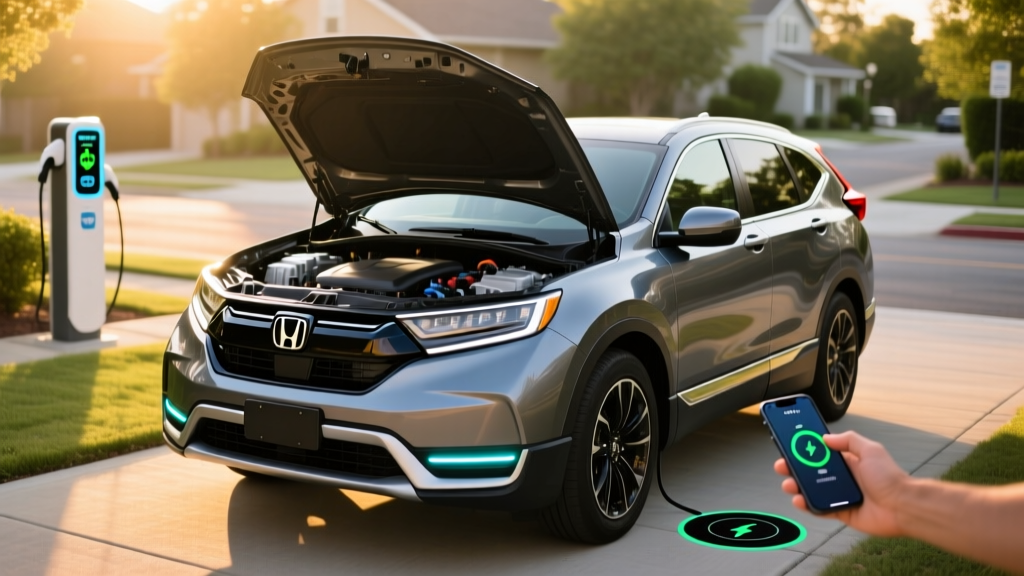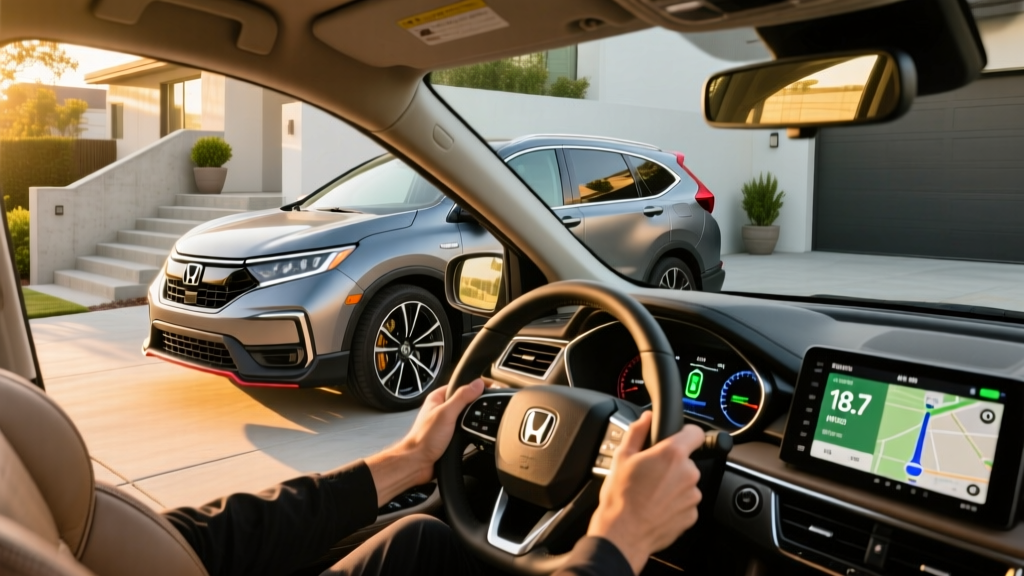
The 2023 Honda CR-V Hybrid Sport Touring sits at the top of Honda's compact crossover hybrid lineup, pairing a turbocharged engine with a two-motor hybrid system for an EPA-estimated 40 MPG combined. As a conventional hybrid (HEV) — not a plug-in — it requires zero lifestyle change: no charging cables, no range math, no plug-in infrastructure dependence. You just fill it with gas and drive.
But does the Sport Touring's real-world fuel economy match the EPA sticker? What does long-term battery reliability look like? And in a market increasingly crowded with PHEVs and full EVs, where does this HEV actually fit? This guide answers those questions with exact numbers.
2023 Honda CR-V Hybrid Sport Touring: Key Specs at a Glance
| Specification | Value |
|---|---|
| Powertrain | 2.0L 4-cyl DOHC + 2-motor hybrid system |
| Combined Horsepower | 204 hp (145 hp engine + electric motors) |
| Combined Torque | 247 lb-ft (electric motor peak) |
| Drivetrain | Real Time AWD™ (standard on Sport Touring) |
| EPA Fuel Economy (FWD) | 43 city / 36 highway / 40 combined MPG |
| EPA Fuel Economy (AWD) | 40 city / 34 highway / 37 combined MPG |
| Fuel Tank Capacity | 14.0 gallons |
| Total Driving Range (AWD) | ~518 miles (EPA est.) |
| 0–60 mph | ~7.6 seconds (tested) |
| Cargo Volume (rear seats up) | 36.3 cu ft |
| Cargo Volume (rear seats folded) | 76.5 cu ft |
| Towing Capacity | 1,000 lbs |
| MSRP (Sport Touring AWD) | $38,600 (2023 launch MSRP) |
| Hybrid Battery Warranty | 8 years / 100,000 miles (10 yr/150,000 mi in CARB states) |
Source: fueleconomy.gov — 2023 Honda CR-V Hybrid AWD
Fuel Economy: EPA Sticker vs. Real-World MPG
The 2023 CR-V Hybrid Sport Touring comes exclusively with Real Time AWD, which drops the EPA rating compared to the FWD Sport and Sport-L trims. Here's the breakdown:
| Driving Scenario | EPA Estimate (AWD) | Real-World Expectation |
|---|---|---|
| City | 40 MPG | 41–45 MPG (hybrids excel in stop-and-go) |
| Highway (70 mph cruise) | 34 MPG | 32–35 MPG (varies with terrain and wind) |
| Combined | 37 MPG | 36–40 MPG (depends on city/highway mix) |
| Cold Weather (below 30°F) | — | 30–34 MPG (engine runs more for cabin heat) |
Hybrids consistently outperform their EPA city ratings in real-world driving because regenerative braking recovers energy that gas-only vehicles waste as heat. In urban commuting with frequent stops, owners regularly report 42–45 MPG. Highway driving is the hybrid's relative weak spot — the electric motor assists less at sustained high speeds, and the 2.0L engine carries more of the load.
Cold weather hits all vehicles, but hybrids lose a slightly higher percentage because the engine must run more frequently to generate cabin heat (unlike EVs with heat pumps). Expect a 10–15% fuel economy reduction in sustained sub-freezing temperatures.
Powertrain: How Honda's Two-Motor Hybrid System Works
The 2023 CR-V Hybrid uses Honda's fourth-generation two-motor hybrid system, which operates differently from a traditional Toyota-style planetary-gear hybrid. Here's the architecture:
- 2.0L DOHC 4-cylinder engine: 145 hp, 138 lb-ft — runs primarily as a generator at low speeds, directly drives the wheels at highway cruising
- Propulsion motor: 181 hp, 247 lb-ft — the primary drive motor for acceleration and low-speed driving
- Generator motor: Starts the engine, generates electricity, and enables regenerative braking
- Combined system output: 204 hp, 247 lb-ft
At low speeds and in city driving, the CR-V Hybrid operates primarily as a series hybrid — the engine generates electricity that powers the propulsion motor, which drives the wheels. This is why city MPG is so strong: the engine always runs at its most efficient RPM regardless of vehicle speed. At highway speeds (typically above 45–55 mph), a lock-up clutch engages and the engine directly drives the front wheels, bypassing the electric motors for better efficiency at sustained speeds.
The Real Time AWD system on the Sport Touring sends up to 50% of torque to the rear wheels via a mechanical driveshaft when slip is detected. It's not a dedicated rear electric motor (like the Toyota RAV4 Hybrid's electronic AWD), but it provides confident traction in rain and light snow.
HEV vs. PHEV vs. Full EV: Which Powertrain Fits You?
The CR-V Hybrid is a conventional hybrid (HEV). Honda does not currently offer a CR-V plug-in hybrid (PHEV) in the US market. Here's how the three electrified powertrain types compare for buyers cross-shopping this segment:
| Factor | HEV (CR-V Hybrid) | PHEV (e.g., Toyota RAV4 Prime) | Full EV (e.g., Tesla Model Y) |
|---|---|---|---|
| Plug-in charging required? | No | Optional (but recommended) | Yes (mandatory) |
| Electric-only range | None (EV assist only) | ~42 miles (RAV4 Prime) | 270–330 miles |
| Home charging install needed? | No | Recommended (Level 2) | Yes (Level 2 strongly recommended) |
| Fuel/energy cost per mile | ~$0.10–0.12 (at $3.50/gal) | ~$0.04 electric / $0.10 gas | ~$0.03–0.05 (home charging) |
| Federal tax credit (§30D) | Not eligible | Up to $7,500 (if eligible) | Up to $7,500 (if eligible) |
| Upfront price premium vs. gas | ~$1,500–2,500 | ~$6,000–8,000 | ~$8,000–15,000 |
| Best for | No home charging access; simplicity | Home charging + short commutes | Home charging + low running costs |
Pricing, Tax Credits, and Total Ownership Cost
The 2023 Honda CR-V Hybrid Sport Touring launched at an MSRP of $38,600 (including destination). As a conventional hybrid (HEV), it does not qualify for the federal §30D clean vehicle tax credit, which is reserved for plug-in electric vehicles (BEVs and PHEVs) with batteries meeting specific critical-mineral and battery-component sourcing requirements per IRS guidelines.
Some states offer their own incentives for hybrid vehicles, though these are increasingly rare as state programs shift focus to plug-in vehicles. Check your state's energy office or department of environmental quality for any current hybrid rebates.
5-Year Ownership Cost Estimate
| Cost Category | CR-V Hybrid Sport Touring (AWD) | CR-V EX-L (Gas AWD) |
|---|---|---|
| Purchase Price (MSRP) | $38,600 | $36,300 |
| Fuel (5 yr / 75,000 mi at $3.50/gal) | ~$7,095 (37 MPG) | ~$9,075 (29 MPG) |
| Maintenance (5 yr est.) | ~$2,800 | ~$3,200 |
| Insurance (5 yr avg.) | ~$7,500 | ~$7,200 |
| Estimated Depreciation (5 yr) | ~$15,400 | ~$15,000 |
| Total 5-Year Cost (est.) | ~$71,395 | ~$70,775 |
The hybrid's fuel savings (~$1,980 over 5 years at current gas prices) partially offset its $2,300 higher MSRP. At higher gas prices or higher annual mileage, the hybrid breaks even faster. Honda hybrids also tend to experience slightly lower brake wear due to regenerative braking handling much of the deceleration.
Hybrid Battery Reliability, Warranty, and Replacement Cost
Honda's hybrid battery track record is strong. The company has been deploying two-motor hybrid systems since the 2014 Accord Hybrid, and widespread battery failures have been rare. Unlike early-generation hybrid batteries (nickel-metal hydride), the current lithium-ion packs are designed to last the vehicle's lifetime under normal use.
What Does Replacement Cost Out of Warranty?
If a hybrid battery fails outside the warranty window, replacement costs typically range from $2,000 to $4,000 including parts and labor at a Honda dealer. Independent hybrid specialists may offer refurbished packs for $1,500–$2,500. This is significantly less than full EV battery replacements ($8,000–$20,000+) because hybrid batteries are much smaller — the CR-V Hybrid's pack is approximately 1.1 kWh (usable), compared to 60–80+ kWh in a full EV.
For context, the vast majority of Honda hybrid owners never face an out-of-warranty battery replacement. The system is designed so the battery operates in a narrow state-of-charge window (roughly 40–80%), which minimizes degradation over time.
Who Should Buy the CR-V Hybrid Sport Touring — and Who Shouldn't
Choose This Hybrid If:
- You want better fuel economy without plugging in anything
- You lack access to home or workplace charging
- You drive 12,000–20,000+ miles/year and want fuel savings
- You want AWD capability with minimal MPG penalty
- You prefer a proven, simple ownership experience
- You value the Sport Touring's premium features (Bose audio, wireless CarPlay, heated rear seats, hands-free liftgate)
Look Elsewhere If:
- You have home charging and want to drive mostly on electricity (consider a PHEV or EV)
- You want federal tax credit eligibility (requires a PHEV or BEV)
- You need more than 1,000 lbs towing capacity
- You want a third row (consider the Honda Pilot Hybrid)
- You prioritize 0–60 acceleration over efficiency
- You want a fully electric daily commute with zero gas use
The Sport Touring trim specifically is for buyers who want the hybrid powertrain and the highest available feature content: 9-inch touchscreen with wireless Apple CarPlay/Android Auto, 12-speaker Bose audio, wireless phone charging, heated front and rear seats, heated steering wheel, Honda Sensing suite (adaptive cruise, lane-keeping, collision mitigation), and a hands-free power liftgate. If those features aren't priorities, the Sport or Sport-L hybrid trims deliver the identical powertrain and MPG at $3,000–$5,000 less.
Frequently Asked Questions
How many MPG does the 2023 Honda CR-V Hybrid Sport Touring actually get?
The EPA rates the AWD Sport Touring at 40 city / 34 highway / 37 combined MPG. In real-world city driving, many owners report 41–45 MPG thanks to aggressive regenerative braking. Highway driving at 70+ mph typically yields 32–35 MPG. Cold weather can drop combined figures to 30–34 MPG due to increased engine runtime for cabin heating.
Does the CR-V Hybrid need to be plugged in?
No. The 2023 CR-V Hybrid is a conventional hybrid (HEV). It charges its own small battery through regenerative braking and the gasoline engine. There is no plug, no charging cable, and no electric-only driving range. You fuel it exclusively at gas stations, just like a conventional vehicle — but with significantly better fuel economy.
Is the CR-V Hybrid eligible for any federal tax credit?
No. The federal §30D Clean Vehicle Credit applies only to plug-in electric vehicles (battery electric vehicles and plug-in hybrids) that meet battery sourcing, MSRP, and buyer income requirements. Conventional hybrids like the CR-V Hybrid are not eligible. Some states may offer small rebates for hybrid purchases — check your state's energy or environmental agency for current programs.
How long will the CR-V Hybrid battery last?
Honda warranties the hybrid battery for 8 years/100,000 miles (10 years/150,000 miles in CARB states). Based on Honda's track record with hybrid systems since 2014, most batteries last well beyond the warranty period. The battery is small (~1.1 kWh) and operates in a narrow charge window, which minimizes wear. Out-of-warranty replacement, if needed, runs $2,000–$4,000.
Is the CR-V Hybrid reliable compared to the gas version?
Honda's two-motor hybrid system has proven reliable since its introduction. The hybrid actually eliminates some traditional wear items — regenerative braking extends brake pad life significantly, and the engine often operates under lighter load than in the gas-only model. The continuously variable transmission (e-CVT) in the hybrid has fewer moving parts than a conventional automatic. According to IIHS, the 2023 CR-V earned top safety marks, and Honda's hybrid components carry strong warranty coverage.
Should I get the CR-V Hybrid or wait for a plug-in version?
Honda has not announced a CR-V PHEV for the US market as of this writing. If you need plug-in capability now, the closest competitors are the Toyota RAV4 Prime (42 miles EV range, but long waitlists and $43,000+ MSRP) or the Hyundai Tucson PHEV (33 miles EV range, ~$38,000). If you can't charge at home, the CR-V Hybrid remains one of the most efficient and practical compact hybrid SUVs available without any plug-in requirement.
What's the difference between the Sport Touring and lower hybrid trims?
All 2023 CR-V Hybrid trims (Sport, Sport-L, Sport Touring) share the identical 204-hp two-motor hybrid powertrain, AWD system, and EPA fuel economy ratings. The Sport Touring adds premium features: Bose 12-speaker audio, 9-inch touchscreen with navigation, wireless phone charging, heated rear seats, heated steering wheel, hands-free power liftgate, and low-speed braking control. The powertrain, battery, and MPG are the same across all hybrid trims.