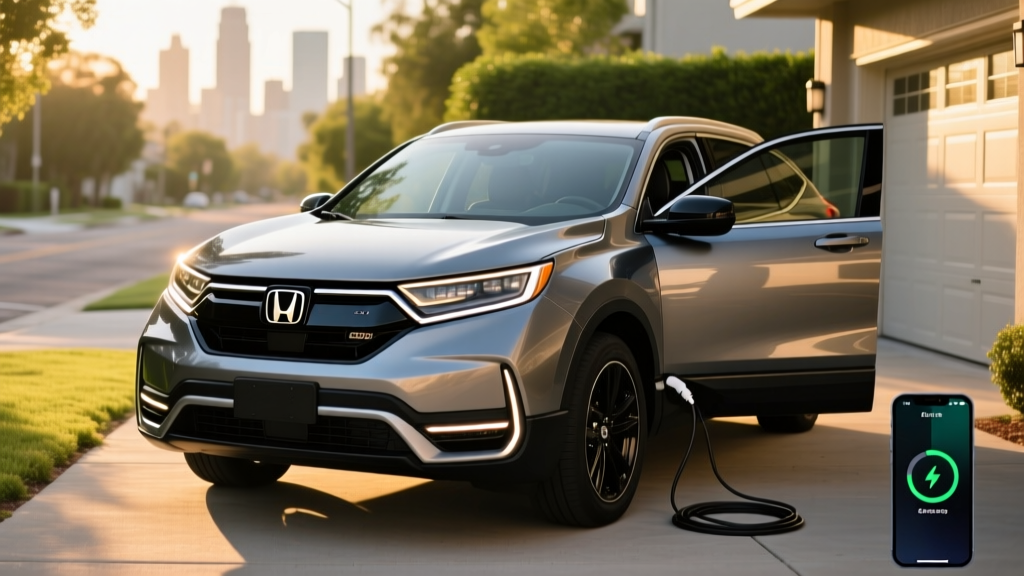
Quick Verdict: Honda's Flagship Compact Hybrid SUV
The 2023 Honda CR-V Sport Touring Hybrid sits at the top of Honda's sixth-generation CR-V lineup, pairing a turbocharged 2.0-liter Atkinson-cycle engine with a two-motor hybrid system for a combined 204 horsepower. It's the trim that delivers the most equipment — leather, a 9-inch touchscreen with wireless Apple CarPlay and Android Auto, a Bose 12-speaker audio system, a wireless phone charger, and Honda Sensing ADAS — while returning an EPA-estimated 40 MPG combined. For buyers who want SUV practicality without plugging in, this is one of the most compelling conventional hybrids on the market.
But how does that EPA number hold up in real-world driving? What does long-term battery ownership look like? And does this hybrid qualify for any federal tax incentives? This guide breaks down every number that matters.
2023 Honda CR-V Sport Touring Hybrid — Key Specifications
| Specification | Value |
|---|---|
| Powertrain | 2.0L 4-cyl Atkinson + two-motor hybrid system |
| Combined Horsepower | 204 hp |
| Combined Torque | 247 lb-ft (electric motor) |
| EPA MPG (AWD) | 40 city / 34 highway / 37 combined |
| EPA MPG (FWD) | 43 city / 36 highway / 40 combined |
| Fuel Tank | 15.3 gallons |
| Total Range (FWD) | ~612 miles |
| Drivetrain | FWD standard; AWD optional |
| Cargo Volume | 36.3 cu ft (rear seats up) / 76.5 cu ft (folded) |
| Towing Capacity | 1,000 lbs |
| 0–60 mph | ~7.6 seconds |
| Base MSRP (Sport Touring Hybrid FWD) | $38,600 |
| AWD Add-on | +$1,500 |
| Hybrid Battery Warranty | 8 years / 100,000 miles |
| Federal Tax Credit (§30D) | Not eligible (conventional HEV) |
HEV vs PHEV: Where the CR-V Sport Touring Hybrid Fits
A common source of confusion is the difference between a conventional hybrid (HEV) and a plug-in hybrid (PHEV). The 2023 CR-V Sport Touring Hybrid is a conventional hybrid (HEV) — it has no plug, no electric-only driving mode of meaningful distance, and no external charging requirement. Its small lithium-ion battery (roughly 1.06 kWh) recharges exclusively through regenerative braking and the gasoline engine.
HEV vs PHEV vs BEV — Which Powertrain Is Right for You?
| Factor | HEV (this CR-V) | PHEV (e.g., Toyota RAV4 Prime) | BEV (e.g., Tesla Model Y) |
|---|---|---|---|
| Plug-in Required? | No | Yes (Level 2 recommended) | |
| Electric-Only Range | ~1 mile at low speed | 35–42 miles typical | 250–330+ miles |
| Gas Engine? | Yes (primary) | Yes (backup) | No |
| Home Charging Needed? | No | Yes for EV benefit | Yes (essential) |
| Federal Tax Credit (§30D) | Not eligible | Up to $7,500 if qualified | Up to $7,500 if qualified |
| Best For | No home charging access; simplicity | Home charging + daily short commutes | Full electrification; lowest running cost |
If you don't have access to home or workplace charging, the HEV route eliminates infrastructure headaches entirely. You simply fill up at any gas station and let the hybrid system optimize efficiency automatically. If you do have a garage outlet and a short commute, a PHEV like the RAV4 Prime or the upcoming Honda CR-V e:PHEV (available in other markets) could let you drive most weekdays on electricity alone while keeping the gas engine for road trips.
Fuel Economy: EPA Numbers and Real-World MPG
The EPA rates the 2023 CR-V Sport Touring Hybrid at 43 city / 36 highway / 40 combined MPG in front-wheel-drive form. Choosing AWD drops those figures to 40 city / 34 highway / 37 combined.
EPA Fuel Economy Breakdown
| Configuration | City | Highway | Combined | Est. Annual Fuel Cost* |
|---|---|---|---|---|
| FWD | 43 MPG | 36 MPG | 40 MPG | ~$1,350 |
| AWD | 40 MPG | 34 MPG | 37 MPG | ~$1,450 |
*Based on 15,000 miles/year, $3.60/gallon regular unleaded. Actual costs vary by region and driving habits. Source: fueleconomy.gov.
Real-World MPG: What Owners Actually See
Honda's two-motor hybrid system excels in stop-and-go city driving, where regenerative braking recaptures energy and the electric motor handles low-speed propulsion. In real-world testing by owners and automotive publications, the CR-V Hybrid consistently meets or slightly exceeds its EPA city estimate — many drivers report 42–45 MPG in urban and suburban driving.
Highway driving tells a different story. At sustained 70–80 mph speeds, the aerodynamic drag of an SUV and the engine operating more frequently reduce efficiency. Expect 32–35 MPG on the highway in real-world conditions. In cold weather (below 35°F), the engine runs more often to provide cabin heat and maintain battery temperature, which can drop city MPG by 3–5 points until the system warms up.
Over a mixed-driving 500-mile road trip combining city, suburban, and interstate driving, a realistic expectation is 36–39 MPG combined for the FWD model — close to but slightly below the EPA sticker. This is normal for hybrids and still significantly better than the non-hybrid CR-V's 30 MPG combined rating.
Powertrain Deep Dive: How the Two-Motor System Works
Honda's fourth-generation two-motor hybrid system is fundamentally different from Toyota's planetary-gear hybrid synergy drive. Here's how it operates:
- EV Drive: At low speeds and light loads, the electric drive motor powers the wheels alone using energy from the 1.06 kWh lithium-ion battery. Range in this mode is roughly one mile.
- Hybrid Drive: The gasoline engine spins a generator motor that produces electricity to feed the drive motor. The engine does not mechanically connect to the wheels in this mode — it acts as a range extender.
- Engine Drive: At higher steady-state speeds (typically above 45 mph on the highway), a lock-up clutch connects the engine directly to the wheels for maximum efficiency.
The 2.0-liter Atkinson-cycle four-cylinder produces 146 hp and 134 lb-ft on its own, while the drive motor contributes 181 hp and 247 lb-ft. Combined system output is 204 hp. The result is smooth, electric-like acceleration from a stop with the engine only becoming audible under hard acceleration or steep grades.
The AWD system adds a rear-mounted electric motor that provides up to 97 lb-ft of torque to the rear axle when slip is detected or during hard acceleration. Unlike mechanical AWD systems, there's no driveshaft — it's fully electric and engages only when needed, minimizing efficiency losses.
Hybrid Battery Longevity: Warranty, Degradation, and Replacement Cost
Battery lifespan is the single most common concern for hybrid buyers. Here's what you need to know about the CR-V Sport Touring Hybrid's lithium-ion pack.
Battery & Hybrid Component Warranty
| Component | Warranty Coverage |
|---|---|
| Hybrid Battery (Li-ion) | 8 years / 100,000 miles (10 years / 150,000 miles in CARB states*) |
| Hybrid System Components (inverter, motors) | 8 years / 100,000 miles |
| Powertrain (engine, transmission) | 5 years / 60,000 miles |
| Bumper-to-Bumper | 3 years / 36,000 miles |
*CARB states include CA, CO, CT, DE, ME, MD, MA, NJ, NM, NY, OR, RI, VT, VA, WA, and DC. These states mandate extended hybrid battery coverage.
What Does Real-World Degradation Look Like?
Conventional hybrid batteries are far smaller than EV batteries and operate within a narrow state-of-charge window (typically 40–80%), which significantly reduces stress on the cells. Honda's hybrid systems have demonstrated strong longevity — many owners of earlier Honda hybrids (Insight, Accord Hybrid) have reported 150,000–200,000+ miles on the original battery with minimal capacity loss.
Because the CR-V Hybrid's battery is small (1.06 kWh), even a 20% capacity loss over 10 years would only reduce the already-brief EV-mode range and slightly affect regenerative braking buffering. The hybrid system compensates by relying more on the engine, so you'd notice a marginal MPG decrease — not a catastrophic failure.
Battery Replacement Cost
If the hybrid battery does fail outside warranty, replacement costs for Honda's current-generation hybrid systems typically range from $2,000 to $4,000 including labor at a dealership. Independent hybrid specialists may offer refurbished packs for $1,500–$2,500. This is dramatically less than EV battery replacements, which can exceed $10,000–$20,000, because the pack is small and less complex.
Pricing, Trims, and Tax Credit Eligibility
The 2023 Honda CR-V Sport Touring Hybrid carries an MSRP of $38,600 for FWD and $40,100 for AWD, including the $1,345 destination charge. As the top-tier trim, it includes features that would cost thousands more as options on lower trims: leather-trimmed seats, heated front and rear seats, a heated steering wheel, a power moonroof, a 9-inch touchscreen with navigation, wireless phone charging, a hands-free power tailgate, and low-speed braking control.
Federal Tax Credit: Not Eligible
The 2023 CR-V Sport Touring Hybrid is a conventional HEV and does not qualify for the federal §30D Clean Vehicle Credit. That credit — up to $7,500 — is reserved for plug-in electric vehicles (BEVs and PHEVs) that meet battery sourcing, critical minerals, MSRP cap, and buyer income requirements per current IRS rules.
Some states and local utilities offer modest rebates for conventional hybrids, but these are typically $250–$1,000 and vary widely. Check your state energy office or utility provider for current programs.
Total Cost of Ownership vs. Non-Hybrid CR-V
Compared to the gasoline-only CR-V EX-L (MSRP ~$36,300, 30 MPG combined), the Sport Touring Hybrid costs roughly $2,300 more upfront but saves approximately $500–$600 per year in fuel at 15,000 miles driven annually. The break-even point on the powertrain premium alone is roughly 4 years — but the Sport Touring Hybrid also includes substantially more equipment (Bose audio, navigation, rear heated seats) that would not be available on the gas EX-L, making the effective price gap smaller when comparing equivalent features.
Pros and Cons: The Honest Assessment
Pros
- 40 MPG combined (FWD) — among the best in the compact SUV segment
- Smooth, responsive two-motor hybrid system with 204 hp
- No plug-in required — works with existing gas infrastructure
- Generous cargo space: 36.3 cu ft behind rear seats
- Top-tier Sport Touring trim is fully loaded at a competitive price
- Strong hybrid battery warranty (8yr/100k mi; 10yr/150k mi in CARB states)
- Excellent Honda Sensing ADAS suite standard
- Higher real-world city MPG than EPA estimate for many drivers
Cons
- Highway MPG drops to 32–35 real-world at 75+ mph
- No plug-in hybrid option available in the US CR-V lineup
- AWD reduces combined MPG from 40 to 37
- 1,000-lb towing capacity is low for the segment
- Engine drone under hard acceleration (CVT-like behavior)
- No spare tire — tire repair kit only
- Not eligible for federal §30D tax credit
Who Should Choose the CR-V Sport Touring Hybrid?
Decision Framework
Choose the CR-V Sport Touring Hybrid if:
- You don't have access to home or workplace charging
- You drive 12,000–20,000 miles per year and want to minimize fuel costs without lifestyle changes
- You want a fully loaded compact SUV under $42,000
- You plan to own the vehicle 8+ years and value a long hybrid battery warranty
- You live in a city or suburb with frequent stop-and-go traffic (where hybrids shine)
Consider a PHEV or BEV instead if:
- You have a garage with a 240V outlet and a commute under 35 miles (a PHEV covers most daily driving on electricity)
- You want to qualify for the $7,500 federal tax credit (requires a qualifying BEV or PHEV)
- You want zero tailpipe emissions for daily driving
- You drive fewer than 8,000 miles per year (fuel savings won't offset a hybrid premium quickly)
Frequently Asked Questions
How many MPG does the 2023 Honda CR-V Sport Touring Hybrid get?
The EPA rates it at 43 city / 36 highway / 40 combined in FWD form, and 40 city / 34 highway / 37 combined with AWD. Real-world city driving often exceeds the EPA estimate, while sustained highway driving at 75+ mph typically returns 32–35 MPG.
Does the CR-V Hybrid need to be plugged in?
No. The 2023 CR-V Sport Touring Hybrid is a conventional hybrid (HEV). It charges its small battery through regenerative braking and the gasoline engine. You never plug it in — just fill it with regular unleaded gasoline.
Does the 2023 CR-V Hybrid qualify for any tax credit?
It does not qualify for the federal §30D Clean Vehicle Credit, which is limited to plug-in vehicles (BEVs and PHEVs) meeting specific battery sourcing, MSRP, and income requirements. Some state or utility rebates for hybrids may apply — check your local programs.
How long will the hybrid battery last?
Honda covers the hybrid battery for 8 years or 100,000 miles (10 years / 150,000 miles in CARB states). Based on historical Honda hybrid data, many batteries last 150,000–200,000+ miles before significant degradation. Replacement costs $2,000–$4,000 out of warranty.
Is the CR-V Hybrid reliable?
Honda's two-motor hybrid system has been in use across multiple models since 2014 and has demonstrated strong reliability. The 2023 CR-V earned IIHS Top Safety Pick status, and the hybrid powertrain has fewer wear items than a conventional automatic transmission (no torque converter, no traditional gear shifts). Consumer Reports and J.D. Power historically rate Honda hybrid systems above average for long-term dependability.
How does the CR-V Hybrid compare to the Toyota RAV4 Hybrid?
The RAV4 Hybrid (41 MPG combined, 219 hp, ~$37,500 for the top Limited trim) is the CR-V Hybrid's closest rival. The RAV4 offers slightly more horsepower and a PHEV variant (RAV4 Prime), while the CR-V Hybrid offers a more refined interior, slightly more cargo space, and a more car-like driving experience. Both are excellent — the choice often comes down to brand preference and which dealer is closer.
Does AWD hurt fuel economy significantly?
AWD reduces combined MPG by 3 points (40 → 37 combined for EPA). In real-world driving, the difference is often less noticeable because the rear electric motor only engages when needed. If you live in a snowy or rainy climate, the AWD system's traction benefit usually outweighs the modest MPG penalty.
Final Assessment
The 2023 Honda CR-V Sport Touring Hybrid earns its position as the default recommendation for compact SUV buyers who want maximum fuel efficiency without the complexity of plug-in charging. At 40 MPG combined, it cuts fuel costs by roughly 25% compared to the non-hybrid CR-V, while the Sport Touring trim's equipment list rivals luxury-brand compact crossovers costing $10,000 more. The 8-year/100,000-mile hybrid battery warranty provides peace of mind, and real-world ownership data supports Honda's hybrid durability claims. If you can charge at home and want to access the $7,500 federal tax credit, a PHEV or BEV may save you more. But for the majority of buyers who just want to drive, fill up less often, and not think about it — this CR-V is the benchmark.