Quick Verdict: The 2023 CR-V Hybrid Sport at a Glance
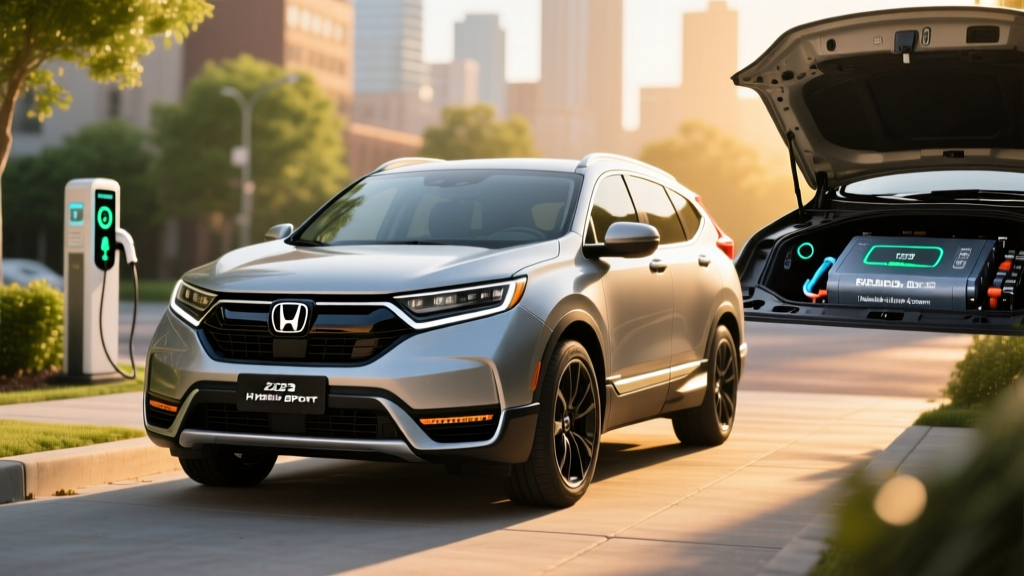
The 2023 Honda CR-V Hybrid Sport is a conventional hybrid electric vehicle (HEV) — not a plug-in — that pairs a 2.0-liter Atkinson-cycle four-cylinder engine with two electric motors for a combined 204 horsepower. It delivers an EPA-estimated 40 MPG combined, making it one of the most fuel-efficient compact SUVs available without requiring any change to your fueling routine. You simply fill it with regular gasoline and drive; the hybrid system handles the rest.
For 2026 buyers shopping the used market or comparing against newer models, the 2023 CR-V Hybrid Sport remains a compelling choice. It occupies the sweet spot between a standard gas CR-V and a full battery-electric vehicle, offering meaningful fuel savings without range anxiety, charging infrastructure dependence, or a steep price premium.
| Specification | Value |
|---|---|
| Powertrain | 2.0L Atkinson I-4 + 2 electric motors (HEV) |
| Combined Horsepower | 204 hp |
| Combined Torque | 247 lb-ft (electric motor) |
| Transmission | e-CVT (direct drive) |
| Drivetrain | FWD standard / AWD available |
| EPA Fuel Economy (FWD) | 43 city / 36 highway / 40 combined MPG |
| EPA Fuel Economy (AWD) | 40 city / 34 highway / 37 combined MPG |
| Fuel Tank | 15.3 gallons |
| Total Range (FWD, est.) | ~612 miles |
| 0–60 mph | ~7.9 seconds (tested) |
| Cargo Volume | 36.3 cu ft (behind rear) / 76.5 cu ft (max) |
| Towing Capacity | 1,000 lbs |
| Original MSRP (FWD) | $32,990 |
| Original MSRP (AWD) | $34,490 |
| Hybrid Battery Warranty | 8 years / 100,000 miles |
HEV vs PHEV: Why the CR-V Hybrid Sport Doesn't Plug In
A common source of confusion is the difference between a conventional hybrid (HEV) and a plug-in hybrid (PHEV). The 2023 CR-V Hybrid Sport is an HEV. It has no charging port, no plug, and no electric-only driving range to speak of. Its small lithium-ion battery pack — approximately 1.06 kWh — recharges exclusively through regenerative braking and the gasoline engine.
| Feature | HEV (CR-V Hybrid) | PHEV (e.g., Toyota RAV4 Prime) | BEV (e.g., Tesla Model Y) |
|---|---|---|---|
| Plug-in Charging | No | Yes | Yes |
| Battery Size | ~1 kWh | ~18 kWh | 60–82 kWh |
| Electric-Only Range | < 1 mile at low speed | 25–42 miles | 250–330 miles |
| Fuel Required | Yes (gasoline) | Yes (gasoline + electricity) | No (electricity only) |
| Tax Credit Eligibility | None | Up to $7,500 (§30D, if eligible) | Up to $7,500 (§30D, if eligible) |
| Typical Price Premium vs Gas | $1,500–$2,000 | $5,000–$8,000 | $10,000–$20,000+ |
| Home Charging Needed | No | Recommended | Essential |
If you want electric-only commuting with a gas engine backup, a PHEV like the Toyota RAV4 Prime (42 miles electric range) or the Hyundai Tucson PHEV (33 miles) would be a better fit. If you want zero gasoline and have reliable home charging access, a full BEV is worth considering. The CR-V Hybrid Sport is the right call for buyers who want better fuel economy with zero lifestyle changes — no plug, no app, no charging anxiety.
Fuel Economy: EPA Numbers and Real-World MPG
The EPA rates the 2023 CR-V Hybrid Sport FWD at 43 city / 36 highway / 40 combined MPG. The AWD variant drops to 40 city / 34 highway / 37 combined. These are strong numbers for a compact SUV, but real-world results depend heavily on your driving mix.
| Scenario | FWD MPG (est.) | AWD MPG (est.) |
|---|---|---|
| EPA Combined | 40 | 37 |
| City-heavy commute (stop-and-go) | 42–46 | 39–43 |
| Highway cruising (70–75 mph) | 33–36 | 31–34 |
| Cold weather (below 30°F, city) | 36–40 | 34–38 |
| Mixed real-world average | 37–41 | 34–38 |
Why city MPG beats highway: Like all series-parallel hybrids, the CR-V Hybrid leverages regenerative braking to recapture energy during deceleration and stop-and-go traffic. The electric motor handles low-speed propulsion where gasoline engines are least efficient. On the highway, the engine runs more continuously and aerodynamic drag dominates, which is why the highway number is lower — the opposite of a conventional gas car.
Cold-weather impact: In temperatures below freezing, expect a 5–10% fuel economy reduction. The engine runs more frequently to generate cabin heat and warm up the catalytic converter. This is less severe than a BEV's cold-weather range loss (typically 20–30%), but it's noticeable.
According to fueleconomy.gov, the FWD CR-V Hybrid Sport's 40 MPG combined translates to an estimated annual fuel cost of approximately $1,400 (based on 15,000 miles/year at $3.50/gallon). A comparable gas-only 2023 CR-V AWD (28 MPG combined) would cost roughly $2,000 annually — a savings of about $600 per year with the hybrid.
Powertrain and Driving Impressions
Honda's two-motor hybrid system in the CR-V Sport operates differently from a traditional transmission. There is no fixed gear ratio — instead, the e-CVT uses a clutch-based system that switches between three modes:
- EV Drive: The electric motor powers the wheels using battery energy alone (brief, low-speed situations like parking lot maneuvers).
- Hybrid Drive: The gasoline engine generates electricity that feeds the drive motor, which propels the wheels. This is the predominant mode in city driving.
- Engine Drive: At steady highway speeds, a lock-up clutch connects the engine directly to the wheels for maximum efficiency.
The result is 204 combined horsepower and an especially strong 247 lb-ft of torque from the electric motor, available from zero RPM. This gives the CR-V Hybrid Sport a responsive feel off the line that the non-hybrid 1.5L turbo CR-V (190 hp, 179 lb-ft) cannot match. The 0–60 mph time of approximately 7.9 seconds is adequate for merging and passing, though not sporty despite the "Sport" badge.
The AWD system adds a rear-mounted electric motor that provides torque to the rear axle when slip is detected or during hard acceleration. It's not a mechanical driveshaft system — it's fully electric and engages seamlessly.
Hybrid vs PHEV vs EV: Which Powertrain Fits You?
Choosing between a hybrid, plug-in hybrid, and full electric vehicle comes down to your daily routine, charging access, and budget.
Choose the CR-V Hybrid Sport (HEV) if:
- You don't have access to home or workplace charging
- You want fuel savings without any behavioral change
- Your budget is under $35,000 (used market in 2026)
- You take frequent long road trips where charging infrastructure is uncertain
- You want the lowest purchase price among electrified SUVs
Choose a PHEV if:
- You can install a Level 2 home charger or have workplace charging
- Your daily commute is under 40 miles round-trip
- You want to drive mostly on electricity but keep a gas engine for road trips
- You can take advantage of the §30D federal tax credit (up to $7,500)
Choose a full BEV if:
- You have reliable home Level 2 charging
- Your daily driving is under 250 miles
- You want to eliminate gasoline costs entirely
- You're eligible for the federal tax credit and/or state incentives
- You want minimal maintenance (no oil changes, no engine)
Battery Warranty, Reliability, and Replacement Cost
Honda covers the CR-V Hybrid's lithium-ion battery pack for 8 years or 100,000 miles (whichever comes first) under its hybrid system warranty. In California Air Resources Board (CARB) states — which include California, New York, Massachusetts, Colorado, and several others — the warranty extends to 10 years or 150,000 miles due to stricter emissions-component requirements.
Honda Hybrid Battery Warranty
- Standard (most states): 8 years / 100,000 miles
- CARB states: 10 years / 150,000 miles
- Coverage: Battery capacity below threshold, hybrid motor, inverter, control unit
- Typical failure rate: Very low — Honda's hybrid systems have proven durable across multiple generations (Insight, Accord Hybrid, CR-V Hybrid)
Reliability track record: Honda's two-motor hybrid system has been in production since 2014 (Accord Hybrid) and has demonstrated strong reliability. Unlike early hybrid systems from the 2000s, modern lithium-ion hybrid batteries experience minimal degradation because they operate in a narrow state-of-charge window — the system never fully charges or fully depletes the pack, which dramatically extends cycle life.
Replacement cost if out of warranty: A hybrid battery replacement for the CR-V Hybrid typically ranges from $2,000 to $4,000 including labor at a dealership. Independent hybrid specialists may offer refurbished packs for $1,500–$2,500. However, based on failure rates observed in Honda hybrids now reaching 150,000+ miles, full battery replacement remains uncommon. The far more likely maintenance item is the 12-volt auxiliary battery, which costs $200–$350 to replace every 4–5 years.
For safety data, the 2023 CR-V earned top marks from both NHTSA (5-Star Overall) and IIHS (Top Safety Pick+), giving buyers confidence in the vehicle's crashworthiness alongside its hybrid efficiency.
Pricing, Tax Credits, and Ownership Economics
The 2023 CR-V Hybrid Sport originally started at $32,990 (FWD) and $34,490 (AWD), including destination. In the 2026 used market, expect to pay roughly $26,000–$31,000 depending on mileage, condition, and trim.
Federal tax credit: The conventional CR-V Hybrid Sport does not qualify for the IRS §30D Clean Vehicle Credit. That credit applies only to plug-in electric vehicles (PHEVs and BEVs) with a battery capacity of at least 7 kWh. The CR-V Hybrid's ~1 kWh pack falls well short of this threshold. There is no federal tax incentive for purchasing a conventional hybrid, new or used.
State incentives: A handful of states offer modest rebates or HOV lane access for hybrids, but these vary by jurisdiction and change frequently. Check your state's energy office or DMV for current programs.
| Cost Category | CR-V Hybrid Sport (AWD) | CR-V EX AWD (Gas, 28 MPG) |
|---|---|---|
| Purchase Price (est. used 2026) | $29,000 | $27,500 |
| Fuel (15,000 mi/yr, $3.50/gal, 5 yrs) | $6,689 | $9,375 |
| Insurance (5-yr est.) | $7,500 | $7,200 |
| Maintenance (5-yr est.) | $2,800 | $3,200 |
| Estimated Depreciation | $10,500 | $10,000 |
| 5-Year Total (est.) | $56,489 | $57,275 |
The hybrid's fuel savings of approximately $2,686 over five years largely offsets its higher purchase price. Maintenance costs are slightly lower because the hybrid system reduces engine wear — the engine idles off at stops, and regenerative braking extends brake pad life significantly (many hybrid owners report original brake pads beyond 80,000 miles).
Pros and Cons
Pros
- 40 MPG combined (FWD) — best-in-class for a compact SUV
- No plug-in charging required — zero lifestyle change
- Strong low-end torque (247 lb-ft) from electric motor
- Top safety ratings (NHTSA 5-Star, IIHS TSP+)
- Spacious cargo area (36.3 / 76.5 cu ft)
- Proven hybrid reliability with 8-yr/100k-mi battery warranty
- Regenerative braking extends brake pad life
Cons
- AWD drops fuel economy to 37 MPG combined
- Engine drone under hard acceleration (e-CVT character)
- No federal tax credit eligibility
- 1,000-lb towing limit (below gas CR-V's 1,500 lbs)
- Highway MPG lags behind city (36 FWD) — not ideal for road-trip-heavy drivers
- Used-market pricing still carries a hybrid premium over gas trims
Frequently Asked Questions
How many MPG does the 2023 CR-V Hybrid Sport get?
The EPA rates the FWD model at 43 city / 36 highway / 40 combined MPG. The AWD version is rated at 40 city / 34 highway / 37 combined. In real-world city driving, many owners report exceeding the EPA city number thanks to the hybrid system's regenerative braking efficiency. Highway driving at 75+ mph will yield lower numbers, typically 33–35 MPG for FWD.
Does the CR-V Hybrid Sport plug in?
No. The 2023 CR-V Hybrid Sport is a conventional hybrid (HEV), not a plug-in hybrid (PHEV). It has no charging port and cannot be plugged in. The hybrid battery charges through regenerative braking and the gasoline engine. If you want plug-in capability, look at the Honda Clarity PHEV (discontinued) or competitors like the Toyota RAV4 Prime.
Does the 2023 CR-V Hybrid qualify for any tax credit?
No. The federal §30D Clean Vehicle Credit requires a battery capacity of at least 7 kWh and plug-in capability. The CR-V Hybrid Sport's ~1 kWh battery does not meet this threshold. There is no federal tax credit for conventional hybrids. Some states may offer minor incentives — check your local programs. For details on §30D eligibility, see IRS.gov.
Is the CR-V Hybrid reliable and what does a battery replacement cost?
Honda's two-motor hybrid system has a strong reliability record since its 2014 introduction. The hybrid battery is warrantied for 8 years/100,000 miles (10 years/150,000 in CARB states). Full battery failures are rare. If replacement is needed out of warranty, expect $2,000–$4,000 at a dealer, or $1,500–$2,500 from an independent hybrid specialist.
Should I buy the CR-V Hybrid Sport or a full EV?
If you lack home charging access, drive more than 300 miles regularly, or want the lowest possible purchase price, the CR-V Hybrid Sport is the practical choice. If you have Level 2 home charging, commute under 250 miles daily, and want to eliminate gasoline costs and engine maintenance, a BEV like the Hyundai Ioniq 5 or Tesla Model Y offers lower running costs — but at a higher purchase price and with charging-planning requirements for longer trips.
How does the CR-V Hybrid compare to the Toyota RAV4 Hybrid?
The 2023 Toyota RAV4 Hybrid (41 MPG combined, AWD standard, 219 hp) is the CR-V Hybrid's closest rival. The RAV4 Hybrid comes standard with AWD at 41 MPG, while the CR-V Hybrid's best 40 MPG figure requires FWD. The CR-V Hybrid offers slightly more cargo space and a more refined interior, while the RAV4 Hybrid has a slight edge in horsepower and standard AWD. Both carry excellent reliability reputations and similar pricing.
What maintenance does the CR-V Hybrid require?
The hybrid system adds virtually no extra maintenance. Follow Honda's standard schedule: oil changes every 7,500–10,000 miles (the engine runs less, so oil stays cleaner longer), tire rotations, and fluid checks. The hybrid battery and electric motors require no scheduled maintenance. Brake pads typically last 80,000+ miles thanks to regenerative braking doing most of the deceleration work.