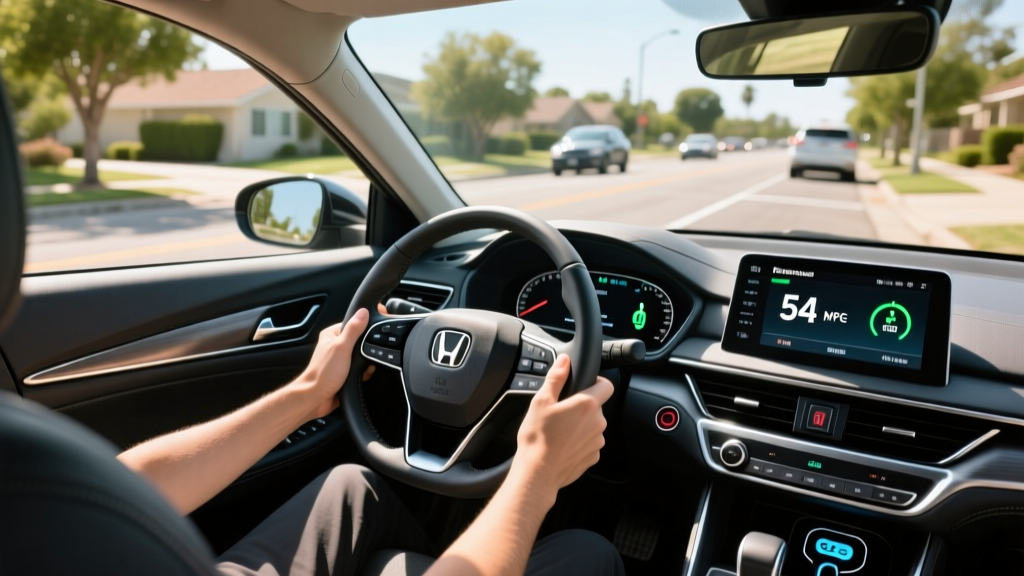
The 2023 Honda Accord Hybrid Touring represents Honda's flagship midsize sedan offering — a two-motor hybrid system wrapped in the most feature-loaded trim available. For buyers weighing a conventional hybrid against a plug-in hybrid or full battery-electric vehicle, the Accord Hybrid poses a compelling question: do you actually need a plug to achieve exceptional fuel economy?
After examining EPA data, real-world driving reports, and Honda's powertrain specifications, this guide breaks down exactly what the 2023 Accord Hybrid Touring delivers — and where a PHEV or BEV might serve you better.
2023 Honda Accord Hybrid Touring: Powertrain and Performance Specs
The 2023 Accord Hybrid uses Honda's fourth-generation two-motor hybrid system, which pairs a 2.0-liter Atkinson-cycle inline-4 engine with two electric motors. This is a conventional hybrid (HEV), meaning it generates and recovers all its own electricity — there is no plug, no charging cable, and no electric-only driving mode of meaningful distance.
| Specification | Value |
|---|---|
| Engine | 2.0L Atkinson-cycle I-4 |
| Engine Horsepower | 146 hp @ 6,100 rpm |
| Engine Torque | 134 lb-ft @ 4,500 rpm |
| Drive Motor Output | 181 hp / 247 lb-ft |
| Combined System Output | 204 hp |
| Transmission | e-CVT (direct drive) |
| Drivetrain | Front-wheel drive |
| 0–60 mph (est.) | ~7.2 seconds |
| Hybrid Battery | 1.06 kWh lithium-ion |
| Curb Weight | 3,477 lbs |
| Base MSRP (Touring Hybrid) | $38,990 |
The two-motor system operates primarily in EV Drive (electric motor only, using battery buffer) at low speeds and light loads, switching to Hybrid Drive (engine generates electricity to feed the drive motor) under moderate acceleration, and engaging Engine Drive (direct mechanical connection via lock-up clutch) only at steady highway cruising. This architecture eliminates the traditional geared transmission entirely, yielding seamless power delivery.
EPA Fuel Economy: City, Highway, and Combined MPG
The EPA rates the 2023 Honda Accord Hybrid at 51 MPG city / 44 MPG highway / 48 MPG combined for the Sport, EX-L, and Sport-L trims. However, the Touring and Sport Touring trims — equipped with larger 19-inch wheels and additional equipment weight — receive slightly lower ratings: 46 MPG city / 41 MPG highway / 44 MPG combined.
| Trim | City MPG | Highway MPG | Combined MPG |
|---|---|---|---|
| Sport / EX-L / Sport-L | 51 | 44 | 48 |
| Touring / Sport Touring | 46 | 41 | 44 |
Source: fueleconomy.gov — 2023 Honda Accord Hybrid
Real-World MPG vs. EPA Estimates
Conventional hybrids like the Accord tend to meet or exceed their EPA city ratings in real-world stop-and-go driving, because regenerative braking recovers energy that a gas car wastes as heat. Highway driving is where hybrids lose their advantage somewhat — at sustained 75+ mph speeds, the engine runs continuously, and aerodynamic drag dominates.
- City/suburban driving: 45–50 MPG (regen braking maximized)
- Highway (65–70 mph): 39–43 MPG
- Highway (75–80 mph): 35–39 MPG
- Cold weather (below 32°F): Expect a 5–10% reduction across all conditions
Owner-reported averages on Fuelly cluster around 42–46 MPG for the Touring trim in mixed driving, closely tracking the EPA combined figure.
HEV vs. PHEV vs. EV: Which Powertrain Fits Your Life?
The 2023 Accord Hybrid is a conventional hybrid (HEV) — it cannot be plugged in and has no meaningful electric-only range. This is a critical distinction from plug-in hybrids (PHEVs) like the Toyota Prius Prime or Hyundai Tucson PHEV, which offer 30–40 miles of electric-only driving before the gas engine engages.
| Factor | HEV (Accord Hybrid) | PHEV (e.g., Prius Prime) | BEV (e.g., Tesla Model 3) |
|---|---|---|---|
| Plug-in required? | No | Yes (for EV range) | Yes (always) |
| Electric-only range | ~1 mile (low speed) | 30–44 miles | 250–360 miles |
| Total range | ~580 miles | ~400–600 miles | 250–360 miles |
| Home charging needed? | No | Recommended | Essential |
| Federal tax credit | None | Up to $7,500* | Up to $7,500* |
| Maintenance | Oil changes, standard | Oil changes, standard | Minimal (no oil) |
| Best for | No home charging access | Short commute + road trips | Home charging + daily driving |
*Federal §30D tax credit eligibility depends on MSRP caps, buyer income limits, and battery mineral sourcing requirements. See IRS.gov §30D guidelines for current-year rules.
- You lack access to home or workplace charging
- You want maximum range without planning charging stops
- You drive 15,000+ miles/year in mixed conditions
- You want a premium sedan without the EV price premium
- You can install a Level 2 charger at home
- Your daily commute is under 40 miles (a PHEV covers it on electricity)
- You want to minimize gasoline use and tailpipe emissions
- You qualify for the federal tax credit and want to offset a higher purchase price
Hybrid Battery Warranty, Lifespan, and Replacement Cost
The 2023 Accord Hybrid uses a compact 1.06 kWh lithium-ion battery pack positioned beneath the rear seats. Unlike a full EV battery (which might hold 60–100 kWh), this small buffer pack sees frequent shallow charge/discharge cycles — and Honda engineers it for longevity under those conditions.
- Hybrid battery: 8 years / 100,000 miles (10 years / 150,000 miles in CARB states — CA, CT, ME, MA, NJ, NY, OR, RI, VT, WA)
- Hybrid system components (inverter, motor): 8 years / 100,000 miles
- Limited vehicle warranty: 3 years / 36,000 miles
- Powertrain warranty: 5 years / 60,000 miles
How Long Will the Accord Hybrid Battery Last?
Honda's hybrid batteries in real-world use have proven remarkably durable. Third-generation Accord Hybrid owners (2018–2022) report minimal capacity loss at the 100,000-mile mark. The battery management system maintains a state-of-charge buffer — never allowing the pack to fully charge or fully deplete — which dramatically extends cycle life.
Based on industry data and Honda's track record, expect the hybrid battery to last 150,000–200,000+ miles before any significant degradation. Many first-generation Insight and Civic Hybrid batteries exceeded 200,000 miles on the original pack.
Battery Replacement Cost
If replacement is needed outside warranty:
- OEM replacement battery: $2,000–$3,500 (parts + labor)
- Refurbished/remanufactured pack: $1,200–$2,000
- Individual cell/module replacement: $500–$1,000 (if only one module fails)
This is dramatically less than a full EV battery replacement ($10,000–$20,000+), reflecting the Accord Hybrid's much smaller pack size.
2023 Accord Hybrid Touring: Features and Interior
The Touring trim sits at the top of the Accord Hybrid lineup and includes features not available on lower trims:
- 12.3-inch touchscreen with wireless Apple CarPlay and Android Auto
- 12-speaker Bose premium audio system
- Wireless phone charging pad
- Heated and ventilated front seats; heated rear seats
- Heated steering wheel
- Head-up display (HUD)
- Low-speed braking assist and front/rear parking sensors
- Google built-in (Google Assistant, Google Maps, Play Store)
- Adaptive driving beam headlights
- Rain-sensing windshield wipers
Honda Sensing — the brand's suite of driver-assistance features — is standard across all trims and includes adaptive cruise control with low-speed follow, lane-keeping assist, road-departure mitigation, and traffic-sign recognition. This is an SAE Level 1–2 system, meaning the driver must remain fully engaged and hands-on at all times. It is not autonomous driving.
Pricing, Tax Credits, and Ownership Economics
| Trim | MSRP | Federal Tax Credit |
|---|---|---|
| Sport Hybrid | $32,990 | Not eligible |
| EX-L Hybrid | $34,635 | Not eligible |
| Sport-L Hybrid | $34,970 | Not eligible |
| Sport Touring Hybrid | $38,390 | Not eligible |
| Touring Hybrid | $38,990 | Not eligible |
Does the Accord Hybrid Qualify for Any Tax Credit?
No. The 2023 Honda Accord Hybrid is a conventional hybrid (HEV), not a plug-in vehicle. The federal §30D Clean Vehicle Credit applies only to battery-electric vehicles (BEVs) and plug-in hybrids (PHEVs) with a battery capacity of at least 7 kWh. The Accord Hybrid's 1.06 kWh battery does not qualify.
Some states previously offered rebates for conventional hybrids, but most have shifted incentives toward PHEVs and BEVs. Check your state's energy office for any remaining hybrid-specific programs.
5-Year Ownership Cost Snapshot
At 44 MPG combined and $3.50/gallon gasoline, the Accord Hybrid Touring burns approximately $1,193/year in fuel for a 15,000-mile annual drive. A comparable gas-only midsize sedan at 30 MPG combined would cost roughly $1,750/year — a savings of $557/year or $2,785 over five years with the hybrid.
Factor in the hybrid's slightly higher initial cost (roughly $1,500 more than a gas-equivalent trim) and the fuel savings pay back the premium in under three years. Insurance costs for the Accord Hybrid Touring are comparable to its gas siblings — no EV-specific insurance premium applies.
Reliability Ratings and Safety Scores
Honda's two-motor hybrid system has accumulated years of field data across the Accord, CR-V, and Civic lineups. The 2023 Accord earned top marks from both major US safety agencies:
- NHTSA: 5-Star Overall Safety Rating — NHTSA.gov
- IIHS: Top Safety Pick+ (highest honor) with Good ratings across all crashworthiness tests — IIHS.org
The hybrid system adds no meaningful reliability risk. The e-CVT has no traditional transmission bands, clutches, or torque converter — fewer wear components than a conventional automatic. The electric drive motor is essentially maintenance-free. Oil changes, brake pads (which last longer thanks to regenerative braking), and tire rotations remain the primary service items.
Frequently Asked Questions
How many MPG does the 2023 Honda Accord Hybrid Touring get?
The EPA rates the Touring trim at 46 MPG city / 41 MPG highway / 44 MPG combined. Lower trims (Sport, EX-L) achieve 51/44/48 MPG. Real-world mixed driving typically yields 42–46 MPG for the Touring, with city driving often exceeding the EPA city rating.
Does the 2023 Accord Hybrid need to be plugged in?
No. The Accord Hybrid is a conventional hybrid (HEV). It charges its small battery through regenerative braking and the gasoline engine. There is no plug, no charging cable, and no need for any electrical infrastructure.
How far can the Accord Hybrid drive on electric only?
Effectively less than one mile at very low speeds (under 25 mph in EV mode). The 1.06 kWh battery is a buffer, not a traction battery. For meaningful electric-only range (30+ miles), you would need a plug-in hybrid like the Toyota Prius Prime or a full BEV.
Is the Accord Hybrid battery expensive to replace?
Outside warranty, an OEM replacement runs $2,000–$3,500 installed. However, Honda's hybrid batteries routinely last 150,000–200,000+ miles, and the battery is covered for 8 years/100,000 miles (10 years/150,000 miles in CARB states). Most owners will never need a replacement.
Does the 2023 Accord Hybrid qualify for the $7,500 federal tax credit?
No. The federal §30D Clean Vehicle Credit applies only to plug-in vehicles (BEVs and PHEVs) with battery packs of 7 kWh or larger. The Accord Hybrid's 1.06 kWh pack does not qualify. No federal tax incentive is available for conventional hybrids as of 2024–2026 tax years.
How does the Accord Hybrid compare to the Toyota Camry Hybrid?
The 2023 Camry Hybrid (LE trim) achieves 52/53/52 MPG EPA — slightly better fuel economy. However, the Accord Hybrid Touring offers a more premium interior, larger touchscreen, Google built-in, and a more refined driving experience. The Camry Hybrid XSE with its larger wheels drops to 44/47/46 MPG, closely matching the Accord Touring. Both are excellent choices; the Accord edges ahead on interior quality and tech, while the Camry Hybrid wins on peak MPG.