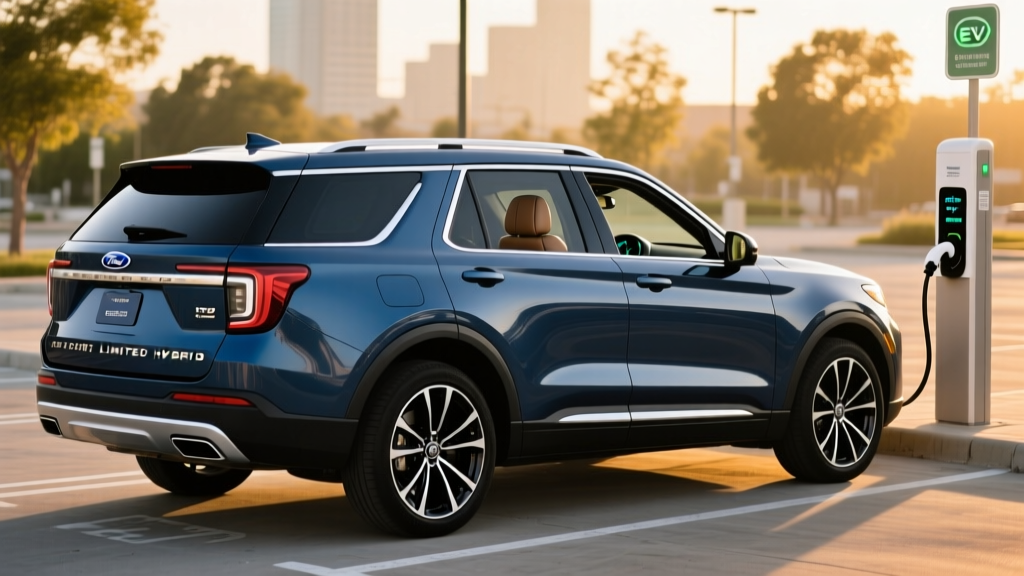
The 2023 Ford Explorer Limited Hybrid sits at a crossroads that many three-row SUV buyers face: you want the fuel savings of electrification, but you're not ready to commit to a plug. As a conventional hybrid electric vehicle (HEV), the Explorer Limited Hybrid requires zero lifestyle changes — no charging cables, no range apps, no trip planning around DC fast chargers. It simply sips less fuel while delivering the same 318 horsepower and seven-seat utility as its gas-only sibling. But with EPA ratings that tell only part of the story and a 2023 model year now available on the used market, is this hybrid SUV still a smart buy in 2026?
Below, we break down the real-world MPG you can expect, the powertrain engineering, battery longevity concerns, tax-credit eligibility, and how this HEV stacks up against plug-in hybrid and full-electric alternatives.
HEV vs PHEV: Understanding What the Explorer Hybrid Actually Is
Before diving into specs, it's essential to distinguish the Explorer Limited Hybrid from a plug-in hybrid (PHEV). Ford does not offer a plug-in version of the Explorer in the U.S. market. The Explorer Limited Hybrid is a conventional hybrid (HEV), meaning:
- No plug required. The 1.35 kWh lithium-ion battery recharges exclusively through regenerative braking and the gasoline engine.
- No electric-only driving range. Unlike a PHEV that can travel 20-40 miles on battery alone, the Explorer Hybrid uses its electric motor to assist the gas engine at all times, not to replace it.
- No federal §30D tax credit. The IRS clean vehicle credit applies only to plug-in vehicles (BEVs and PHEVs) with batteries ≥7 kWh. The Explorer's 1.35 kWh pack doesn't qualify.
- Simpler ownership. No home charger installation, no public charging network dependency, no preconditioning routines.
If you were hoping for an Explorer with a plug, you're thinking of the Ford Escape PHEV (37 miles electric-only) or competitors like the Toyota Highlander Hybrid (also an HEV, no plug) or the Jeep Grand Cherokee 4xe (PHEV, 25 miles electric). The Explorer Hybrid occupies the same space as the Highlander Hybrid: a self-charging three-row family hauler.
Fuel Economy: EPA Ratings vs. Real-World MPG
The headline number for the 2023 Explorer Limited Hybrid is its EPA-estimated fuel economy. Here's the official breakdown from fueleconomy.gov:
| Metric | FWD Hybrid | AWD Hybrid (Intelligent 4WD) |
|---|---|---|
| City MPG | 24 | 23 |
| Highway MPG | 28 | 26 |
| Combined MPG | 25 | 23 |
| Annual Fuel Cost (est.) | $2,550 | $2,750 |
Real-world expectations: Hybrid SUVs tend to outperform their EPA city ratings in stop-and-go traffic because regenerative braking recaptures more energy at low speeds. Owners on forums and tracking apps like Fuelly commonly report 25-27 MPG in mixed suburban driving with the FWD model, and 23-25 MPG with AWD. Highway-heavy commutes at 75+ mph tend to drop efficiency to 22-24 MPG, as the aerodynamic drag of a 4,700-pound SUV overwhelms the hybrid system's advantages.
In cold weather (below 30°F), expect a 5-10% fuel economy reduction — the engine runs more frequently to provide cabin heat and maintain battery temperature. This is less severe than the 20-30% range loss a full EV experiences in cold, but it's worth budgeting for if you live in northern climates.
For context, the gas-only 2023 Explorer Limited with the 2.3L EcoBoost I-4 rates at 21 city / 28 highway / 24 combined (RWD) and 20/27/23 (AWD). The hybrid's advantage is most pronounced in city driving, where it gains 3-4 MPG over the gas model. On the highway, the difference narrows to nearly nothing.
Powertrain Specs: Engine, Motor, and Combined Output
| Specification | 2023 Explorer Limited Hybrid |
|---|---|
| Engine | 3.3L V6 naturally aspirated |
| Engine Output | 290 HP @ 6,500 RPM / 290 lb-ft torque |
| Electric Motor | AC synchronous permanent-magnet, 44 HP (33 kW) |
| Combined System Output | 318 HP |
| Transmission | 10-speed modular hybrid automatic |
| Battery Capacity | 1.35 kWh lithium-ion (usable ~1.0 kWh) |
| Drivetrain | RWD standard; Intelligent AWD optional |
| 0-60 MPH | ~7.6 seconds (estimated) |
| Towing Capacity | 5,300 lbs (with Class III tow package) |
| Curb Weight | ~4,725 lbs |
| Seating | 7 passengers (standard) |
| Cargo Volume | 18.2 cu ft (behind 3rd row) / 87.8 cu ft (max) |
The 3.3L V6 is a carryover from Ford's modular engine family, chosen for its smoothness and adequate torque. The electric motor is sandwiched between the engine and transmission, providing torque fill at low RPMs and enabling brief engine-off coasting at cruising speeds. The combined 318 HP gives the Explorer Hybrid a slight power advantage over the 2.3L EcoBoost gas model (300 HP) and makes highway merging and uphill grades feel confident even with a full load of passengers and cargo.
The 10-speed automatic transmission is a key differentiator. Unlike many hybrid systems that use a continuously variable transmission (CVT), Ford's modular hybrid architecture retains fixed gears. This means more natural-feeling acceleration and none of the "rubber-band" drone associated with CVTs. The trade-off is slightly less seamless electric-motor integration — you may feel occasional gear shifts during gentle acceleration that a CVT-equipped hybrid (like the Toyota Highlander Hybrid) wouldn't exhibit.
Pricing and Tax Credit Eligibility
The 2023 Ford Explorer Limited Hybrid launched with an MSRP of approximately $54,625 (including destination). With Intelligent AWD, that climbed to roughly $56,625. The Limited trim includes leather-trimmed seats, a 12-inch SYNC 4 touchscreen, a 12-speaker B&O audio system, hands-free liftgate, and Ford's Co-Pilot360 Assist+ suite (adaptive cruise control, lane centering, evasive steering assist).
As of 2026, the 2023 model year is available only on the used market. Expect pricing between $35,000 and $45,000 depending on mileage, condition, and regional demand.
Federal Tax Credit: Not Eligible
The 2023 Explorer Limited Hybrid does not qualify for the IRS §30D Clean Vehicle Credit. This credit requires a plug-in vehicle with a battery capacity of at least 7 kWh. The Explorer's 1.35 kWh battery falls far below this threshold. There is no federal hybrid-specific tax credit for conventional HEVs.
Some states offer modest rebates or HOV lane access for hybrids, but these vary by jurisdiction and are phasing out in many areas. Check your state's department of energy or environmental agency for current programs.
For comparison, the used EV tax credit (§25E) allows up to $4,000 on qualifying pre-owned electric vehicles priced under $25,000 — but this also applies only to plug-in vehicles, not conventional hybrids.
Battery Warranty, Reliability, and Replacement Costs
Hybrid Battery Warranty
- Standard coverage: 8 years / 100,000 miles (whichever comes first)
- CARB-state coverage: 10 years / 150,000 miles in California Air Resources Board states (CA, CO, CT, ME, MD, MA, NJ, NY, OR, RI, VT, WA)
- Capacity threshold: Ford covers the hybrid battery if it falls below ~70% of original capacity during the warranty period
The 1.35 kWh lithium-ion pack in the Explorer Hybrid is relatively small and experiences shallow charge/discharge cycles — typically operating between 20% and 80% state of charge. This gentle usage pattern is favorable for long-term battery health. For reference, Ford's Escape Hybrid (which uses a similar architecture) has demonstrated strong battery longevity, with many examples surpassing 150,000 miles without battery replacement.
Reliability track record: The 3.3L V6 engine is well-proven across Ford's lineup. The 10-speed hybrid transmission has drawn some early complaints about shift hunting in the Explorer's first model years (2020-2021), but Ford issued software updates that improved behavior. By 2023, most owners report smooth operation. According to NHTSA data, the 2023 Explorer has average reliability ratings for its class.
Battery replacement cost: If the hybrid battery fails outside of warranty, expect a replacement cost of $2,000 to $3,500 (parts and labor). This is significantly less than a full EV battery replacement ($8,000-$20,000+) because the pack is small. Some independent hybrid specialists offer refurbished battery modules for $1,200-$1,800.
Powertrain warranty: The engine and transmission are covered for 5 years / 60,000 miles under Ford's standard powertrain warranty.
Real-World Ownership: What Hybrid Buyers Should Know
Living with the Explorer Limited Hybrid differs from both gas and full-electric ownership in practical ways:
- Fueling: The 18.0-gallon fuel tank provides a real-world range of approximately 415-470 miles (FWD) or 380-420 miles (AWD), depending on driving style. You'll visit the gas station roughly once every 7-10 days with a 30-mile daily commute.
- Maintenance: Hybrid maintenance is similar to gas models — oil changes every 7,500-10,000 miles, brake fluid, tire rotations. However, regenerative braking reduces brake pad wear significantly; many hybrid owners report 60,000+ miles on original brake pads.
- Insurance: Insurance premiums for the Explorer Hybrid are typically 5-10% higher than the gas model due to the higher repair costs associated with hybrid components. Average annual premium: $1,700-$2,100 depending on your profile.
- Depreciation: The Explorer Hybrid depreciates at a similar rate to the gas model — approximately 40-45% over 3 years. Hybrid premiums on used models have softened as more electrified SUVs enter the market.
Explorer Hybrid vs. the Alternatives: HEV, PHEV, or Full EV?
The three-row SUV segment offers buyers three distinct electrification paths. Here's how the Explorer Limited Hybrid compares to key alternatives:
| Vehicle | Type | Combined MPG / MPGe | Electric-Only Range | Starting MSRP (2023) | Tax Credit |
|---|---|---|---|---|---|
| Ford Explorer Limited Hybrid | HEV | 23-25 MPG | None | ~$54,625 | None |
| Toyota Highlander Hybrid | HEV | 35-36 MPG | None | ~$40,220 | None |
| Jeep Grand Cherokee 4xe | PHEV | 56 MPGe / 25 MPG gas-only | 25 miles | ~$59,995 | Up to $3,750* |
| Kia EV9 | BEV | 88-89 MPGe | 270-304 miles | ~$54,900 | Up to $7,500* |
*Tax credit amounts depend on MSRP caps, buyer income limits, battery sourcing requirements, and point-of-sale transfer rules per IRS §30D guidelines. Consult a tax professional.
Which Is Right for You?
Choose the Explorer Limited Hybrid (HEV) if:
- You need three rows and 5,300-lb towing capacity
- You don't have reliable access to home or workplace charging
- You want fuel savings without any plug-in routine
- You prefer Ford's Co-Pilot360 tech and SYNC 4 interface
Choose the Toyota Highlander Hybrid (HEV) if:
- Maximum fuel economy is your top priority (35-36 MPG vs 23-25 MPG)
- You're willing to trade 100 HP and ~2,000 lbs of towing for efficiency
- You want a lower starting price (~$40K vs ~$55K)
Choose a PHEV (like the Grand Cherokee 4xe) if:
- You have Level 2 home charging and a commute under 25 miles
- You want electric-only daily driving with gas-engine road-trip flexibility
- You want to capture a partial federal tax credit
Choose a full EV (like the Kia EV9) if:
- You have reliable Level 2 home charging
- You want the lowest per-mile energy cost (~$0.04/mi vs ~$0.14/mi for hybrid)
- You want the full $7,500 federal credit and zero tailpipe emissions
- You rarely tow and can accept 270-304 miles of range
Pros and Cons
Pros
- 318 HP with smooth V6 + electric motor torque fill
- No charging infrastructure required
- 5,300-lb towing capacity (best-in-class for hybrid SUVs)
- 10-speed automatic avoids CVT drone
- Generous cargo space (87.8 cu ft max)
- Comprehensive Co-Pilot360 Assist+ driver aids
- Hybrid battery warranty up to 10 yr/150K mi in CARB states
Cons
- Only 2-4 MPG improvement over gas Explorer on the highway
- Significantly lower MPG than Toyota Highlander Hybrid
- No federal tax credit eligibility
- $54K+ MSRP new (premium for the Limited trim)
- Small hybrid battery limits electric-motor contribution
- Real-world MPG can drop below 22 in cold weather or heavy towing
Frequently Asked Questions
How many MPG does the 2023 Ford Explorer Limited Hybrid get?
The EPA rates the FWD model at 24 city / 28 highway / 25 combined MPG, and the AWD model at 23/26/23. In real-world mixed driving, owners typically report 24-27 MPG (FWD) and 22-25 MPG (AWD). City-heavy driving favors the hybrid, while highway-only commutes at high speeds narrow the gap with the gas model.
Does the Explorer Hybrid need to be plugged in?
No. The 2023 Explorer Limited Hybrid is a conventional hybrid (HEV), not a plug-in hybrid. The 1.35 kWh battery charges entirely through regenerative braking and the gasoline engine. There is no charging port, no plug, and no electric-only driving mode.
Does the 2023 Explorer Hybrid qualify for any tax credit?
No. The federal §30D Clean Vehicle Credit requires a plug-in vehicle with a battery of at least 7 kWh. The Explorer Hybrid's 1.35 kWh battery does not qualify. There is currently no federal tax credit for conventional hybrids. Some states may offer minor incentives — check your local energy office.
How long will the hybrid battery last and what does replacement cost?
Ford covers the hybrid battery for 8 years/100,000 miles (10 years/150,000 miles in CARB states). The small battery undergoes shallow cycles, which favors longevity. Many Ford hybrid owners report 150,000+ miles without battery issues. Out-of-warranty replacement costs approximately $2,000-$3,500 at a dealer, or $1,200-$1,800 at an independent hybrid specialist.
Is the Explorer Hybrid more reliable than the gas Explorer?
Overall reliability is comparable. The 3.3L V6 is a proven engine, and the hybrid system adds relatively few failure points (the electric motor and battery have strong track records in Ford's hybrid lineup). Early 2020-2021 models had transmission software complaints that Ford addressed via updates. By 2023, the powertrain is considered mature. According to NHTSA, the 2023 Explorer has no major safety recalls specific to the hybrid system.
How does the Explorer Hybrid compare to the Toyota Highlander Hybrid?
The Highlander Hybrid is significantly more fuel-efficient (35-36 MPG combined vs 23-25 MPG) and starts at a lower price (~$40K vs ~$55K). However, the Explorer Hybrid offers more horsepower (318 vs 243), higher towing capacity (5,300 lbs vs 3,500 lbs), and a more traditional driving feel with its 10-speed automatic vs the Highlander's CVT. If efficiency is paramount, the Highlander wins. If towing and power matter more, the Explorer has the edge.
Can the Explorer Hybrid tow a camper trailer?
Yes. With the available Class III trailer tow package, the Explorer Hybrid can tow up to 5,300 lbs — adequate for most mid-size travel trailers, boat trailers, and utility trailers. Note that towing will reduce fuel economy to approximately 16-19 MPG depending on trailer weight and terrain.
The 2023 Ford Explorer Limited Hybrid is a niche product: a three-row SUV that offers modest fuel savings for buyers who can't or won't plug in. Its 2-4 MPG advantage over the gas model won't dramatically change your fuel budget, but the additional torque, smooth V6 character, and zero-lifestyle-change ownership make it a reasonable choice for the right buyer. If maximum efficiency is your goal, the Toyota Highlander Hybrid is the clear winner. If you're ready for a plug, a PHEV or BEV will deliver far greater per-mile savings. But if you need towing capacity, seven seats, and a no-fuss hybrid that just works, the Explorer Limited Hybrid fills that specific brief competently.