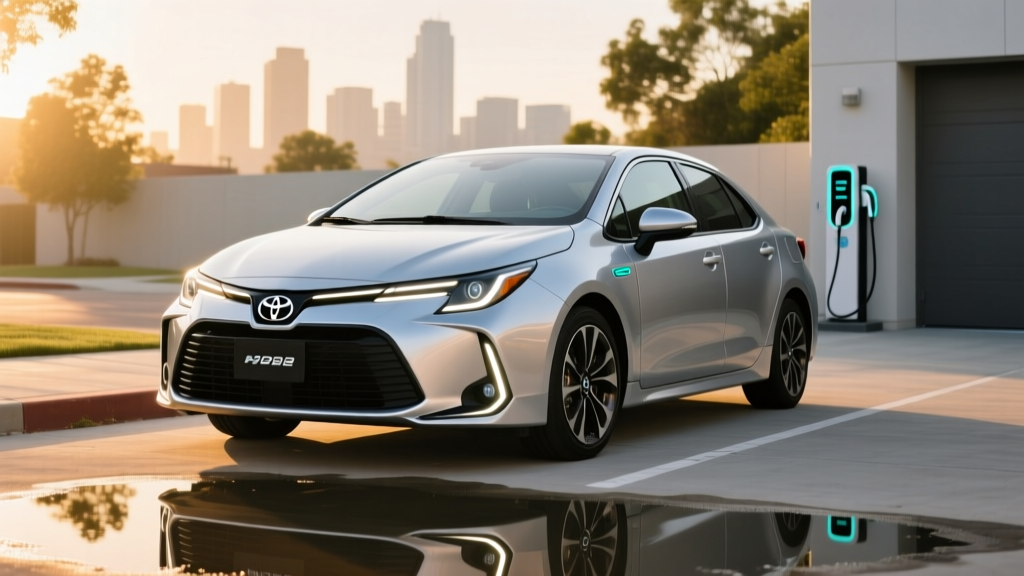
The 2023 Toyota Corolla Hybrid occupies a specific niche that continues to attract buyers even as the used market matures in 2026: a no-compromise conventional hybrid sedan that requires zero behavioral change from its owner. No plugs, no range calculations, no charging apps — just a 1.8-liter engine paired with Toyota's fifth-generation hybrid system delivering an EPA-estimated 50 MPG combined. For shoppers cross-referencing fuel savings against a growing crop of plug-in hybrids and battery-electric vehicles, the Corolla Hybrid remains a benchmark for simplicity and low total cost of ownership.
This guide breaks down the 2023 Corolla Hybrid's real-world fuel economy, powertrain specifications, battery longevity, warranty coverage, and whether it still qualifies for any federal tax incentives when purchased used in 2026.
HEV vs PHEV vs EV: Where the Corolla Hybrid Fits
Before examining specs, it's critical to understand what the 2023 Corolla Hybrid is — and what it isn't. Toyota offers the Corolla exclusively as a conventional hybrid (HEV). There is no plug-in hybrid (PHEV) Corolla variant in the US market. This distinction matters because it determines how the car is fueled, what incentives apply, and what kind of driving it optimizes for.
Conventional Hybrid (HEV) vs Plug-In Hybrid (PHEV) vs Battery Electric (BEV)
| Feature | HEV (Corolla Hybrid) | PHEV (e.g., Prius Prime) | BEV (e.g., Tesla Model 3) |
|---|---|---|---|
| Plug-in charging required? | No — regenerative braking charges a small battery | Yes — for electric-only range | Yes — sole energy source |
| Electric-only range | ~1 mile at low speed | 25–44 miles typical | 250–360+ miles |
| Gasoline engine? | Yes (primary) | Yes (backup) | No |
| Federal tax credit (new) | None | Up to $7,500 (§30D) | Up to $7,500 (§30D) |
| Used vehicle credit (§25E) | None (not a PHEV/BEV) | Up to $4,000 | Up to $4,000 |
| Home charger needed? | No | Recommended (Level 2) | Essential (Level 2) |
The Corolla Hybrid's self-charging architecture means you treat it exactly like a gas car at the pump — you simply fill up less often. The hybrid system recovers energy during deceleration and braking, storing it in a compact nickel-metal hydride (NiMH) traction battery that assists the gasoline engine during acceleration and enables brief electric-only creeping at low speeds.
EPA Fuel Economy and Real-World MPG
The headline number for the 2023 Corolla Hybrid is its fuel efficiency, and Toyota's fifth-generation Hybrid Synergy Drive delivers on the sticker promise in real-world driving — particularly in city conditions where regenerative braking and electric-motor assist do the heaviest lifting.
| Trim / Drivetrain | City MPG | Highway MPG | Combined MPG |
|---|---|---|---|
| LE (FWD) | 53 | 46 | 50 |
| LE (AWD) | 47 | 41 | 44 |
| SE (FWD) | 50 | 43 | 47 |
Source: EPA Fuel Economy Guide
Real-World MPG vs EPA: What Owners Actually See
Conventional hybrids like the Corolla Hybrid tend to meet or exceed their EPA city estimates in stop-and-go traffic, where the electric motor handles low-speed propulsion and regenerative braking recovers energy constantly. On the highway, however, the gasoline engine carries most of the load, and real-world highway MPG often lands 2–4 MPG below the EPA sticker — especially at sustained speeds above 70 mph or in cold weather below 35°F, when the engine runs longer to maintain cabin heat and battery temperature.
Expect 48–54 MPG combined in mixed suburban/city driving, and 42–46 MPG on extended highway road trips. Owners in warm climates with heavy city commutes routinely report exceeding 52 MPG.
Powertrain Specifications: Engine, Motor, and Output
The 2023 Corolla Hybrid pairs Toyota's proven 1.8-liter four-cylinder Atkinson-cycle engine with one or two electric motor-generators depending on drivetrain configuration. The AWD model adds a rear-mounted electric motor that provides on-demand rear traction without a mechanical driveshaft — a packaging and weight advantage unique to Toyota's hybrid AWD system.
| Specification | FWD Models | AWD Models |
|---|---|---|
| Gasoline Engine | 1.8L 4-cyl Atkinson-cycle | 1.8L 4-cyl Atkinson-cycle |
| Engine Horsepower | 96 hp @ 5,200 rpm | 96 hp @ 5,200 rpm |
| Front Electric Motor | 94 hp (MG1/MG2 combined) | 94 hp (MG1/MG2 combined) |
| Rear Electric Motor (AWD) | N/A | 40 hp |
| Net Combined System HP | 138 hp | 138 hp |
| Transmission | eCVT (planetary gearset) | eCVT (planetary gearset) |
| Traction Battery | ~1.3 kWh NiMH (sealed) | ~1.3 kWh NiMH (sealed) |
| 0–60 mph (est.) | ~9.2 seconds | ~9.5 seconds |
| Curb Weight | ~3,085 lbs | ~3,210 lbs |
The 138 combined horsepower figure is modest by modern standards, but the electric motor's instant torque fill makes the Corolla Hybrid feel more responsive than its 0–60 time suggests in daily driving. The eCVT is not a belt-and-pulley CVT — it uses a planetary gearset that seamlessly blends engine and motor power with no shifting, which contributes to both smoothness and long-term reliability.
Hybrid Battery Longevity, Warranty, and Replacement Cost
For any hybrid buyer, the traction battery is the single biggest long-term ownership question. The 2023 Corolla Hybrid uses a compact nickel-metal hydride (NiMH) battery pack — a chemistry Toyota has refined over 25+ years of Prius and Camry Hybrid production. NiMH is less energy-dense than the lithium-ion packs in PHEVs and BEVs, but it is exceptionally durable and tolerant of the shallow charge-discharge cycles that define conventional hybrid operation.
Toyota Hybrid Battery Warranty Coverage
- Hybrid Battery: 10 years / 150,000 miles (whichever comes first) — transferable to subsequent owners
- Hybrid System Components (inverter, motor-generators, control module): 8 years / 100,000 miles
- Basic Vehicle Warranty: 3 years / 36,000 miles
- Powertrain Warranty: 5 years / 60,000 miles
Source: Toyota Warranty Guide. California-emissions states may have extended hybrid component coverage (10 yr/150k mi) — verify with your dealer.
Real-World Battery Lifespan
Toyota's NiMH hybrid batteries routinely last 150,000–200,000+ miles before significant degradation, and many first-generation Prius packs exceeded 250,000 miles. The Corolla Hybrid's battery management system keeps the pack in a narrow state-of-charge window (roughly 40–80%), which dramatically reduces stress on the cells. Unlike a BEV battery that cycles through deep charge states, the Corolla Hybrid's small pack experiences only shallow micro-cycles — the primary reason for its longevity.
Battery Replacement Cost
If the hybrid battery does fail outside warranty, a new OEM replacement from Toyota costs approximately $2,500–$3,500 installed at a dealership. Independent hybrid specialists and refurbished/reconditioned packs are available for $1,000–$2,000. Given the 10-year/150,000-mile warranty and the proven durability of Toyota's NiMH system, most original owners will never face this expense.
2023 Corolla Hybrid Pricing and Tax Credit Eligibility in 2026
The 2023 Corolla Hybrid launched with an MSRP starting at $22,050 for the LE FWD trim, with the AWD LE at approximately $23,450 and the sportier SE trim at $25,450 (all prices before destination). On the used market in 2026, expect to pay roughly $17,000–$23,000 depending on mileage, condition, and trim.
Federal Tax Credit: Does the 2023 Corolla Hybrid Qualify?
No. The Corolla Hybrid is a conventional hybrid (HEV), not a plug-in hybrid or battery-electric vehicle. Under IRS §30D Clean Vehicle Credit rules, only PHEVs and BEVs with sufficient battery capacity (≥7 kWh for PHEVs, ≥16 kWh for BEVs) are eligible for the new-vehicle credit of up to $7,500.
Similarly, the §25E Used Clean Vehicle Credit (up to $4,000 or 30% of sale price for qualifying used PHEVs and BEVs priced at $25,000 or less) does not apply to conventional hybrids. The Corolla Hybrid's ~1.3 kWh battery does not meet the minimum threshold for any federal electrification incentive.
Some states and utilities offer rebates for conventional hybrids — check your state energy office or local utility for current programs. These vary by jurisdiction and change frequently.
Who Should Choose the Corolla Hybrid vs a PHEV or Full EV?
The Corolla Hybrid isn't trying to be an EV or a PHEV — it solves a different problem. Here's a practical decision framework based on driving patterns, housing situation, and budget.
Choose the 2023 Corolla Hybrid If:
- You cannot install a home charger (apartment, street parking, no garage) and need zero infrastructure changes
- Your budget is under $25,000 and you want to minimize both purchase price and fuel cost
- You drive 10,000–15,000 miles/year in mixed city/highway conditions and want 500+ mile range per tank
- You plan to own the car 10+ years and value Toyota's proven long-term reliability
- You want a simple ownership experience with no apps, no charging networks, no preconditioning
Choose a PHEV (e.g., Toyota Prius Prime) If:
- You have home Level 2 charging and a short commute (under 40 miles round-trip) that could run mostly on electricity
- You want to qualify for the $7,500 federal tax credit (new) or $4,000 used credit to offset a higher purchase price
- You want the option of zero-emission daily driving with a gas engine for road trips
Choose a Full EV (e.g., Tesla Model 3, Hyundai Ioniq 6) If:
- You have reliable home charging and want to eliminate gasoline entirely
- Your daily driving is under 250 miles and you have access to DC fast charging for road trips
- You want the lowest per-mile energy cost (~$0.04–$0.06/mi on home electricity vs ~$0.10–$0.12/mi for the Corolla Hybrid at 50 MPG and $3.20/gal gas)
- Performance, instant torque, and reduced maintenance (no oil changes, fewer moving parts) are priorities
Pros and Cons at a Glance
Pros
- 50 MPG combined EPA (FWD) — among the highest of any non-plug-in sedan
- No plug-in charging or infrastructure required
- AWD available with rear electric motor (rare in this segment)
- 10-year/150,000-mile hybrid battery warranty
- Low starting MSRP; strong used-market value retention
- Proven Toyota reliability with 25+ years of hybrid refinement
- 500+ mile total range on a single 11.4-gallon tank
Cons
- 138 hp — adequate but not quick (0–60 in ~9.2 sec)
- No federal tax credit eligibility (HEV, not PHEV/BEV)
- Modest rear-seat legroom (35.0 in) and trunk space (13.1 cu ft)
- AWD model drops to 44 MPG combined
- No DC fast charging capability (not applicable to HEV architecture)
- Infotainment interface dated compared to competitors
- NiMH battery (older chemistry) — lighter, less energy-dense than lithium-ion
2023 Corolla Hybrid vs Competitors: Quick MPG Comparison
| Vehicle (2023 Model Year) | Type | EPA Combined MPG | HP | Starting MSRP (New) |
|---|---|---|---|---|
| Toyota Corolla Hybrid LE (FWD) | HEV | 50 | 138 | $22,050 |
| Hyundai Elantra Hybrid Blue | HEV | 54 | 139 | $24,550 |
| Honda Civic (gas, Sport Touring) | ICE | 33 | 180 | $28,950 |
| Toyota Prius LE | HEV | 57 | 194 | $27,450 |
| Toyota Prius Prime SE (PHEV) | PHEV | 52 MPG / 127 MPGe | 220 | $32,675 |
The Elantra Hybrid edges the Corolla Hybrid on paper (54 vs 50 combined), but the Corolla offers available AWD — a meaningful advantage in snow-belt states. The redesigned 2023 Prius is more powerful and slightly more efficient, but starts $5,000+ higher. For pure value-per-MPG, the Corolla Hybrid LE FWD remains difficult to beat.
Frequently Asked Questions
How many MPG does the 2023 Corolla Hybrid actually get?
The EPA rates the Corolla Hybrid LE FWD at 53 city / 46 highway / 50 combined MPG. In real-world driving, owners typically achieve 48–54 MPG combined, with city-heavy commutes often exceeding the EPA city estimate thanks to regenerative braking. Highway-only driving at 75+ mph may drop to 42–44 MPG.
Does the Corolla Hybrid need to be plugged in?
No. The Corolla Hybrid is a conventional (self-charging) hybrid. Its small NiMH battery is charged entirely by the gasoline engine and regenerative braking. You never plug it in — you simply refuel at a gas station as you would with any conventional car.
Is the Corolla Hybrid available as a plug-in hybrid (PHEV)?
No. Toyota does not offer a plug-in hybrid Corolla in the US market. If you want a Toyota PHEV, the Prius Prime (44 miles electric-only range, 220 hp, eligible for the $7,500 federal credit) is the closest alternative in a similar size class.
Is the hybrid battery reliable, and what does replacement cost?
Toyota's NiMH hybrid batteries have an exceptional reliability record, routinely lasting 150,000–200,000+ miles. The 2023 Corolla Hybrid's battery is covered by a 10-year/150,000-mile warranty. Out-of-warranty replacement costs approximately $2,500–$3,500 for a new OEM pack, or $1,000–$2,000 for a refurbished unit from an independent specialist.
Does the 2023 Corolla Hybrid qualify for any tax credit?
No federal tax credit applies. The IRS §30D new-vehicle credit and §25E used-vehicle credit require a minimum battery capacity that only PHEVs and BEVs meet. The Corolla Hybrid's ~1.3 kWh battery does not qualify. Some state or utility programs may offer small rebates for conventional hybrids — check local resources.
How does AWD affect fuel economy?
The electronic AWD system (which adds a 40 hp rear electric motor) reduces the combined EPA rating from 50 MPG to 44 MPG — a 6 MPG penalty. This is because the rear motor adds weight and the system occasionally engages the engine to generate electricity for the rear axle. For buyers in mild climates who don't need AWD, the FWD model is the more efficient choice.
What is the total driving range on a full tank?
With an 11.4-gallon fuel tank and 50 MPG combined, the FWD Corolla Hybrid delivers approximately 570 miles of total range — competitive with or exceeding most BEVs and eliminating any range-anxiety concern for long road trips.