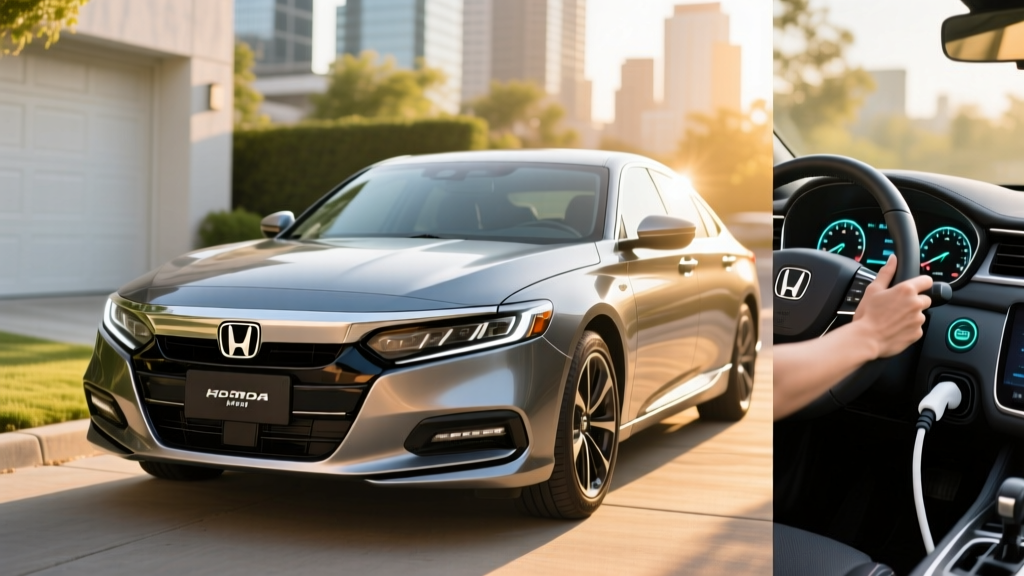
The 2023 Honda Accord Hybrid arrived as part of the eleventh-generation Accord redesign, bringing a refined two-motor hybrid system tuned for efficiency rather than outright performance. For buyers who want dramatic fuel savings without plugging in, changing driving habits, or worrying about charging infrastructure, this midsize sedan remains one of the most compelling options on the used and certified-pre-owned market in 2026. Here is everything you need to know about its real-world efficiency, powertrain, battery longevity, and how it compares to plug-in hybrids and full battery-electric vehicles.
HEV vs PHEV: Where the Accord Hybrid Fits
Before examining the numbers, it is critical to understand what the 2023 Accord Hybrid is—and is not. It is a conventional hybrid electric vehicle (HEV), sometimes called a "self-charging" hybrid. It has no plug, no external charging port, and no meaningful electric-only driving range. Instead, its small lithium-ion battery recharges through regenerative braking and the gasoline engine.
| Feature | HEV (Accord Hybrid) | PHEV (e.g., Toyota Prius Prime) | BEV (e.g., Tesla Model 3) |
|---|---|---|---|
| Plug-in charging | No | Yes (Level 1/2) | Yes (Level 1/2/DC) |
| Electric-only range | <1 mile at low speed | 25–44 miles typical | 250–350+ miles |
| Gasoline engine | Yes (primary power) | Yes (backup) | None |
| Battery size | ~1.06 kWh (nominal) | 13–18 kWh | 60–82 kWh |
| Fuel/energy source | Gasoline only | Gasoline + electricity | Electricity only |
| Federal tax credit (§30D) | Not eligible | Up to $7,500* | Up to $7,500* |
*§30D eligibility depends on MSRP caps, buyer income limits, and battery-sourcing requirements. See IRS clean vehicle credits for current rules.
The Accord Hybrid is engineered for drivers who want the simplicity of a gas-car ownership experience—fill up at any station, no home charger needed—with substantially better fuel economy. If you need electric-only commuting or want to eliminate gasoline entirely, you need to look at PHEVs or BEVs instead.
EPA Fuel Economy and Real-World MPG
The 2023 Accord Hybrid uses Honda's fourth-generation two-motor hybrid system. EPA estimates differ by trim, because the Sport and Sport-L trims ride on larger 19-inch wheels that increase rolling resistance.
| Trim | City MPG | Highway MPG | Combined MPG |
|---|---|---|---|
| Sport / Sport-L | 46 | 41 | 44 |
| EX-L / Sport Touring | 51 | 44 | 48 |
Source: EPA Fuel Economy Guide
Real-World MPG: What Owners Actually See
Hybrids frequently outperform their EPA city estimates in stop-and-go traffic, where regenerative braking recaptures energy that a conventional car wastes as heat. The Accord Hybrid's 51 MPG city figure (EX-L trim) is already exceptional, but many owners report 52–56 MPG in urban and suburban driving during mild weather.
Highway driving tells a different story. At sustained 70–80 mph speeds, the hybrid system provides less advantage because there is minimal braking to recapture energy. Expect 40–43 MPG on the highway in real-world conditions—slightly below the EPA sticker for some trims.
Real-World Fuel Economy Summary
- City/suburban: 50–56 MPG (often exceeds EPA)
- Highway (70–80 mph): 40–43 MPG
- Mixed driving: 45–50 MPG
- Cold weather penalty: Expect 5–10% lower MPG in winter due to cabin heating and reduced battery efficiency
With a 14.8-gallon fuel tank and 48 MPG combined, the EX-L trim delivers a theoretical 710+ miles of total range per fill-up. Real-world mixed driving typically yields 620–680 miles before the low-fuel warning.
Powertrain Specs: Engine, Motors, and Horsepower
The 2023 Accord Hybrid pairs a 2.0-liter Atkinson-cycle inline-four engine with Honda's two-motor hybrid system. Here is the complete powertrain breakdown:
| Specification | Value |
|---|---|
| Engine | 2.0L DOHC Atkinson-cycle I-4 |
| Engine horsepower | 146 hp @ 6,100 rpm |
| Engine torque | 134 lb-ft @ 4,500 rpm |
| Drive motor output | 181 hp / 247 lb-ft |
| Combined system horsepower | 204 hp |
| Combined system torque | 247 lb-ft |
| Transmission | e-CVT (no traditional gears) |
| Drivetrain | Front-wheel drive |
| 0–60 mph | ~7.5 seconds (estimated) |
| Battery type | Lithium-ion |
| Battery capacity (nominal) | ~1.06 kWh |
The Accord Hybrid operates primarily as a series hybrid at low and moderate speeds: the gasoline engine drives a generator, which powers the electric drive motor that turns the wheels. At highway cruising speeds, a lock-up clutch engages to connect the engine directly to the wheels for efficiency. This architecture delivers smooth, electric-like acceleration around town while maintaining strong highway passing power.
The 204 combined horsepower is adequate for daily driving and highway merging, but this is not a performance-oriented sedan. Drivers seeking the 252-hp turbocharged 1.5T engine should note that Honda dropped the turbo four-cylinder from the Accord lineup for 2023, making the hybrid the standard powertrain across all trims.
Battery Warranty, Lifespan, and Replacement Cost
Hybrid battery longevity is consistently the top concern for buyers considering a used or CPO Accord Hybrid. Honda provides robust warranty coverage, and real-world data from prior-generation Accord Hybrids is encouraging.
| Warranty Coverage | Duration |
|---|---|
| Hybrid battery warranty | 8 years / 100,000 miles (10 yr / 150,000 mi in CARB states) |
| Hybrid system components | 8 years / 100,000 miles |
| Powertrain warranty | 5 years / 60,000 miles |
| Bumper-to-bumper | 3 years / 36,000 miles |
CARB states include CA, CO, CT, ME, MA, NJ, NY, OR, RI, VT, WA, and others that have adopted California emissions standards. Verify your state's status at purchase.
What Happens When the Battery Degrades?
The 2023 Accord Hybrid's ~1.06 kWh lithium-ion battery is small compared to a BEV's 60–80 kWh pack, which means it experiences shallower charge-discharge cycles. Honda's hybrid system manages the battery within a narrow state-of-charge window (roughly 40–80%), which significantly reduces stress and extends cycle life.
Based on data from 2014–2022 Accord Hybrids, most owners report minimal noticeable degradation over 150,000–200,000 miles. When failures do occur, they typically involve individual cell modules rather than the entire pack.
Replacement cost estimates (2026):
- Full hybrid battery replacement: $2,000–$4,000 at a Honda dealer (parts + labor)
- Independent hybrid specialist refurbishment: $1,200–$2,500
- Individual cell module replacement: $500–$1,500 (where available)
For context, the hybrid battery in the Accord is far less expensive to replace than a BEV traction battery ($8,000–$20,000+), because it is much smaller and simpler. Most Accord Hybrid owners will never need a battery replacement during typical ownership.
Pricing, Trims, and Tax Credit Eligibility
The 2023 Accord Hybrid launched with the following MSRP structure. As a used or CPO vehicle in 2026, prices will be lower depending on mileage and condition.
| Trim | Original MSRP (2023) | Estimated CPO/Used Range (2026) |
|---|---|---|
| Sport | $32,990 | $25,000–$29,000 |
| EX-L | $34,635 | $26,500–$30,500 |
| Sport-L | $34,970 | $27,000–$31,000 |
| Sport Touring | $38,340 | $29,500–$34,000 |
Federal Tax Credit Eligibility
The 2023 Accord Hybrid is a conventional HEV and does not qualify for the federal §30D New Clean Vehicle Credit. That credit (up to $7,500) is reserved for plug-in electric vehicles—BEVs and PHEVs with sufficient battery capacity and qualifying battery sourcing.
However, there are still financial considerations:
- Used clean vehicle credit (§25E): The Accord Hybrid also does not qualify, as this credit applies only to used BEVs and PHEVs.
- State incentives: A handful of states offer rebates or HOV lane access for hybrids, though most incentive programs have shifted toward plug-in vehicles. Check your state's energy office or DMV for current programs.
- Fuel savings: At 48 MPG combined vs. a typical 30 MPG midsize sedan, the Accord Hybrid saves roughly $500–$700 per year in fuel costs (based on 15,000 miles/year and $3.50/gallon), which partially offsets the hybrid premium over a gas-only competitor.
Reliability and Long-Term Ownership
Honda's hybrid powertrain has matured significantly since the first Accord Hybrid in 2005. The 2023 model benefits from the fourth-generation two-motor system, which eliminates the traditional transmission entirely—there are no gears, belts, or torque converters to fail. The e-CVT is fundamentally a pair of motor-generators connected by a planetary gearset, with far fewer moving parts than a conventional automatic.
Key reliability considerations:
- Hybrid system: Very few reported failures in the fourth-generation system. Honda's thermal management keeps the battery within optimal temperature range.
- Brakes: Regenerative braking reduces wear on the friction brakes. Many Accord Hybrid owners report original brake pads lasting 80,000–100,000+ miles.
- 12V battery: Like all modern cars, the Accord Hybrid has a conventional 12V auxiliary battery that may need replacement every 4–6 years. This is unrelated to the hybrid traction battery.
- Oil changes: The 2.0L engine still requires regular maintenance. Honda's Maintenance Minder system typically calls for oil changes every 7,500–10,000 miles.
The 2023 Accord received strong safety ratings, earning the IIHS Top Safety Pick+ award with acceptable or good ratings across all crashworthiness tests.
Who Should Choose the Accord Hybrid vs. a PHEV or EV?
Choose the 2023 Accord Hybrid if:
- You cannot install a home charger (apartment, street parking, no garage)
- You want a no-compromise ownership experience identical to a gas car
- You drive 15,000+ miles per year and want to minimize fuel costs
- You frequently take long road trips and don't want to plan around charging stations
- You prefer a proven midsize sedan with strong resale value
Choose a PHEV instead if:
- You can charge at home and want 25–40 miles of electric-only commuting
- Your daily commute is under 40 miles round-trip
- You want to reduce gasoline use dramatically while keeping a gas engine for road trips
- You want potential access to the §30D tax credit (up to $7,500)
Choose a full EV instead if:
- You can charge at home and want zero gasoline costs
- Your daily driving is under 250 miles and you're comfortable with DC fast charging on road trips
- You want minimal maintenance (no oil changes, no engine, fewer moving parts)
- You want to qualify for the full §30D credit and potential state rebates
Pros and Cons at a Glance
Pros
- 48 MPG combined (EX-L) — among the best in the midsize sedan class
- No plug-in charging required; seamless gas-car experience
- 710+ mile total range per tank
- Strong hybrid battery warranty (8 yr/100k mi, 10 yr/150k mi in CARB states)
- Spacious interior with 16.7 cu ft trunk (no battery intrusion)
- IIHS Top Safety Pick+ rating
- Low brake wear thanks to regenerative braking
Cons
- Not eligible for federal EV tax credits
- 204 hp is adequate but not quick; ~7.5 sec 0–60
- Highway MPG drops to low 40s at 75+ mph
- CVT-like drone under hard acceleration
- No all-wheel-drive option
- Sport trims sacrifice 4 MPG for 19-inch wheels
- Cold weather reduces MPG by 5–10%
Frequently Asked Questions
How many MPG does the 2023 Accord Hybrid get?
The EPA rates the EX-L and Sport Touring trims at 51 city / 44 highway / 48 combined MPG. The Sport and Sport-L trims are rated at 46 city / 41 highway / 44 combined due to larger 19-inch wheels. In real-world city driving, many owners exceed the EPA city estimate, achieving 52–56 MPG in stop-and-go traffic.
Does the Accord Hybrid need to be plugged in?
No. The 2023 Accord Hybrid is a conventional HEV with no plug and no charging port. Its lithium-ion battery recharges automatically through regenerative braking and the gasoline engine. You fuel it exactly like a conventional car—at any gas station.
Can the Accord Hybrid drive on electric power alone?
Only at very low speeds (under ~25 mph) for brief distances of a few hundred feet. The battery is too small (~1.06 kWh) to provide meaningful electric-only range. This is normal for conventional hybrids—the electric motor assists the gasoline engine rather than replacing it.
How long will the hybrid battery last?
Honda warranties the hybrid battery for 8 years/100,000 miles (10 years/150,000 miles in CARB states). Real-world data from prior-generation Accord Hybrids shows most packs lasting well beyond 150,000 miles with minimal degradation. Full replacement, if needed, costs approximately $2,000–$4,000.
Does the 2023 Accord Hybrid qualify for any tax credit?
No. The federal §30D New Clean Vehicle Credit applies only to plug-in vehicles (BEVs and PHEVs). As a conventional hybrid, the Accord Hybrid is not eligible for federal EV tax credits. Some states may offer minor incentives for hybrids, but most programs have shifted to plug-in vehicles.
Is the Accord Hybrid better than a full EV for saving money?
It depends on your situation. The Accord Hybrid saves $500–$700/year in fuel vs. a 30 MPG gas sedan, with zero charging infrastructure investment. A full EV like the Tesla Model 3 or Hyundai Ioniq 6 can save $1,000–$1,500/year in fuel (depending on electricity rates) and qualifies for up to $7,500 in federal tax credits, but requires home charging access and a higher purchase price. For apartment dwellers or those without home charging, the Accord Hybrid is often the more practical money-saver.
How does the Accord Hybrid compare to the Toyota Camry Hybrid?
The 2023 Camry Hybrid is rated at 52 city / 53 highway / 52 combined MPG (LE trim), edging out the Accord Hybrid by about 4 MPG combined. However, the Accord offers a larger trunk (16.7 vs. 15.1 cu ft), more rear legroom, and a more refined interior. Both carry excellent hybrid battery warranties. The choice often comes down to whether you prioritize maximum MPG (Camry) or interior space and driving refinement (Accord).