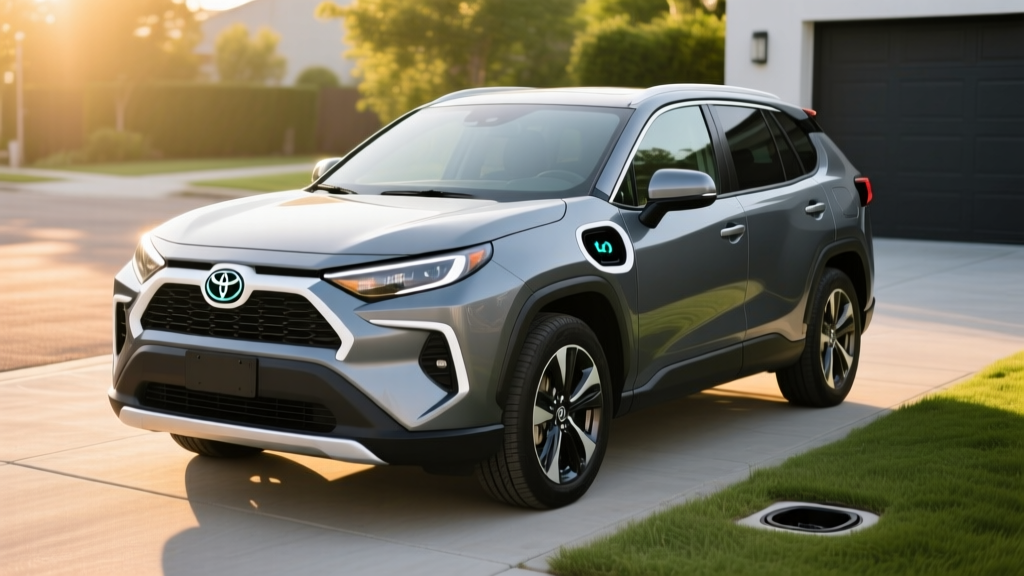
The Toyota RAV4 Hybrid has been one of the best-selling electrified vehicles in America for good reason: it delivers SUV practicality with fuel economy that embarrasses many compact sedans. If you're researching the 2022 Toyota RAV4 Hybrid EPA combined MPG, you've likely seen the headline number — 40 MPG combined — but there's far more to this powertrain than a single figure. In this deep-dive, we unpack the city/highway split, real-world efficiency data, the hybrid vs. plug-in hybrid (Prime) decision, battery longevity, and whether this HEV still makes sense for buyers in 2026.
2022 RAV4 Hybrid EPA MPG: The Official Numbers
The EPA rates the 2022 Toyota RAV4 Hybrid at the following fuel economy figures across all AWD trims (LE, XLE, XLE Premium, SE, Woodland Edition, Limited):
| Metric | MPG |
|---|---|
| City | 41 MPG |
| Highway | 38 MPG |
| Combined | 40 MPG |
| Fuel Tank Capacity | 14.5 gallons |
| Total EPA Range | ~580 miles |
That 41-city / 38-highway split is a signature trait of Toyota's hybrid system. Unlike a conventional gas vehicle — which typically gets worse mileage in stop-and-go traffic — the RAV4 Hybrid actually excels in the city. The electric motor handles low-speed propulsion, regenerative braking recaptures energy that would otherwise be lost as heat, and the gasoline engine shuts off entirely at stops. Highway driving relies more heavily on the 2.5-liter four-cylinder, which is why the highway number dips slightly.
Hybrid (HEV) vs. Plug-In Hybrid (PHEV): RAV4 Hybrid vs. RAV4 Prime
Toyota offered the 2022 RAV4 in two electrified flavors: the conventional RAV4 Hybrid (HEV) and the RAV4 Prime (PHEV). Understanding the difference is critical before you shop, because pricing, capability, and tax-credit eligibility diverge sharply.
| Spec | RAV4 Hybrid (HEV) | RAV4 Prime (PHEV) |
|---|---|---|
| Powertrain Type | Self-charging hybrid | Plug-in hybrid |
| Needs to Plug In? | No | Yes (for EV range) |
| Combined HP | 219 hp | 302 hp |
| EPA Combined MPG (hybrid mode) | 40 MPG | 38 MPG (gas only) |
| Electric-Only Range | N/A (EV assist only) | 42 miles (EPA) |
| MPGe (EV + gas combined) | N/A | 94 MPGe |
| Battery Capacity | 1.6 kWh (NiMH) | 18.1 kWh (Li-ion) |
| DC Fast Charging | N/A | No (Level 2 AC only) |
| Level 2 Charge Time (0–100%) | N/A | ~2.5 hrs (6.6 kW onboard charger) |
| 0–60 MPH | 7.4 sec | 5.7 sec |
| Starting MSRP (2022) | ~$29,075 | ~$39,800 |
| Federal Tax Credit (§30D) | Not eligible | Up to $7,500 (subject to eligibility) |
The HEV is the simpler, lower-cost option. You never plug it in — it charges its small battery through regenerative braking and the gas engine. The Prime gives you 42 miles of pure electric driving for daily commutes, then operates as a conventional hybrid once the battery is depleted. If you can charge at home and your daily round-trip is under 40 miles, the Prime can run weeks without burning a drop of gasoline.
Powertrain Breakdown: How the RAV4 Hybrid Achieves 40 MPG
The 2022 RAV4 Hybrid pairs a 2.5-liter Dynamic Force four-cylinder engine with Toyota's fourth-generation hybrid system. Here's the hardware:
- Gasoline Engine: 2.5L inline-4, 176 hp / 163 lb-ft torque (Atkinson cycle for efficiency)
- Front Electric Motor: 118 hp / 149 lb-ft (integrated into transaxle)
- Rear Electric Motor (AWD-e): 54 hp / 89 lb-ft (powers rear axle independently)
- Net System Output: 219 combined horsepower
- Transmission: eCVT (planetary gearset, not a belt-driven CVT)
- Drivetrain: Electronic on-demand AWD (all trims)
- Hybrid Battery: 1.6 kWh nickel-metal hydride (NiMH), located under rear seat
The eCVT is worth noting because it's fundamentally different from the rubber-band-feel CVTs found in some competitors. Toyota's planetary gearset seamlessly blends engine and motor power with no shifting sensation. The result is smooth, linear acceleration that feels more like an EV than a traditional automatic.
The AWD-e system deserves attention too. There's no mechanical driveshaft connecting the front and rear axles. Instead, the rear electric motor engages only when slip is detected or during hard acceleration, which eliminates the parasitic drivetrain loss that reduces efficiency in conventional AWD systems. This is why every 2022 RAV4 Hybrid trim comes with AWD standard without a meaningful MPG penalty.
Who Should Choose the RAV4 Hybrid vs. a Full EV or Gas Car?
The RAV4 Hybrid occupies a specific niche. Here's a decision framework:
Choose the RAV4 Hybrid (HEV) if:
- You lack access to home or workplace charging (apartment, street parking, no garage)
- You want zero behavior change — just drive and refuel at any gas station
- Your budget is under $35,000 and you need a compact SUV
- You regularly take long road trips and don't want to plan around charging stations
- You want proven long-term reliability with minimal maintenance
Choose the RAV4 Prime (PHEV) if:
- You can install a Level 2 charger at home (240V outlet or hardwired)
- Your daily commute is under 42 miles round-trip
- You want EV-like daily driving with gas-engine backup for road trips
- You qualify for the federal tax credit (see eligibility below)
- You value the 302 hp performance upgrade
Choose a full BEV (like a Tesla Model Y or Hyundai Ioniq 5) if:
- You have reliable home Level 2 charging
- You want zero tailpipe emissions and the lowest per-mile fuel cost
- You're comfortable with 250–320 miles of range and DC fast charging for road trips
- You want to eliminate oil changes and engine maintenance entirely
Battery Longevity, Warranty, and Replacement Costs
Hybrid battery anxiety is one of the most common concerns we hear from first-time hybrid buyers. Here are the facts for the 2022 RAV4 Hybrid:
The 1.6 kWh NiMH battery in the HEV is notably smaller and less stressed than the lithium-ion pack in a full EV or PHEV. It never fully charges or fully depletes — Toyota's battery management system keeps the state of charge in a narrow middle band (roughly 40–80%), which dramatically extends cycle life. This is why Toyota Prius taxis have been known to exceed 300,000 miles on original hybrid batteries.
If the battery does need replacement out of warranty, here's what to expect:
- RAV4 Hybrid (HEV) NiMH battery replacement: $2,000–$3,500 (parts + labor at a Toyota dealer)
- RAV4 Prime (PHEV) Li-ion battery replacement: $8,000–$12,000+ (significantly larger 18.1 kWh pack)
- Refurbished/remanufactured HEV battery: $1,200–$2,000 (third-party option, warranty varies)
For context, the HEV battery replacement cost is comparable to a major transmission repair on a conventional vehicle — and far less likely to be needed within typical ownership periods. According to reliability data aggregated by Consumer Reports and J.D. Power, the RAV4 Hybrid consistently ranks above average for long-term dependability.
Pricing, Trims, and Tax Credit Eligibility (2026 Update)
The 2022 Toyota RAV4 Hybrid was offered in six trims. While new 2022 models are no longer available from dealers, these MSRPs matter for used-market valuation and comparison to current models:
| Trim | Original MSRP |
|---|---|
| LE | $29,075 |
| XLE | $30,575 |
| XLE Premium | $33,005 |
| SE | $33,265 |
| Woodland Edition | $34,135 |
| Limited | $36,910 |
Federal tax credit status: The conventional RAV4 Hybrid (HEV) does not qualify for the IRS §30D Clean Vehicle Credit. That credit is reserved for plug-in vehicles (PHEVs and BEVs) with a battery capacity of at least 7 kWh. The RAV4 Hybrid's 1.6 kWh NiMH pack falls well short of this threshold.
The RAV4 Prime (PHEV), with its 18.1 kWh lithium-ion battery, does qualify — but eligibility depends on several factors under current IRS rules:
- Buyer income cap: Modified AGI must not exceed $150,000 (single), $225,000 (head of household), or $300,000 (joint filing)
- MSRP cap: The vehicle's MSRP must not exceed $80,000 for SUVs (the Prime clears this easily)
- Battery sourcing requirements: Critical minerals and battery component sourcing must meet phased-in thresholds that tighten annually through 2029 — check the latest IRS guidance for current-year specifics
- Point-of-sale transfer: As of 2024, buyers can transfer the credit to the dealer at purchase, reducing the out-of-pocket price immediately rather than waiting for a tax refund
For used 2022 RAV4 Hybrid buyers in 2026, the Used Clean Vehicle Credit (§25E) is worth noting: it offers up to $4,000 (or 30% of the sale price, whichever is less) for qualifying pre-owned plug-in vehicles — but again, this applies to the Prime, not the conventional Hybrid. The used vehicle must be purchased from a dealer for $25,000 or less to qualify, and buyer income caps are lower ($75k single / $150k joint).
Real-World Ownership: What 40 MPG Actually Saves You
Let's translate the EPA's 40 MPG combined rating into real dollars. Using the national average gas price of approximately $3.30/gallon (early 2026) and 15,000 miles driven annually:
| Vehicle | Combined MPG | Gallons/Year | Annual Fuel Cost |
|---|---|---|---|
| 2022 RAV4 Hybrid AWD | 40 MPG | 375 | $1,238 |
| 2022 RAV4 Gas AWD (2.5L) | 29 MPG | 517 | $1,706 |
| 2022 Honda CR-V AWD (gas) | 28 MPG | 536 | $1,768 |
| 2022 Ford Escape AWD (gas, 1.5T) | 28 MPG | 536 | $1,768 |
The RAV4 Hybrid saves roughly $468–$530 per year in fuel compared to its gas-only counterpart and key competitors. Over a 5-year ownership period, that's $2,340–$2,650 in fuel savings alone — which largely offsets the hybrid's modest price premium over the gas RAV4.
One often-overlooked benefit: because the hybrid system reduces engine runtime and regenerative braking handles much of the deceleration, brake pad wear is significantly lower. Many RAV4 Hybrid owners report original brake pads lasting 70,000–100,000 miles, saving $300–$500 per brake service interval.
Pros and Cons of the 2022 RAV4 Hybrid
- 40 MPG combined EPA — best-in-class for compact AWD SUVs
- Standard AWD on every trim with no MPG penalty
- No plug-in charging required — zero behavior change
- 10-year / 150,000-mile hybrid battery warranty
- Strong reliability track record (Toyota's 4th-gen hybrid system)
- Good cargo space (37.6 cu ft behind rear seats)
- Smooth eCVT with no gear-hunting
- No federal tax credit for the HEV variant
- 219 hp is adequate but not quick — 7.4 sec 0–60
- Engine drone under hard acceleration (eCVT characteristic)
- Infotainment feels dated vs. competitors (8-inch screen on most trims)
- No DC fast charging (not applicable to HEV, but Prime also lacks it)
- Highway MPG drops noticeably above 75 MPH
- Used market prices remain elevated due to demand
Frequently Asked Questions
How many MPG does the 2022 Toyota RAV4 Hybrid actually get?
The EPA rates it at 41 city / 38 highway / 40 combined MPG. Real-world owner data clusters around 37–43 MPG depending on driving mix. City-heavy drivers tend to exceed the EPA combined figure, while sustained highway driving at high speeds pulls it below.
Does the RAV4 Hybrid need to be plugged in?
No. The RAV4 Hybrid is a conventional (self-charging) hybrid. It generates all its own electricity through regenerative braking and the gasoline engine. You simply fill it with gas like any other vehicle. Only the RAV4 Prime (PHEV) benefits from being plugged in.
How far can the RAV4 Prime go on electric only?
The 2022 RAV4 Prime is EPA-rated for 42 miles of electric-only range on a full charge. In real-world conditions, expect 35–40 miles in warm weather and 28–33 miles in freezing temperatures, as the cabin heater draws significant energy from the 18.1 kWh battery.
Is the RAV4 Hybrid reliable, and what does a battery replacement cost?
The RAV4 Hybrid has an above-average reliability record across major tracking organizations. Toyota's hybrid battery warranty covers 10 years / 150,000 miles. Out-of-warranty replacement of the NiMH hybrid battery typically costs $2,000–$3,500 at a dealer, though these batteries rarely fail within normal ownership periods.
Does the 2022 RAV4 Hybrid qualify for any tax credit?
The conventional RAV4 Hybrid (HEV) does not qualify for any federal tax credit — it lacks the minimum 7 kWh battery required by IRS §30D. The RAV4 Prime (PHEV) can qualify for up to $7,500 under §30D, subject to buyer income limits, MSRP caps, and battery-sourcing requirements. Check fueleconomy.gov for current eligibility details.
How does the RAV4 Hybrid compare to a full EV for daily driving?
If you have home charging and a predictable routine, a full EV like the Tesla Model Y or Hyundai Ioniq 5 will cost significantly less per mile to "fuel" (roughly $0.04–$0.06/mile on electricity vs. $0.08–$0.10/mile on gas for the RAV4 Hybrid). However, the RAV4 Hybrid wins on flexibility — no charging infrastructure needed, no range planning for road trips, and lower upfront purchase price.