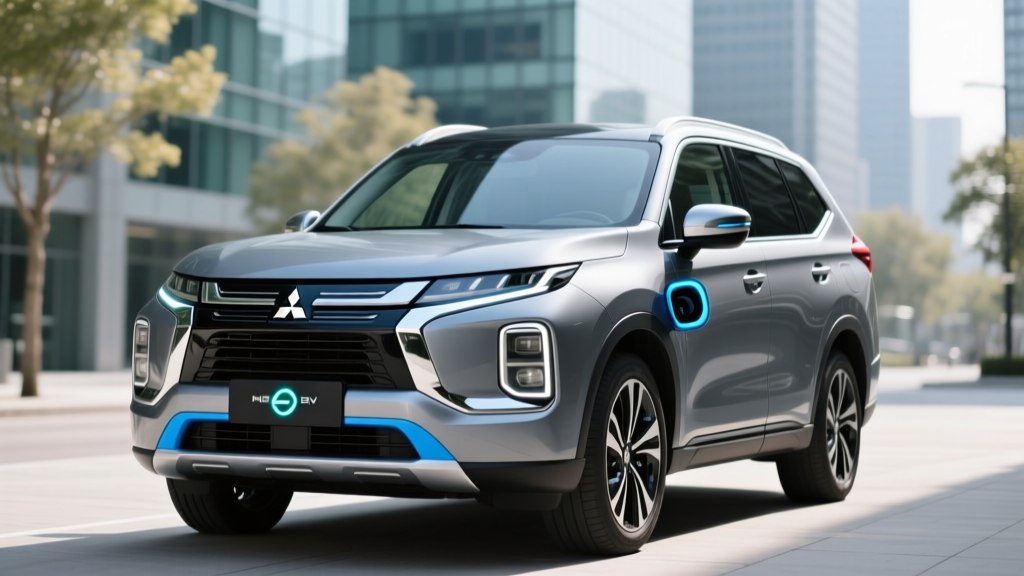
The 2022 Mitsubishi Outlander PHEV occupies a specific niche: it is one of the most affordable plug-in hybrid SUVs on the used market, and it remains one of the very few PHEVs in its class with DC fast-charging capability. If you are shopping the secondhand market in 2026 and want electric commuting without full range-anxiety on road trips, this generation of the Outlander PHEV demands a close look — but it also carries real trade-offs in power, refinement, and interior quality that buyers should weigh carefully.
This guide covers the 2022 model year specifically — the final year of the first-generation Outlander PHEV before the redesigned 2023+ model arrived with a larger battery, more power, and an updated interior. We will break down exact EPA figures, real-world efficiency, charging logistics, battery longevity, and whether this PHEV still qualifies for any federal tax incentives when purchased used.
HEV vs PHEV: What the Outlander PHEV Actually Is
Before evaluating the Outlander, it is worth clarifying the distinction between a conventional hybrid (HEV) and a plug-in hybrid (PHEV), because the ownership experience differs substantially.
Conventional Hybrid (HEV)
- Battery: small (1–2 kWh), recharged only by regenerative braking and the engine
- Electric-only driving: minimal (under 1 mile at low speeds, if at all)
- Plug-in charging: not required or possible
- Example: Toyota RAV4 Hybrid
Plug-In Hybrid (PHEV)
- Battery: larger (10–20+ kWh), charged via plug or engine/regen
- Electric-only driving: meaningful range (typically 20–40+ miles)
- Plug-in charging: recommended to maximize electric driving; operates as a hybrid when battery is depleted
- Example: 2022 Mitsubishi Outlander PHEV
The 2022 Outlander PHEV is a PHEV. You do not have to plug it in — it will function as a conventional hybrid if you never charge it — but doing so unlocks its 24-mile electric-only range and its 74 MPGe combined efficiency rating. Owners who skip plugging in will see fuel economy closer to a standard hybrid, roughly 25–26 MPG combined.
EPA Fuel Economy and Electric-Only Range
The EPA rates the 2022 Mitsubishi Outlander PHEV with two distinct figures: an MPGe rating for charge-sustaining + charge-depleting operation combined, and a gasoline-only MPG figure for when the battery is depleted.
| Metric | EPA Rating |
|---|---|
| Combined MPGe (gas + electric) | 74 MPGe |
| Combined MPG (gas-only, battery depleted) | 26 MPG |
| City MPG (gas-only) | 25 MPG |
| Highway MPG (gas-only) | 27 MPG |
| Electric-only range | 24 miles |
| Total combined range (gas + electric) | 318 miles |
| Fuel tank capacity | 11.3 gallons |
Source: EPA Fuel Economy Guide — 2022 Mitsubishi Outlander PHEV
Real-World MPG vs EPA Estimates
In real-world driving, the Outlander PHEV's gas-only MPG tends to align closely with its EPA rating, hovering around 25–27 MPG in mixed driving when the battery is depleted. Highway cruising at 70+ mph can drop this to 23–24 MPG given the vehicle's boxy aerodynamics and 4,200-pound curb weight. City driving with frequent regenerative braking opportunities may push it slightly above the EPA city estimate to 27–28 MPG.
The 24-mile electric-only range is achievable in moderate temperatures (55–80°F) at speeds under 45 mph. In cold weather (below 32°F), expect electric range to drop to 16–19 miles due to cabin heating demands and reduced battery efficiency. Highway-speed electric driving at 70 mph will also deplete the battery faster, yielding roughly 18–20 miles.
Battery, Charging, and the DC Fast-Charging Advantage
The 2022 Outlander PHEV uses a 13.8 kWh lithium-ion battery pack (gross capacity). Usable capacity is approximately 10.5 kWh, as the system maintains a buffer to protect long-term battery health.
| Charging Level | Power | Time (0–100%) | Connector |
|---|---|---|---|
| Level 1 (120V household outlet) | ~1.4 kW | ~8 hours | J1772 |
| Level 2 (240V home/public) | ~3.7 kW (max onboard charger) | ~3.5 hours | J1772 |
| DC Fast Charge (CHAdeMO) | Up to 22 kW | ~25 min (0–80%) | CHAdeMO |
The Outlander PHEV's DC fast-charging capability via CHAdeMO is a standout feature. Very few PHEVs offer DC fast charging at all, and among 2022-model competitors — the Toyota RAV4 Prime, Hyundai Tucson PHEV, Kia Sorento PHEV — none include it. This means you can add roughly 15–18 miles of electric range in a 20-minute stop at a compatible CHAdeMO station.
However, there is a significant caveat for 2026 buyers: the CHAdeMO network has been shrinking as the industry standardized on CCS and NACS. Electrify America has largely transitioned to CCS/NACS-only stalls, and new CHAdeMO installations are rare. Check your local charging infrastructure via PlugShare or ChargeHub before counting on DC fast charging as a regular feature.
Powertrain: Engine, Motors, and Combined Output
The 2022 Outlander PHEV pairs a 2.4-liter Atkinson-cycle four-cylinder gasoline engine with twin electric motors — one on each axle — providing standard all-wheel drive.
| Component | Specification |
|---|---|
| Gasoline engine | 2.4L 4-cyl Atkinson cycle |
| Engine horsepower | 126 hp |
| Front electric motor | 80 hp (60 kW) |
| Rear electric motor | 94 hp (70 kW) |
| Combined system output | 221 hp |
| Drivetrain | AWD (twin-motor, no mechanical link to rear) |
| 0–60 mph | ~7.4 seconds |
| Towing capacity | 1,500 lbs |
The twin-motor AWD system is fully electric at the rear axle — there is no driveshaft connecting the engine to the rear wheels. This provides responsive torque vectoring and competent traction in snow and rain, though the 1,500-pound towing limit is modest compared to the RAV4 Prime's 1,750-pound rating.
Driving modes include EV (pure electric), Series Hybrid (engine generates electricity for the motors), and Parallel Hybrid (engine and front motor drive the wheels directly at highway speeds). The system manages these transitions automatically, though you can manually select EV mode for quiet, zero-emission neighborhood driving.
Reliability, Battery Warranty, and Replacement Cost
Battery & Powertrain Warranty
- Hybrid/EV battery warranty: 10 years / 100,000 miles (capacity retention above ~70%)
- Powertrain warranty: 10 years / 100,000 miles
- Basic vehicle warranty: 5 years / 60,000 miles
Note: For second owners, Mitsubishi's 10-year/100,000-mile powertrain and battery warranty typically transfers, but confirm with a Mitsubishi dealer using the VIN.
Mitsubishi's hybrid system in this generation has proven reliable. The Outlander PHEV has been sold globally since 2013 (with updates), and the powertrain architecture is well-established. Common complaints on owner forums center on infotainment sluggishness, interior material quality, and road noise — not hybrid-system failures.
If a battery replacement were needed outside of warranty, estimates for the 13.8 kWh pack range from $4,000 to $7,000 including labor, based on dealer parts pricing and independent hybrid-shop quotes. However, PHEV batteries of this size experience less thermal stress than full EV packs, and Mitsubishi's conservative buffer management means most units retain 85–90% capacity at 100,000 miles.
For reference, NHTSA has no open battery-related recalls specific to the 2022 Outlander PHEV as of early 2026.
Used Pricing and Federal Tax Credit Eligibility in 2026
When new, the 2022 Outlander PHEV started at approximately $38,000 (SEL trim) and topped out near $45,000 (GT-Premium). In the 2026 used market, expect pricing in the following ranges:
| Trim | Original MSRP | Estimated Used Price (2026) |
|---|---|---|
| SEL | ~$38,000 | $22,000–$26,000 |
| SEL Touring | ~$40,500 | $24,000–$28,000 |
| GT | ~$42,500 | $26,000–$30,000 |
| GT-Premium | ~$45,000 | $28,000–$33,000 |
Does It Qualify for a Tax Credit?
The 2022 Outlander PHEV did qualify for the full $7,500 federal tax credit under §30D when purchased new, provided the buyer met income thresholds. However, buying one used in 2026 falls under the Previously Owned Clean Vehicle Credit (§25E), which has different rules:
- Credit amount: Up to $4,000 or 30% of the sale price, whichever is less
- Maximum sale price cap: $25,000
- Buyer income cap: $75,000 single / $112,500 head of household / $150,000 married filing jointly
- Vehicle age requirement: Must be at least 2 model years old (2022 qualifies in 2026)
- Battery capacity: Must be at least 7 kWh (Outlander PHEV's 13.8 kWh qualifies)
- Dealer requirement: Must be purchased from a licensed dealer, not a private party
- Point-of-sale transfer: Available — credit can reduce the purchase price at the dealership
The $25,000 sale price cap is the critical constraint. SEL and SEL Touring trims may fall at or just under this cap, making them eligible for the full $4,000 credit. GT and GT-Premium trims selling above $25,000 would not qualify. Always verify current rules via the IRS §25E page and consult a tax professional before finalizing a purchase.
Outlander PHEV vs Full EV vs Conventional Hybrid: Which Fits You?
The right choice depends on your driving pattern, charging access, and road-trip frequency.
Choose the 2022 Outlander PHEV if:
- Your daily commute is under 25 miles round-trip and you can charge at home (Level 1 or 2)
- You take road trips where charging infrastructure is sparse or unreliable
- You want AWD for snow/rain but do not need serious towing capacity
- You want to spend $22,000–$28,000 on a used electrified SUV
Choose a full EV (e.g., used Tesla Model Y, Hyundai Ioniq 5) if:
- You have reliable home Level 2 charging
- Your daily driving is under 200 miles and you road-trip along well-served corridors
- You want zero maintenance on engine components (no oil, spark plugs, transmission fluid)
- You prioritize acceleration and driving refinement
Choose a conventional hybrid (e.g., Toyota RAV4 Hybrid) if:
- You cannot charge at home or at work
- You want maximum simplicity — no plugs, no battery-management decisions
- You want higher MPG in gas-only operation (RAV4 Hybrid achieves 40 MPG combined)
Pros and Cons
Pros
- DC fast charging (CHAdeMO) — rare in the PHEV segment
- Standard AWD with twin electric motors
- Affordable used pricing; potential $4,000 used-EV credit
- 10-year/100,000-mile battery and powertrain warranty
- 24-mile electric range covers most daily commutes
- V2L (vehicle-to-load) capability — can power small appliances via 120V outlet
Cons
- Modest 221 hp; acceleration feels leisurely for a 4,200-lb SUV
- Gas-only MPG of 26 combined is unimpressive vs RAV4 Hybrid's 40 MPG
- CHAdeMO network shrinking — DC fast charging may be impractical in some areas
- Dated interior materials and infotainment vs 2023+ redesign
- 1,500-lb towing capacity limits utility
- Only 24 miles of electric range; competitors like RAV4 Prime offer 42 miles
Frequently Asked Questions
How many MPG does the 2022 Mitsubishi Outlander PHEV get?
The EPA rates it at 74 MPGe combined when factoring in electric driving, and 26 MPG combined (25 city / 27 highway) when running on gasoline alone with a depleted battery. Real-world gas-only driving typically yields 25–27 MPG in mixed conditions, with highway cruising at 70+ mph dropping to around 23–24 MPG.
How far can the 2022 Outlander PHEV go on electric only?
The EPA rates it at 24 miles of electric-only range. In real-world moderate-temperature city driving, expect 22–24 miles. Highway speeds and cold weather reduce this to 16–20 miles. The total combined range (electric + 11.3-gallon fuel tank) is rated at 318 miles.
Is the 2022 Outlander PHEV reliable, and what does battery replacement cost?
The Outlander PHEV's hybrid system has a strong reliability record globally since the platform launched in 2013. The battery and powertrain are covered by a 10-year/100,000-mile warranty. Out-of-warranty battery replacement is estimated at $4,000–$7,000, though most PHEV batteries of this size retain 85–90% capacity at high mileage due to conservative buffer management.
Does the 2022 Outlander PHEV qualify for any tax credit in 2026?
As a used vehicle, it may qualify for the Previously Owned Clean Vehicle Credit (§25E) of up to $4,000, provided the sale price is $25,000 or less, the buyer's income is within limits ($75K single / $150K married), and the purchase is made through a licensed dealer. Higher trims selling above $25,000 would not qualify. Always verify current rules at IRS.gov.
Can I charge the Outlander PHEV at home with a regular outlet?
Yes. Level 1 charging on a standard 120V household outlet will fully recharge the battery in approximately 8 hours, which works well for overnight charging. A 240V Level 2 charger reduces this to about 3.5 hours. Given the 13.8 kWh battery (roughly 10.5 kWh usable), even Level 1 is practical for daily top-ups.
How does the Outlander PHEV compare to the Toyota RAV4 Prime?
The RAV4 Prime offers significantly more electric range (42 miles vs 24), more combined power (302 hp vs 221 hp), and better gas-only fuel economy (38 MPG vs 26 MPG). However, the RAV4 Prime commands a substantial price premium on the used market ($35,000–$42,000 vs $22,000–$30,000 for the Outlander) and does not offer DC fast charging. The Outlander PHEV is the budget-conscious choice; the RAV4 Prime is the performance-and-range choice.