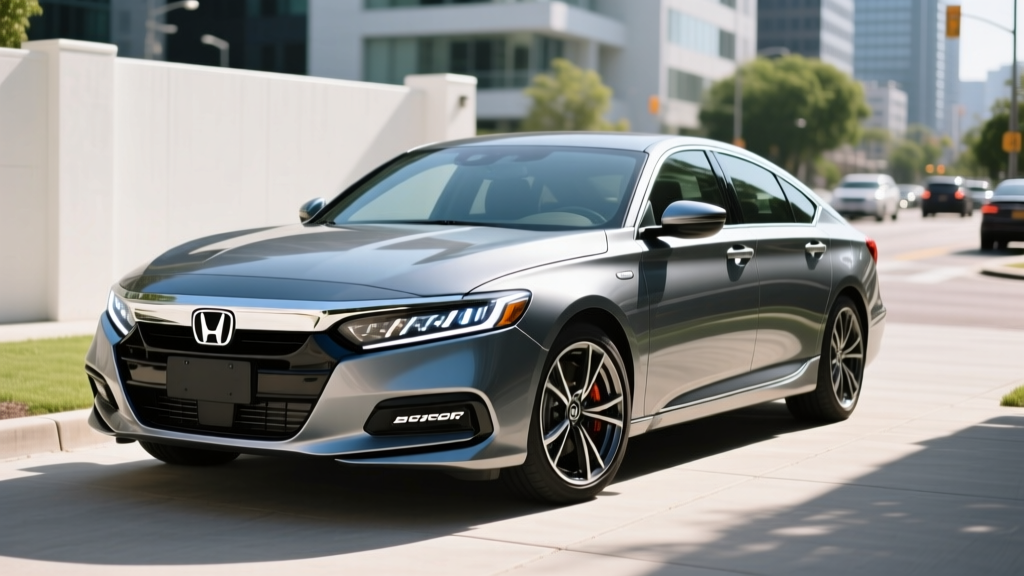
The midsize hybrid sedan segment is crowded, but the 2022 Honda Accord Hybrid Sport carved out a distinct niche before Honda restructured the Accord lineup for 2023. With its 48 MPG EPA combined rating, sport-tuned suspension, and a two-motor hybrid system that prioritizes electric propulsion, the Sport trim was the enthusiast-adjacent pick in Honda's hybrid stable. If you're shopping the used market or evaluating whether this generation still holds up in 2026, this guide covers every number that matters.
This is a conventional hybrid (HEV) — not a plug-in. You never plug it in. The gasoline engine and regenerative braking recharge the small lithium-ion battery automatically. That distinction matters because buyers sometimes confuse HEVs with plug-in hybrids (PHEVs) that offer 20–40 miles of electric-only range. The Accord Hybrid does not offer that; instead, it delivers consistently high MPG across all driving conditions without any change to your fueling routine.
HEV vs PHEV vs EV: Where the Accord Hybrid Fits
Before diving into specs, it's worth clarifying the three electrified powertrain types so you can decide which fits your lifestyle:
| Feature | HEV (Accord Hybrid) | PHEV (e.g., Toyota Prius Prime) | BEV (e.g., Tesla Model 3) |
|---|---|---|---|
| Plug in to charge? | No | Yes (optional) | Yes (required) |
| Electric-only range | ~1 mile at low speed | 25–44 miles typical | 250–360+ miles |
| Fuel/energy source | Gasoline only | Gasoline + electricity | Electricity only |
| EPA MPG / MPGe | 48 MPG combined | 48–52 MPG + 114–127 MPGe | 120–140 MPGe |
| Battery size | ~1.3 kWh | 13.6–18.1 kWh | 50–82 kWh |
| Home charging install needed? | No | Recommended (Level 2) | Yes (Level 2 strongly recommended) |
| Federal tax credit (§30D) | Not eligible | Up to $7,500 (if eligible) | Up to $7,500 (if eligible) |
Choose the Accord Hybrid (HEV) if: you want maximum MPG with zero lifestyle change — no plug, no charging apps, no range planning. It's the simplest path to cutting fuel costs by 40–50% versus a comparable gas-only midsize sedan.
Consider a PHEV if: you have home charging access and a short commute (under 30 miles each way) that could be fully electric, plus the ability to take longer gas-powered road trips.
Go full BEV if: you have reliable home or workplace Level 2 charging, want to eliminate gasoline entirely, and are ready to plan around DC fast charging on road trips.
Fuel Economy: EPA Ratings and Real-World MPG
The 2022 Accord Hybrid Sport carries the following EPA-estimated fuel economy:
| Driving Cycle | EPA Estimate | Real-World Expectation |
|---|---|---|
| City | 48 MPG | 46–52 MPG (hybrids often beat EPA in stop-and-go) |
| Highway | 47 MPG | 42–46 MPG (aerodynamic drag and sustained speed reduce hybrid advantage) |
| Combined | 48 MPG | 44–49 MPG depending on driving mix |
Honda's two-motor hybrid system is one of the most efficient in the segment because it operates primarily as a series hybrid at low and moderate speeds — the gasoline engine acts as a generator, and the electric drive motor turns the wheels. Only at sustained highway cruising does the engine mechanically connect to the wheels via a lock-up clutch. This architecture is why the city and highway numbers are nearly identical, unlike conventional automatics that suffer in stop-and-go traffic.
Real-World Range Estimate: With a 12.8-gallon fuel tank and an observed 45 MPG combined, expect roughly 575 miles per tank in mixed driving. In cold weather (below 30°F), expect a 5–10% reduction — roughly 520–540 miles — as the engine runs more frequently to provide cabin heat and the battery's efficiency drops.
Powertrain: Two-Motor Hybrid System Explained
The 2022 Accord Hybrid Sport uses Honda's third-generation two-motor hybrid powertrain. Here are the exact figures:
| Specification | Value |
|---|---|
| Engine | 2.0L Atkinson-cycle inline-4 |
| Engine horsepower | 143 hp @ 6,200 rpm |
| Engine torque | 129 lb-ft @ 3,500 rpm |
| Drive motor output | 181 hp / 232 lb-ft |
| Combined system horsepower | 212 hp |
| Transmission | Electronic CVT (e-CVT, no fixed gears) |
| Drivetrain | Front-wheel drive |
| 0–60 mph | ~7.1 seconds |
| Battery type | Lithium-ion (Li-ion) |
| Battery capacity | ~1.3 kWh (gross) |
| Curb weight | ~3,465 lbs |
The combined 212 hp figure is not simply the engine plus motor added together — Honda calculates the peak system output at the point where both power sources contribute maximally. The electric motor's 232 lb-ft of torque is available from near-zero RPM, which gives the Accord Hybrid strong initial acceleration that feels punchier than the 0–60 time suggests.
The Sport trim specifically added paddle shifters that simulate stepped gear ratios through the e-CVT, along with a slightly firmer suspension tune and 19-inch alloy wheels. The larger wheels cost roughly 1 MPG versus the smaller wheels on the Hybrid EX-L, a trade-off most Sport buyers accepted for the sharper appearance.
Battery Warranty, Lifespan, and Replacement Cost
Hybrid battery longevity is the number one concern for used-hybrid shoppers, and Honda's coverage is among the best in the industry.
Honda Hybrid Battery Warranty (2022 model year):
- Standard states: 8 years / 100,000 miles
- CARB states (CA, CT, ME, MD, MA, NJ, NY, OR, RI, VT, WA): 10 years / 150,000 miles
- Hybrid system components (inverter, motor, control unit): 8 years / 100,000 miles (all states)
In practice, Honda's lithium-ion hybrid batteries have proven durable. Unlike early nickel-metal-hydride (NiMH) packs in first-generation hybrids, modern Li-ion cells with active thermal management rarely require full replacement before 150,000–200,000 miles. That said, individual cell degradation can occur.
Battery replacement cost: If the hybrid battery fails out of warranty, a new OEM replacement from Honda runs approximately $2,000–$4,000 including labor at a dealership. Independent hybrid specialists and refurbished cell options can reduce this to $1,500–$2,500. This is significantly cheaper than full EV battery replacements, which can exceed $10,000, because the Accord Hybrid's ~1.3 kWh pack is a fraction of the size.
Maximizing battery life: The hybrid system automatically manages the battery's state of charge between roughly 40% and 80%, never allowing a full 0% or 100% state — this buffer significantly extends cycle life. There is no maintenance action required from the owner beyond normal driving.
Does the 2022 Accord Hybrid Qualify for a Tax Credit?
No. The 2022 Honda Accord Hybrid is a conventional hybrid (HEV) and does not qualify for the federal §30D new clean vehicle credit, which requires a plug-in electric vehicle with a minimum battery capacity of 7 kWh. Since the Accord Hybrid's battery is approximately 1.3 kWh and the vehicle cannot be plugged in, it is ineligible.
Under current IRS §30D rules, only plug-in hybrids (PHEVs) and battery electric vehicles (BEVs) meeting battery sourcing, critical minerals, MSRP caps, and buyer income limits can receive the credit. The Accord Hybrid Sport's original MSRP of $32,810 would have been within any applicable cap, but the powertrain type disqualifies it entirely.
State incentives: A handful of states have offered rebates for high-efficiency hybrids in the past, but most have shifted incentive budgets exclusively to PHEVs and BEVs. Check your state's energy office or DMV for any residual programs, but do not count on a credit for this model.
Pricing, Trims, and Used Market Value in 2026
When new, the 2022 Accord Hybrid Sport carried an MSRP of $32,810 (including destination). It sat between the Hybrid EX-L ($33,210) and the Hybrid Touring ($37,190) in the lineup.
As of early 2026, used-market pricing for the 2022 Accord Hybrid Sport with 30,000–60,000 miles typically ranges from $22,000 to $27,000 depending on condition, mileage, and region. Well-maintained examples with under 40,000 miles and clean title history command the upper end of that range.
Cost-per-mile fuel comparison:
| Vehicle | Combined MPG | Cost per Mile (at $3.50/gal) |
|---|---|---|
| 2022 Accord Hybrid Sport | 48 MPG | $0.073 |
| 2022 Accord 1.5T (gas) | 33 MPG | $0.106 |
| 2022 Toyota Camry V6 | 26 MPG | $0.135 |
At 15,000 miles per year, the Accord Hybrid saves roughly $500–$930 annually in fuel versus the gas-only Accord and comparable V6 midsize sedans. Over a 5-year ownership period, that's $2,500–$4,650 in fuel savings — a meaningful offset to any used-market premium over the gas model.
Pros, Cons, and Who Should Buy
Pros
- 48 MPG combined with no plug-in requirement — effortless efficiency
- 212 hp provides confident passing power and strong low-end torque
- Spacious cabin with 16.7 cu ft trunk (only 0.4 cu ft less than gas model)
- Honda Sensing suite standard (adaptive cruise, lane-keeping, automatic emergency braking)
- Proven reliability with 8yr/100k-mi hybrid battery warranty
- 575+ mile range per tank reduces fuel stop frequency
Cons
- No electric-only driving beyond very low-speed creeping (~1 mile)
- No federal tax credit eligibility
- e-CVT drone under hard acceleration (simulated steps help but don't eliminate)
- Sport trim's 19-inch wheels add road noise on rough pavement
- Discontinued after 2022 — 2023+ Accord Hybrid has updated styling and tech
- No all-wheel-drive option (unlike Toyota Camry Hybrid)
Who should buy the 2022 Accord Hybrid Sport: Commuters covering 20,000+ miles per year who want to minimize fuel costs without altering their routine. Ride-share drivers who need rear-seat space and high MPG. Buyers in states without robust charging infrastructure who aren't ready for a PHEV or BEV. Anyone who values Honda's long-standing hybrid reliability record.
Who should look elsewhere: Apartment dwellers with short commutes who could benefit from a PHEV's electric-only mode (if they have workplace charging). Buyers who want AWD for snow-belt climates (consider the Toyota Camry Hybrid AWD or a Subaru Crosstrek Hybrid). Shoppers wanting the latest infotainment — the 2023+ Accord redesign brought a significantly updated interior.
Frequently Asked Questions
How many MPG does the 2022 Honda Accord Hybrid Sport get?
The EPA rates it at 48 MPG city, 47 MPG highway, and 48 MPG combined. In real-world mixed driving, owners typically see 44–49 MPG. City driving often exceeds the EPA estimate because regenerative braking recaptures energy in stop-and-go conditions.
Can the Accord Hybrid drive on electric power alone?
Only at very low speeds (under ~25 mph) for roughly one mile if the battery is sufficiently charged. This is not a plug-in hybrid — the electric-only capability is a byproduct of the hybrid system's efficiency, not a designed EV mode. For meaningful electric-only range, you need a PHEV like the Toyota Prius Prime (44 miles) or a full BEV.
Is the 2022 Accord Hybrid reliable?
Honda's hybrid system has a strong reliability record. The two-motor architecture has fewer wear components than a conventional automatic transmission — there are no traditional gear sets or torque converters to fail. NHTSA gave the 2022 Accord a 5-star overall safety rating, and the IIHS named it a Top Safety Pick+. The hybrid battery is warranted for 8 years/100,000 miles (10 years/150,000 in CARB states).
What does it cost to replace the hybrid battery?
An OEM replacement battery from Honda costs approximately $2,000–$4,000 including dealer labor. Independent hybrid shops can perform the replacement for $1,500–$2,500 using refurbished or aftermarket cells. Given the battery's typical 150,000–200,000+ mile lifespan, most original owners will never face this expense.
Does the 2022 Accord Hybrid Sport qualify for any federal tax credit?
No. The federal §30D clean vehicle credit requires a plug-in vehicle with at least 7 kWh of battery capacity. The Accord Hybrid is a conventional HEV with a ~1.3 kWh battery and no plug-in capability. It does not qualify for the federal credit or most state EV incentives. The IRS page on clean vehicle credits details which vehicle types are eligible.
How does the Accord Hybrid compare to the Toyota Camry Hybrid?
The 2022 Camry Hybrid SE is rated at 44 MPG combined (46 city/39 highway with the LE trim at 52 combined), slightly less than the Accord Hybrid's 48 combined in the Sport trim. However, the Camry Hybrid offers available AWD — a significant advantage in snow climates. The Accord Hybrid has more rear legroom (40.8 vs 38.0 inches) and more trunk space (16.7 vs 15.1 cu ft). Both are excellent choices; the Accord wins on space and highway comfort, the Camry wins on AWD availability and slightly lower starting price.