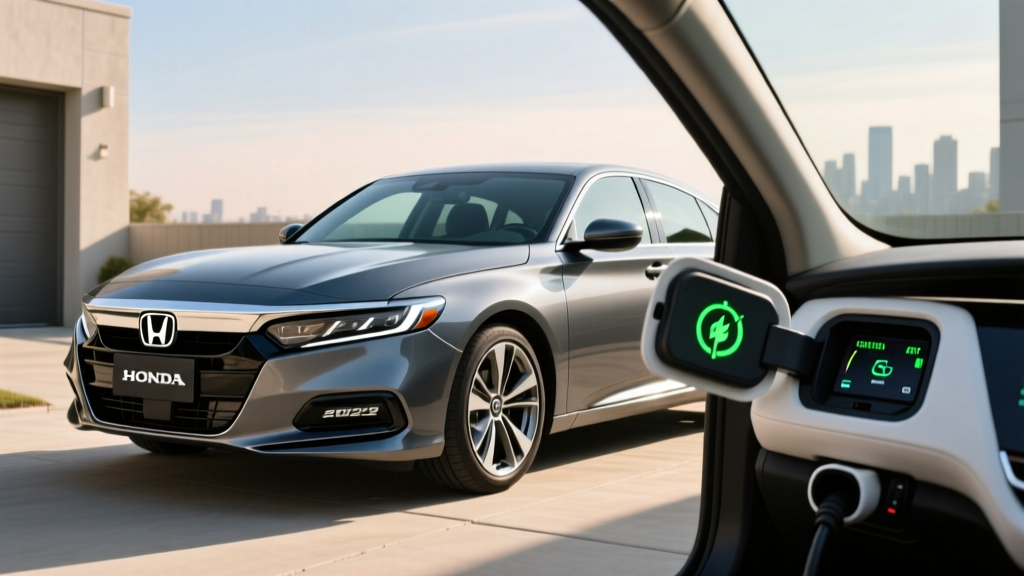
The 2022 Honda Accord Hybrid remains one of the most efficient midsize sedans on the used market in 2026, and for good reason. With an EPA-estimated 48 MPG combined, a proven two-motor hybrid powertrain, and Honda's long-standing hybrid battery warranty, it occupies a specific niche: drivers who want EV-like city efficiency without ever plugging in. This guide breaks down every number that matters — EPA and real-world fuel economy, powertrain specs, battery longevity, ownership costs, and whether this conventional hybrid (HEV) or a plug-in alternative better fits your driving life.
2022 Honda Accord Hybrid MPG: The Official EPA Numbers
The 2022 Accord Hybrid uses Honda's third-generation two-motor hybrid system paired with a 2.0-liter Atkinson-cycle four-cylinder engine. The EPA rates it across three trims (EX-L, Sport, Touring) with slight variations due to wheel size and equipment weight.
| Trim | City MPG | Highway MPG | Combined MPG | Fuel Tank (gal) | EPA Total Range (mi) |
|---|---|---|---|---|---|
| EX-L | 48 | 47 | 48 | 12.8 | ~614 |
| Sport | 44 | 41 | 43 | 12.8 | ~550 |
| Touring | 44 | 41 | 43 | 12.8 | ~550 |
The EX-L's higher rating comes from its lighter 17-inch wheels and lower accessory load. The Sport and Touring trims ride on 19-inch wheels and carry more standard equipment, dropping efficiency by roughly 5 MPG combined. This is a meaningful difference if fuel economy is your primary purchase driver — the EX-L is the efficiency pick.
How the Accord Hybrid Powertrain Works (HEV, Not PHEV)
A critical distinction for shoppers cross-researching electrified vehicles: the 2022 Accord Hybrid is a conventional hybrid electric vehicle (HEV), not a plug-in hybrid (PHEV). It cannot be plugged in, has no electric-only driving range to speak of, and charges its small battery entirely through regenerative braking and the gasoline engine.
| Specification | Detail |
|---|---|
| Powertrain Type | Conventional Hybrid (HEV) — no plug |
| Engine | 2.0L Atkinson-cycle inline-4 |
| Engine Output | 143 hp / 129 lb-ft torque |
| Electric Motors | Two-motor system (propulsion + generator) |
| Electric Motor Output | 184 hp / 232 lb-ft torque |
| Combined System Output | 212 hp |
| Transmission | e-CVT (no traditional gears) |
| Drivetrain | Front-wheel drive |
| Hybrid Battery | ~1.3 kWh lithium-ion (not plug-accessible) |
| 0–60 MPH | ~7.1 seconds |
Honda's hybrid system operates primarily as a series hybrid at city speeds — the gasoline engine acts as a generator, and the electric propulsion motor drives the wheels. At highway speeds, a lock-up clutch connects the engine directly to the wheels for efficiency. This architecture explains the Accord Hybrid's excellent city MPG: the electric motor handles the stop-and-go work where gasoline engines are least efficient.
Conventional Hybrid (HEV): No plug. Small battery (~1–2 kWh). Charges via regen braking and engine. Better MPG than gas. Examples: Accord Hybrid, Toyota Camry Hybrid.
Plug-In Hybrid (PHEV): Plugs into a wall or charger. Larger battery (8–20+ kWh). 20–45 miles of electric-only range before the gas engine kicks in. Examples: Toyota RAV4 Prime, Chrysler Pacifica Hybrid.
Battery Electric (BEV): No gas engine. Large battery (50–100+ kWh). 200–400+ miles of range. Must be charged. Examples: Tesla Model 3, Hyundai Ioniq 5.
The 2022 Accord Hybrid is an HEV. Honda did not offer a plug-in Accord in the US market for this model year.
Real-World Ownership: MPG, Maintenance, and Running Costs
Beyond the EPA sticker, what does Accord Hybrid ownership actually cost in 2026? Here's a practical breakdown based on aggregated owner data and current fuel pricing.
| Category | Annual Estimate | Notes |
|---|---|---|
| Fuel (15,000 mi/yr) | $1,060 | 48 MPG combined, $3.40/gal regular |
| Insurance | $1,500–$1,900 | Varies by state, age, driving record |
| Maintenance | $400–$600 | Oil changes, tire rotation, brake inspection |
| Estimated Total | $2,960–$3,560 | Excludes depreciation, financing |
One maintenance advantage of Honda's hybrid system: regenerative braking significantly reduces brake pad wear. Many owners report original brake pads lasting 70,000–100,000 miles. The engine also cycles off at stops and during low-load driving, reducing overall engine wear and oil degradation compared to a conventional gasoline Accord.
Battery Warranty, Lifespan, and Replacement Cost
The hybrid battery is the single biggest concern for used hybrid buyers. Here's what you need to know about the 2022 Accord Hybrid's battery longevity.
• Federal emissions/hybrid battery warranty: 8 years / 80,000 miles (whichever comes first)
• CARB-state warranty (CA, CT, ME, MD, MA, NJ, NY, OR, RI, VT, WA): 10 years / 150,000 miles
• Warranty covers battery capacity loss below a functional threshold and complete failure
• For a 2022 model, federal warranty expires in 2030; CARB-state warranty expires in 2032
Honda's hybrid battery in the Accord is a ~1.3 kWh lithium-ion pack. Because it's a conventional hybrid, the battery operates in a narrow state-of-charge window (roughly 20–80%), which significantly reduces degradation compared to a full EV battery that cycles through deeper ranges. Real-world data from earlier-generation Accord and Civic Hybrids suggests these packs routinely last 150,000–200,000+ miles before capacity loss becomes noticeable.
Replacement cost if out of warranty: A new OEM Honda Accord Hybrid battery pack costs approximately $2,000–$4,000 including labor as of 2026. Third-party refurbished packs are available for $1,200–$2,000. Individual cell replacement (if only one module fails) can reduce costs further. This is substantially less than EV battery replacement, which can exceed $10,000–$20,000.
2022 Accord Hybrid Pricing and Tax Credit Eligibility in 2026
The 2022 Accord Hybrid is available exclusively on the used market. Original MSRPs at launch were:
| Trim | Original MSRP | Approximate Used Price (2026) |
|---|---|---|
| EX-L | $32,870 | $20,000–$24,000 |
| Sport | $33,870 | $21,000–$25,000 |
| Touring | $37,070 | $23,000–$27,000 |
Federal tax credit: The 2022 Accord Hybrid does not qualify for the IRS §30D new clean vehicle credit — it is a conventional hybrid, not a plug-in, and the vehicle is no longer new. However, if you purchase one from a dealer, there is no federal used-EV credit available either, as the §25E used clean vehicle credit applies only to plug-in EVs and fuel cell vehicles with at least 4 kWh of battery capacity that are charged from an external source. The Accord Hybrid's ~1.3 kWh battery and non-plug architecture disqualify it.
Some states offer separate incentives for hybrid purchases, though most have shifted incentives toward PHEVs and BEVs. Check your state's energy office or Alternative Fuels Data Center for current local programs.
Accord Hybrid vs. the Competition: How Does It Compare?
The midsize hybrid sedan segment has strong alternatives. Here's how the 2022 Accord Hybrid stacks up against its direct rivals on EPA fuel economy.
| Vehicle | City | Highway | Combined | System HP | Hybrid Type |
|---|---|---|---|---|---|
| Honda Accord Hybrid (EX-L) | 48 | 47 | 48 | 212 | HEV |
| Toyota Camry Hybrid (LE) | 51 | 53 | 52 | 208 | HEV |
| Hyundai Sonata Hybrid (Blue) | 50 | 54 | 52 | 192 | HEV |
| Toyota Camry Hybrid (SE/XLE) | 44 | 47 | 46 | 208 | HEV |
The Camry Hybrid LE and Sonata Hybrid Blue edge out the Accord on pure EPA numbers, but the Accord Hybrid counters with a more spacious rear seat (40.8 inches of legroom), a larger trunk (16.7 cubic feet), and a more refined driving feel at highway speeds. The Accord's 212 combined horsepower also gives it a slight acceleration advantage over the Sonata Hybrid. If you prioritize maximum MPG above all else, the Camry Hybrid LE wins. If you want the best blend of space, power, and efficiency, the Accord Hybrid holds its own.
- Excellent real-world city MPG (often exceeds EPA)
- Spacious cabin with best-in-class rear legroom
- Smooth, quiet hybrid powertrain with 212 hp
- Strong reliability record and long battery warranty
- Low brake wear from regenerative braking
- No charging infrastructure needed
- Sport/Touring trims drop to 43 MPG combined
- No all-wheel-drive option (Camry Hybrid offers AWD)
- Not eligible for any federal tax credits
- No plug-in variant available in the US
- e-CVT drone under hard acceleration
- Infotainment shows age vs. 2025+ competitors
Who Should Choose the Accord Hybrid vs. a PHEV or Full EV?
Choose the Accord Hybrid (HEV) if:
- You cannot charge at home (apartment, street parking, no garage)
- You want zero behavior change — just fill up with gas and go
- Your commute is mixed city/highway and under 60 miles round-trip
- You want a proven, reliable sedan with low maintenance costs
- Budget is a priority — used HEVs cost significantly less than PHEVs or EVs
- You can install a Level 2 charger at home
- Your daily commute is under 40 miles (within electric-only range)
- You want electric driving for daily trips but gas flexibility for road trips
- You want to qualify for the §30D federal tax credit (up to $7,500 for new PHEVs meeting sourcing and income requirements per IRS rules)
- You have reliable home charging and your daily driving is under 250 miles
- You want the lowest per-mile fuel cost (electricity is typically $0.03–$0.05/mile vs. $0.08–$0.12/mile for gas)
- You want zero tailpipe emissions and minimal maintenance (no oil changes, fewer moving parts)
- You're ready to plan around DC fast charging for road trips
Frequently Asked Questions
How many MPG does the 2022 Honda Accord Hybrid actually get?
The EPA rates the EX-L trim at 48 city / 47 highway / 48 combined MPG, and the Sport and Touring trims at 44/41/43 MPG. In real-world driving, owners commonly see 45–52 MPG in city and suburban conditions, with highway-only driving returning 38–42 MPG at speeds above 70 MPH.
Does the 2022 Accord Hybrid need to be plugged in?
No. The Accord Hybrid is a conventional hybrid (HEV). It charges its small battery through regenerative braking and the gasoline engine. There is no plug, no charging cable, and no electric-only driving range. You fuel it exclusively at gas stations.
Is the 2022 Accord Hybrid reliable?
Honda's two-motor hybrid system has been in production since 2014 (second-gen) and 2020 (third-gen in the Accord). It has a strong reliability track record with no widespread failure patterns. The hybrid battery is warrantied for 8 years/80,000 miles federally and 10 years/150,000 miles in CARB states. IIHS named the 2022 Accord a Top Safety Pick+.
How much does a Honda Accord Hybrid battery replacement cost?
Out-of-warranty replacement runs approximately $2,000–$4,000 for a new OEM pack, or $1,200–$2,000 for a refurbished unit. However, hybrid batteries in this generation typically last 150,000–200,000+ miles, and most will remain under warranty for years to come on a 2022 model.
Does the 2022 Accord Hybrid qualify for any tax credit?
No. As a conventional hybrid with no plug-in capability, it does not qualify for the federal §30D new vehicle credit or the §25E used EV credit. It is also no longer sold new. Some states may offer minor hybrid incentives — check your local programs via the Alternative Fuels Data Center.
Is the Accord Hybrid better than the gas-only Accord?
On fuel economy, decisively yes. The gas-only 2022 Accord 1.5T is rated at 30/38/33 MPG (city/highway/combined), making the Hybrid roughly 30–45% more efficient depending on trim. The Hybrid also produces more combined torque (232 lb-ft from the electric motor vs. 192 lb-ft from the 1.5T), giving it stronger low-speed acceleration. The trade-off is a higher purchase price on the used market and slightly less trunk space due to battery placement.