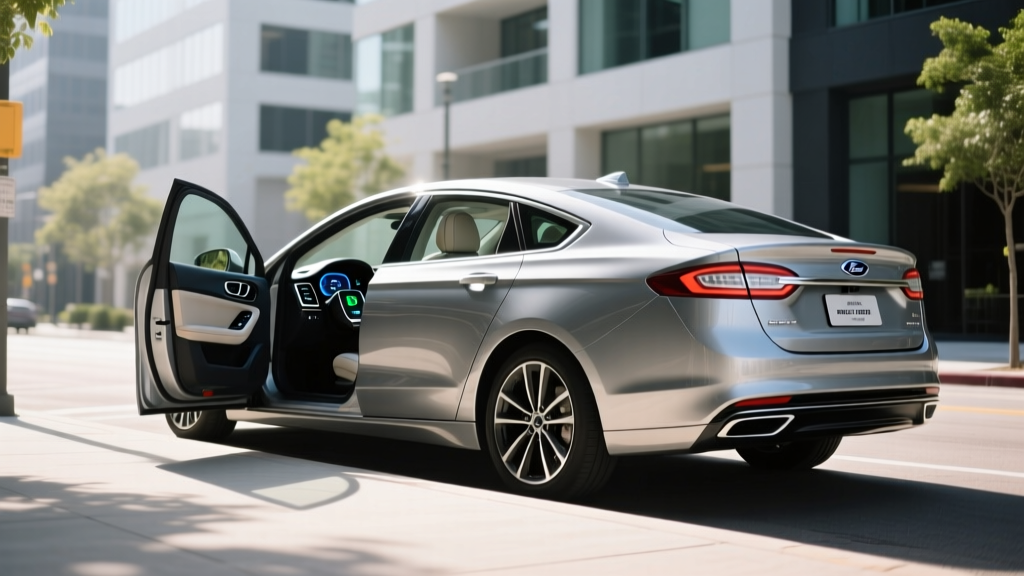
The Ford Fusion Hybrid was discontinued after the 2020 model year in the United States, which means there is no new 2022 Ford Fusion Hybrid from the factory. However, the 2020 model year remains the final and most refined version of this midsize hybrid sedan, and it continues to circulate heavily on the used market in 2026. For buyers searching for a "2022 Ford Fusion Hybrid," what you'll actually find are 2020 Fusion Hybrids (the last production year) listed on dealer lots and private-party sales — often with low mileage and plenty of battery life remaining.
This guide covers everything a used-car buyer needs to know about the final-generation Ford Fusion Hybrid: real-world MPG, the HEV vs. the Energi PHEV variant, battery longevity, reliability data, and how it stacks up against buying a new hybrid or full EV in 2026.
HEV vs. PHEV: Understanding the Two Fusion Hybrid Variants
Ford offered the final-generation Fusion in two electrified flavors, and confusing them is the most common mistake shoppers make. Here's the breakdown:
| Feature | Fusion Hybrid (HEV) | Fusion Energi (PHEV) |
|---|---|---|
| Powertrain Type | Conventional hybrid — no plug | Plug-in hybrid — charges via outlet |
| Electric-Only Range | N/A (electric assist only) | 26 miles (EPA) |
| Battery Capacity | 1.4 kWh (usable) | 7.6 kWh (usable) |
| Combined MPG / MPGe | 43 MPG combined | 103 MPGe (elec+gas) / 42 MPG (gas only) |
| Charging Required? | No — regenerative braking charges it | Yes — Level 1 or Level 2 |
| DC Fast Charging | No | No |
| Total Range | ~570 miles | ~610 miles (electric + gas) |
| Federal Tax Credit (New) | None | Expired — was up to $4,007 |
The conventional Fusion Hybrid (HEV) uses a small lithium-ion battery charged exclusively by the gasoline engine and regenerative braking. You never plug it in. It operates like a Toyota Camry Hybrid — the electric motor assists the gas engine at low speeds and during acceleration, reducing fuel consumption without any change to your refueling habits.
The Fusion Energi (PHEV) has a larger battery that you can plug in to charge, giving you roughly 26 miles of electric-only driving before the gas engine kicks in. Once the battery is depleted, it functions as a conventional hybrid at 42 MPG combined. The Energi is ideal for commuters with short round trips and access to home or workplace charging.
Fuel Economy: EPA Ratings and Real-World MPG
The 2020 Ford Fusion Hybrid (the final model year and closest equivalent to a "2022 Fusion Hybrid") carries the following EPA fuel economy ratings:
| Driving Cycle | Fusion Hybrid (HEV) | Fusion Energi (PHEV, gas-only mode) |
|---|---|---|
| City | 43 MPG | 43 MPG |
| Highway | 41 MPG | 41 MPG |
| Combined | 43 MPG | 42 MPG |
| MPGe (Energi, electric+gas) | N/A | 103 MPGe |
Real-World MPG Note: The Fusion Hybrid's Atkinson-cycle 2.0L engine and electric motor combination actually tends to exceed its EPA city rating in stop-and-go traffic, where regenerative braking recovers the most energy. Owners commonly report 45–48 MPG in city driving. Highway fuel economy is closer to the EPA sticker or slightly below (38–41 MPG) at sustained 70+ mph speeds, since the electric motor provides less benefit at constant high velocity. In cold weather (below 30°F), expect a 3–5 MPG drop due to increased engine idling for cabin heat and reduced battery efficiency.
Powertrain Specs: What's Under the Hood
| Specification | Fusion Hybrid (HEV) | Fusion Energi (PHEV) |
|---|---|---|
| Engine | 2.0L Atkinson-cycle I4 | 2.0L Atkinson-cycle I4 |
| Engine Horsepower | 141 hp | 141 hp |
| Electric Motor Output | 118 hp | 118 hp |
| Combined System Horsepower | 195 hp | 195 hp |
| Transmission | eCVT (planetary gearset) | eCVT (planetary gearset) |
| Battery Chemistry | Lithium-ion | Lithium-ion |
| Battery Capacity (Usable) | 1.4 kWh | 7.6 kWh |
| 0–60 mph | ~8.1 seconds | ~8.4 seconds |
| Drivetrain | FWD | FWD |
| Fuel Tank | 13.5 gallons | 14.0 gallons |
The eCVT in the Fusion is not a belt-driven CVT like those in some Nissan or Subaru products. It uses a planetary gearset (Toyota-licensed Hybrid Synergy Drive architecture) that blends engine and motor power seamlessly. This design has proven extremely durable — there are no belts, cones, or clutch packs to wear out, and it's one of the reasons the Fusion Hybrid powertrain is considered among the most reliable in its class.
Battery Warranty, Lifespan, and Replacement Cost
Original Hybrid Battery Warranty: Ford covered the Fusion Hybrid's high-voltage battery for 8 years / 100,000 miles (whichever comes first) in most states, and 10 years / 150,000 miles in California Air Resources Board (CARB) states including CA, CT, ME, MD, MA, NJ, NY, OR, RI, VT, and WA.
For a 2020 model purchased new, the standard 8-year/100k warranty expires in 2028. In CARB states, coverage extends to 2030. This means most used Fusion Hybrids on the market in 2026 still carry some remaining factory battery warranty.
Real-World Battery Degradation: The Fusion Hybrid's relatively small 1.4 kWh battery (HEV) experiences minimal perceptible degradation because it operates in a narrow state-of-charge window — typically between 40% and 60%. The battery management system never allows a full charge or full discharge, which dramatically extends cycle life. Reports of Fusion Hybrids exceeding 200,000 miles on the original hybrid battery are common in fleet and taxi use.
The Energi's larger 7.6 kWh battery sees more cycling and may show modest capacity loss over time — typically a 10–15% reduction in electric-only range after 8–10 years. This means the 26-mile EV range might drop to 22–23 miles, which is still functional for most commutes.
Battery Replacement Cost: If a replacement is needed out of warranty, a remanufactured Fusion Hybrid battery pack costs between $2,000 and $3,500 installed at an independent hybrid specialist. A new OEM pack from Ford (if still available for this discontinued model) may run $4,000–$5,500. The Energi's larger battery is more expensive: $4,500–$7,000 for replacement. These costs are comparable to a major transmission repair on a conventional vehicle and are rarely needed within the first 15 years of ownership.
Pricing in 2026: What a Used Fusion Hybrid Costs
Since the Fusion Hybrid was last sold new in 2020, all examples in 2026 are used. Current market pricing (based on Kelley Blue Book and Autotrader listings) for a 2020 Ford Fusion Hybrid:
- SE trim (base hybrid): $16,000–$20,000 depending on mileage (40k–80k miles typical)
- SEL trim (mid-level): $18,000–$22,000
- Titanium trim (loaded): $20,000–$25,000
- Fusion Energi (PHEV, Titanium only): $19,000–$26,000
For comparison, a new 2026 Toyota Camry Hybrid LE starts at approximately $30,000, and a new 2026 Hyundai Sonata Hybrid starts around $31,000. The used Fusion Hybrid represents significant value for buyers who want proven hybrid fuel economy without new-car depreciation.
Does It Qualify for Any Tax Credit?
No. The Fusion Hybrid (HEV) never qualified for a federal tax credit — only plug-in vehicles are eligible under IRS §30D clean vehicle rules. The Fusion Energi (PHEV) originally qualified for up to $4,007 in federal tax credits when purchased new, but that credit is no longer available for used purchases unless the vehicle is bought through a qualified used-EV credit program (vehicles with a sale price under $25,000 may qualify for up to $4,000 under the previously owned clean vehicle credit, §25E, subject to income limits and dealer documentation). Check current IRS guidance, as these rules are subject to legislative change.
Reliability and Ownership Costs
The final-generation Fusion Hybrid (2013–2020, with a major refresh in 2017) earned strong reliability marks. Key data points:
- Consumer Reports: The 2020 Fusion Hybrid received an "Average" to "Better Than Average" reliability rating across most categories, with the hybrid powertrain itself rated "Much Better Than Average."
- NHTSA: The 2020 Fusion earned a 5-star overall safety rating.
- IIHS: The 2020 Fusion received "Good" ratings in most crash tests, though its small-overhead front passenger-side test was rated "Marginal" on earlier builds.
- Common Issues: The most reported problems are minor — infotainment SYNC 3 glitches, occasional 12V battery drain (common in all modern vehicles), and some reports of brake actuator noise as the regenerative braking system ages. The hybrid powertrain and eCVT have very few failure reports.
Estimated Annual Maintenance: $350–$500 per year, which is lower than most gas-only midsize sedans. Hybrids are easier on brakes (regenerative braking reduces pad wear), have no traditional starter motor or alternator to fail, and the eCVT has no transmission fluid service interval in normal use.
Pros
- 43 MPG combined, often exceeded in city driving
- Proven, durable planetary-gearset eCVT
- Remaining factory battery warranty on most 2020 models
- Strong used-market value ($16k–$25k range)
- Comfortable, quiet midsize sedan ride
- SYNC 3 with Apple CarPlay and Android Auto
Cons
- Discontinued — no new models, limited future OEM parts support
- Smaller trunk than Camry Hybrid (12.0 cu ft vs 15.1 cu ft due to battery placement)
- No AWD option (unlike 2026 Camry Hybrid and Sonata Hybrid)
- Energi PHEV has only 26 miles EV range (modern PHEVs offer 35–50+)
- Driver-assist tech (Ford Co-Pilot360) is basic by 2026 standards
- Atkinson-cycle engine feels sluggish on highway merges (195 hp in a 3,500-lb car)
Fusion Hybrid vs. Buying New: What Makes Sense in 2026?
The core question for shoppers is whether to buy a used Fusion Hybrid or spend more on a new 2026 hybrid or full EV. Here's a practical decision framework:
Choose the used Fusion Hybrid if:
- Your budget is $16,000–$25,000 and you want maximum MPG per dollar
- You drive mostly in the city (where its 43–48 real-world MPG shines)
- You don't have reliable access to home charging (rules out EVs and makes PHEVs less useful)
- You want a comfortable sedan with proven reliability and low running costs
- You plan to keep the car 3–5 years and don't need the latest tech
Choose a new hybrid (Camry, Sonata, Accord Hybrid) if:
- You want a full factory warranty (5-year/60,000-mile bumper-to-bumper)
- You need AWD (available on Camry Hybrid and some competitors)
- You want current-generation ADAS (adaptive cruise, lane-centering, intersection assist)
- You plan to keep the car 8+ years and want OEM parts availability guaranteed
Choose a full EV (Model 3, Ioniq 6, Model Y) if:
- You have Level 2 home charging access
- Your daily commute is under 250 miles round-trip
- You want to eliminate gasoline costs entirely and reduce maintenance further
- You qualify for the §30D federal tax credit (up to $7,500, subject to MSRP caps, income limits, and battery sourcing requirements)
Frequently Asked Questions
How many MPG does the Ford Fusion Hybrid get?
The 2020 Ford Fusion Hybrid (the final model year) is EPA-rated at 43 MPG city, 41 MPG highway, and 43 MPG combined. In real-world city driving, many owners report 45–48 MPG thanks to aggressive regenerative braking. Highway driving at 75+ mph typically yields 38–41 MPG.
How far can the Fusion Energi go on electric only?
The Fusion Energi PHEV has an EPA-rated 26 miles of electric-only range. In mild weather at city speeds, some drivers report 28–30 miles. In cold weather or at highway speeds, expect 20–22 miles before the gas engine engages.
Is the Ford Fusion Hybrid reliable?
Yes. The Fusion Hybrid's planetary-gearset eCVT and lithium-ion battery system have proven highly reliable, with many examples exceeding 200,000 miles without major powertrain work. The 2020 model year benefits from seven years of refinements to the hybrid system. The main risk on a used example is deferred maintenance — check service records and confirm the hybrid battery warranty status.
What does a Fusion Hybrid battery replacement cost?
A remanufactured hybrid battery for the Fusion HEV costs $2,000–$3,500 installed. The Energi PHEV battery runs $4,500–$7,000. However, battery failure before 150,000+ miles is uncommon, and most 2020 models still have remaining factory warranty coverage through at least 2028.
Does the Ford Fusion Hybrid qualify for any tax credit?
The conventional Fusion Hybrid (HEV) does not and never did qualify for federal tax credits. The Fusion Energi (PHEV) originally qualified for up to $4,007 when new, but that credit is no longer available for new purchases. A used Energi purchased for under $25,000 from a dealer may qualify for the §25E previously owned clean vehicle credit (up to $4,000), subject to buyer income limits and dealer reporting requirements. Verify current rules at IRS.gov before relying on credit eligibility.
Should I buy the HEV or the Energi PHEV?
If you can charge at home or work and your daily driving is under 30 miles round-trip, the Energi lets you do most of your commuting on electricity while keeping a gas engine for longer trips. If you don't have charging access, the conventional HEV is simpler, slightly cheaper on the used market, and still delivers 43 MPG without any plug-in hassle.
How does the Fusion Hybrid compare to a Toyota Camry Hybrid?
The Camry Hybrid (2020 model year) is rated at 52 MPG combined (LE trim) versus the Fusion's 43 MPG — a meaningful advantage. The Camry also has a larger trunk (15.1 cu ft vs 12.0 cu ft). However, the Fusion Hybrid is typically $2,000–$4,000 cheaper on the used market and offers a slightly more refined ride quality and better sound insulation. Both use proven planetary-gearset hybrid systems.