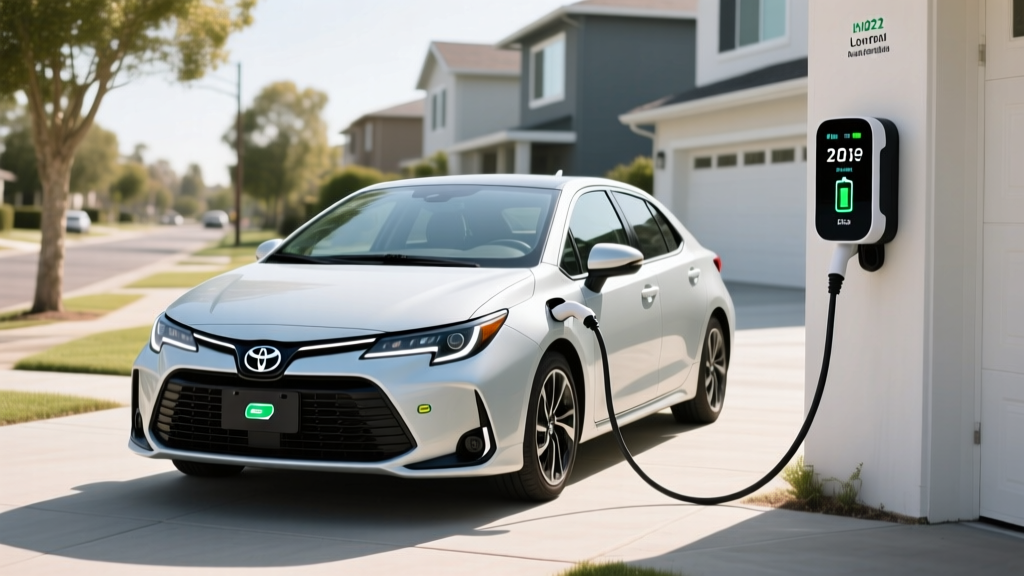
The 2022 Toyota Corolla Hybrid occupies a specific lane in the electrified-vehicle market: maximum fuel efficiency with zero plug-in hassle. It is a conventional hybrid electric vehicle (HEV), not a plug-in hybrid (PHEV), meaning you never search for a charger — you simply fill it with gas and let Toyota's fifth-generation Hybrid Synergy Drive handle the rest. With an EPA-estimated 52 MPG combined, it undercuts nearly every non-plugged competitor on fuel cost while carrying Toyota's reputation for long-term hybrid battery durability.
But in 2026, with plug-in hybrids offering 30–45 miles of electric-only range and full EVs crossing 300 miles per charge, where does a no-plug HEV like the Corolla Hybrid fit? This guide breaks down the real-world MPG, powertrain specs, battery longevity, tax-credit reality, and decision framework to help you determine whether this car — or a newer alternative — is the right call.
HEV vs. PHEV: What the 2022 Corolla Hybrid Actually Is
Before evaluating specs, it is essential to understand what you are buying. The 2022 Corolla Hybrid is a conventional hybrid (HEV). It pairs a gasoline engine with an electric motor and a small battery that recharges through regenerative braking and engine power. There is no plug, no charging cable, and no electric-only driving range beyond brief low-speed assist.
| Feature | HEV (2022 Corolla Hybrid) | PHEV (e.g., Prius Prime) | BEV (e.g., Tesla Model 3) |
|---|---|---|---|
| Plug-in charging | No — gas only | Yes — Level 1/2 | Yes — Level 1/2/DC fast |
| Electric-only range | N/A (motor assists engine) | 30–45 miles typical | 250–350+ miles |
| Battery size | ~1.3 kWh (NiMH) | 13–18 kWh (lithium-ion) | 50–85 kWh (NMC/LFP) |
| Fuel required | Yes — regular unleaded | Yes — but less often | No — electricity only |
| Federal tax credit (§30D) | Not eligible | Up to $7,500 (if eligible) | Up to $7,500 (if eligible) |
| Best for | No home charging access | Short commutes + road trips | Home charging + daily driving |
This distinction matters because buyers sometimes confuse the Corolla Hybrid with Toyota's plug-in offerings. If you want electric-only commuting with a gas backup, you need a PHEV like the Prius Prime. If you want zero gasoline, you need a BEV. The Corolla Hybrid is for drivers who want maximum MPG without changing any refueling habit.
Fuel Economy: EPA Ratings and Real-World MPG
The 2022 Corolla Hybrid's headline number is its EPA-estimated fuel economy, which remains one of the best in its class for a non-plug vehicle.
| Trim / Drivetrain | City MPG | Highway MPG | Combined MPG |
|---|---|---|---|
| LE Hybrid (FWD) | 53 | 52 | 52 |
| LE Hybrid (AWD-e) | 47 | 41 | 44 |
Source: EPA Fuel Economy
Real-World MPG: What Owners Actually See
Hybrids frequently exceed their EPA estimates in city driving because regenerative braking recaptures energy during stop-and-go traffic — the exact scenario where gas cars are least efficient. Many Corolla Hybrid owners report 54–58 MPG in mixed city driving during mild weather. However, highway-dominant commutes at 75+ MPH tend to pull the number down to 44–48 MPG, as aerodynamic drag increases and the engine works harder without regenerative assist.
Cold weather also impacts hybrid efficiency. In sub-freezing temperatures, expect a 5–10% drop in MPG. The engine runs more frequently to maintain cabin heat and bring the catalytic converter to operating temperature, reducing the electric motor's contribution.
Cost Per Mile vs. Gasoline-Only Competitors
At a national average of $3.40 per gallon (regular unleaded) and 52 MPG combined, the Corolla Hybrid costs approximately $0.065 per mile in fuel. A comparable gas-only Corolla (33 MPG combined) costs about $0.103 per mile. Over 15,000 annual miles, that translates to roughly $570 in annual fuel savings with the hybrid.
Powertrain and Performance Specs
| Specification | 2022 Corolla Hybrid LE (FWD) | 2022 Corolla Hybrid LE (AWD-e) |
|---|---|---|
| Engine | 1.8L 4-cylinder Atkinson cycle | 1.8L 4-cylinder Atkinson cycle |
| Engine horsepower | 96 HP @ 5,200 RPM | 96 HP @ 5,200 RPM |
| Electric motor | Permanent magnet AC synchronous | Front + rear motor (AWD-e) |
| Combined net horsepower | 121 HP | 121 HP |
| Transmission | ECVT (electronically controlled) | ECVT |
| 0–60 MPH (est.) | ~9.5 seconds | ~9.8 seconds |
| Drivetrain | Front-wheel drive | Electronic AWD (AWD-e) |
| Hybrid battery | ~1.3 kWh NiMH | ~1.3 kWh NiMH |
| Curb weight | ~3,050 lbs | ~3,150 lbs |
The 121 combined horsepower figure is modest, and the Corolla Hybrid is not a performance vehicle. The 0–60 time of roughly 9.5 seconds places it in adequate-but-unhurried territory. Where the powertrain excels is in seamless low-speed electric assist — the car launches from stops on electric torque before the gas engine engages, creating a smooth, quiet takeoff that feels more refined than the horsepower number suggests.
The AWD-e variant adds a small rear-mounted electric motor that engages automatically during acceleration from stops and when front-wheel slip is detected. It is not a full-time AWD system — it activates only when needed, which preserves much of the FWD model's fuel economy advantage. The trade-off is a 7 MPG combined penalty versus FWD, dropping from 52 to 44 MPG combined.
Battery Warranty, Lifespan, and Replacement Cost
2022 Corolla Hybrid Battery Coverage
- Hybrid battery warranty: 10 years / 150,000 miles (whichever comes first) in all 50 states, per Toyota's updated coverage policy
- Hybrid system components: 8 years / 100,000 miles
- Battery chemistry: Nickel-metal hydride (NiMH) — proven technology with decades of field data
Toyota's hybrid battery longevity is among the best-documented in the industry. The Prius, which shares Toyota's hybrid architecture, has demonstrated battery lifespans of 200,000–300,000+ miles in fleet and owner reports before requiring replacement. The Corolla Hybrid uses a similar NiMH pack, which is less energy-dense than lithium-ion but extremely durable and thermally stable.
What Does a Hybrid Battery Replacement Cost?
If the battery does eventually need replacement outside of warranty, the cost typically falls between $2,000 and $3,500 for a new OEM pack, including labor. Refurbished or reconditioned packs are available for $1,000–$1,800. This is dramatically less than a full EV battery replacement, which can exceed $10,000–$15,000. The small 1.3 kWh pack in the Corolla Hybrid is a fraction of the size and cost of an EV traction battery.
For context, Toyota's 10-year/150,000-mile warranty covers the vast majority of ownership periods. Most Corolla Hybrid buyers will sell or trade the vehicle well before the battery reaches end-of-life.
Pricing and Tax Credit Eligibility
The 2022 Corolla Hybrid was offered exclusively in the LE trim when new, with an MSRP starting at approximately $23,750 (FWD) and $25,150 (AWD-e), including destination charge. On the used market in 2026, expect to pay between $18,000 and $23,000 depending on mileage and condition.
Does the 2022 Corolla Hybrid Qualify for a Tax Credit?
No. The 2022 Corolla Hybrid is a conventional HEV and does not qualify for the federal §30D Clean Vehicle Credit. That credit — up to $7,500 — applies only to plug-in electric vehicles (BEVs and PHEVs) that meet battery sourcing, critical mineral, MSRP cap, and buyer income requirements.
However, some states and local utilities have offered incentives for high-efficiency hybrids in the past. Check your state energy office or utility provider for any current programs. These vary significantly by jurisdiction and change frequently, so always verify with official sources.
If federal tax credit eligibility is a priority, you would need to look at a PHEV like the Toyota Prius Prime or a full BEV — but both come with higher purchase prices and, in the case of PHEVs and BEVs, the need for charging access.
Who Should Buy the 2022 Corolla Hybrid?
Choose the Corolla Hybrid If
- You want maximum MPG without any change to your refueling routine
- You lack access to home or workplace EV charging
- You drive a mix of city and highway miles and want 50+ MPG real-world
- You prioritize low cost of ownership and long-term reliability
- You want AWD availability in an ultra-efficient sedan
- Your budget is under $25,000 for a used efficient vehicle
Look Elsewhere If
- You want any electric-only driving range (consider a PHEV)
- You want to qualify for the $7,500 federal tax credit (need a BEV/PHEV)
- You prioritize acceleration and driving dynamics (0–60 is ~9.5 sec)
- You want the latest infotainment or ADAS tech (2022 model year is dated)
- You take mostly highway trips at 80+ MPH (hybrid advantage shrinks)
Corolla Hybrid vs. PHEV vs. Full EV: Decision Framework
Choose the Corolla Hybrid (HEV) if: You have no reliable charging access, your budget is tight, and you want the simplest path to 50+ MPG. It works for apartment dwellers, street parkers, and anyone who doesn't want to think about charging.
Choose a PHEV (e.g., Prius Prime) if: You have home charging and a short commute (under 40 miles), but you also take road trips where you want gas-engine range. You'll drive mostly on electricity during the week and use gas only on weekends.
Choose a full BEV (e.g., Model 3, Ioniq 6) if: You have reliable Level 2 home charging, your daily driving is under 250 miles, and you want zero tailpipe emissions plus the lowest per-mile fuel cost (electricity at ~$0.04/mile vs. $0.065/mile for the Corolla Hybrid).
Reliability Ratings and Safety
Toyota's hybrid powertrain has an exceptional reliability track record spanning over two decades since the original Prius. The Corolla nameplate itself is one of the best-selling and most dependable compact cars globally. While the 2022 Corolla Hybrid is too recent for long-term high-mileage data specific to this model, the shared Hybrid Synergy Drive components have proven durable across millions of Toyota hybrid vehicles.
The NHTSA gave the 2022 Corolla sedan a 5-star overall safety rating. The vehicle comes standard with Toyota Safety Sense 2.0, which includes:
- Pre-collision system with pedestrian detection
- Lane departure alert with steering assist
- Automatic high beams
- Full-speed range dynamic radar cruise control
- Lane tracing assist
Note: Toyota Safety Sense 2.0 is a Level 1–2 driver-assistance system (per SAE automation levels). It provides steering and speed support but requires full driver attention at all times. It is not a self-driving system.
Frequently Asked Questions
How many MPG does the 2022 Corolla Hybrid get?
The EPA rates the FWD model at 53 city / 52 highway / 52 combined MPG. The AWD-e model is rated at 47 city / 41 highway / 44 combined. In real-world city driving, many owners report 54–58 MPG during mild weather, while sustained highway driving at higher speeds can pull the average down to the mid-40s.
Does the 2022 Corolla Hybrid need to be plugged in?
No. The Corolla Hybrid is a conventional hybrid (HEV), not a plug-in hybrid (PHEV). It charges its small battery entirely through regenerative braking and the gasoline engine. You refuel it at any gas station with regular unleaded.
How far can the 2022 Corolla Hybrid go on electric power alone?
It cannot drive on electric power alone for any meaningful distance. The electric motor assists the gasoline engine during acceleration and low-speed maneuvers, but the gas engine is always the primary power source. If you want electric-only range, you need a PHEV like the Prius Prime (up to 44 miles electric-only) or a full BEV.
Is the hybrid battery reliable, and what does replacement cost?
Toyota's NiMH hybrid batteries are among the most durable in the industry, with many lasting 200,000+ miles. The battery is covered by a 10-year / 150,000-mile warranty. If replacement is needed outside of warranty, expect to pay $2,000–$3,500 for a new OEM pack or $1,000–$1,800 for a refurbished unit.
Does the 2022 Corolla Hybrid qualify for any federal tax credit?
No. The §30D Clean Vehicle Credit applies only to plug-in electric vehicles (BEVs and PHEVs) that meet specific battery sourcing, MSRP, and buyer income requirements. The Corolla Hybrid, as a conventional HEV, does not qualify. Check your state and utility for any local hybrid incentives, which vary by jurisdiction.
Is the AWD-e system worth the MPG trade-off?
If you live in a region with frequent rain, snow, or icy roads, the AWD-e system provides meaningful traction benefits during acceleration and low-grip conditions. The trade-off is 8 MPG combined (52 vs. 44). For drivers in mild climates who rarely encounter slippery roads, the FWD model's superior efficiency is the better choice.
How does the 2022 Corolla Hybrid compare to the newer Prius?
The redesigned 2023+ Prius offers more power (194 HP FWD, 196 HP AWD), a more modern interior, and similar fuel economy (up to 57 MPG combined). If you are shopping used and budget is the priority, the 2022 Corolla Hybrid offers comparable efficiency at a lower price point. If you want more power and updated tech, the newer Prius is worth the premium.
The 2022 Corolla Hybrid remains a rational, low-risk choice for drivers who want exceptional fuel economy without the complexity, cost, or charging requirements of plug-in vehicles. Its 52 MPG combined rating, proven hybrid reliability, and sub-$25,000 used-market pricing make it one of the most accessible efficient vehicles available — even as the market shifts toward PHEVs and BEVs.