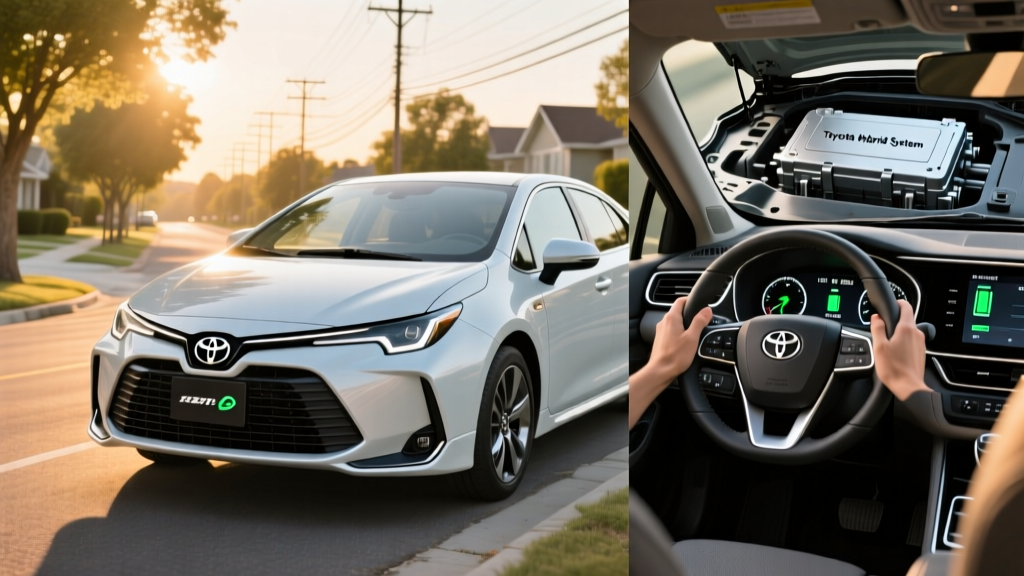
Quick Verdict: The 2021 Toyota Corolla Hybrid LE at a Glance
The 2021 Toyota Corolla Hybrid LE is a conventional hybrid (HEV) — not a plug-in — that pairs a 1.8-liter four-cylinder engine with a compact electric motor to achieve an EPA-rated 52 MPG combined. For buyers who want dramatic fuel savings without changing their refueling habits, this sedan remains one of the most practical choices on the used market in 2026. It never needs to be plugged in, carries Toyota's proven hybrid reliability record, and costs roughly $10,000–$14,000 less than a comparable battery-electric vehicle.
If you're cross-shopping this against a plug-in hybrid (PHEV) like the Toyota Prius Prime or a full EV like the Chevrolet Bolt, the Corolla Hybrid LE occupies a specific niche: maximum simplicity with minimum compromise. No charging infrastructure required, no range anxiety, no plug — just fill up at any gas station and go.
| Spec | Value |
|---|---|
| Powertrain | 1.8L 4-cyl Atkinson-cycle + AC synchronous electric motor |
| Combined Horsepower | 121 hp (net system output) |
| Transmission | Electronically controlled CVT (eCVT) |
| EPA Fuel Economy | 53 city / 52 highway / 52 combined MPG |
| Fuel Tank Capacity | 11.4 gallons |
| Total Driving Range | ~593 miles (EPA est.) |
| Hybrid Battery | Nickel-metal hydride (NiMH), ~1.3 kWh (not plug-in) |
| Drivetrain | Front-wheel drive |
| 0–60 mph | ~10.7 seconds (est.) |
| Original MSRP (2021) | $23,600 |
| 2026 Used Price Range | $16,500–$21,000 (depending on mileage/condition) |
| Hybrid Battery Warranty | 10 years / 150,000 miles (from original in-service date) |
HEV vs. PHEV: Why the Corolla Hybrid Is NOT a Plug-In
Before going further, it's essential to distinguish what this car is — and what it isn't. The 2021 Corolla Hybrid LE is a conventional hybrid electric vehicle (HEV). It generates all its electricity internally through regenerative braking and the gasoline engine. You never plug it in. There is no charging port, no electric-only driving range to manage, and no home charger to install.
HEV (This Car) vs. PHEV vs. Full EV — At a Glance
| Feature | HEV (Corolla Hybrid) | PHEV (e.g., Prius Prime) | BEV (e.g., Chevy Bolt) |
|---|---|---|---|
| Plug-in required? | No | Yes (optional but recommended) | Yes (mandatory) |
| Electric-only range | None (motor assists engine) | ~25–44 miles | 200–350+ miles |
| Home charger needed? | No | Recommended (Level 2) | Yes (Level 2 ideal) |
| Federal tax credit (new) | None | Up to $7,500 (§30D) | Up to $7,500 (§30D) |
| Used EV credit (2026) | Not eligible | Not eligible | Up to $4,000 (§25E) |
| Best for | No home charging access | Short commutes + road trips | Home charging + low running costs |
The Corolla Hybrid's small ~1.3 kWh NiMH battery pack exists solely to capture energy during braking and coasting, then redeploy it to assist the engine during acceleration. This is fundamentally different from a PHEV's much larger battery (typically 8–18 kWh) that enables genuine electric-only driving for 25–44 miles before the gas engine kicks in.
Fuel Economy: EPA Numbers and Real-World MPG
The EPA rates the 2021 Corolla Hybrid LE at 53 MPG city / 52 MPG highway / 52 MPG combined. These are outstanding numbers for a non-plug-in sedan, and they reflect Toyota's fourth-generation Hybrid Synergy Drive system, which is optimized for stop-and-go efficiency.
| Driving Condition | EPA Rating | Real-World Expectation |
|---|---|---|
| City | 53 MPG | 52–58 MPG (hybrids often exceed EPA in city) |
| Highway | 52 MPG | 46–50 MPG (sustained 70+ mph reduces regen benefit) |
| Combined | 52 MPG | 48–54 MPG (varies with driving mix) |
| Cold weather (below 32°F) | N/A | 42–47 MPG (engine runs more for cabin heat) |
Real-world insight: Hybrid owners consistently report that city driving yields the best MPG because regenerative braking recovers energy at every stoplight. Highway cruising at 75–80 mph reduces the hybrid system's advantage since the engine runs continuously at steady load. In cold climates, expect a 10–15% MPG drop in winter — the engine must run more frequently to provide cabin heat, since the Corolla Hybrid LE does not include a heat pump (a feature found on some EVs and the Prius Prime PHEV).
With the 11.4-gallon fuel tank, real-world total range typically falls between 520 and 600 miles per fill-up, depending on driving style and climate. That's comparable to or better than most EVs' total range and eliminates any refueling anxiety.
Powertrain Deep Dive: How 121 HP Moves a Compact Sedan
The Corolla Hybrid's powertrain pairs a 1.8-liter Atkinson-cycle four-cylinder engine (producing 98 hp and 105 lb-ft of torque on its own) with a permanent-magnet AC synchronous electric motor integrated into the transaxle. The net system output is 121 horsepower.
The Atkinson cycle is key to understanding hybrid efficiency: it keeps the intake valve open slightly longer during the compression stroke, effectively reducing pumping losses and improving thermal efficiency at the cost of peak power. That's why the engine alone feels modest — but the electric motor fills in the low-RPM torque gap that the Atkinson cycle sacrifices.
The eCVT (electronically controlled continuously variable transmission) is not a traditional belt-and-pulley CVT. It uses a planetary gearset to seamlessly blend power from the engine and motor. This design is inherently robust — there are no belts, clutches, or friction bands to wear out — and is a major reason Toyota hybrids achieve such strong long-term reliability.
Performance is adequate, not thrilling. The 0–60 mph time of roughly 10.7 seconds places the Corolla Hybrid LE behind the gas-only Corolla (which hits 60 in about 8.0 seconds with the 2.0L engine) and well behind any EV. Overtaking on two-lane highways requires planning. For daily commuting and city driving, however, the low-end electric torque makes the car feel responsive from a stoplight.
Battery Longevity, Warranty, and Replacement Cost
Hybrid Battery Warranty Coverage
Original warranty: 10 years / 150,000 miles from the vehicle's original in-service date (for 2020+ model-year Toyota hybrids, upgraded from the prior 8-year/100,000-mile term).
For a 2021 model in 2026: Original factory hybrid battery warranty remains active until approximately 2031 or 150,000 miles — whichever comes first — assuming it transfers to subsequent owners (Toyota's hybrid battery warranty is transferable to second owners).
Capacity note: The NiMH pack is ~1.3 kWh and is not user-serviceable or designed for capacity monitoring like an EV battery. Degradation manifests as slightly reduced MPG over time, not a dashboard percentage.
Toyota's hybrid battery track record is among the best in the industry. Data from fleet operators and long-term owners shows that Toyota NiMH hybrid batteries routinely last 150,000–200,000+ miles before requiring replacement. The Prius, which shares similar hybrid architecture, has documented cases of original batteries exceeding 250,000 miles.
If replacement is needed out of warranty, costs break down as follows:
- OEM new battery (Toyota dealer): $2,500–$3,500 installed
- Remanufactured battery (specialist shops): $1,200–$2,000 installed
- Refurbished / individual cell replacement: $500–$1,000 (independent hybrid specialists)
Compared to full EV battery replacements ($8,000–$20,000+), the Corolla Hybrid's small NiMH pack is remarkably affordable to replace — and far less likely to need it within typical ownership periods.
Pricing, Tax Credits, and Total Cost of Ownership
The 2021 Corolla Hybrid LE carried an original MSRP of $23,600 (including destination). In the 2026 used market, expect to pay between $16,500 and $21,000 depending on mileage, condition, and regional demand. Well-maintained examples under 50,000 miles command a premium.
Federal tax credit status: The Corolla Hybrid LE does not qualify for the IRS §30D Clean Vehicle Credit (up to $7,500 for new plug-in vehicles) because it is a conventional HEV with no plug-in capability. The IRS §30D credit applies only to battery-electric vehicles (BEVs) and plug-in hybrids (PHEVs) that meet battery capacity, critical-mineral sourcing, MSRP, and buyer income requirements.
Similarly, the §25E used clean vehicle credit (up to $4,000) does not apply — it also requires plug-in capability with a minimum 7 kWh battery.
However, some states offer their own incentives for high-efficiency hybrids. Check your state's energy office or DMV for current programs, as these vary significantly by jurisdiction.
| Cost Category | Estimated 5-Year Total | Notes |
|---|---|---|
| Purchase price | $18,500 | Average used, ~45k miles |
| Fuel (12,000 mi/yr) | $5,200 | @ $3.40/gal, 50 MPG real-world |
| Insurance | $6,800 | ~$113/month average |
| Maintenance | $2,400 | Oil changes, tires, brakes (regen reduces brake wear) |
| Depreciation | $5,500 | Estimated resale ~$13,000 in 2031 |
| Total 5-year cost | ~$38,400 | |
| Cost per mile | ~$0.32/mile | Excluding purchase price amortization nuances |
For comparison, a gas-only 2021 Corolla LE (rated 33 MPG combined) would cost roughly $1,700 more in fuel over the same 60,000-mile period. The hybrid premium pays for itself within 3–4 years of average driving at current fuel prices.
Who Should Choose the Corolla Hybrid LE — And Who Shouldn't
Pros
- 52 MPG combined — among the highest of any non-plug-in sedan
- No charging infrastructure needed — works for apartment dwellers and street parkers
- Proven Toyota hybrid reliability with transferable 10-year battery warranty
- Low maintenance costs (regenerative braking extends pad life significantly)
- 593-mile total range eliminates road-trip refueling stops
- Standard Toyota Safety Sense 2.0 (AEB, lane-keeping, adaptive cruise)
Cons
- Modest 121 hp — slow acceleration (10.7 sec 0–60)
- Only available in LE trim — no premium options, no sunroof, basic interior
- No all-wheel-drive option (the AWD-e was not offered on the 2021 Corolla Hybrid)
- No federal or used-EV tax credit eligibility
- Cargo space is 13.1 cu ft — smaller than some competitors
- Infotainment is dated by 2026 standards (8-inch screen, no wireless CarPlay)
Decision Framework: Is This the Right Electrified Car for You?
Choose the 2021 Corolla Hybrid LE if:
- You cannot install a home charger (apartment, condo, street parking)
- You want fuel savings with zero lifestyle change
- Your budget is under $22,000 and you want proven reliability
- You drive a mix of city and highway and want 500+ mile range
Choose a PHEV (like the Prius Prime) instead if:
- You have home charging and a commute under 40 miles round-trip
- You want to drive mostly on electricity but need gas for road trips
- You qualify for the §30D tax credit on a new purchase
Choose a full EV (like a used Bolt or Model 3) instead if:
- You have reliable home Level 2 charging
- You want the lowest per-mile fuel cost (~$0.04–$0.06/mile on home electricity)
- You want stronger acceleration and one-pedal driving
- You're eligible for the §25E used-EV credit (up to $4,000)
Frequently Asked Questions
How many MPG does the 2021 Toyota Corolla Hybrid LE get?
The EPA rates it at 53 city / 52 highway / 52 combined MPG. In real-world driving, most owners see 48–54 MPG combined, with city driving often exceeding the EPA estimate thanks to regenerative braking. Cold weather and sustained high-speed highway driving reduce MPG by 10–15%.
Does the Corolla Hybrid need to be plugged in?
No. The 2021 Corolla Hybrid LE is a conventional hybrid (HEV), not a plug-in hybrid (PHEV). It charges its small battery entirely through regenerative braking and the gasoline engine. There is no charging port on the vehicle.
Does the 2021 Corolla Hybrid qualify for any tax credit?
No. Federal tax credits under IRS §30D (new clean vehicles) and §25E (used clean vehicles) require plug-in capability with a minimum battery capacity. Since the Corolla Hybrid is a conventional HEV, it does not qualify for any federal EV tax credit. Some states may offer separate incentives for high-efficiency vehicles — check your state's energy office.
How reliable is the hybrid battery, and what does replacement cost?
Toyota's NiMH hybrid batteries have an excellent longevity record, typically lasting 150,000–200,000+ miles. The 2021 model carries a 10-year/150,000-mile hybrid battery warranty that transfers to second owners. If replacement is needed out of warranty, expect $1,200–$3,500 depending on whether you choose a remanufactured or new OEM unit — far less than an EV battery replacement.
Is the Corolla Hybrid LE slower than the gas-only Corolla?
Yes. The hybrid's 121 net horsepower and ~10.7-second 0–60 time trail the gas-only Corolla's available 2.0L engine (169 hp, ~8.0 seconds 0–60). The hybrid prioritizes efficiency over acceleration. For daily commuting, the low-end electric torque makes it feel adequately responsive, but highway merging and passing require more lead time.
How does the Corolla Hybrid compare to the Prius?
The 2021 Prius achieves similar EPA ratings (54–58 MPG combined depending on trim) but offers a hatchback body style with significantly more cargo room (~27 cu ft vs. 13.1 cu ft). The Prius also offers an available AWD-e variant. The Corolla Hybrid LE's advantage is its conventional sedan styling and slightly lower used-market pricing. Mechanically, both use Toyota's fourth-generation hybrid system.
Can I get all-wheel drive on the 2021 Corolla Hybrid?
No. The AWD-e option (which adds a small rear electric motor) was not available on the Corolla Hybrid until later model years. The 2021 Corolla Hybrid LE is front-wheel drive only. If AWD is essential, look at the Prius AWD-e or the gas-only Corolla with available AWD.