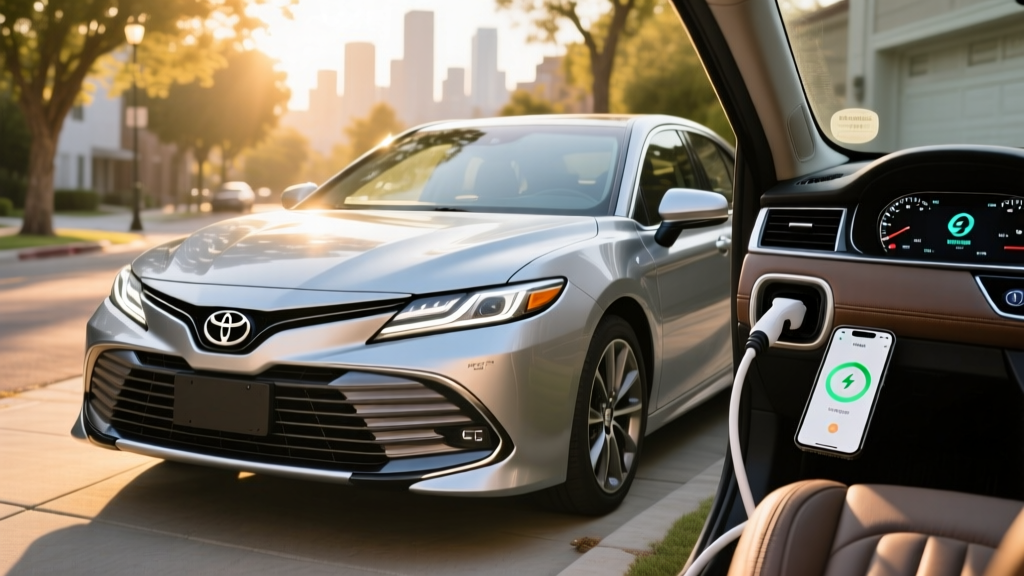
Quick Verdict: The Sportiest Hybrid Sedan That Doesn't Ask You to Plug In
The 2021 Toyota Camry Hybrid XSE occupies a specific niche: buyers who want the fuel-economy upside of a hybrid powertrain without changing how they refuel. No plug, no range anxiety, no charging-curve math — just a 13.2-gallon tank, a regenerative braking system that silently recovers energy, and an EPA rating that translates directly to fewer stops at the pump. The XSE trim adds sport-tuned suspension, 19-inch wheels, a gloss-black rear spoiler, and paddle shifters that make the hybrid system feel more engaged than any Camry has a right to be.
Now well into its lifecycle on the used market in 2026, the 2021 Camry Hybrid XSE has proven itself as one of the most efficient midsize sedans ever sold in the US — and one of the most reliable. Here's every number that matters.
HEV vs PHEV: Where the Camry Hybrid Fits
Conventional Hybrid (HEV) — this is what the Camry Hybrid is: The gasoline engine and electric motor work together, and the small battery recharges through regenerative braking and engine power. You never plug it in. You simply fill up at a gas station like any other car.
Plug-In Hybrid (PHEV) — this is what the Camry Hybrid is NOT: A PHEV (like the Toyota RAV4 Prime or Prius Prime) has a larger battery you charge from a wall outlet or public charger, giving 25–42 miles of pure electric driving before the gas engine kicks in. Toyota never made a plug-in Camry for the US market.
Full Battery Electric (BEV): No gasoline at all. Vehicles like the Tesla Model 3 or Hyundai Ioniq 6 run entirely on electricity stored in a large battery pack (60–100+ kWh) and require regular plug-in charging.
The Camry Hybrid's traction battery is a compact 1.6 kWh nickel-metal hydride (NiMH) pack — far too small to plug in and far too small for meaningful electric-only driving. Its job is to buffer energy from braking events and assist the gas engine during acceleration. This is the simplest, most proven hybrid architecture Toyota has deployed across millions of vehicles worldwide.
Fuel Economy: EPA Numbers and Real-World Results
The 2021 Camry Hybrid XSE with front-wheel drive carries an EPA rating of 44 mpg city / 47 mpg highway / 46 mpg combined. Opting for the available electronic all-wheel-drive (AWD-e) system drops those figures slightly to 44/43/44 mpg combined, per fueleconomy.gov.
| Drivetrain | City MPG | Highway MPG | Combined MPG | Annual Fuel Cost* |
|---|---|---|---|---|
| FWD | 44 | 47 | 46 | ~$1,150 |
| AWD-e | 44 | 43 | 44 | ~$1,200 |
*EPA estimated annual fuel cost based on 15,000 miles/year at $3.50/gallon. Actual costs vary with fuel prices and driving habits.
Real-World MPG: Why City Drivers Often Beat the Sticker
Hybrids behave opposite to conventional gas cars in traffic. Stop-and-go driving generates frequent regenerative braking events, which recharge the battery and let the electric motor shoulder more of the acceleration load. In real-world city commuting with moderate traffic, many Camry Hybrid owners report 48–52 mpg — beating the EPA city figure.
Highway driving, by contrast, relies more heavily on the gasoline engine since there's little braking to recover energy. Expect 40–44 mpg at sustained 70–80 mph speeds. In cold weather (below 30°F), the engine runs more frequently to maintain cabin heat and battery temperature, reducing economy to roughly 38–42 mpg combined until ambient temperatures recover.
With the 13.2-gallon fuel tank, real-world range sits between 530 and 620 miles per fill-up depending on your driving mix — enough for most commuters to visit the gas station once every two to three weeks.
Powertrain Specs: 208 Horsepower from Two Power Sources
| Engine | 2.5L Dynamic Force 4-cylinder (A25A-FXS) |
| Engine Output | 176 hp @ 5,700 rpm / 163 lb-ft @ 5,200 rpm |
| Electric Motor (FWD) | 88 kW (118 hp) / 149 lb-ft |
| AWD-e Rear Motor | 40 kW (54 hp) — engages only when needed |
| Net Combined Horsepower | 208 hp |
| Transmission | eCVT (planetary gearset, not a belt-driven CVT) |
| Hybrid Battery | 1.6 kWh NiMH (sealed, air-cooled) |
| 0–60 mph | ~7.1 seconds (FWD) |
| Drivetrain | FWD standard; AWD-e available |
| Fuel Tank | 13.2 gallons |
The combined 208 hp output doesn't come from simply adding the engine and motor figures — Toyota's Hybrid Synergy Drive uses a planetary gearset that blends the two power sources at varying ratios depending on speed and load. The result is seamless torque fill at low RPMs where the gas engine alone would feel sluggish.
The XSE's sport-tuned suspension, thicker stabilizer bars, and 19-inch alloy wheels give it noticeably firmer ride quality than the LE or SE trims. Paddle shifters let you simulate six fixed gear ratios in manual mode, though the eCVT still prioritizes efficiency over sportiness. The AWD-e system uses a separate rear-mounted electric motor that activates only during acceleration from a stop or when wheel slip is detected — it doesn't run continuously, which is why the fuel economy penalty is minimal.
Battery Warranty, Lifespan, and Replacement Costs
Toyota Hybrid Battery Warranty: 10 years / 150,000 miles (whichever comes first) for 2020 and newer model years, covering the hybrid traction battery against defects and abnormal capacity loss. This was extended from the previous 8-year/100,000-mile standard starting with the 2020 model year. For California-emissions states (CA, CT, ME, MA, NJ, NY, OR, RI, VT, WA), additional powertrain emission component coverage may apply.
How Long Do Camry Hybrid Batteries Actually Last?
The 2021 Camry Hybrid uses a nickel-metal hydride (NiMH) battery — a chemistry Toyota has refined over 25+ years since the original Prius. NiMH is less energy-dense than modern lithium-ion, but it's exceptionally tolerant of the shallow charge-discharge cycles that define hybrid operation. The battery management system keeps the pack in a narrow state-of-charge window (roughly 40–80%), which dramatically reduces degradation.
Real-world data from high-mileage Toyota hybrids consistently shows NiMH packs lasting 180,000–250,000+ miles before meaningful capacity loss. Many first-generation Prius taxis surpassed 300,000 miles on original battery packs. For a 2021 model in 2026 with typical annual mileage, the hybrid battery should have the vast majority of its service life ahead of it.
Battery Replacement Cost
If the hybrid battery does eventually need replacement outside warranty:
- New OEM Toyota pack: $2,500–$4,000 (parts + labor at a dealership)
- Refurbished/reconditioned pack: $1,200–$2,200 from independent hybrid specialists
- Individual module replacement: $300–$800 if only specific cells have failed (a common repair at specialist shops)
For context, this is a fraction of what a full EV battery replacement costs ($8,000–$20,000+), and the smaller pack size makes the physical swap a 2–3 hour job rather than a multi-day lift procedure.
Pricing: New MSRP and 2026 Used Market Value
When new, the 2021 Camry Hybrid XSE carried an MSRP of approximately $32,720 for the FWD model and $34,120 with AWD-e (including destination charge). Popular options like the panoramic glass roof, JBL premium audio, and navigation added $2,000–$4,000 to the sticker.
| Original MSRP (FWD) | $32,720 |
| Original MSRP (AWD-e) | $34,120 |
| 2026 Used Market Range (60K–90K mi) | $18,500–$24,000 |
| 2026 Used Market Range (30K–50K mi) | $23,000–$28,500 |
Tax Credit Eligibility
The 2021 Toyota Camry Hybrid is a conventional HEV — it does not qualify for the federal §30D Clean Vehicle Credit ($7,500 for new EVs/PHEVs) or the §25E Used Clean Vehicle Credit ($4,000 for used EVs/PHEVs). These credits are reserved for plug-in vehicles meeting specific battery-capacity, critical-mineral sourcing, MSRP, and buyer income requirements as outlined by the IRS.
Some states offer modest rebates for high-efficiency hybrids, but these are uncommon and typically small ($250–$500). Check your state energy office or AFDC state incentive database for current programs. The financial case for the Camry Hybrid rests entirely on fuel savings, not tax incentives.
Camry Hybrid vs PHEV vs Full EV: Which Fits You?
Choose the Camry Hybrid (HEV) If:
- You don't have access to home or workplace charging
- You want 44–47 mpg without any behavior change
- You regularly take long road trips through areas with sparse charging infrastructure
- You want Toyota's proven hybrid reliability with minimal maintenance
- Your budget is $18,000–$28,000 on the used market
Choose a PHEV (e.g., Prius Prime, RAV4 Prime) If:
- You can charge at home nightly (Level 1 or Level 2)
- Your daily commute is under 40 miles round-trip (covers most PHEV electric ranges)
- You want to drive mostly electric on weekdays but need gas flexibility for weekend trips
- You qualify for the §30D or §25E tax credit on eligible models
Choose a Full EV (e.g., Tesla Model 3, Ioniq 6) If:
- You have reliable home Level 2 charging
- You want the lowest per-mile fuel cost (electricity vs gasoline)
- You want zero tailpipe emissions and minimal drivetrain maintenance
- You're willing to plan around charging on road trips over 250 miles
Camry Hybrid XSE Pros and Cons
- Pro: 46 mpg combined — exceptional for a 3,500-lb sedan with 208 hp
- Pro: No plug required — zero infrastructure dependency
- Pro: 10-year/150,000-mile hybrid battery warranty
- Pro: XSE sport tuning makes it genuinely engaging for a hybrid
- Pro: AWD-e available for snow-belt buyers
- Con: No electric-only driving mode of any meaningful distance
- Con: NiMH battery is older chemistry (heavier, less energy-dense than Li-ion)
- Con: No federal tax credit eligibility
- Con: XSE's 19-inch wheels and sport suspension mean a firmer ride than LE/SE
- Con: eCVT drone under hard acceleration (common to all Toyota hybrids)
Reliability, Safety, and Long-Term Ownership
The 2021 Camry earned the IIHS Top Safety Pick+ rating — the institute's highest honor — with Good ratings across all crashworthiness tests and a Superior rating for front crash prevention. The NHTSA awarded it a 5-Star Overall Safety Rating.
Toyota's hybrid powertrains have consistently ranked at or near the top of long-term reliability surveys. The eCVT has no belts, no clutch packs, and no traditional friction components to wear — the planetary gearset is one of the most durable transmissions in the automotive industry. Brake pad life is often extended to 80,000–100,000+ miles because regenerative braking handles the majority of deceleration.
Routine maintenance is minimal: oil changes every 10,000 miles (the engine runs less than in a gas-only car), cabin air filter, tire rotations, and coolant service at 100,000 miles. There are no spark plugs to replace at typical intervals (the Atkinson-cycle engine uses iridium plugs rated for 120,000+ miles), no transmission fluid flushes on the eCVT, and no emissions-system complexity like a turbo or direct-injection carbon buildup concerns.
Frequently Asked Questions
How many MPG does the 2021 Camry Hybrid XSE get?
The EPA rates the FWD model at 44 city / 47 highway / 46 combined mpg. The AWD-e model is rated at 44/43/44 mpg. In real-world city driving with frequent stops, many owners see 48–52 mpg thanks to regenerative braking. Highway-only driving at 75+ mph typically yields 40–44 mpg.
Does the Camry Hybrid need to be plugged in?
No. The 2021 Camry Hybrid is a conventional hybrid (HEV), not a plug-in hybrid. Its 1.6 kWh battery recharges entirely through regenerative braking and the gasoline engine. There is no charge port, no charging cable, and no electric-only driving range to manage.
How far can the Camry Hybrid drive on electric power alone?
Less than one mile at very low speeds (under 25 mph) in ideal conditions. The battery is far too small for meaningful EV-mode driving. If electric-only commuting is a priority, look at a PHEV like the Prius Prime (44 miles electric) or a full BEV.
Is the hybrid battery reliable and what does replacement cost?
Toyota's NiMH hybrid batteries are among the most durable in the industry, routinely lasting 180,000–250,000+ miles. The 2021 model carries a 10-year/150,000-mile hybrid battery warranty. Out-of-warranty replacement runs $2,500–$4,000 for a new OEM pack, or $1,200–$2,200 for a refurbished unit.
Does the 2021 Camry Hybrid qualify for any tax credit?
No. Federal §30D and §25E clean vehicle credits apply only to plug-in vehicles (PHEVs and BEVs) meeting specific battery and sourcing requirements. The Camry Hybrid, as a conventional HEV, does not qualify. Some states may offer small efficiency rebates — check the AFDC database for your area.
How does the XSE trim differ from the Hybrid LE and SE?
The XSE adds 19-inch black alloy wheels, sport-tuned suspension with thicker stabilizer bars, a gloss-black rear spoiler, leather-trimmed seats with sport bolsters, paddle shifters, and unique interior trim. The mechanical hybrid powertrain is identical across all trims. The XSE's larger wheels carry a negligible 1 mpg highway penalty versus the LE's 16-inch wheels.
Is the AWD-e system worth it?
If you live in a region with frequent snow or rain, the AWD-e's rear electric motor provides meaningful traction improvement during launch and low-grip conditions. The fuel economy penalty is just 2 mpg combined (44 vs 46). For dry-climate drivers, the FWD model's extra efficiency and lower cost make it the better choice.