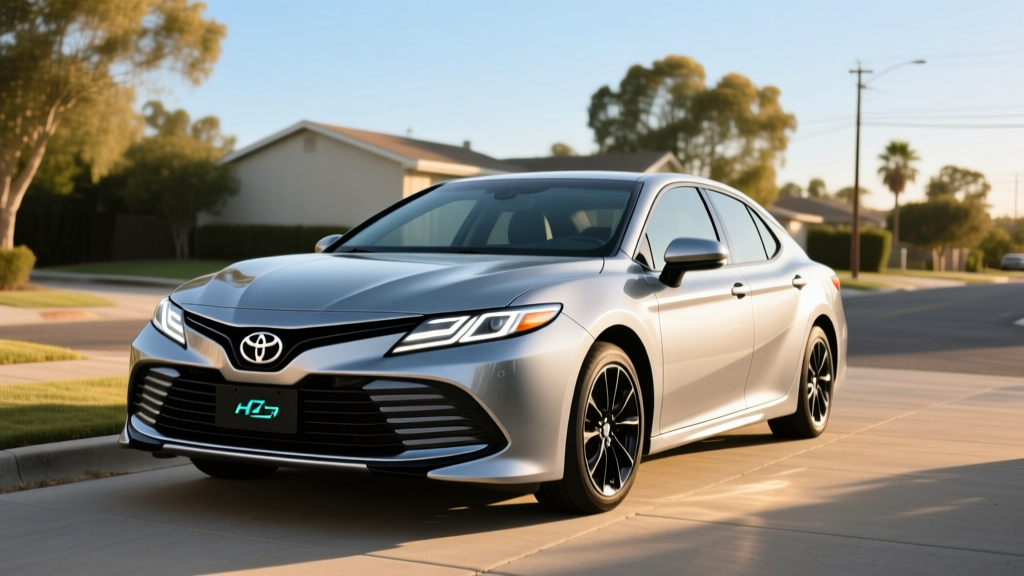
The 2021 Toyota Camry Hybrid occupies a specific niche that full EVs still can't fill for many buyers: midsize-sedan comfort with no plug, no range anxiety, and fuel economy that embarrasses cars twice its price. In 2021, Toyota added the fuel-sipping LE trim with a 52 MPG combined EPA rating, while the sportier SE and XSE trims traded a few MPGs for firmer suspension tuning and a 44 MPG combined figure. Five years on, this generation has proven itself as one of the most dependable hybrid sedans on the used market — but it remains a conventional hybrid (HEV), not a plug-in, which matters for buyers weighing electrification options today.
This guide breaks down the 2021 Camry Hybrid's real-world efficiency, powertrain details, battery longevity, ownership costs, and how it stacks up against PHEVs and full EVs in 2026.
HEV vs PHEV: Where the Camry Hybrid Fits
Before diving into specs, it's critical to understand what the 2021 Camry Hybrid is — and what it isn't.
Conventional Hybrid (HEV) — Camry Hybrid
- No plug required. The battery recharges via regenerative braking and the gasoline engine.
- No electric-only driving range beyond brief low-speed creep (under ~1 mile).
- No federal tax credit under current IRS §30D rules, which apply only to plug-in vehicles.
- Fuel economy advantage comes from the engine running at optimal efficiency and electric motor assist.
Plug-In Hybrid (PHEV) — e.g., Toyota Prius Prime
- Larger battery (13.6 kWh in current Prius Prime) with a charge port for Level 1/Level 2 AC charging.
- Electric-only range of 39–44 miles EPA before the gas engine engages.
- May qualify for federal tax credit depending on battery sourcing, income, and MSRP caps.
- Total range exceeds 400 miles when combining electric and gasoline operation.
Battery Electric Vehicle (BEV) — e.g., Tesla Model 3, Hyundai Ioniq 6
- No gasoline engine. 100% electric with 250–360+ miles of EPA range.
- Requires charging access (home Level 2 or reliable public DC fast charging).
- Eligible for up to $7,500 federal tax credit if all §30D requirements are met.
- Lowest per-mile fuel cost but highest upfront purchase price in most segments.
The 2021 Camry Hybrid is firmly in the HEV column. You never plug it in. You simply drive it, and the hybrid system handles the rest — making it ideal for apartment dwellers, street parkers, and anyone without reliable charging access.
Fuel Economy: EPA Ratings and Real-World MPG
The 2021 Camry Hybrid is available in three trims, and the LE is the efficiency king. Here's the full EPA breakdown from fueleconomy.gov:
| Trim | City MPG | Highway MPG | Combined MPG | Annual Fuel Cost* |
|---|---|---|---|---|
| Camry Hybrid LE | 51 | 53 | 52 | ~$1,050 |
| Camry Hybrid SE | 44 | 47 | 44 | ~$1,250 |
| Camry Hybrid XLE | 44 | 47 | 44 | ~$1,250 |
*Based on 15,000 miles/year at $3.50/gallon regular unleaded. Your costs will vary with local fuel prices.
Real-World MPG vs. EPA Sticker
Toyota's hybrid system excels in stop-and-go city driving, where the electric motor handles low-speed propulsion and regenerative braking recaptures energy. In real-world ownership:
- City driving: Many owners report exceeding the EPA city rating — 54–56 MPG in warm-weather urban commuting is common. The engine shuts off frequently at stops and low speeds.
- Highway driving: Expect 44–48 MPG at 70–75 mph on the LE trim. Hybrids lose their city advantage at sustained highway speeds where the gas engine does most of the work.
- Cold weather penalty: In sub-30°F conditions, expect a 5–10% drop in MPG. The engine runs more often to heat the cabin and bring the catalytic converter to operating temperature.
- Combined real-world: Most owners average 46–50 MPG on the LE in mixed driving, closely matching or slightly trailing the 52 MPG EPA combined figure.
The SE and XLE trims carry a roughly 8 MPG penalty versus the LE. The difference comes from wider tires (235/45R18 vs. 205/65R16), a sport-tuned suspension, and slightly more weight. If maximizing fuel economy is your priority, the LE is the clear choice.
Powertrain Specs: Engine, Motor, and Combined Output
| Specification | 2021 Camry Hybrid (All Trims) |
|---|---|
| Engine | 2.5L inline-4 (Dynamic Force, Atkinson cycle) |
| Engine Output | 176 hp / 163 lb-ft torque |
| Electric Motor | Permanent-magnet synchronous (front axle) |
| Motor Output | 118 hp / 149 lb-ft torque |
| Net Combined Horsepower | 208 hp |
| Transmission | eCVT (planetary gearset, not a belt CVT) |
| Drivetrain | Front-wheel drive (AWD-e available on LE/SE) |
| Hybrid Battery | ~1.6 kWh (nickel-metal hydride, sealed) |
| 0–60 mph | ~7.2 seconds |
| Fuel Tank | 13.2 gallons |
| Total Range (LE) | ~686 miles (13.2 gal × 52 MPG) |
The 208 combined horsepower figure is legitimate — Toyota's Hybrid Synergy Drive blends engine and motor output through a planetary gearset rather than a traditional transmission. The result is smooth, linear acceleration with no shift shock. The AWD-e option (available on LE and SE trims) adds a rear-axle electric motor that engages automatically during acceleration and low-traction conditions, adding minimal weight and a negligible MPG penalty (~1 MPG combined).
For context, the non-hybrid 2021 Camry with the 2.5L four-cylinder makes 203 hp and rates 28/39/32 MPG. The hybrid delivers more power and 60% better fuel economy — the premium pays for itself quickly at the pump.
Battery Longevity, Warranty, and Replacement Costs
Hybrid battery reliability is the top concern for used-hybrid buyers. Here's what you need to know about the 2021 Camry Hybrid's battery system.
Toyota Hybrid Battery Warranty
- Hybrid Battery: 10 years / 150,000 miles (whichever comes first) for 2020+ model-year Toyotas sold in all 50 states. This was extended from the previous 8-year/100,000-mile standard starting with the 2020 model year.
- Hybrid System Components: 8 years / 100,000 miles (inverter, converter, control modules).
- Transferability: The hybrid battery warranty is fully transferable to subsequent owners — critical for used-car buyers.
Source: Toyota Owner's Warranty Guide
Real-World Degradation and Lifespan
The 2021 Camry Hybrid uses a nickel-metal hydride (NiMH) battery pack — a mature, well-proven chemistry that Toyota has refined over two decades of Prius and Camry Hybrid production. Unlike the lithium-ion packs in EVs and PHEVs, NiMH packs in Toyota HEVs are small (~1.6 kWh) and operate within a narrow state-of-charge window (roughly 40–80%), which dramatically reduces degradation stress.
In practice:
- 100,000+ miles with minimal capacity loss is the norm, not the exception. Taxi fleets running Camry Hybrids routinely exceed 200,000 miles on the original battery.
- Gradual degradation manifests as slightly reduced electric-only assist duration and marginally lower MPG — not a sudden failure.
- Individual cell replacement is possible at some specialist shops for $500–$1,500, extending pack life without a full replacement.
Battery Replacement Cost
If the hybrid battery does fail outside warranty:
- New OEM battery (Toyota dealer): $2,000–$4,000 including labor.
- Remanufactured battery: $1,000–$2,000 from aftermarket suppliers like Green Bean Battery (which also offers a lifetime warranty on their units).
- Used/salvage battery: $500–$1,000, though this carries unknown remaining life.
For a 2021 model, the 10-year/150,000-mile warranty means coverage extends through at least 2031 — providing peace of mind for buyers purchasing in 2026.
Pricing, Tax Credits, and Ownership Economics
Original MSRP and Current Used Pricing
| Trim | 2021 MSRP (New) | Est. Used Price (2026)* |
|---|---|---|
| Hybrid LE | $27,270 | $18,000–$22,000 |
| Hybrid SE | $28,770 | $19,500–$23,500 |
| Hybrid XLE | $32,720 | $21,000–$26,000 |
*Used price ranges based on typical 40,000–70,000 mile examples in good condition. Varies by region and market conditions.
Federal Tax Credit Eligibility
The 2021 Toyota Camry Hybrid does not qualify for the federal §30D Clean Vehicle Credit. Under current IRS rules, only plug-in electric vehicles (PHEVs and BEVs) with sufficient battery capacity are eligible. Conventional hybrids like the Camry Hybrid have no plug and a battery too small to meet the credit's requirements.
However, the Camry Hybrid's lower purchase price — often $10,000–$15,000 less than a comparable EV — means the total cost of ownership can still be highly competitive, especially for buyers without home charging access.
Five-Year Fuel Cost Comparison
| Vehicle | Combined MPG / MPGe | 5-Year Fuel Cost (15k mi/yr) |
|---|---|---|
| 2021 Camry Hybrid LE | 52 MPG | ~$5,250 (gas @ $3.50/gal) |
| 2021 Camry 2.5L (gas) | 32 MPG | ~$8,530 (gas @ $3.50/gal) |
| 2021 Tesla Model 3 RWD | 132 MPGe | ~$3,000 (electricity @ $0.14/kWh) |
The Camry Hybrid saves roughly $3,280 in fuel over five years compared to the gas-only Camry. Against a Model 3, the EV saves about $2,250 more in fuel — but the Model 3's higher purchase price, insurance premiums, and charging-infrastructure requirements offset much of that advantage for many buyers.
Who Should Choose the Camry Hybrid vs. a PHEV or EV?
Choose the 2021 Camry Hybrid If:
- You cannot charge at home (apartment, street parking, no garage) and public charging is unreliable in your area.
- Your budget is under $25,000 and you want a modern, efficient midsize sedan.
- You drive mostly city or suburban miles where the hybrid system delivers peak MPG.
- You want zero behavior change — no apps, no charging planning, no preconditioning.
- You plan to keep the car 10+ years and value Toyota's long-term reliability track record.
Consider a PHEV (e.g., Prius Prime) If:
- You can charge at home (even a standard 120V outlet provides ~4 miles/hour of charging for a PHEV).
- Your daily commute is under 40 miles and you want electric-only driving for most trips.
- You want to reduce gasoline consumption by 70–80% without full EV commitment.
- You may qualify for a federal tax credit on a new PHEV purchase.
Consider a Full EV (e.g., Tesla Model 3, Hyundai Ioniq 6) If:
- You have reliable home Level 2 charging (240V, 32–48A circuit).
- You want the lowest per-mile fuel cost and minimal maintenance (no oil changes, fewer brake replacements due to regen).
- Your budget allows $35,000+ new or $20,000+ used, and you qualify for the §30D tax credit.
- You drive under 300 miles between charging stops or have access to DC fast charging on road trips.
Pros, Cons, and the Bottom Line
Pros
- 52 MPG combined (LE) with no plug required — best-in-class for midsize sedans
- 208 hp provides confident highway merging and passing
- 10-year/150,000-mile hybrid battery warranty (transferable)
- AWD-e option for snow-belt buyers
- Spacious interior with 15.1 cu-ft trunk (no battery intrusion)
- Toyota Safety Sense 2.5+ standard (AEB, adaptive cruise, lane tracing)
- Low insurance costs relative to EVs
Cons
- SE and XLE trims drop to 44 MPG combined — significant gap from LE
- No federal tax credit eligibility
- Infotainment (7" or 9" screen) feels dated versus competitors
- No Apple CarPlay wireless (wired only); Android Auto was not available on 2021 models
- Rear seat doesn't fold flat on Hybrid (battery placement blocks pass-through)
- Engine drone under hard acceleration (eCVT characteristic)
The 2021 Toyota Camry Hybrid remains one of the smartest used-car purchases in the midsize sedan segment in 2026. It delivers exceptional fuel economy without demanding any lifestyle changes — no charging, no planning, no apps. For buyers who prioritize low running costs, proven reliability, and a vehicle that simply works every time you turn it on, the Camry Hybrid LE is difficult to beat at current used-car prices.
Frequently Asked Questions
How many MPG does the 2021 Toyota Camry Hybrid get?
The 2021 Camry Hybrid LE achieves an EPA-rated 51 city / 53 highway / 52 combined MPG. The SE and XLE trims rate at 44 city / 47 highway / 44 combined MPG. In real-world city driving, many owners exceed the EPA city rating, while highway driving typically yields 44–48 MPG for the LE.
Does the 2021 Camry Hybrid need to be plugged in?
No. The Camry Hybrid is a conventional hybrid (HEV), not a plug-in hybrid (PHEV). The battery recharges automatically through regenerative braking and the gasoline engine. There is no charge port and no electric-only driving range beyond brief low-speed assist.
How far can the Camry Hybrid go on electric only?
Effectively zero miles in any meaningful sense. The hybrid system uses the electric motor for low-speed assist, engine start-stop, and torque fill — but it cannot sustain electric-only driving beyond roughly 0.5–1 mile at very low speeds (under 25 mph). If electric-only range is important to you, consider a PHEV like the Toyota Prius Prime (39–44 miles electric) or a full EV.
Is the 2021 Camry Hybrid reliable, and what does battery replacement cost?
The 2021 Camry Hybrid has excellent reliability ratings. Toyota's hybrid system is one of the most proven in the industry, with millions of units on the road globally. The hybrid battery carries a 10-year/150,000-mile warranty (transferable to second owners). Out-of-warranty replacement costs range from $1,000–$2,000 for a remanufactured unit to $2,000–$4,000 for a new OEM battery. Most Camry Hybrids exceed 150,000 miles on the original battery.
Does the 2021 Camry Hybrid qualify for any tax credit?
No. Under current IRS §30D rules, the federal Clean Vehicle Credit applies only to plug-in electric vehicles (PHEVs and BEVs) with battery capacity of at least 7 kWh. The Camry Hybrid's ~1.6 kWh NiMH battery and lack of a charge port make it ineligible. Some states may offer minor incentives for hybrid purchases, but these vary by jurisdiction — check your state's energy office for current programs.
Is the 2021 Camry Hybrid AWD available?
Yes. Toyota offered the AWD-e system on the Hybrid LE and SE trims for 2021. It uses a separate rear-axle electric motor (no mechanical driveshaft) that engages during acceleration and low-traction conditions. The MPG penalty is minimal — approximately 1 MPG combined.
Hybrid vs PHEV vs EV — which should I buy in 2026?
It depends on your charging access and driving patterns. If you can't charge at home, the Camry Hybrid (HEV) is your best electrified option — no infrastructure required. If you can charge at home and commute under 40 miles daily, a PHEV gives you electric-only weekday driving with gas-engine flexibility for road trips. If you have Level 2 home charging and want the lowest operating costs, a full EV delivers the cheapest per-mile fuel cost and minimal maintenance, though at a higher purchase price.