Quick Verdict: The Avalon Hybrid's Second Life on the Used Market
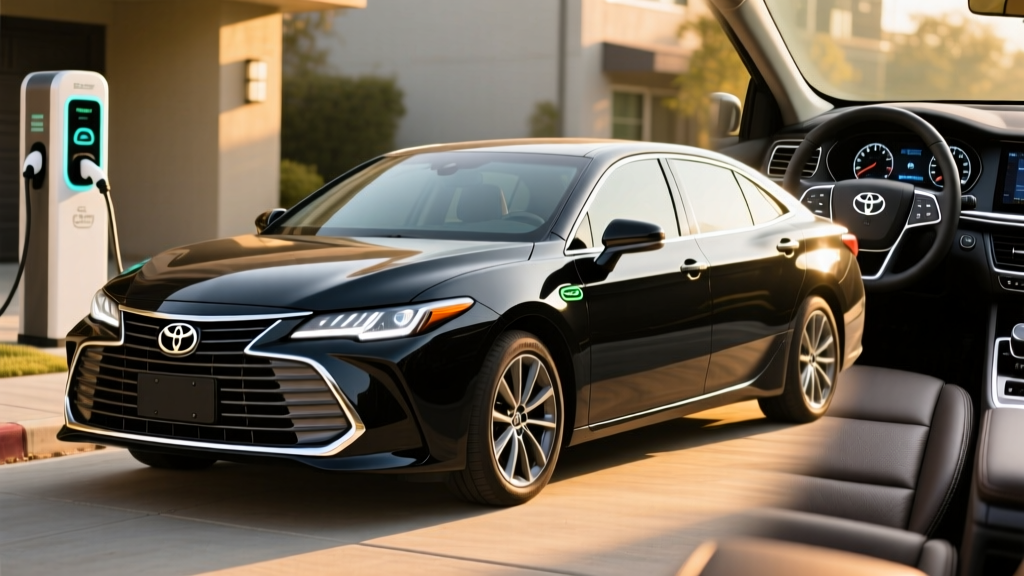
Toyota discontinued the Avalon after the 2022 model year, but the 2021 Toyota Avalon Hybrid remains one of the most compelling used full-size sedans for buyers who want exceptional fuel economy without plugging in. With an EPA-rated 44 MPG combined, a proven 2.5-liter four-cylinder hybrid powertrain, and Toyota's industry-leading hybrid battery warranty, it occupies a specific niche: large-sedan comfort with compact-car fuel costs.
From a 2026 perspective, the Avalon Hybrid is strictly a conventional hybrid (HEV)—not a plug-in. You never plug it in. It generates and recaptures electricity internally through regenerative braking and engine-driven generation. For buyers weighing a used HEV against a new PHEV or full EV, this guide breaks down exactly what the 2021 Avalon Hybrid delivers, where it falls short, and who should still consider it.
HEV vs PHEV vs EV: Where the Avalon Hybrid Fits
Conventional Hybrid (HEV) — Toyota Avalon Hybrid: No plug. A small battery (1.6 kWh nickel-metal hydride) assists the gas engine and captures energy from braking. You fuel it like a normal car. Fuel economy: 44 MPG combined.
Plug-in Hybrid (PHEV) — e.g., Toyota RAV4 Prime: Larger battery (18.1 kWh), plug-in charging, ~42 miles electric-only range before the gas engine engages. Requires home or public charging access to maximize value.
Battery Electric (BEV) — e.g., Tesla Model 3, Hyundai Ioniq 6: No gas engine. 250-360+ miles of range. Requires reliable charging access (home Level 2 strongly recommended). Zero tailpipe emissions.
The 2021 Avalon Hybrid is firmly an HEV. Toyota never offered a plug-in Avalon variant. If you're searching for an Avalon you can plug in, it doesn't exist—you're likely thinking of the RAV4 Prime or Prius Prime. The Avalon Hybrid's appeal is simplicity: no charging infrastructure needed, no range anxiety, no behavioral change from a traditional sedan.
Fuel Economy: EPA Ratings vs Real-World MPG
| Trim | City (MPG) | Highway (MPG) | Combined (MPG) |
|---|---|---|---|
| XLE Hybrid | 43 | 44 | 44 |
| XSE Hybrid | 43 | 43 | 43 |
| Limited Hybrid | 43 | 43 | 43 |
The XLE trim achieves slightly better highway and combined numbers due to its lighter weight and less aggressive wheel/tire package. The XSE and Limited trims, with larger 18- or 19-inch wheels and additional equipment, sacrifice 1 MPG on the highway.
Real-world expectation: Toyota's hybrid system excels in city driving, where regenerative braking and low-speed electric assist dominate. Many owners report exceeding the EPA city estimate by 2-4 MPG in stop-and-go traffic. Highway driving at 75+ MPH tends to return 39-42 MPG—slightly below the sticker. In cold weather (below 30°F), expect a 5-8% fuel economy reduction as the engine runs more frequently to maintain cabin heat and battery temperature. Source: EPA Fuel Economy Guide — 2021 Toyota Avalon Hybrid.
Over 15,000 miles per year at $3.40/gallon (national average as of early 2026), the Avalon Hybrid costs roughly $1,160 annually in fuel. Compare that to the gas-only 2021 Avalon V6 (26 MPG combined), which would cost approximately $1,960/year—an $800 annual savings that compounds significantly over ownership.
Powertrain Specs: What's Under the Hood
| Specification | Detail |
|---|---|
| Engine | 2.5L inline-4 (Dynamic Force, A25A-FXS) |
| Engine Output | 176 hp / 163 lb-ft torque |
| Electric Motor | Permanent magnet synchronous (front axle) |
| Motor Output | 118 hp / 149 lb-ft torque |
| Combined System Output | 215 hp |
| Transmission | eCVT (planetary gearset, not belt-driven) |
| Drivetrain | Front-wheel drive |
| 0-60 MPH | ~7.7 seconds |
| Hybrid Battery | 1.6 kWh, Nickel-Metal Hydride (NiMH) |
| Fuel Tank | 13.2 gallons |
| Total Range | ~580 miles (EPA combined) |
The 215-hp combined output is delivered through Toyota's fourth-generation hybrid synergy drive. The eCVT uses a planetary gearset rather than a traditional belt-and-cone CVT, which contributes to its reliability—there's no belt to wear or slip. The gas engine runs on the Atkinson cycle for maximum thermal efficiency, sacrificing some low-end torque in exchange for fuel economy.
Acceleration is adequate for highway merging and passing but not sporty. The Avalon Hybrid prioritizes smoothness over urgency. The transition between electric-only and gas-engine operation is nearly imperceptible at low speeds—a hallmark of Toyota's hybrid refinement.
Battery Warranty, Lifespan, and Replacement Cost
Toyota Hybrid Battery Warranty: 10 years / 150,000 miles (whichever comes first) for 2020+ model-year hybrids in all 50 states. This was upgraded from the previous 8-year/100,000-mile coverage. The 2021 Avalon Hybrid benefits from the extended terms.
Warranty threshold: Toyota covers the battery if capacity drops below approximately 70% of original, though the exact diagnostic threshold is determined by Toyota's hybrid battery diagnostic tool at a dealership.
As of 2026, a 2021 Avalon Hybrid is 5 model years old. If the original in-service date was mid-2021, the hybrid battery warranty remains active until approximately mid-2031 or 150,000 miles—whichever arrives first. This is a major advantage for used buyers: you're likely purchasing a vehicle with 5+ years of battery warranty remaining.
Battery longevity data: Toyota's NiMH hybrid batteries have an exceptional track record. Third-generation Prius taxis routinely surpassed 300,000 miles on the original hybrid battery. The Avalon's relatively small 1.6 kWh battery operates in a shallow state-of-charge window (roughly 40-80% SoC), which dramatically reduces cell stress. The battery management system never allows full charge or full discharge.
Replacement cost if out of warranty: A new OEM Toyota hybrid battery for the Avalon Hybrid runs approximately $2,500-$3,500 including labor at a dealership. Independent hybrid specialists and refurbished battery options can reduce this to $1,500-$2,200. Given the battery's proven longevity and remaining warranty coverage on a 2021 model, replacement is unlikely to be a near-term concern.
Note: The Avalon Hybrid also has a conventional 12V auxiliary battery (standard lead-acid or AGM) that powers accessories and computers. This is separate from the hybrid traction battery and typically requires replacement every 4-6 years at a cost of $150-$250.
Pricing and Tax Credit Eligibility in 2026
The 2021 Avalon Hybrid is now exclusively available on the used market. Original MSRP when new:
- XSE Hybrid: ~$37,000
- XLE Hybrid: ~$37,800
- Limited Hybrid: ~$43,000
As of early 2026, used 2021 Avalon Hybrids typically list between $22,000 and $30,000 depending on trim, mileage, and condition.
Federal tax credit: The IRS §30D Clean Vehicle Credit applies only to new vehicles or to used EVs/PHEVs under the separate §25E Used Clean Vehicle Credit. The Avalon Hybrid, as a conventional HEV, does not qualify for any federal tax credit—neither when new nor on the used market. Only plug-in vehicles (PHEVs and BEVs) with sufficient battery capacity are eligible.
Some states and utilities offer rebates for conventional hybrids, but these are increasingly rare as incentive programs shift toward plug-in vehicles. Check your state's energy office or utility provider for any current hybrid incentives, but don't count on them.
Who Should Buy the Avalon Hybrid vs a PHEV or EV
Choose the 2021 Avalon Hybrid (HEV) if:
- You lack access to home or workplace charging (apartment, street parking, no garage)
- You want a full-size sedan with a smooth ride, large trunk (16.1 cu ft), and premium features
- You drive 12,000-20,000 miles/year and want maximum fuel savings without lifestyle changes
- You prioritize proven reliability and low maintenance costs over cutting-edge tech
- You frequently take long road trips and don't want to plan around charging stops
Choose a PHEV (e.g., RAV4 Prime, Prius Prime) if:
- You have home Level 2 charging and a commute under 40 miles round-trip
- You want electric-only daily driving with gas-engine flexibility for road trips
- You want to qualify for potential federal or state incentives
Choose a full EV (e.g., Tesla Model 3, Hyundai Ioniq 6) if:
- You have reliable home charging (Level 2 strongly recommended)
- Your daily driving is under 250 miles and you road-trip infrequently
- You want the lowest per-mile fuel cost and zero tailpipe emissions
- You want access to the §30D federal tax credit (up to $7,500, subject to income/MSRP/sourcing rules)
The Avalon Hybrid's competitive advantage in 2026 is its zero-infrastructure requirement. If you can't install a Level 2 charger at home, an HEV delivers 70-80% of the fuel-cost savings of a PHEV or EV without any charging logistics. The trade-off is that you'll always buy gasoline, and you won't access plug-in tax incentives.
Reliability and Ownership Costs
Toyota's hybrid powertrain is among the most reliable in the industry. The eCVT eliminates the traditional automatic transmission's clutch packs, torque converter, and shift solenoids—common failure points in non-hybrid vehicles. The regenerative braking system significantly reduces wear on friction brake pads; many Toyota hybrid owners report original brake pads lasting 80,000-100,000+ miles.
The 2021 Avalon earned the IIHS Top Safety Pick+ designation with good ratings across all crash tests when equipped with specific headlights. Toyota Safety Sense 2.0 comes standard, including pre-collision braking, lane departure alert with steering assist, full-speed-range adaptive cruise control, and automatic high beams. Source: IIHS 2021 Toyota Avalon Safety Ratings.
Pros
- 44 MPG combined with no plug-in required
- Spacious rear seat and 16.1 cu-ft trunk
- 10-year/150,000-mile hybrid battery warranty (still active on 2021 models)
- Smooth, quiet ride quality
- Standard Toyota Safety Sense 2.0
- Low brake wear from regen braking
- Proven long-term reliability
Cons
- Discontinued after 2022 — no new models available
- No all-wheel-drive option (FWD only)
- Modest 215 hp — not a performance sedan
- No federal tax credit eligibility
- Infotainment system feels dated vs 2026 competitors
- Only NiMH battery (not lighter lithium-ion)
- Large sedan footprint in an SUV-dominated market
Frequently Asked Questions
How many MPG does the 2021 Toyota Avalon Hybrid get?
The EPA rates the XLE Hybrid at 43 city / 44 highway / 44 combined MPG. XSE and Limited trims are rated at 43/43/43. In real-world city driving, many owners report 45-48 MPG. Highway driving at 75+ MPH typically returns 39-42 MPG.
Does the 2021 Avalon Hybrid need to be plugged in?
No. The Avalon Hybrid is a conventional hybrid (HEV), not a plug-in hybrid (PHEV). It charges its small 1.6 kWh battery internally through regenerative braking and the gasoline engine. You fuel it like any other car.
Is the Avalon Hybrid battery expensive to replace?
A new OEM replacement hybrid battery costs approximately $2,500-$3,500 installed at a dealership, or $1,500-$2,200 through independent hybrid specialists. However, Toyota's NiMH hybrid batteries routinely last 200,000+ miles, and the 10-year/150,000-mile warranty on the 2021 model likely still has several years of coverage remaining as of 2026.
Does the 2021 Avalon Hybrid qualify for a federal tax credit?
No. The IRS §30D Clean Vehicle Credit and the §25E Used Clean Vehicle Credit apply only to plug-in electric vehicles (PHEVs and BEVs). Conventional hybrids like the Avalon Hybrid are not eligible for any federal tax credit.
Hybrid vs PHEV vs EV — which is right for me?
If you can't charge at home, the Avalon Hybrid (HEV) gives you excellent fuel economy with zero infrastructure changes. If you have home charging and a short commute, a PHEV lets you drive on electricity daily while keeping a gas engine for road trips. If you have reliable charging and mostly drive under 250 miles daily, a full EV offers the lowest operating costs and access to federal tax credits up to $7,500.
Is the 2021 Avalon Hybrid reliable?
Yes. Toyota's fourth-generation hybrid system is one of the most proven powertrains in the automotive industry. The eCVT has no belts, clutch packs, or torque converter to fail. Combined with the 10-year hybrid battery warranty and standard Toyota Safety Sense 2.0, the Avalon Hybrid is among the most dependable used full-size sedans available.
How far can the 2021 Avalon Hybrid drive on a full tank?
With a 13.2-gallon fuel tank and 44 MPG combined, the Avalon Hybrid can travel approximately 580 miles between fill-ups. In city-heavy driving where it exceeds its EPA rating, 600+ miles per tank is realistic.