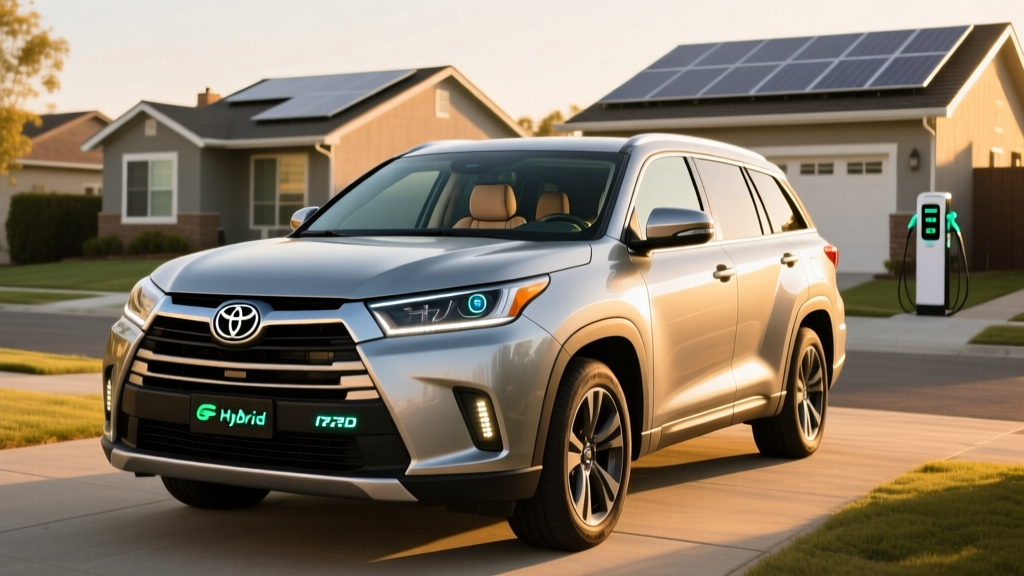
The 2020 Toyota Highlander Hybrid arrived as a full redesign, moving to Toyota's TNGA-K platform and swapping the old V6 hybrid system for a more efficient 2.5-liter four-cylinder hybrid powertrain. For families shopping the used three-row SUV market in 2026, it remains one of the most practical hybrid options available — delivering strong fuel economy without requiring a plug, a charging routine, or any change to how you drive.
This guide covers the exact EPA numbers, real-world MPG expectations, battery longevity data, and total cost of ownership so you can decide whether the 2020 Highlander Hybrid is the right fit versus a newer PHEV or a full battery-electric vehicle.
Fuel Economy: EPA Ratings and Real-World MPG
The 2020 Highlander Hybrid comes in front-wheel drive (FWD) and electronic all-wheel drive (AWD-e) configurations. The AWD-e model adds a rear electric motor for traction without a mechanical driveshaft, and the efficiency penalty is minimal.
| Drivetrain | City MPG | Highway MPG | Combined MPG |
|---|---|---|---|
| FWD (LE trim) | 36 | 35 | 36 |
| AWD-e (LE trim) | 35 | 35 | 35 |
| AWD-e (XLE, Limited, Platinum) | 35 | 34 | 35 |
Source: fueleconomy.gov
Powertrain Specs: What Moves the Highlander Hybrid
The 2020 model uses Toyota's fourth-generation hybrid system (THS IV), pairing a 2.5-liter Atkinson-cycle four-cylinder engine with two front electric motors (one for propulsion, one for starting/generating) and, on AWD-e models, a third independent motor at the rear axle.
| Specification | Value |
|---|---|
| Engine | 2.5L inline-4 Atkinson-cycle |
| Engine Power | 186 hp @ 6,000 rpm / 175 lb-ft torque |
| Front Electric Motors | 2 motor-generators (MG1, MG2) |
| Rear Electric Motor (AWD-e) | 54 hp / 89 lb-ft |
| Net Combined System Output | 243 hp |
| Transmission | eCVT (electronically controlled) |
| 0–60 MPH | ~7.8 seconds |
| Towing Capacity | 3,500 lbs (all trims) |
| Fuel Tank | 17.1 gallons |
| Total Driving Range | ~598 miles (FWD), ~581 miles (AWD-e) |
The eCVT is not a belt-and-pulley CVT — it uses a planetary gearset to blend power from the engine and electric motors seamlessly. There are no rubber bands or slipping sensations. Acceleration is linear and adequate for a 4,500-pound family hauler, though it won't win stoplight sprints.
HEV vs PHEV vs EV: Which Is Right for You?
The 2020 Highlander Hybrid is a conventional hybrid (HEV). This is an important distinction because Toyota does not offer a plug-in hybrid (PHEV) version of the Highlander — if you want a Toyota PHEV SUV, you'd look at the RAV4 Prime.
HEV (This Vehicle)
No plug needed. The battery recharges through regenerative braking and the gas engine. You fuel up at any gas station. Best for: drivers without home charging access, families who road-trip frequently, and those who want maximum simplicity.
PHEV (e.g., RAV4 Prime)
Plug in for 30–42 miles electric-only. Once the battery depletes, it operates as a regular hybrid. Best for: commuters with home charging who want electric-only daily driving but gas-engine range for road trips.
BEV (e.g., Tesla Model X, Kia EV9)
100% electric, 250–350+ mile range. No gas engine. Requires home or reliable public charging. Best for: households with Level 2 home charging, mostly predictable routes, and willingness to plan around DC fast charging on road trips.
- Choose the 2020 Highlander Hybrid if: You need three rows, don't have reliable home charging, road-trip often, and want to spend $25K–$35K on the used market.
- Choose a PHEV if: You have a two-car household, can install a Level 2 charger, and your daily commute is under 40 miles — but you still need gas-engine flexibility for longer trips.
- Choose a BEV if: You have home charging, your daily driving is under 250 miles, you want the lowest per-mile energy cost, and you're comfortable with DC fast charging on road trips.
Battery Health, Warranty, and Replacement Cost
The 2020 Highlander Hybrid uses a 1.6 kWh nickel-metal hydride (NiMH) traction battery pack. This is a small battery by EV standards — it's not designed for electric-only driving beyond very low-speed, short-distance creep. Its job is to buffer energy from regenerative braking and assist the gas engine during acceleration.
Toyota covers the hybrid battery for 10 years or 150,000 miles (whichever comes first) on 2020 models. This applies to the original owner and transfers to subsequent owners. Additional hybrid system components (inverter, control module, electric motors) carry the same 10-year/150,000-mile warranty. For a 2020 model purchased in 2026, you still have approximately 4 years or ~100,000+ miles of factory coverage remaining, assuming average mileage.
Real-World Battery Longevity
Toyota's hybrid batteries have an excellent longevity track record. Data from fleet operators and high-mileage owners shows NiMH packs in the Highlander Hybrid commonly lasting 180,000–250,000 miles before meaningful capacity loss. Unlike larger EV batteries, the hybrid pack operates in a narrow state-of-charge window (roughly 40–80%), which drastically reduces degradation stress.
If the battery does eventually need replacement outside of warranty:
- New OEM battery from Toyota: $3,000–$4,500 (parts + labor at a dealer)
- Refurbished/remanufactured battery: $1,500–$2,500 (from third-party suppliers like Green Bean Battery)
- Individual module replacement: $500–$1,200 (if only a few cells have failed — requires a specialist shop)
The key takeaway: hybrid battery replacement is far cheaper than a full EV battery swap, and the likelihood of needing one during typical ownership (5–7 years, 60,000–90,000 miles) is very low.
Pricing and Tax Credit Eligibility (2026 Used Market)
When new, the 2020 Highlander Hybrid started at $38,200 (LE FWD) and climbed to roughly $50,000 (Platinum AWD-e) with options. On the used market in early 2026, expect to pay:
| Trim | Typical Mileage | Used Price Range |
|---|---|---|
| LE FWD/AWD-e | 50,000–80,000 mi | $25,000–$29,000 |
| XLE AWD-e | 45,000–75,000 mi | $28,000–$33,000 |
| Limited AWD-e | 40,000–70,000 mi | $31,000–$36,000 |
| Platinum AWD-e | 35,000–65,000 mi | $34,000–$40,000 |
Does It Qualify for a Tax Credit?
The 2020 Highlander Hybrid does not qualify for the federal §30D new clean vehicle credit — it's a conventional hybrid, not a plug-in vehicle. It also does not qualify for the used clean vehicle credit (up to $4,000 or 30% of sale price, max $4,000), because that credit requires a plug-in electric vehicle (BEV or PHEV) with at least 7 kWh of battery capacity.
However, some states and utilities offer rebates for purchasing any hybrid vehicle. Check your state's energy office or utility provider for local programs. A few states with active hybrid incentives include Colorado, Maryland, and Connecticut — though amounts and eligibility vary, and programs change frequently. Always verify current incentives through your state's official energy or environmental agency website.
Ownership Costs: 5-Year Comparison
To put the Highlander Hybrid's value in perspective, here's a five-year cost comparison against the gas-only 2020 Highlander (3.5L V6, 295 hp, EPA 23 MPG combined) and a comparable BEV three-row SUV.
| Cost Category | Highlander Hybrid (AWD-e) | Highlander Gas V6 (AWD) | BEV 3-Row SUV (e.g., Kia EV9) |
|---|---|---|---|
| Fuel / Energy | $7,500 | $11,700 | $3,900 (home charging) |
| Maintenance | $2,800 | $3,500 | $1,800 |
| Insurance (avg) | $8,500 | $8,200 | $9,800 |
| Depreciation (est.) | $12,000 | $14,000 | $18,000 |
| Total (excl. purchase) | $30,800 | $37,400 | $33,500 |
Fuel costs assume $3.50/gallon gas and $0.14/kWh electricity. Actual costs vary by region, driving habits, and insurance profile. Source methodology based on fueleconomy.gov data.
The hybrid saves roughly $6,600 over five years compared to the gas V6, primarily through fuel savings and slightly lower maintenance (less brake wear from regenerative braking, no timing belt). The BEV saves more on fuel but carries higher insurance and depreciation costs in the current market.
Pros and Cons at a Glance
✓ Pros
- 35–36 MPG combined EPA; often exceeds in city driving
- No plug required — zero lifestyle change from a gas car
- 10-year/150,000-mile hybrid battery warranty (strong remaining coverage on 2020 models)
- 3,500-lb towing capacity (best in hybrid SUV class)
- Proven Toyota reliability; low maintenance costs
- AWD-e provides confident traction without efficiency penalty
- Third-row seating for up to 8 passengers (LE/XLE bench)
✗ Cons
- Modest 243 hp — acceleration is adequate, not quick (7.8s 0–60)
- Highway MPG drops to ~30–32 at 75+ MPH
- No PHEV variant available — no electric-only driving mode
- Third row is tight for adults; best for children
- Infotainment (2020 system) feels dated vs. 2024+ models
- No federal tax credit eligibility (new or used)
- Cargo space (16.1 cu ft behind 3rd row) is below class average
Frequently Asked Questions
How many MPG does the 2020 Toyota Highlander Hybrid actually get?
The EPA rates it at 35–36 MPG combined depending on drivetrain and trim. In real-world mixed driving, most owners report 34–38 MPG, with city driving often pushing above the EPA estimate and sustained highway driving dropping to 30–32 MPG. Cold weather reduces efficiency by about 3–5 MPG until the engine warms up.
Can I plug in the Highlander Hybrid to charge?
No. The 2020 Highlander Hybrid is a conventional hybrid (HEV), not a plug-in hybrid (PHEV). The 1.6 kWh battery recharges exclusively through regenerative braking and the gasoline engine. You never plug it in — you simply fill up at a gas station like any other car.
Is the hybrid battery reliable and what does replacement cost?
Toyota's hybrid batteries are among the most reliable in the industry. The NiMH pack in the Highlander Hybrid typically lasts 180,000–250,000 miles. Toyota's 10-year/150,000-mile hybrid battery warranty still has meaningful remaining coverage on a 2020 model in 2026. If replacement is ever needed, expect $3,000–$4,500 for a new OEM battery or $1,500–$2,500 for a refurbished unit.
Does the 2020 Highlander Hybrid qualify for any tax credit?
No federal tax credit applies. The §30D new vehicle credit and the used clean vehicle credit both require plug-in electric vehicles (BEVs or PHEVs) with minimum battery capacities. Conventional hybrids do not qualify. Some state and utility programs may offer small rebates for hybrid purchases — check your local energy agency for current programs.
How does the Highlander Hybrid compare to a three-row EV like the Kia EV9?
The EV9 offers 270–304 miles of EPA range, lower per-mile energy costs, and a smoother, quieter ride — but starts around $55,000+ new, requires home charging infrastructure, and adds complexity for road trips (DC fast charging planning). The used 2020 Highlander Hybrid costs $25K–$40K, needs no charging setup, and provides 580+ miles of total range per tank. For families without reliable home charging or who frequently drive 400+ miles in a day, the hybrid remains the more practical choice.
What's the difference between the Highlander Hybrid and the RAV4 Prime?
The RAV4 Prime is a plug-in hybrid (PHEV) with 42 miles of electric-only range, a 18.1 kWh battery, and 302 combined hp. It qualifies for potential tax credits and can drive purely on electricity for most commutes. However, it only has two rows of seating and a smaller cargo area. If you need three rows and don't want to plug in, the Highlander Hybrid is the right Toyota. If two rows work and you have home charging, the RAV4 Prime offers more electric versatility.
For official fuel economy data, see fueleconomy.gov. For current federal tax credit rules, consult IRS.gov §30D guidance. Safety ratings available at NHTSA.gov.