Quick Verdict: The Sportiest Camry Hybrid You Can Buy Used
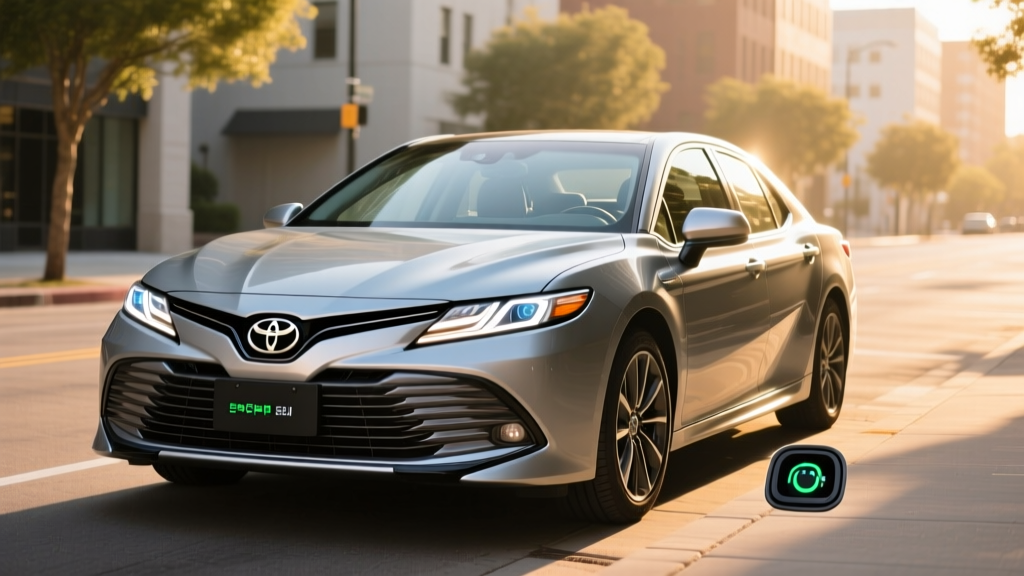
The 2020 Toyota Camry Hybrid SE occupies a specific niche in the midsize sedan market: it pairs Toyota's proven hybrid synergy drive with a sport-tuned suspension, 18-inch alloy wheels, and a more aggressive exterior treatment. For buyers shopping the used market in 2026, it represents one of the most efficient non-plug-in sedans available, with an EPA-rated 46 MPG combined and a track record of exceptional powertrain reliability.
This is a conventional hybrid (HEV), not a plug-in. You never plug it in — the 1.6 kWh nickel-metal hydride battery charges exclusively through regenerative braking and the gasoline engine. If you want electric-only driving, you'd need to look at a PHEV like the discontinued Prius Prime or a full BEV. But if your goal is maximum fuel efficiency with zero charging hassle, the Camry Hybrid SE delivers.
EPA Fuel Economy vs. Real-World MPG
| Metric | Rating |
|---|---|
| City MPG | 44 MPG |
| Highway MPG | 47 MPG |
| Combined MPG | 46 MPG |
| Fuel Tank Capacity | 13.2 gallons |
| Total Range | ~607 miles |
Source: fueleconomy.gov
The SE trim's 18-inch wheels and slightly wider tires carry a small efficiency penalty compared to the LE trim's 16-inch wheels (the LE is rated at 51/53/52 MPG). You trade roughly 5-6 MPG for the sportier handling and aesthetics.
Powertrain: Engine, Motor, and Combined Output
The 2020 Camry Hybrid SE uses Toyota's fourth-generation Hybrid Synergy Drive, pairing a 2.5-liter Dynamic Force four-cylinder engine with an electric motor and a continuously variable transmission (eCVT).
| Component | Specification |
|---|---|
| Engine | 2.5L 4-cylinder Dynamic Force (A25A-FXS) |
| Engine Power | 176 HP @ 5,700 RPM / 163 lb-ft torque |
| Electric Motor | Permanent magnet synchronous (88 kW / 118 HP) |
| Combined Net Horsepower | 208 HP |
| Transmission | eCVT (planetary gearset, not belt-driven) |
| 0-60 MPH | ~7.5 seconds |
| Drivetrain | Front-wheel drive |
| Drive Modes | NORMAL / ECO / EV / SPORT |
The SE trim specifically includes a sport-tuned suspension with stiffer dampers and a unique calibration for the electric power steering. It also features paddle shifters that simulate six "gears" in the eCVT for a more engaging feel, though this is purely a software emulation — there are no physical gears to shift.
EV Mode allows short-distance, low-speed electric-only driving (typically under 1 mile at speeds below 25 MPH), useful for creeping through a parking garage or quiet neighborhood. This is not comparable to a PHEV's electric range — the battery is far too small to sustain highway-speed electric driving.
HEV vs. PHEV vs. BEV: Which Powertrain Fits You?
Buyers cross-shopping the used 2020 Camry Hybrid SE often wonder whether they should consider a plug-in hybrid or full electric vehicle instead. Here's the decision framework:
| Factor | HEV (Camry Hybrid) | PHEV (e.g., Prius Prime) | BEV (e.g., Tesla Model 3) |
|---|---|---|---|
| Plug-in Charging Required? | No | Yes (for EV range) | Yes (always) |
| Electric-Only Range | <1 mile at low speed | 25-40 miles typical | 250-350+ miles |
| Total Range | ~607 miles | ~600+ miles (EV + gas) | 250-350 miles |
| Home Charging Needed? | No | Recommended (120V OK) | Essential (240V ideal) |
| Federal Tax Credit (New) | None | Up to $7,500 (§30D) | Up to $7,500 (§30D) |
| Maintenance Complexity | Low (proven) | Moderate (two systems) | Lowest (no engine) |
| Best For | No charging access, high mileage | Short commutes + home charging | Home charging + daily <250 mi |
Battery Health, Warranty, and Replacement Cost
The 2020 Camry Hybrid SE uses a 1.6 kWh nickel-metal hydride (NiMH) traction battery pack located beneath the rear seat. This is a mature, well-understood chemistry that Toyota has used in its hybrids since the original Prius. NiMH batteries are less energy-dense than the lithium-ion packs in PHEVs and BEVs, but they are extremely durable and tolerant of the shallow charge-discharge cycles that characterize hybrid operation.
Toyota's hybrid battery warranty for the 2020 Camry Hybrid is 10 years / 150,000 miles (whichever comes first) in states that follow California emissions standards (CA, CT, ME, MD, MA, NJ, NY, OR, RI, VT, WA). In all other states, coverage is 8 years / 100,000 miles. This warranty covers battery capacity loss below a defined threshold and defects. The hybrid system components (inverter, motor, control unit) carry the same coverage.
Real-world battery longevity: Data from fleet operators and high-mileage owners consistently shows Toyota hybrid NiMH batteries lasting 150,000-200,000+ miles with gradual capacity loss. Because the battery management system keeps the pack in a narrow state-of-charge window (roughly 40-80%), deep degradation is rare. Most owners will sell the car before the battery needs replacement.
Replacement cost if needed out of warranty: A new OEM hybrid battery from Toyota runs approximately $2,500-$3,500 for parts alone, with labor adding $300-$600. Refurbished/reconditioned packs are available from third-party shops for $1,200-$2,000 installed. Individual module replacement (only the weak cells) can cost $500-$1,000 at a hybrid specialist.
Pricing, Trim Details, and Tax Credit Eligibility
The 2020 Camry Hybrid SE had an original MSRP of approximately $29,195 (including destination). In the used market as of early 2026, expect to pay between $18,000 and $24,000 depending on mileage, condition, and region, based on Kelley Blue Book and Edmunds transaction data.
| Feature | Specification |
|---|---|
| Wheels | 18-inch black machined alloy |
| Suspension | Sport-tuned independent MacPherson front / multilink rear |
| Infotainment | 7-inch touchscreen, Apple CarPlay, Android Auto, Amazon Alexa |
| Safety Suite | Toyota Safety Sense 2.0 (pre-collision, lane departure, dynamic radar cruise, auto high beams) |
| Climate | Automatic single-zone climate control |
| Seating | SofTex-trimmed front seats, 8-way power driver |
| Cargo Volume | 15.1 cu ft trunk (battery does not intrude) |
Federal tax credit: As a conventional hybrid (HEV), the Camry Hybrid does not qualify for the IRS §30D New Clean Vehicle Credit. That credit applies only to plug-in electric vehicles (PHEVs and BEVs) meeting battery sourcing and MSRP/income requirements. There is no federal tax incentive for purchasing a conventional hybrid, new or used.
State incentives: A small number of states offer rebates or HOV lane access for hybrids, but most have shifted incentives toward plug-in vehicles. Check your state's energy office or DMV for current programs — these vary significantly by jurisdiction and change frequently.
Reliability, Safety Ratings, and Ownership Costs
The 2020 Camry Hybrid benefits from Toyota's longstanding reputation for hybrid reliability. The A25A-FXS engine uses a timing chain (not a belt), the eCVT has no friction bands or clutches to wear, and regenerative braking significantly extends brake pad life — many owners report 60,000-80,000 miles on original brake pads.
Safety ratings: The 2020 Camry earned the IIHS Top Safety Pick+ award with Good ratings in all crashworthiness tests and a Superior rating for front crash prevention. The NHTSA awarded it 5 stars overall. Source: IIHS.
Estimated 5-year ownership costs:
- Fuel: At 15,000 miles/year, 46 MPG combined, and $3.40/gallon national average — approximately $1,108/year or $5,540 over 5 years.
- Maintenance: Toyota's hybrid maintenance schedule is similar to a gas Camry (oil changes every 10,000 miles with synthetic). Budget $400-$600/year.
- Insurance: Hybrid Camrys carry a slight premium over gas models (roughly 5-8% higher) due to higher repair costs for the hybrid system. Expect $1,400-$1,800/year depending on your profile.
- Depreciation: Camry Hybrids hold value well. A 2020 model purchased at $21,000 in 2026 might be worth $14,000-$16,000 by 2031 — roughly 25-30% depreciation over the next 5 years.
Compared to a gas-only 2020 Camry SE (rated at 29 MPG combined), the Hybrid saves roughly $700-$900/year in fuel at current prices, paying back any used-market price premium within 2-3 years.
Pros and Cons
Pros
- 46 MPG combined (real-world city often exceeds EPA)
- 10-year/150k-mile hybrid battery warranty (CARB states)
- Sport-tuned suspension sets it apart from LE/XLE trims
- No charging infrastructure needed — just fill up with gas
- Toyota Safety Sense 2.0 standard (adaptive cruise, lane keep)
- Strong resale value and proven long-term reliability
- 15.1 cu ft trunk with no battery intrusion
Cons
- 5-6 MPG penalty vs. LE trim due to 18-inch wheels
- No federal tax credit (HEV, not a plug-in)
- eCVT drone under hard acceleration (no physical gears)
- EV Mode limited to <1 mile at very low speeds
- Single-zone climate on SE (dual-zone on XLE)
- 7-inch screen feels dated vs. 2024+ models
- Road noise noticeable on coarse pavement with sport tires
Frequently Asked Questions
How many MPG does the 2020 Toyota Camry Hybrid SE actually get?
The EPA rates it at 44 city / 47 highway / 46 combined. In real-world driving, city mileage frequently reaches 48-52 MPG thanks to aggressive regenerative braking in stop-and-go traffic. Highway cruising at 75 MPH typically yields 40-43 MPG. Cold weather and aggressive acceleration reduce these figures by 5-10%.
Does the Camry Hybrid SE need to be plugged in?
No. This is a conventional hybrid (HEV), not a plug-in hybrid (PHEV). The 1.6 kWh battery charges entirely through regenerative braking and the gasoline engine. You fuel it exactly like a regular gas car — there is no charging port.
How far can it drive on electric power alone?
In EV Mode, the Camry Hybrid SE can travel roughly 0.5-1 mile at speeds under 25 MPH on a fully charged hybrid battery. This is useful for parking garages or very short residential blocks. It cannot sustain highway speeds on electric power. If you need meaningful electric-only range (25-40 miles), you need a PHEV like the RAV4 Prime or Prius Prime.
Is the 2020 Camry Hybrid reliable, and what does battery replacement cost?
Toyota's hybrid powertrain is among the most reliable in the industry. The hybrid battery is warrantied for 10 years/150,000 miles in CARB states and 8 years/100,000 miles elsewhere. Real-world data shows these NiMH packs routinely lasting 150,000-200,000+ miles. If replacement is needed out of warranty, expect $2,500-$4,000 for a new OEM pack installed, or $1,200-$2,000 for a refurbished unit.
Does the 2020 Camry Hybrid qualify for any tax credit?
No. The IRS §30D New Clean Vehicle Credit applies only to plug-in electric vehicles (PHEVs and BEVs). Conventional hybrids like the Camry Hybrid are not eligible for any federal purchase incentive, whether bought new or used. Some states may offer minor incentives — check your local programs.
Should I buy the Camry Hybrid SE or a full electric vehicle?
Choose the Camry Hybrid SE if you lack home charging access, regularly drive 300+ miles between fill-ups, live in an area with sparse public charging, or want the lowest-risk transition from a gas car. Choose a BEV if you have reliable home Level 2 charging, your daily driving is under 250 miles, you want to eliminate oil changes and gasoline costs entirely, and you can access the §30D tax credit on a new EV purchase. A PHEV splits the difference if your commute is short but you still take road trips.
What is the difference between the SE and LE Camry Hybrid trims?
The LE prioritizes maximum efficiency (52 MPG combined on 16-inch wheels) and a softer ride. The SE adds 18-inch alloy wheels, a sport-tuned suspension, paddle shifters, a black rear spoiler, and SofTex sport seats — at the cost of roughly 6 MPG. Both share the identical 208 HP hybrid powertrain and battery system.