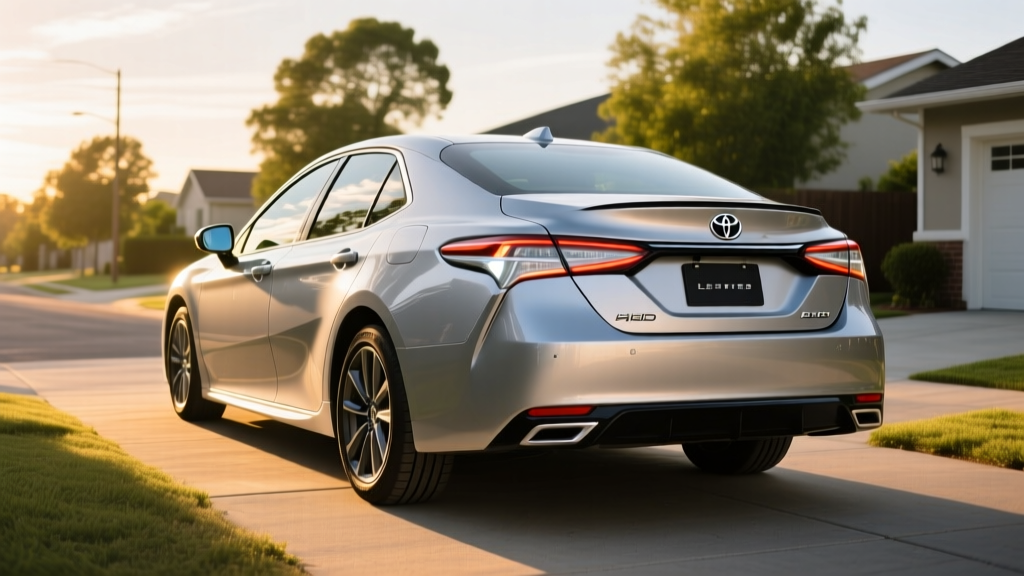
The 2020 Toyota Camry Hybrid sits at an inflection point in Toyota's midsize sedan lineup. It was the last model year before Toyota introduced the redesigned 2021 Camry with updated infotainment and standard Toyota Safety Sense 2.5. For used-car shoppers in 2026, that makes the 2020 model a value proposition: proven fifth-generation hybrid hardware, exceptional fuel economy, and depreciation that has already absorbed the new-car premium. Here is everything you need to evaluate one today.
HEV vs. PHEV vs. EV: Where the 2020 Camry Hybrid Fits
The 2020 Camry Hybrid is a conventional hybrid electric vehicle (HEV). It cannot be plugged in. Its small traction battery recharges through regenerative braking and the gasoline engine. This is fundamentally different from a plug-in hybrid (PHEV) like the Toyota RAV4 Prime, which offers 42 miles of electric-only driving and qualifies for federal tax credits, or a battery-electric vehicle (BEV) like the Tesla Model 3.
| Attribute | HEV (Camry Hybrid) | PHEV (e.g., RAV4 Prime) | BEV (e.g., Model 3) |
|---|---|---|---|
| Plug-in charging | No | Yes (Level 1/2) | Yes (Level 1/2/DC) |
| Electric-only range | ~1 mi at low speed | 25–42 mi typical | 250–360 mi EPA |
| Gasoline engine | Yes (primary) | Yes (backup) | None |
| Federal §30D tax credit | Not eligible (new); possible used credit | Eligible when new (subject to sourcing) | Eligible when new (subject to sourcing) |
| Home charger needed | No | Recommended | Essential |
If you lack access to home or workplace charging, the HEV architecture of the 2020 Camry Hybrid is a practical advantage: you simply fuel up at any gas station and the hybrid system handles the rest.
Fuel Economy: EPA Ratings and Real-World MPG
The 2020 Camry Hybrid comes in three trims — LE, SE, and XLE — and fuel economy varies by trim because of wheel size, weight, and tire differences. The LE trim is the efficiency champion.
| Trim | City MPG | Highway MPG | Combined MPG |
|---|---|---|---|
| LE | 51 | 53 | 52 |
| SE | 44 | 47 | 46 |
| XLE | 44 | 47 | 46 |
Source: EPA fueleconomy.gov
Real-World MPG: What Owners Actually See
Toyota hybrids historically exceed their EPA city ratings in stop-and-go driving because regenerative braking recaptures energy that a gas car wastes as heat. In mixed suburban and city driving, many Camry Hybrid LE owners report 50–55 MPG in warm weather. Highway-only driving at 75+ MPH tends to drop to 42–46 MPG for the LE trim because the aerodynamic drag of a midsize sedan works against the hybrid system's city-biased advantage.
In cold weather (below 35°F), expect a 5–10% fuel economy reduction. The engine runs longer to heat the cabin and bring the catalytic converter to operating temperature, reducing the time the car spends in electric-only mode at low speeds.
Powertrain and Performance Specs
The 2020 Camry Hybrid pairs a 2.5-liter Dynamic Force four-cylinder engine (176 HP, 163 lb-ft torque) with a permanent-magnet synchronous electric motor integrated into the transaxle. Combined system output is 208 horsepower. Power routes through an electronically controlled continuously variable transmission (eCVT) — Toyota's planetary gearset design, not a belt-driven CVT.
| Engine | 2.5L inline-4 (A25A-FXS) |
| Engine power | 176 HP @ 5,700 RPM |
| Electric motor power | 88 kW (118 HP) |
| Combined system output | 208 HP |
| Transmission | eCVT (planetary gearset) |
| 0–60 MPH | ~7.5 seconds |
| Drivetrain | Front-wheel drive |
| Hybrid battery | 1.6 kWh nickel-metal hydride (NiMH), 245V |
| Fuel tank | 13.2 gallons |
| Total driving range | ~686 miles (LE, combined EPA) |
The 1.6 kWh NiMH battery pack is small by modern standards — it stores roughly 0.6 kWh of usable energy. That is intentional. Toyota's Hybrid Synergy Drive uses the battery as a buffer for regenerative energy capture and electric assist, not as a primary energy source. The car can creep on electric power alone for roughly one mile at very low speeds (under 25 MPH), but this is not a meaningful electric-only driving mode.
Battery Warranty, Lifespan, and Replacement Cost
Hybrid battery longevity is the single most common concern among used hybrid buyers. Here is the data:
2020 Camry Hybrid Battery Warranty
- Hybrid battery: 10 years / 150,000 miles (in California Air Resources Board states); 8 years / 100,000 miles (all other states)
- Hybrid system components: 8 years / 100,000 miles nationwide (inverter, transaxle, control module)
- Basic warranty: 3 years / 36,000 miles
- Powertrain warranty: 5 years / 60,000 miles
For a 2020 model in 2026, the original factory hybrid battery warranty may still apply if the vehicle has under 150,000 miles and is registered in a CARB state (CA, CO, CT, ME, MD, MA, NJ, NY, OR, RI, VT, WA). Verify warranty transferability with a Toyota dealer using the VIN.
Real-World Battery Degradation
Toyota's NiMH hybrid batteries have an extensive track record. Data from fleet operators and owner surveys indicate that Camry and Prius hybrid batteries typically retain 85–90% of their original capacity after 150,000 miles. Unlike large BEV batteries, the small NiMH pack in the Camry Hybrid is shallow-cycled — it rarely drops below 40% or charges above 80% state of charge, which dramatically extends cycle life.
When replacement is needed, a new OEM hybrid battery from Toyota costs approximately $2,500–$3,500 including labor at a dealership. Independent hybrid specialists often offer refurbished or reconditioned packs for $1,500–$2,200 installed. Given that the hybrid battery is one of the few expensive components unique to the hybrid system, this replacement cost is modest relative to the fuel savings accumulated over the battery's lifespan.
Maintaining Hybrid Battery Health
There is little an owner needs to do. The battery management system handles thermal regulation and charge limits automatically. The most impactful practice is driving the car regularly — prolonged storage (weeks without use) at very high or very low state of charge can stress NiMH cells. For daily drivers, the system is essentially maintenance-free.
Pricing in 2026: Used Market Values
The 2020 Camry Hybrid has depreciated significantly from its original MSRP ($28,430–$32,685 depending on trim). As of early 2026, typical used-market pricing is:
- LE trim, 50,000–70,000 miles: $17,000–$20,000
- SE trim, 50,000–70,000 miles: $18,500–$21,500
- XLE trim, 50,000–70,000 miles: $20,000–$24,000
Vehicles with under 40,000 miles or certified pre-owned (CPO) status command a $2,000–$4,000 premium. CPO Toyotas carry an additional 12-month/12,000-mile comprehensive warranty and a 7-year/100,000-mile powertrain warranty from the original date of sale, which can extend hybrid system coverage.
Tax Credit Eligibility
The 2020 Camry Hybrid did not qualify for the federal §30D new clean vehicle credit when sold new — conventional HEVs are excluded. However, if you purchase one as a used vehicle from a licensed dealer in 2026, it may qualify for the §25E Used Clean Vehicle Credit of up to $4,000 (30% of the sale price, capped at $4,000), provided:
- The sale price is $25,000 or less
- Your modified adjusted gross income does not exceed $75,000 (single), $112,500 (head of household), or $150,000 (joint)
- The vehicle is at least two model years old (a 2020 model qualifies)
- You purchase from a licensed dealer (private-party sales are excluded)
- You have not claimed the used-vehicle credit in the prior three years
Consult IRS guidance on §25E or a tax professional to confirm eligibility for your specific situation.
Reliability and Ownership Costs
The 2020 Camry Hybrid benefits from Toyota's reputation for hybrid powertrain durability. The A25A-FXS engine uses Toyota's D-4S dual injection (port + direct) and has shown no widespread failure patterns in NHTSA complaint data. The eCVT planetary gearset has no belts, clutches, or bands to wear — it is one of the most mechanically simple and reliable transmissions in production.
The Insurance Institute for Highway Safety (IIHS) named the 2020 Camry a Top Safety Pick when equipped with specific headlights, and NHTSA awarded it a 5-star overall safety rating. Toyota Safety Sense-P (TSS-P) was standard on all trims, including pre-collision braking with pedestrian detection, full-speed adaptive cruise control, lane departure alert with steering assist, and automatic high beams.
Five-Year Ownership Cost Estimate
For a 2020 Camry Hybrid LE purchased at $18,500 with 60,000 miles, driven 12,000 miles per year at a national average gas price of $3.20/gallon:
- Annual fuel cost: ~$738 (at 52 MPG combined)
- 5-year fuel cost: ~$3,690
- Comparable gas-only midsize sedan (30 MPG): ~$6,400 over 5 years
- 5-year fuel savings vs. gas sedan: ~$2,710
Insurance premiums for the Camry Hybrid are typically 5–10% higher than the gas-only Camry due to the higher repair cost of hybrid-specific components after a collision, but this varies significantly by carrier and driver profile.
Who Should Choose the 2020 Camry Hybrid?
Pros
- 52 MPG combined (LE) — among the best of any midsize sedan ever sold
- No plug-in charging required — ideal for apartment dwellers and street parkers
- 686-mile total range eliminates fuel stops on long road trips
- Proven hybrid reliability with strong used-market parts availability
- Standard Toyota Safety Sense-P (adaptive cruise, auto-braking, lane-keep)
- Spacious rear seat and 15.1 cu-ft trunk — no cargo compromise vs. gas Camry
- Potential $4,000 used-vehicle tax credit (income and price caps apply)
Cons
- Dated infotainment — no wireless Apple CarPlay/Android Auto, small 7-inch or 9-inch screen
- SE and XLE trims drop to 46 MPG combined (still strong, but a 6-MPG gap)
- No all-wheel-drive option (AWD-e was added for 2021+ Camry Hybrid)
- NiMH battery (not lithium-ion) — heavier and lower energy density, though durable
- Modest 208 HP — adequate for commuting, not sporty
- Factory warranty may be expiring depending on mileage and state
Decision Framework: Camry Hybrid vs. Alternatives
Choose the 2020 Camry Hybrid if:
- You drive 10,000–20,000+ miles per year and want to minimize fuel cost without changing your fueling routine
- You lack reliable access to home or workplace EV charging
- You want a midsize sedan with strong safety ratings, a spacious trunk, and proven long-term reliability
- Your budget is $17,000–$24,000 for a used vehicle
Look at a PHEV (e.g., RAV4 Prime, Prius Prime) if:
- You have home Level 2 charging and a commute under 30–40 miles round-trip
- You want to drive mostly on electricity but still take gas-powered road trips
- You qualify for a larger used-vehicle tax credit on a PHEV (same §25E rules apply)
Look at a full BEV if:
- You have reliable home charging and want zero tailpipe emissions
- Your daily driving is under 250 miles and you rarely take road trips beyond DC fast-charger coverage
- You want to eliminate oil changes, spark plugs, and transmission fluid entirely
Frequently Asked Questions
How many MPG does the 2020 Toyota Camry Hybrid get?
The LE trim achieves 51 city / 53 highway / 52 combined MPG per the EPA. The SE and XLE trims rate at 44 city / 47 highway / 46 combined. Real-world city driving often exceeds the EPA city number, while sustained highway driving at 75+ MPH typically returns 42–46 MPG for the LE.
Does the 2020 Camry Hybrid need to be plugged in?
No. The 2020 Camry Hybrid is a conventional HEV. Its battery recharges through regenerative braking and the gasoline engine. There is no charging port and no plug. If you want plug-in capability, you need a PHEV like the Prius Prime.
Is the 2020 Camry Hybrid reliable?
Yes. Toyota's Hybrid Synergy Drive is one of the most proven electrified powertrains in production, with millions of units on the road globally. The eCVT has no wear-prone friction components. NHTSA complaint data for the 2020 model year shows no systemic powertrain failure patterns. The main wear items are the same as any car: brakes, tires, suspension bushings.
What does a hybrid battery replacement cost?
A new OEM hybrid battery from a Toyota dealer costs approximately $2,500–$3,500 installed. Refurbished packs from independent hybrid specialists run $1,500–$2,200 installed. Most Camry Hybrid batteries last well beyond 150,000 miles with minimal capacity loss due to the shallow-cycle battery management strategy.
Does the 2020 Camry Hybrid qualify for any tax credit?
It did not qualify for the federal new-vehicle EV credit (§30D) when sold new, as conventional hybrids are excluded. However, as a used vehicle purchased from a dealer in 2026 for $25,000 or less, it may qualify for the §25E Used Clean Vehicle Credit of up to $4,000, subject to buyer income limits and the three-year claim restriction. Check IRS §25E rules for current eligibility.
How does the 2020 Camry Hybrid compare to the 2020 Honda Accord Hybrid?
The Accord Hybrid rates at 48 MPG combined (EPA) versus the Camry Hybrid LE's 52 MPG combined. The Accord offers slightly more rear legroom and a more refined infotainment system, but the Camry edges it on fuel economy and offers a lower used-market entry price. Both are strong choices; the Camry wins on pure efficiency.