The 2020 Lexus NX 300h occupies a specific niche in the luxury compact crossover segment: a conventional hybrid (HEV) that prioritizes fuel efficiency and refinement without requiring a plug. For buyers researching a 2020 Lexus NX hybrid NX 300h wrap kit to personalize their vehicle — or evaluating whether this HEV still makes sense in 2026 — this guide covers the powertrain specs, real-world MPG, battery longevity, and customization considerations you need before committing.
The NX 300h was discontinued after the 2021 model year and replaced by the redesigned NX 350h (and the plug-in NX 450h+). That makes the 2020 model a strong used-market contender today, often available between $24,000 and $31,000 depending on mileage and condition. Let's break down exactly what you're getting.
HEV vs PHEV: What the NX 300h Actually Is
Before diving into specs, it's critical to understand what the NX 300h is — and what it isn't. This is a conventional hybrid (HEV), not a plug-in hybrid (PHEV). That distinction drives everything about ownership.
| Feature | HEV (NX 300h) | PHEV (e.g., NX 450h+) | BEV (e.g., RZ 450e) |
|---|---|---|---|
| Plugs in? | No — self-charging via regen + engine | Yes — Level 1/2 charging | Yes — Level 1/2/DC fast charging |
| Electric-only range | ~1 mile at low speed | ~37 miles (NX 450h+) | 220+ miles |
| Battery size | 1.6 kWh (NiMH) | 18.1 kWh (Li-ion) | 71.4 kWh (Li-ion) |
| Federal tax credit | None (expired for Lexus HEVs) | Up to $7,500 (§30D, if eligible) | Up to $7,500 (§30D, if eligible) |
| Best for | No home charging access; simple ownership | Short commutes + road trip flexibility | Home charging + mostly electric driving |
The NX 300h's small 1.6 kWh nickel-metal hydride (NiMH) battery charges itself through regenerative braking and the gasoline engine. You never plug it in. The electric motor assists the engine during acceleration and enables brief low-speed electric-only movement (typically under 25 mph, for roughly a mile), but the engine is always doing the heavy lifting. This is fundamentally different from a PHEV, which can operate as a true electric car for a meaningful distance before the engine kicks in.
Powertrain and Performance Specs
| Specification | 2020 Lexus NX 300h |
|---|---|
| Engine | 2.5L inline-4 Atkinson cycle |
| Electric motors | Front motor + rear motor (AWD) |
| Combined system output | 194 hp |
| Transmission | eCVT (electronically controlled CVT) |
| Drivetrain | AWD (electric rear axle, no mechanical driveshaft) |
| Battery type / capacity | NiMH / 1.6 kWh |
| 0-60 mph | ~9.0 seconds |
| Towing capacity | Not rated for towing |
| Curb weight | ~4,070 lbs |
The 194 hp combined output sounds modest, and the 9.0-second 0-60 time confirms this isn't a performance-oriented crossover. The eCVT keeps engine revs steady and the electric motor fills in torque at low speeds, which makes around-town driving feel smoother than the numbers suggest. Highway passing requires planning — the engine drones noticeably under hard acceleration, a characteristic trait of Toyota/Lexus eCVT systems.
The AWD system is worth noting: there's no traditional driveshaft connecting the front and rear axles. Instead, a dedicated rear electric motor engages when the system detects front-wheel slip or when extra traction is needed. This setup is lightweight and efficient, but it's designed for light-duty traction (rain, light snow), not off-road use.
Fuel Economy: EPA Ratings vs Real-World MPG
Fuel efficiency is the NX 300h's primary selling point. Here's how the EPA rates it, according to fueleconomy.gov:
| Driving Cycle | EPA MPG | Real-World Expectation |
|---|---|---|
| City | 33 MPG | 33-36 MPG (hybrids often beat EPA in city) |
| Highway | 30 MPG | 27-30 MPG (hybrids lose advantage at sustained speed) |
| Combined | 31 MPG | 29-34 MPG (varies by driving mix) |
Why city MPG exceeds highway: Conventional hybrids recapture energy during stop-and-go braking via regeneration, and the electric motor handles low-speed driving where gasoline engines are least efficient. At sustained highway speeds (70-80 mph), aerodynamic drag dominates and the engine carries the full load — reducing the hybrid advantage.
In real-world ownership, many NX 300h drivers report averaging 30-34 MPG across mixed driving, which is strong for a luxury AWD crossover. For comparison, the non-hybrid 2020 NX 300 (turbocharged gas model) is EPA-rated at 24 MPG combined — roughly a 29% improvement for the hybrid. Over 15,000 miles annually at $3.50/gallon, that's approximately $550/year in fuel savings.
Battery Longevity, Warranty, and Replacement Cost
2020 NX 300h Hybrid Battery Coverage
- Original warranty: 8 years / 100,000 miles (10 years / 150,000 miles in CARB states including CA, NY, MA, and others adopting California emissions standards)
- Battery type: Nickel-metal hydride (NiMH) — proven, durable chemistry with decades of Toyota/Lexus field data
- Expected lifespan: 150,000-200,000+ miles based on Prius and RX 400h/450h fleet data
- Replacement cost (2026 estimate): $2,500-$4,000 for a refurbished or new OEM battery pack installed at a dealership; independent hybrid shops may offer reconditioned packs for $1,800-$2,800
The NiMH battery in the NX 300h is one of the most proven hybrid battery packs in the industry. Toyota and Lexus have been deploying NiMH chemistry since the original Prius in 1997, and failure rates on these packs are remarkably low within the warranty period. Degradation is gradual — you may notice slightly reduced electric-assist availability and a 1-2 MPG drop over 100,000+ miles, but catastrophic failure is uncommon.
For a 2020 model purchased in 2026, the original 8-year/100,000-mile warranty may still be partially active (expiring in 2028 by time, or earlier if the odometer exceeds 100,000 miles). If you're buying in a CARB state, the extended 10-year/150,000-mile coverage provides protection through 2030. Always verify warranty transferability with a Lexus dealer using the VIN before purchase.
Practical tip: Hybrid battery health can be checked via an OBD-II scanner app (such as Dr. Prius or Hybrid Assistant) that reads individual cell voltages and internal resistance. If you're evaluating a used NX 300h, this $20 investment can reveal whether the battery is healthy or approaching end-of-life.
Wrap Kit Customization: What NX 300h Owners Need to Know
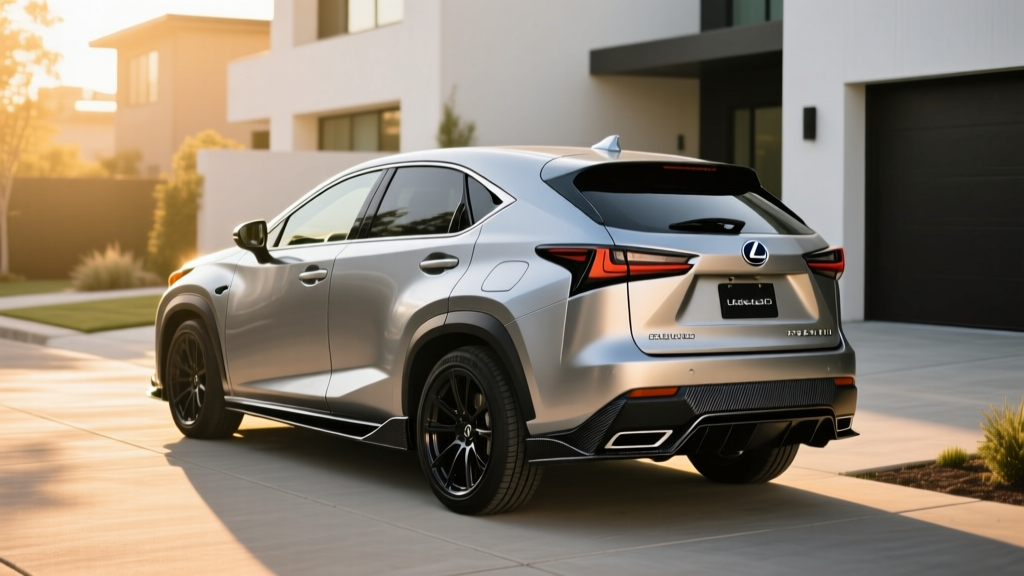
The search for a 2020 Lexus NX hybrid NX 300h wrap kit typically falls into two categories: vinyl color-change wraps and body kit/trim modifications. Here's what applies specifically to the NX 300h.
Vinyl Wrap (Color Change or Paint Protection)
A full vinyl wrap on the NX 300h typically costs $2,500-$4,500 depending on material (3M 2080, Avery Dennison, or KPMF), complexity (chrome delete, roof, mirrors included), and installer quality. The NX's body panels are relatively flat with moderate curvature, making it a straightforward wrap job compared to more sculpted vehicles.
Hybrid-specific considerations:
- The hybrid badge on the rear hatch and the blue-accented Lexus emblems (indicating hybrid status) can be preserved, removed, or replaced during wrapping — specify your preference to the installer.
- The NX 300h's roof rails and antenna/shark fin should be carefully masked; some installers remove them for a seamless wrap, others wrap around them.
- Paint protection film (PPF) is an alternative if your goal is preserving the factory paint rather than changing color — expect $1,500-$3,000 for front-end PPF coverage.
Body Kits and Trim Modifications
Aftermarket body kits for the 2020 NX (including the 300h) are available from manufacturers like Wald, Artisan Spirits, and various Chinese-market suppliers. These typically include front lip spoilers, side skirt extensions, and rear diffuser accents. Costs range from $400 for basic ABS plastic lip kits to $3,000+ for full polyurethane wide-body conversions.
Important fitment note: The NX 300h shares its body shell with the NX 300 (gas model) and NX 200t (pre-2018 gas model), so most body kits designed for the 2015-2021 NX generation will fit the 300h. However, the rear bumper diffuser area differs slightly due to the hybrid's exhaust routing — confirm compatibility with the supplier before ordering.
Pricing, Tax Credits, and Used-Market Value in 2026
Since the 2020 NX 300h is only available on the used market, here's what the financial picture looks like:
- Used price range (2026): $24,000-$31,000 depending on mileage (40K-80K miles typical), trim level (base, Luxury, F Sport), and condition
- Original MSRP (2020): $39,030 (base) to ~$45,000+ (fully loaded Luxury or F Sport)
- Federal tax credit: The §30D new-vehicle credit does not apply to used HEVs. However, the used clean vehicle credit (§25E) provides up to $4,000 (30% of sale price, capped at $4,000) for qualifying used EVs and PHEVs — but conventional hybrids like the NX 300h do NOT qualify. Only BEVs and PHEVs are eligible under §25E. See IRS guidelines for current eligibility rules.
- State incentives: Some states offer hybrid-specific rebates or HOV lane access, but these have largely phased out in favor of EV/PHEV incentives. Check your state's energy office for current programs.
The absence of tax credits is a notable disadvantage versus the NX 450h+ (PHEV) or the RZ 450e (BEV), both of which may qualify for federal credits when purchased new. However, the NX 300h's lower used-market price and zero charging infrastructure requirement offset this for many buyers.
Who Should Choose the NX 300h vs a PHEV or Full EV
Choose the NX 300h (HEV) if:
- You lack access to home or workplace charging
- You want a luxury crossover with minimal complexity — no charging cables, no range planning
- Your daily driving is varied (city + highway) and you want consistent 30+ MPG without behavior changes
- You're buying used and want proven reliability with a lower purchase price
- You plan to personalize with a wrap kit or body modifications and want a lower-cost base vehicle
Consider a PHEV or BEV instead if:
- You have Level 2 home charging and a short commute (PHEV covers it on electric)
- You want federal tax credits ($7,500 new §30D or $4,000 used §25E)
- You want electric-only driving for noise reduction, air quality, or HOV lane access
- You drive mostly in the city and want to maximize electric miles (BEV: 2-4¢/mile vs 10-12¢/mile for HEV gas)
- Performance matters — the NX 300h's 9-second 0-60 is noticeably slower than the NX 450h+ (6.0 sec) or RZ 450e (5.1 sec)
Reliability and Safety Record
The 2020 NX 300h benefits from Toyota's hybrid synergy drive system, which is among the most extensively validated powertrains in automotive history. The 2.5L Atkinson-cycle engine (A25A-FXS variant) uses no turbocharger, no high-pressure direct injection complexity, and relatively low stress — all factors that support long-term durability.
Key reliability indicators:
- J.D. Power: The 2020 NX received above-average predicted reliability ratings
- NHTSA: The NX earned a 5-star overall safety rating. See NHTSA results.
- IIHS: Good ratings in most crashworthiness tests, though headlight ratings varied by trim (LED projector headlights on Luxury trim outperformed base halogen units)
- Common issues: Minimal powertrain complaints; occasional reports of infotainment system lag (the 2020 NX uses Lexus's older Remote Touch interface, which is widely criticized for its touchpad controller)
The eCVT transmission is a planetary gearset with no belts, clutches, or bands to wear — it's essentially maintenance-free and has an outstanding field record across millions of Toyota/Lexus hybrids.
Frequently Asked Questions
How many MPG does the 2020 Lexus NX 300h get?
The EPA rates the NX 300h at 33 MPG city, 30 MPG highway, and 31 MPG combined. Real-world results typically range from 29-34 MPG depending on driving mix, with city-heavy driving often exceeding the EPA city figure thanks to regenerative braking.
Does the NX 300h need to be plugged in?
No. The NX 300h is a conventional hybrid (HEV) that charges its small battery through regenerative braking and the gasoline engine. You fuel it like any other car — there is no plug, no charging cable, and no electric-only range to manage.
How far can the NX 300h drive on electric power alone?
Less than 1 mile, at speeds under ~25 mph. The 1.6 kWh NiMH battery is far too small for meaningful electric-only driving. If you want electric-only range, look at the NX 450h+ (PHEV, ~37 miles electric) or the RZ 450e (BEV, 220+ miles).
Is the hybrid battery reliable and what does replacement cost?
Yes — the NiMH hybrid battery is one of the most proven components in the Toyota/Lexus lineup. Expected lifespan is 150,000-200,000+ miles. Replacement costs $2,500-$4,000 at a dealer, or $1,800-$2,800 at an independent hybrid specialist. The original warranty covers 8 years/100,000 miles (10 years/150,000 miles in CARB states).
Does the 2020 NX 300h qualify for any federal tax credit?
No. The NX 300h is a conventional hybrid, which is not eligible for the §30D new-vehicle credit or the §25E used-vehicle credit. Both programs require a plug-in vehicle (PHEV or BEV) with a minimum battery capacity. Some states may offer minor hybrid incentives — check your state energy office.
Will a body kit from a gas NX 300 fit the NX 300h?
Generally yes — the 2015-2021 NX generation shares the same body shell across the 200t, 300, and 300h variants. Front lips, side skirts, and most rear diffusers will fit. However, verify rear bumper compatibility, as the 300h's exhaust routing and hybrid badge placement can differ slightly.
How much does a vinyl wrap cost for the NX 300h?
A professional full-body vinyl wrap typically costs $2,500-$4,500 using quality films (3M 2080, Avery Dennison). Chrome delete, roof, and mirror wraps may add $300-$600. Paint protection film (PPF) for the front end runs $1,500-$3,000.
What's the total range on a full tank?
The NX 300h has a 14.8-gallon fuel tank. At 31 MPG combined, that yields approximately 458 miles of total range — competitive with or exceeding many non-hybrid crossovers and eliminating any range-anxiety concern.