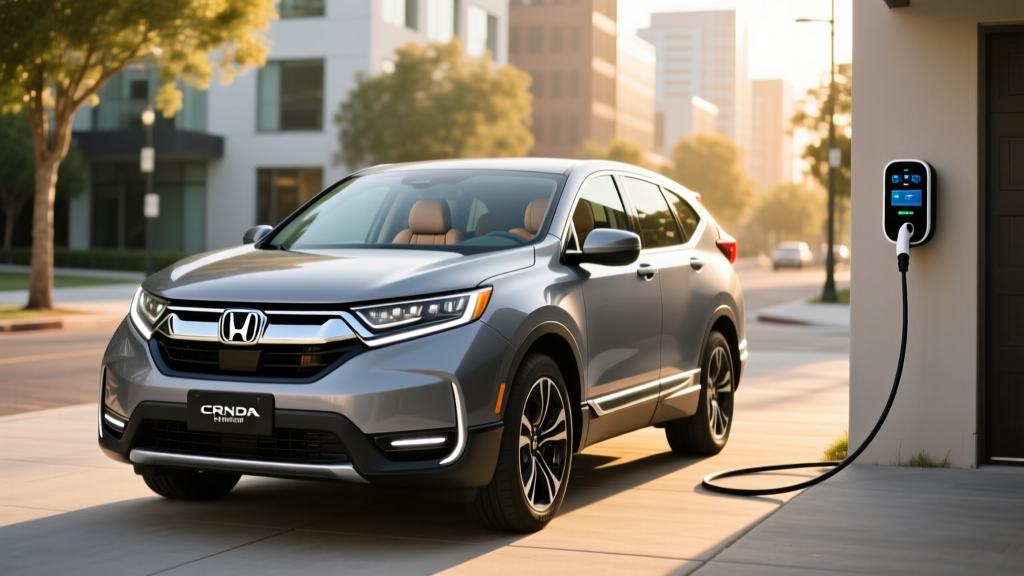
The 2020 Honda CR-V Hybrid occupies a specific niche in today's used-electrified market: a conventional hybrid (HEV) compact SUV that requires zero lifestyle change from its gas-only sibling. No plugs, no range anxiety, no charging apps — just measurably better fuel economy from the same tank of gas. For buyers in 2026 weighing a used electrified crossover, the CR-V Hybrid's real-world efficiency, proven Honda reliability, and strong cargo practicality make it worth a serious look. Here is the data-driven breakdown.
Quick Verdict: Who Should Buy the 2020 CR-V Hybrid?
Choose the 2020 CR-V Hybrid if: You want 35–42 MPG in a compact SUV without installing a home charger, without changing your fueling habits, and with the cargo space of a conventional CR-V.
Choose a PHEV (like the Toyota RAV4 Prime) if: You have home charging access, a short commute you want to cover on electricity, and can pay a premium for plug-in capability.
Choose a full BEV (like the Hyundai Ioniq 5) if: You have reliable home Level 2 charging, want zero tailpipe emissions, and are ready to adopt DC fast charging for road trips.
HEV vs PHEV: What the 2020 CR-V Hybrid Actually Is
The 2020 CR-V Hybrid is a conventional hybrid (HEV), not a plug-in hybrid. This distinction matters because it dictates how you own and fuel the vehicle.
| Feature | HEV (2020 CR-V Hybrid) | PHEV (e.g., RAV4 Prime) | BEV (e.g., Ioniq 5) |
|---|---|---|---|
| Plug-in charging required? | No | Yes (optional but recommended) | Yes (mandatory) |
| Electric-only range | ~1 mile at low speed | ~42 miles | 250–300+ miles |
| Home charger needed? | No | Level 2 recommended | Level 2 essential |
| DC fast charging? | No | No (most PHEVs) | Yes |
| Fuel type | Gasoline only | Gasoline + electricity | Electricity only |
| Federal tax credit (§30D) | No | Up to $7,500 (if eligible) | Up to $7,500 (if eligible) |
Honda did not offer a plug-in hybrid CR-V in the US market for the 2020 model year. The CR-V Hybrid uses a small 1.2 kWh lithium-ion battery that recharges itself through regenerative braking and the gasoline engine. You never plug it in. You simply fill up at any gas station, exactly like a conventional car.
Fuel Economy: EPA Ratings vs Real-World MPG
The headline number for the 2020 CR-V Hybrid is its EPA-rated fuel economy. Here is the official breakdown from fueleconomy.gov:
| Driving Cycle | EPA Rating | Real-World Expectation |
|---|---|---|
| City | 40 MPG | 38–44 MPG (hybrids often exceed EPA in stop-and-go) |
| Highway | 35 MPG | 32–36 MPG (less hybrid advantage at sustained speed) |
| Combined | 38 MPG | 35–40 MPG |
Why the city number is higher than highway: Hybrid systems capture energy during braking and low-speed driving that a conventional gas car wastes as heat. In stop-and-go traffic, the electric motor handles more propulsion, and the gas engine shuts off at stops. On the highway at 70+ mph, aerodynamic drag dominates and the gas engine does most of the work — reducing the hybrid advantage.
Real-world note from ownership data: Drivers with predominantly city and suburban commutes regularly report 39–42 MPG. Those who drive mostly highway miles at 75+ mph should expect closer to 33–35 MPG. Cold weather (below 30°F) typically reduces hybrid MPG by 5–10% due to the engine running more often to provide cabin heat and warm the catalytic converter.
Powertrain Specs: What Moves the CR-V Hybrid
| Specification | 2020 Honda CR-V Hybrid |
|---|---|
| Powertrain type | Two-Motor Hybrid (series-parallel) |
| Gas engine | 2.0L Atkinson-cycle 4-cylinder |
| Engine horsepower | 143 hp @ 6,200 rpm |
| Electric motor output | 181 hp / 232 lb-ft torque |
| Combined system horsepower | 212 hp |
| Transmission | Electronic CVT (e-CVT, no traditional gears) |
| Drivetrain | AWD standard (all trims) |
| Battery capacity | ~1.2 kWh lithium-ion |
| 0–60 mph | ~8.0 seconds (est.) |
| Towing capacity | Not rated for towing |
Honda's two-motor hybrid system is distinct from Toyota's planetary-gear design. In most driving conditions, the CR-V Hybrid operates as a series hybrid: the gas engine drives a generator, which powers the electric motor that turns the wheels. Only at higher cruising speeds does a clutch engage to connect the engine directly to the wheels. This results in smooth, electric-like acceleration feel in city driving with no traditional gear shifts.
AWD is standard on every 2020 CR-V Hybrid trim (EX, EX-L, Touring). A rear-mounted electric motor provides torque to the rear axle when the system detects slip — there is no mechanical driveshaft from the engine to the rear wheels. This is an important distinction for buyers comparing it to the gas CR-V, where AWD was optional on some trims.
Battery Warranty, Lifespan, and Replacement Cost
Honda Hybrid Battery Warranty (2020 CR-V Hybrid):
- Federal emissions states: 8 years / 80,000 miles
- CARB states (CA, NY, MA, and others): 10 years / 150,000 miles
- Capacity retention threshold: Honda does not publish a specific percentage, but warranty covers defects and abnormal degradation
How long do CR-V Hybrid batteries actually last? The 2020 model's 1.2 kWh lithium-ion pack is relatively small and is never deeply discharged — Honda's battery management system maintains a buffer, typically using only about 40–50% of total capacity. This shallow cycling significantly extends cell life. Based on data from earlier Honda hybrid models (Insight, Accord Hybrid), these batteries routinely last 150,000–200,000+ miles before significant degradation.
Battery replacement cost (2026 estimates): If the hybrid battery does fail outside warranty, replacement at a Honda dealer typically runs $2,000–$3,500 for the battery pack plus labor. Independent hybrid specialists and refurbished packs can reduce this to $1,500–$2,500. This is dramatically less than a full EV battery replacement ($5,000–$15,000+), reflecting the CR-V Hybrid's much smaller battery.
For used buyers in 2026: A 2020 CR-V Hybrid is now 6 years old. If the original owner kept the car in a CARB state, the 10-year/150,000-mile battery warranty may still be in effect. Verify warranty transferability with a Honda dealer using the VIN. Even in federal-emissions states, the 8-year/80,000-mile window may still apply depending on mileage.
Used Pricing and Tax Credit Eligibility
The 2020 CR-V Hybrid was sold in three trims. Original MSRP (including destination) was:
- EX: ~$30,560
- EX-L: ~$33,150
- Touring: ~$36,190
2026 used market pricing: Expect to pay approximately $20,000–$27,000 depending on trim, mileage, and condition, based on current used-market listings.
Federal tax credit for used hybrids: The IRS Used Clean Vehicle Credit (§25E) provides up to $4,000 (or 30% of the sale price, whichever is less) for qualifying used EVs and plug-in hybrids. However, conventional hybrids like the 2020 CR-V Hybrid do not qualify for this credit because they lack plug-in capability. The §30D new-vehicle credit also does not apply to used purchases and never applied to conventional HEVs.
If you want a hybrid that qualifies for tax incentives, you would need to look at a used PHEV (like the Toyota RAV4 Prime or Honda Clarity Plug-In Hybrid) purchased from a licensed dealer for under $25,000, subject to income caps and other IRS eligibility rules.
Reliability Ratings and Ownership Costs
The 2020 CR-V Hybrid benefits from Honda's long track record with hybrid powertrains and the general mechanical simplicity of its e-CVT design (no traditional transmission to fail).
- IIHS rating: The 2020 CR-V earned the IIHS Top Safety Pick designation when equipped with specific headlights. Honda Sensing (adaptive cruise, lane-keeping, automatic emergency braking) is standard on all trims. Check full results at iihs.org.
- NHTSA: The 2020 CR-V received a 5-Star Overall Safety Rating from NHTSA.
- Common issues reported: Some owners note a slight engine drone under hard acceleration (inherent to the Atkinson-cycle engine and e-CVT behavior). Infotainment lag and lack of Apple CarPlay/Android Auto wireless capability are common complaints. No widespread hybrid-system failures have been reported.
5-year estimated fuel cost vs gas CR-V: At 38 MPG combined vs the gas CR-V AWD's 29 MPG combined, driving 12,000 miles/year at $3.50/gallon:
- CR-V Hybrid: ~1,105 gallons/year = $3,868/year
- Gas CR-V AWD: ~1,448 gallons/year = $5,069/year
- Annual savings: ~$1,200 ($6,000 over 5 years)
Pros and Cons at a Glance
Pros
- 40 MPG city is exceptional for an AWD compact SUV
- No plug, no charger install, no behavior change required
- AWD standard on every trim
- Strong cargo space (33.0 cu ft behind rear seats)
- Honda Sensing safety suite is standard
- Hybrid battery warranty may still apply on used examples
- Smooth, quiet low-speed electric driving feel
Cons
- No electric-only driving beyond very low speeds (~1 mile)
- No federal or state tax credit eligibility (conventional HEV)
- Engine drone under hard acceleration
- Dated infotainment (no wireless CarPlay/Android Auto)
- Not rated for towing
- Highway MPG advantage over gas model is modest (~6 MPG)
- Hybrid trims were priced $1,500–$2,000 above gas equivalents new
Hybrid vs PHEV vs EV: Which Fits Your Situation?
| Factor | HEV (CR-V Hybrid) | PHEV (RAV4 Prime) | BEV (Ioniq 5) |
|---|---|---|---|
| Home charging access | Not needed | Recommended | Essential |
| Daily commute under 40 mi | Good (great MPG) | Best (electric-only) | Excellent |
| Frequent 300+ mi road trips | Best (just gas up) | Good (gas after EV range) | Requires DC fast charging stops |
| Upfront budget (used, 2026) | $20K–$27K | $30K–$40K | $25K–$35K |
| Tax credit potential | None | Up to $4K used / $7,500 new | Up to $4K used / $7,500 new |
| Maintenance complexity | Low (gas + hybrid) | Moderate (gas + EV systems) | Lowest (no engine) |
| Tailpipe emissions | Reduced vs gas | Zero on EV range, reduced overall | Zero at tailpipe |
The 2020 CR-V Hybrid is the right call if you lack home charging access, want a proven AWD compact SUV, and prioritize simplicity. If you have a garage with a 240V outlet and a sub-40-mile commute, a used PHEV lets you drive most days on electricity while keeping a gas engine for road trips. If you are ready for full electrification and have reliable home charging, a used BEV like the Ioniq 5 or Model 3 offers the lowest per-mile energy cost and the strongest tax-credit eligibility.
Frequently Asked Questions
How many MPG does the 2020 Honda CR-V Hybrid get?
The EPA rates it at 40 city / 35 highway / 38 combined. Real-world owners report 35–42 MPG depending on driving mix. City and suburban driving yields the best results; sustained highway driving at 75+ mph brings the number closer to 33–35 MPG.
Does the 2020 CR-V Hybrid need to be plugged in?
No. It is a conventional hybrid (HEV), not a plug-in hybrid. The small battery recharges through regenerative braking and the gasoline engine. You fuel it exactly like a standard gas car.
How far can the CR-V Hybrid drive on electric power alone?
Approximately 1 mile at very low speeds (under 25 mph) in stop-and-go conditions. This is not a plug-in hybrid — it does not offer meaningful electric-only range. The electric motor assists the gas engine continuously rather than replacing it for extended distances.
Is the hybrid battery reliable, and what does replacement cost?
Honda's hybrid batteries have a strong reliability record. The 2020 CR-V Hybrid's battery is covered by an 8-year/80,000-mile warranty (10-year/150,000-mile in CARB states). Out-of-warranty replacement typically costs $2,000–$3,500 at a dealer, or $1,500–$2,500 through independent specialists. Most Honda hybrid batteries last 150,000–200,000+ miles.
Does the 2020 CR-V Hybrid qualify for any federal tax credit?
No. Conventional hybrids (HEVs) do not qualify for the IRS §30D new-vehicle credit or the §25E used-vehicle credit. Only plug-in hybrids (PHEVs) and battery-electric vehicles (BEVs) are eligible. Some states may offer minor incentives for hybrids — check your state's energy or DMV website for current programs.
What is the difference between the 2020 CR-V Hybrid and the gas CR-V?
The hybrid uses a 2.0L Atkinson-cycle engine with two electric motors for 212 combined hp and standard AWD, versus the gas model's 1.5L turbo making 190 hp with optional AWD. The hybrid gets ~9 MPG more in combined driving (38 vs 29), but was priced $1,500–$2,000 higher when new. The hybrid is not rated for towing; the gas CR-V can tow up to 1,500 lbs.
Should I buy a used 2020 CR-V Hybrid in 2026?
If you want a fuel-efficient AWD compact SUV without the commitment of plug-in charging, and you find a well-maintained example under $25,000 with remaining battery warranty, it is a strong value. The fuel savings of ~$1,200/year over the gas model add up quickly. However, if you have home charging access and want to maximize fuel-cost savings and tax-credit eligibility, a used PHEV or BEV may serve you better long-term.