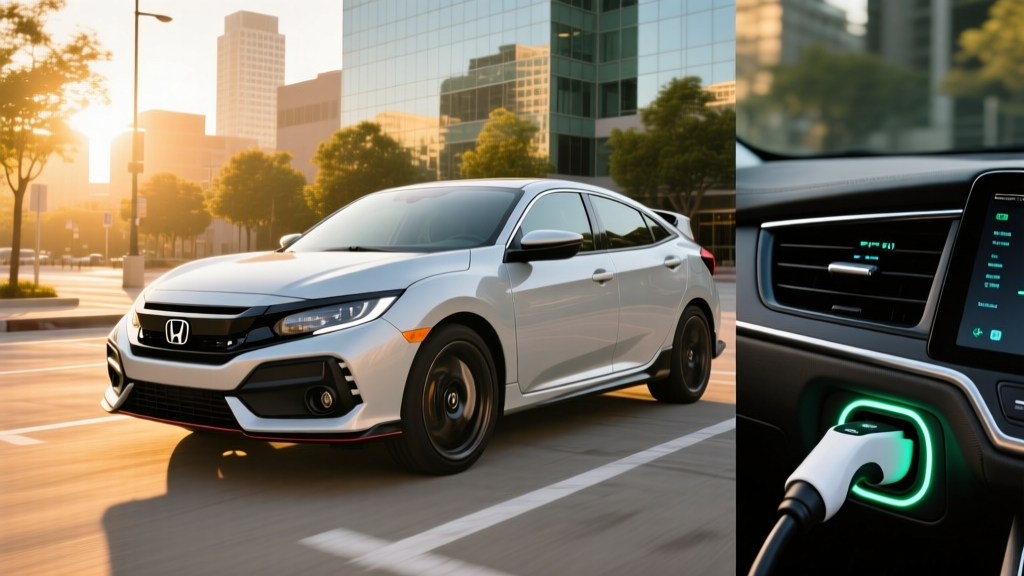
If you are shopping the used compact-car market for maximum fuel efficiency without plugging in, the 2020 Honda Civic Hybrid remains one of the most compelling options available. Sold exclusively as a sedan in the United States for that model year, it pairs a 1.5-liter Atkinson-cycle engine with a two-motor hybrid system to deliver exceptional city efficiency, Honda's reputation for durability, and a price that has become very accessible on the pre-owned market.
This guide covers everything a prospective buyer needs to know — from EPA fuel economy figures and real-world MPG expectations to hybrid battery longevity, replacement costs, and how this conventional hybrid (HEV) stacks up against plug-in hybrids and full battery-electric vehicles.
What Exactly Is the 2020 Honda Civic Hybrid?
The 2020 Honda Civic Hybrid is a conventional hybrid electric vehicle (HEV). That distinction matters. Unlike a plug-in hybrid (PHEV) such as the Toyota Prius Prime, the Civic Hybrid has no charging port. You never plug it in. Its small lithium-ion battery pack recharges entirely through regenerative braking and the gasoline engine. The electric motor assists the engine and can drive the car alone at low speeds, but there is no meaningful electric-only range.
HEV vs. PHEV: Quick Distinction
HEV (Conventional Hybrid): No plug. Small battery (~1-2 kWh). Electric motor assists the gas engine. Zero electric-only highway range. Fuel economy improvement comes from regenerative braking and engine optimization. Example: 2020 Honda Civic Hybrid.
PHEV (Plug-In Hybrid): Has a plug and a larger battery (~8-20 kWh). Offers 20-50 miles of electric-only driving before the gas engine engages. Requires regular charging to maximize value. Example: Toyota Prius Prime, Hyundai Ioniq PHEV.
Honda offered the 2020 Civic Hybrid in a single well-equipped trim level, positioned above the EX sedan. It carried an original MSRP of approximately $28,650 (including destination). On the 2026 used market, clean examples with average mileage typically list between $17,000 and $22,000, depending on condition, mileage, and region.
Fuel Economy: EPA Ratings and Real-World MPG
The headline number for the 2020 Civic Hybrid is its outstanding EPA-estimated fuel economy. Here is the official breakdown from fueleconomy.gov:
| Metric | Value |
|---|---|
| City MPG | 55 MPG |
| Highway MPG | 49 MPG |
| Combined MPG | 52 MPG |
| Fuel Tank Capacity | 12.4 gallons |
| Total Range | ~645 miles |
Real-World MPG: What Owners Actually See
One of the most consistent traits of Honda's two-motor hybrid system is that real-world city driving often matches or slightly exceeds the EPA city estimate. The system operates as a series hybrid at lower speeds — the engine generates electricity that powers the drive motor, which is inherently more efficient in stop-and-go traffic than a conventional drivetrain. Many owners on fuel-tracking platforms report city figures between 53 and 58 MPG in moderate weather.
Highway driving is a different story. At sustained 70-80 mph speeds, the engine engages directly via a lock-up clutch, and efficiency drops. Expect 44-48 MPG on the highway during summer and potentially 40-44 MPG in cold weather when the engine runs more frequently for cabin heat. Overall, a realistic combined real-world figure for mixed driving is 48-52 MPG, which is remarkably close to the EPA sticker.
For context, a comparable gasoline 2020 Civic with the 1.5T engine and CVT is EPA-rated at 32 city / 42 highway / 36 combined. The hybrid delivers roughly a 44% improvement in combined fuel economy.
Powertrain and Performance Specs
| Specification | Value |
|---|---|
| Engine | 1.5L DOHC Atkinson-cycle 4-cylinder |
| Engine Power | 103 hp @ 6,000 rpm |
| Drive Motor Power | 129 hp (96 kW) |
| Total System Horsepower | 151 hp |
| Total System Torque | 197 lb-ft (motor) |
| Transmission | Single-speed direct drive (no conventional transmission) |
| 0-60 mph | ~7.5 seconds |
| Drivetrain | Front-wheel drive |
| Hybrid Battery | ~1.2 kWh lithium-ion |
| Curb Weight | ~3,022 lbs |
Honda's two-motor hybrid system (officially called Sport Hybrid i-DCD in some markets, but the US Civic Hybrid uses the i-MMD architecture) is fundamentally different from Toyota's planetary-gear Hybrid Synergy Drive. In the Honda system, the propulsion motor drives the wheels most of the time. The gasoline engine primarily acts as a generator, only mechanically connecting to the wheels at higher cruising speeds via a single-ratio clutch. This results in a smooth, EV-like driving feel around town with strong low-end torque from the 197 lb-ft electric motor.
The 0-60 mph time of approximately 7.5 seconds puts it on par with the turbocharged Civic EX — it is not slow by any compact-sedan measure, and the instant electric torque makes it feel responsive in urban driving.
Hybrid Battery Warranty, Lifespan, and Replacement Cost
For any used hybrid buyer, the condition and remaining warranty on the high-voltage battery is the single most important financial consideration. Here is what you need to know about the 2020 Civic Hybrid battery:
Hybrid Battery Warranty (Original)
Federal emissions/hybrid battery warranty: 8 years / 80,000 miles (whichever comes first)
CARB-state extended warranty: 10 years / 150,000 miles in California and states that follow California Air Resources Board emissions standards (including NY, MA, NJ, CT, RI, VT, ME, WA, OR, CO, and others).
What this means in 2026: A 2020 Civic Hybrid's federal 8-year warranty has expired as of the 2028 model-year anniversary, but some vehicles may still be within the 80,000-mile limit depending on usage. In CARB states, the 10-year/150,000-mile coverage remains active until approximately 2030.
How Long Do Honda Hybrid Batteries Actually Last?
Honda's lithium-ion hybrid battery packs have proven quite durable. The IMA (Integrated Motor Assist) batteries in earlier Honda hybrids had a mixed reputation, but the current-generation i-MMD system uses a more robust battery management approach with a smaller, shallower cycle depth — the system never fully charges or fully depletes the pack, which dramatically extends cell life.
Based on long-term ownership data and technician reports, most Honda i-MMD hybrid batteries are expected to last 150,000 to 200,000 miles before significant degradation requires attention. Because the battery is small (~1.2 kWh), the replacement cost is also far lower than a full EV battery pack.
Battery Replacement Cost
If the hybrid battery does fail outside of warranty, expect the following:
- OEM replacement (Honda dealer): $2,000 - $4,000 including parts and labor
- Aftermarket/remanufactured battery: $1,200 - $2,500
- Individual cell/module repair (specialist shops): $500 - $1,500
These figures are significantly lower than EV battery replacements (which can exceed $10,000-$20,000), making the financial risk of hybrid battery failure quite manageable.
Does the 2020 Honda Civic Hybrid Qualify for Tax Credits?
No. The 2020 Honda Civic Hybrid does not qualify for the federal §30D clean vehicle tax credit. That credit applies exclusively to plug-in electric vehicles — battery-electric vehicles (BEVs) and plug-in hybrids (PHEVs) with a minimum battery capacity of 7 kWh. The Civic Hybrid's ~1.2 kWh battery does not come close to meeting that threshold.
Conventional hybrids (HEVs) like the Civic Hybrid have not qualified for any federal purchase incentive since the original hybrid tax credits expired for most manufacturers in the late 2000s. Some states and municipalities may offer minor incentives for hybrids (such as HOV lane access or reduced registration fees), but these vary widely by jurisdiction. Check your state's department of energy or transportation website for current local programs.
On the used market, the used clean vehicle credit (up to $4,000 or 30% of the sale price, whichever is less) also applies only to plug-in vehicles — BEVs and PHEVs — so the Civic Hybrid is ineligible for that as well.
2020 Civic Hybrid vs. Alternatives: HEV, PHEV, or EV?
The right electrified vehicle depends entirely on your driving patterns, charging access, and budget. Here is a practical decision framework:
Which Should You Choose?
Choose the 2020 Civic Hybrid (HEV) if:
- You cannot charge at home or work (no garage, apartment living, street parking)
- You want maximum simplicity — just add gas and drive
- Your budget is under $22,000 and you want proven reliability
- You drive a mix of city and highway and want 48-52 MPG real-world
- You do not want to think about charging, plugs, or battery preconditioning
Choose a PHEV (like a Prius Prime or Ioniq PHEV) if:
- You can charge at home (Level 1 outlet is sufficient for most PHEVs)
- Your daily commute is under 25-50 miles round-trip (you could run mostly on electricity)
- You still want a gas engine for road trips without range planning
- You want to reduce fuel consumption dramatically but are not ready for full EV
Choose a full EV (BEV) if:
- You have reliable home Level 2 charging (240V)
- You want the lowest per-mile fuel cost and near-zero routine maintenance
- Your daily driving is predictable and within the vehicle's range
- You want to qualify for federal/state EV tax credits (on new or qualifying used purchases)
Pros, Cons, and Ownership Realities
Pros
- 52 MPG combined EPA — outstanding for any vehicle
- No plug-in required — zero lifestyle change from a gas car
- Strong electric torque for responsive city driving
- Lower hybrid battery replacement cost than PHEV/EV
- Honda Safety Sense suite standard (AEB, lane-keep, adaptive cruise)
- 645-mile total range means fewer fuel stops
- Competitive used pricing ($17K-$22K in 2026)
Cons
- No electric-only driving — always burns some gasoline
- Only offered as a sedan (no hatchback hybrid for 2020)
- Federal hybrid battery warranty may be expiring on some examples
- Highway MPG drops noticeably above 75 mph
- No federal tax credit eligibility (new or used)
- Road noise is more noticeable than in some competitors
- Infotainment system is dated compared to 2024+ models
What to Check Before Buying a Used 2020 Civic Hybrid
If you are evaluating a specific vehicle, prioritize these items:
- Hybrid battery health: Ask the dealer or seller for a hybrid system diagnostic report. Honda's diagnostic tools can show battery module balance and overall state of health. Uneven module voltages may signal impending failure.
- Maintenance records: The 1.5L Atkinson-cycle engine still requires regular oil changes (every 7,500-10,000 miles with full synthetic). Verify the previous owner followed the schedule.
- Warranty status: Confirm whether the vehicle is still within the 8-year/80,000-mile federal hybrid battery warranty or the 10-year/150,000-mile CARB-state warranty. Check the in-service date on the window sticker or Carfax.
- Tire condition: The Civic Hybrid came with low-rolling-resistance tires that contribute meaningfully to its fuel economy rating. Replacing them with standard all-season tires can reduce MPG by 2-4 MPG.
- Brake wear: Regenerative braking handles most deceleration, so the friction brakes typically last well beyond 80,000 miles. If a low-mileage example needs brake work, investigate whether the regen system is functioning properly.
Frequently Asked Questions
How many MPG does the 2020 Honda Civic Hybrid get?
The EPA rates the 2020 Civic Hybrid at 55 city / 49 highway / 52 combined MPG. In real-world driving, owners typically see 48-52 MPG combined, with city driving sometimes exceeding the EPA estimate and highway driving at 75+ mph falling to 44-48 MPG.
Can I plug in the 2020 Honda Civic Hybrid?
No. The Civic Hybrid is a conventional hybrid (HEV) with no plug and no charging port. The battery charges exclusively through regenerative braking and the gasoline engine. You fuel it like any other gas car.
How far can the Civic Hybrid drive on electric power alone?
Essentially zero miles at highway speeds. At very low speeds (under 25 mph), the electric motor can propel the car for short distances — typically a few hundred yards — before the engine restarts. There is no usable electric-only range for commuting. If electric-only driving is a priority, look at a PHEV like the Toyota Prius Prime (25 miles electric-only) or a full EV.
Is the 2020 Civic Hybrid reliable?
Yes. Honda's i-MMD two-motor hybrid system has proven very reliable since its introduction. The system has fewer moving parts than a conventional automatic transmission (there is no traditional multi-gear transmission), and the hybrid battery is small and conservatively managed. The Civic nameplate consistently earns strong reliability ratings from IIHS and owner surveys.
What does it cost to replace the hybrid battery?
An OEM hybrid battery replacement at a Honda dealer typically runs $2,000-$4,000 including labor. Aftermarket and remanufactured options are available for $1,200-$2,500. The battery is expected to last 150,000-200,000 miles under normal conditions, so many owners will never need a replacement.
Does the 2020 Civic Hybrid qualify for any tax credit?
No. Federal tax credits under IRS §30D apply only to plug-in vehicles (BEVs and PHEVs) with at least 7 kWh of battery capacity. The Civic Hybrid's ~1.2 kWh battery does not qualify. The used clean vehicle credit (up to $4,000) also requires a plug-in vehicle. Some states may offer minor hybrid incentives, but there is no federal benefit.
How does the Civic Hybrid compare to a Toyota Prius?
The 2020 Toyota Prius achieves 54 city / 50 highway / 52 combined MPG (Eco trim) — nearly identical to the Civic Hybrid on paper. The Prius offers a hatchback body style and available AWD (on non-hybrid trims), while the Civic Hybrid offers a more conventional sedan design, a more refined interior, and slightly better driving dynamics. Both are excellent used hybrid choices.
Is the hybrid system covered by Honda's powertrain warranty?
Yes. The hybrid battery and hybrid system components are covered under Honda's federal emissions warranty (8 years/80,000 miles) and, in CARB states, under the extended emissions warranty (10 years/150,000 miles). The conventional powertrain warranty is 5 years/60,000 miles.
The Bottom Line for Used Buyers
The 2020 Honda Civic Hybrid occupies a specific and valuable niche: it delivers near-Prius fuel economy in a more conventionally styled, engaging-to-drive sedan that requires absolutely no change in behavior from a gasoline car. No plugs, no charging apps, no range calculations — just fill up every 600+ miles and go.
At $17,000-$22,000 on the 2026 used market, it represents strong value for budget-conscious commuters, rideshare drivers, or anyone seeking to reduce fuel costs without the complexity or upfront investment of a plug-in vehicle. Verify the hybrid battery warranty status on any specific example, and this Civic should deliver dependable, ultra-efficient transportation for years to come.