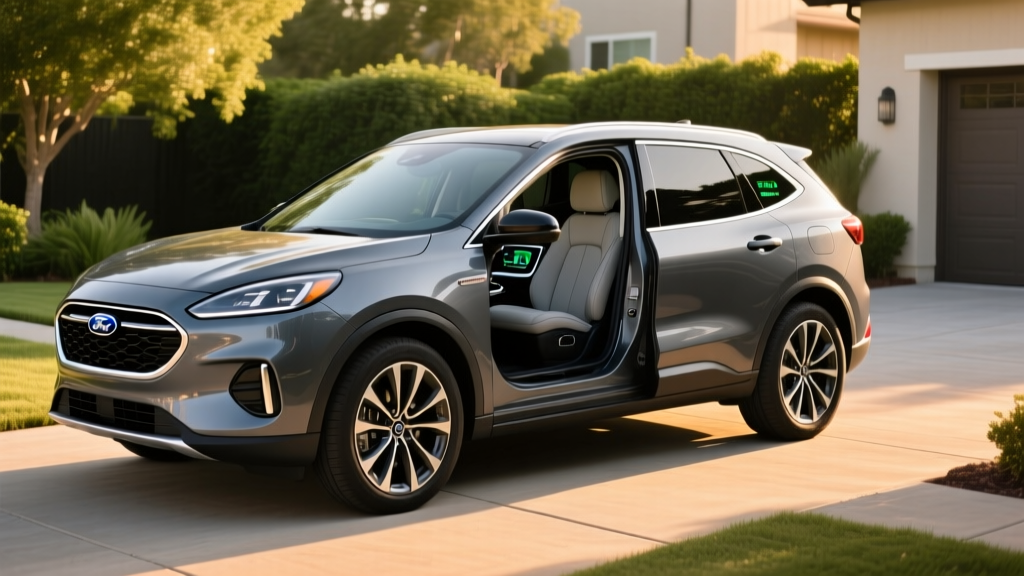
The 2020 Ford Escape Hybrid Titanium sits at an interesting crossroads in the used-car market. As Ford's top-trim conventional hybrid compact SUV from that model year, it pairs a 2.5-liter Atkinson-cycle four-cylinder with an electric motor for a combined 192 horsepower — and an EPA-estimated 41 MPG combined in front-wheel-drive form. For buyers in 2026 weighing a used hybrid against a new EV or gas-only crossover, this Titanium trim remains a compelling, data-backed option worth a close look.
This guide breaks down the exact fuel economy figures, powertrain architecture, battery longevity expectations, and ownership economics you need to decide whether the 2020 Escape Hybrid Titanium fits your daily driving profile.
HEV vs. PHEV: Which Escape Hybrid Are You Looking At?
Before diving into specs, it's critical to distinguish between the two electrified Escape variants Ford offered in 2020. The conventional hybrid (HEV) and the plug-in hybrid (PHEV) are fundamentally different vehicles with different use cases.
| Attribute | 2020 Escape Hybrid (HEV) | 2020 Escape PHEV |
|---|---|---|
| Plug-in charging required? | No — regenerative braking + engine charges battery | Yes — plug in for electric-only driving |
| Battery capacity | ~1.1 kWh (small, self-charging) | 14.4 kWh lithium-ion |
| Electric-only range | Not applicable (EV assist only) | EPA 37 miles |
| EPA combined MPG / MPGe | 41 MPG (FWD) | 102 MPGe (electric) / 41 MPG (gas-only) |
| Total combined range | ~560 miles | ~520 miles (electric + gas) |
| DC fast charging | N/A | No — Level 2 AC only |
| Federal tax credit (original purchase) | None | Eligible at time of sale (now expired for new) |
The Titanium trim was offered on the HEV only. If you're specifically searching for a 2020 Ford Escape Hybrid Titanium, you're looking at the conventional hybrid — no plug, no charging cable, just fill up with gas and drive. The PHEV was available in SE and SEL trims but not Titanium for the 2020 model year.
Fuel Economy: EPA Ratings and Real-World MPG
The headline number for the 2020 Escape Hybrid Titanium is its EPA-estimated fuel economy. Here's the full breakdown by drivetrain configuration:
| Drivetrain | City MPG | Highway MPG | Combined MPG |
|---|---|---|---|
| FWD (standard) | 44 | 37 | 41 |
| AWD (optional) | 42 | 36 | 39 |
Source: U.S. EPA / fueleconomy.gov
Real-World MPG: What Owners Actually Report
Hybrids tend to outperform their EPA ratings in city driving, where regenerative braking recaptures energy at every stop. The Escape Hybrid's 44 MPG city estimate is already strong, and many owners report seeing 43–47 MPG in mixed suburban and urban driving during mild weather.
Highway driving tells a different story. At sustained 70–80 mph speeds, the electric motor contributes less and aerodynamic drag dominates. Expect highway fuel economy in the 34–37 MPG range in real-world conditions. In cold weather (below 35°F), the engine runs more frequently to maintain cabin heat and battery temperature, which can drop combined MPG to the mid-30s.
For a 15,000-mile annual driving schedule at $3.25/gallon (a reasonable 2026 national average for regular unleaded), the FWD Escape Hybrid Titanium would cost approximately $1,190 per year in fuel. A comparable gas-only 2020 Escape with the 1.5L EcoBoost (EPA 30 MPG combined) would cost roughly $1,625 — a difference of about $435 per year in the hybrid's favor.
Powertrain Specs: Engine, Motor, and Combined Output
| Specification | 2020 Ford Escape Hybrid Titanium |
|---|---|
| Engine | 2.5L Atkinson-cycle inline-4 |
| Engine output | 155 HP / 152 lb-ft torque |
| Electric motor | Permanent-magnet AC synchronous |
| Motor output | ~118 HP (integrated with eCVT) |
| Combined system output | 192 HP |
| Transmission | eCVT (electronic continuously variable) |
| Drivetrain | FWD standard / AWD optional |
| 0–60 mph | ~7.8 seconds (FWD) |
| Towing capacity | 1,500 lbs (not rated for heavy towing) |
| Fuel tank | 13.7 gallons (regular unleaded) |
| Battery type | Lithium-ion, ~1.1 kWh |
The eCVT is not a traditional belt-and-pulley CVT. Ford uses a planetary gearset that blends engine and motor power seamlessly — there's no rubber-banding effect common to older CVT designs. Acceleration is adequate for merging and passing, though the 192 HP combined output means this SUV prioritizes efficiency over performance. The AWD variant uses a second electric motor on the rear axle rather than a mechanical driveshaft, which is why the AWD penalty is only 2 MPG combined.
Titanium Trim: What You Get at the Top
The Titanium was the premium trim in the 2020 Escape Hybrid lineup, positioned above the SE Sport Hybrid. Key standard features include:
- 18-inch machined aluminum wheels
- Leather-trimmed seats with heated front row
- 10-speaker B&O sound system
- Hands-free power liftgate
- 8-inch touchscreen with SYNC 3, Apple CarPlay, and Android Auto
- Wireless charging pad
- Adaptive cruise control with stop-and-go
- Lane-keeping system and evasive steering assist
- BLIS (Blind Spot Information System) with cross-traffic alert
The 2020 Escape Hybrid Titanium started at an MSRP of approximately $36,175 (FWD, including destination). AWD added roughly $1,500. In the 2026 used-car market, well-maintained examples with 50,000–70,000 miles typically list between $19,000 and $25,000, depending on condition, mileage, and regional demand.
Battery Longevity, Warranty, and Replacement Cost
Ford Hybrid Battery Warranty (Original)
8 years / 100,000 miles (whichever comes first) for hybrid battery components, including the traction battery pack, battery control module, and electric motor. In states that follow California Air Resources Board (CARB) standards — including CA, NY, MA, WA, and others — the warranty extends to 10 years / 150,000 miles.
For a 2020 model, the standard 8-year/100,000-mile warranty window extends through the 2028 model year. If you're buying in 2026, a 2020 Escape Hybrid Titanium with under 100,000 miles likely still has some factory hybrid battery coverage remaining — verify the in-service date with the selling dealer or a Ford service center.
Real-World Battery Degradation
Conventional hybrid batteries like the Escape's ~1.1 kWh pack experience far less stress than full-EV batteries because they operate in a narrow state-of-charge window (roughly 40–80%). The vehicle's battery management system prevents full charges and full discharges, which is the primary driver of lithium-ion degradation.
Ford's hybrid battery track record is solid. The Escape Hybrid has not shown widespread premature battery failures. When replacement is needed outside of warranty, a new OEM hybrid battery pack typically costs between $2,500 and $4,500 including labor. Refurbished packs are available from independent hybrid specialists for $1,500–$2,500. Given the small capacity of the HEV battery, these costs are significantly lower than full EV battery replacements, which can exceed $10,000.
Does the 2020 Escape Hybrid Titanium Qualify for a Tax Credit?
No. The conventional hybrid (HEV) Escape has never qualified for the federal §30D clean vehicle tax credit. That credit applies only to plug-in electric vehicles (BEVs and PHEVs) meeting specific battery capacity, MSRP, income, and critical-mineral sourcing requirements.
The 2020 Escape PHEV did qualify for a federal tax credit when purchased new, but that credit is no longer available for used purchases of this model year unless you qualify under the separate Used Clean Vehicle Credit (§25E), which offers up to $4,000 (30% of the sale price, capped) for used EVs and PHEVs purchased from a dealer for $25,000 or less. Check current eligibility on IRS.gov, as income caps ($75,000 single / $150,000 joint) and dealer reporting requirements apply.
Some states offer their own hybrid or efficiency incentives, though these vary widely and change frequently. Check your state's energy or environmental agency for current programs.
Escape Hybrid Titanium vs. EV vs. Gas: Which Fits You?
Choose the 2020 Escape Hybrid Titanium if:
- You want 40+ MPG without changing your fueling habits
- You don't have reliable access to home or workplace charging
- You drive a mix of city and highway miles (hybrid advantage is strongest in stop-and-go)
- You want lower fuel costs with zero range anxiety
- You need AWD availability for snow-belt winters
- Budget is $20K–$25K for a well-equipped used crossover
Consider a full EV or PHEV instead if:
- You can install a Level 2 home charger and want near-zero fuel costs
- Your daily commute is under 40 miles (a PHEV covers this on electric alone)
- You want to eliminate tailpipe emissions from daily driving
- You qualify for the §30D tax credit on a new EV/PHEV (up to $7,500)
- You plan to keep the vehicle 8+ years and want lower long-term maintenance
The Escape Hybrid Titanium occupies a practical middle ground. It doesn't require any infrastructure changes — no home charger installation, no route planning around DC fast chargers, no cold-weather range loss anxiety. You simply drive it like any other gas car and reap the efficiency benefits. For apartment dwellers, street parkers, or anyone without dedicated charging access, this remains one of the most pragmatic paths to sub-$1,200 annual fuel costs in a compact SUV.
Reliability and Safety Ratings
The 2020 Escape earned strong safety marks. The NHTSA awarded it a 5-star overall safety rating, and the IIHS named it a Top Safety Pick when equipped with specific headlight configurations. Ford's Co-Pilot360 suite — standard on the Titanium — includes automatic emergency braking, lane-keeping assist, and blind-spot monitoring.
On reliability, the 2.5L Atkinson-cycle engine is a proven design shared across Ford's hybrid lineup (including the Maverick Hybrid and Bronco Sport Hybrid). The eCVT has fewer moving parts than a conventional automatic transmission, which generally translates to lower long-term maintenance costs. Common owner-reported issues are minor: occasional SYNC 3 infotainment glitches and some reports of wind noise around the A-pillars at highway speeds. No systemic hybrid-system failures have emerged as a pattern for this generation.
Frequently Asked Questions
How many MPG does the 2020 Ford Escape Hybrid Titanium get?
The EPA rates the FWD model at 44 city / 37 highway / 41 combined MPG. The AWD version drops slightly to 42 city / 36 highway / 39 combined. Real-world city driving often exceeds the EPA estimate, while sustained highway speeds above 70 mph typically yield 34–37 MPG.
Does the 2020 Escape Hybrid need to be plugged in?
No. The Escape Hybrid (HEV) is a self-charging conventional hybrid. It recovers energy through regenerative braking and the gasoline engine. You never plug it in — just fill up at any gas station with regular unleaded. Only the Escape PHEV variant requires plug-in charging for electric-only driving.
How far can the Escape PHEV go on electric only?
The 2020 Escape PHEV (not available in Titanium trim) has an EPA-estimated 37 miles of electric-only range from its 14.4 kWh battery pack. Once depleted, it operates as a conventional hybrid with 41 MPG combined. Note: the PHEV does not support DC fast charging — Level 2 AC charging takes approximately 3.5 hours from empty.
Is the hybrid battery reliable and what does replacement cost?
Ford's hybrid battery is covered by an 8-year/100,000-mile warranty (10 years/150,000 miles in CARB states). For a 2020 model, some factory coverage may still apply in 2026. Out-of-warranty replacement costs $2,500–$4,500 for an OEM pack, or $1,500–$2,500 for a refurbished unit. Premature failures are uncommon based on owner data.
Does the 2020 Escape Hybrid qualify for any tax credit?
The conventional hybrid (HEV) does not qualify for the federal §30D tax credit. The PHEV variant originally qualified when new. If purchasing a used Escape PHEV for $25,000 or less from a dealer in 2026, you may qualify for the Used Clean Vehicle Credit (§25E) — up to $4,000, subject to income limits. Verify current rules at IRS.gov.
How does the Escape Hybrid compare to the Toyota RAV4 Hybrid?
The 2020 RAV4 Hybrid achieves 40 MPG combined (EPA) with standard AWD and 219 combined HP — slightly more power and a more robust AWD system, but 1 MPG less combined than the FWD Escape Hybrid. The RAV4 Hybrid typically commands a higher used-car price. The Escape Hybrid Titanium offers more premium interior features (B&O audio, wireless charging) at a comparable or lower price point.