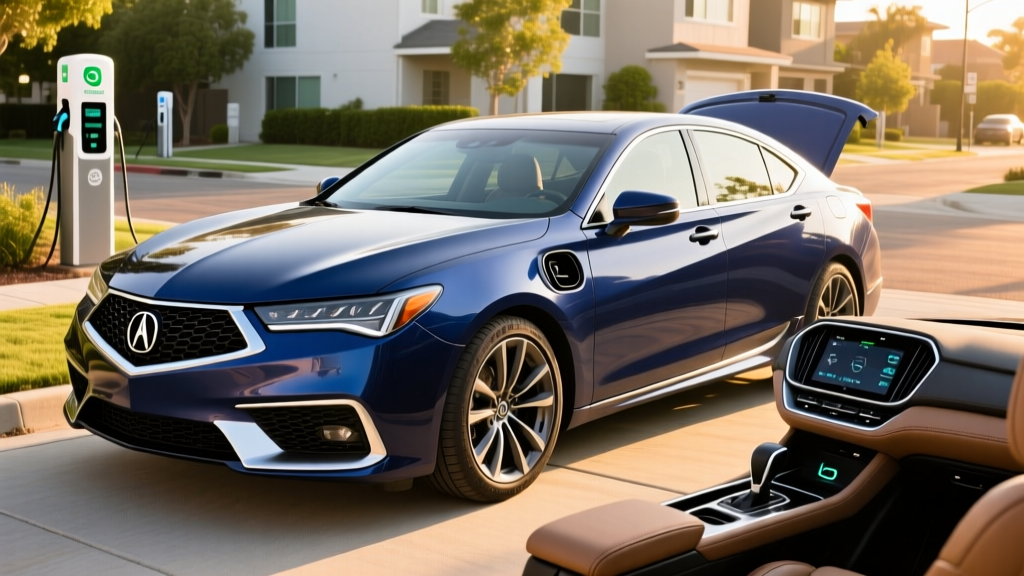
The 2020 Acura RLX Sport Hybrid occupies a rare niche: a full-size luxury sedan with a three-motor hybrid system, standard Super Handling All-Wheel Drive (SH-AWD), and a V6 engine — all without a plug. Acura discontinued the RLX after the 2020 model year, but it remains a compelling used luxury hybrid for buyers who want V6 smoothness, all-weather capability, and no charging hassle. Here is the data-driven breakdown of what ownership actually looks like in 2026.
2020 Acura RLX Sport Hybrid at a Glance
| Spec | Value |
|---|---|
| Powertrain | 3.5L V6 + 3 electric motors (Sport Hybrid SH-AWD) |
| Combined Horsepower | 377 hp |
| Engine Output | 310 hp / 272 lb-ft (V6 alone) |
| Electric Motors | Front: 47 hp; Rear (twin): 36 hp each |
| Transmission | 7-speed dual-clutch automatic |
| Drivetrain | SH-AWD (torque-vectoring rear axle) |
| EPA MPG (City / Hwy / Combined) | 28 / 29 / 29 |
| Fuel Tank | 15.3 gallons |
| Total Range | ~444 miles |
| Hybrid Battery | ~1.3 kWh lithium-ion (non-plug-in) |
| 0–60 mph | ~5.4 seconds |
| Original MSRP | $69,045 (Sport Hybrid w/ Tech Pkg) |
| Typical 2026 Used Price | $28,000–$38,000 (varies by mileage/condition) |
HEV vs PHEV: Where the RLX Sport Hybrid Fits
The RLX Sport Hybrid is a conventional hybrid (HEV), not a plug-in hybrid (PHEV). This distinction matters for buyers cross-shopping electrified sedans:
| Feature | HEV (RLX Sport Hybrid) | PHEV (e.g., BMW 530e) |
|---|---|---|
| Plug-in Charging | No — never needs to plug in | Yes — Level 2 for full EV range |
| Electric-Only Range | ~1 mile at very low speeds | 20–40 miles typical |
| Battery Size | ~1.3 kWh | 12–25 kWh typical |
| How It Charges | Regenerative braking + engine | Plug-in + regen + engine |
| Federal Tax Credit (§30D) | Not eligible | Eligible if new; varies for used |
| Best For | No home charging access; long highway trips | Short daily commutes with home charging |
The RLX's small 1.3 kWh battery is charged entirely through regenerative braking and the gasoline engine. You never plug it in, and there is no meaningful electric-only driving range. The electric motors serve a performance and efficiency role — providing instant torque fill, enabling cylinder deactivation, and powering the rear wheels independently for torque vectoring — but they do not deliver the plug-in EV commute experience.
Real-World MPG: What to Actually Expect
The EPA rates the 2020 RLX Sport Hybrid at 28 city / 29 highway / 29 combined MPG (source: fueleconomy.gov). That highway-biased rating is unusual for a hybrid — most HEVs score higher in the city, where regenerative braking recaptures the most energy. The RLX's relatively flat MPG curve reflects its performance-oriented tuning: the 377-hp powertrain prioritizes acceleration and SH-AWD dynamics over hypermiling.
| Driving Scenario | Expected MPG | Notes |
|---|---|---|
| EPA Combined | 29 MPG | Official sticker rating |
| City / stop-and-go | 27–30 MPG | Regen braking helps; A/C load can reduce |
| Highway (70–80 mph) | 26–29 MPG | 3-cylinder mode activates on cruise |
| Cold weather (below 32°F) | 24–27 MPG | Engine runs longer for cabin heat; battery less efficient |
| Mixed real-world (owner-reported avg) | 26–28 MPG | Aggressive driving and short trips pull this down |
Unlike Toyota-style hybrids that dramatically beat EPA in city driving, the RLX Sport Hybrid's real-world economy clusters tightly around its sticker numbers. Owners who drive conservatively on highway commutes report 29–31 MPG; those with heavy right feet or mostly short urban trips see 24–26 MPG. The Variable Cylinder Management system (shutting down to three cylinders under light load) helps highway efficiency but does not transform city MPG the way a Prius-style system does.
Powertrain Deep Dive: How the Three-Motor SH-AWD Works
The RLX Sport Hybrid's powertrain is one of the most sophisticated hybrid systems Acura has ever produced. The 3.5-liter SOHC i-VTEC V6 produces 310 hp and 272 lb-ft of torque on its own. A 47-hp electric motor is integrated into the front of the 7-speed dual-clutch transmission, providing torque fill during upshifts and enabling the engine to shut off under light loads.
The rear axle is where the real engineering story lives. Two independent 36-hp electric motors — one per rear wheel — provide torque vectoring without a mechanical rear differential. During cornering, the system can send up to 100% of available rear torque to the outside wheel, actively rotating the car. Under deceleration, both rear motors act as generators, recapturing energy independently. This setup eliminates the need for a driveshaft or rear mechanical connection to the engine.
The result is a 377-hp luxury sedan that hits 60 mph in roughly 5.4 seconds and handles with more agility than its 4,400-pound curb weight suggests. The trade-off is complexity: three electric motors, a dual-clutch transmission, and a sophisticated torque-vectoring system mean more potential service points as the vehicle ages.
Battery Reliability, Warranty, and Replacement Cost
Original Hybrid Battery Warranty: 8 years / 100,000 miles (10 years / 150,000 miles in CARB states including CA, NY, MA, and others).
2026 Status: Most 2020 RLX Sport Hybrids are now outside the standard 8-year federal warranty window. CARB-state vehicles retain coverage through 2030 or 150,000 miles.
The RLX Sport Hybrid's ~1.3 kWh lithium-ion battery pack is small by EV standards and operates within a narrow state-of-charge window — typically between 20% and 80%. This conservative cycling strategy, managed by Honda/Acura's battery management system, significantly reduces degradation compared to full EVs that regularly charge to 100%.
Honda and Acura hybrid batteries have a strong reliability track record. The RLX shares its hybrid architecture with the Acura NSX and the Honda Accord Hybrid family. Owner forums and repair databases show few reports of premature hybrid battery failure in the RLX, though the sample size is small given limited production volume.
Battery replacement cost: If the hybrid battery does fail out of warranty, expect a dealer replacement to run $3,000–$5,000 including parts and labor. Independent hybrid specialists may offer refurbished pack replacements for $2,000–$3,500. Given the battery's small size and conservative cycling, this is a low-probability expense for most owners — but it is a cost to budget for on a vehicle now 6 years old.
The 12-volt auxiliary battery, which powers electronics and starts the hybrid system, is a separate maintenance item. Expect to replace it every 4–5 years at roughly $200–$350.
Tax Credits and Incentives: What Applies in 2026
The 2020 Acura RLX Sport Hybrid does not qualify for the federal §30D new clean vehicle tax credit, which applies only to plug-in vehicles (BEVs and PHEVs with at least 7 kWh of battery capacity). Conventional hybrids without a plug are categorically excluded from §30D.
For used-vehicle buyers, the Used Clean Vehicle Credit (§25E) — up to $4,000 or 30% of the sale price — also requires the vehicle to be a qualifying plug-in EV or fuel cell vehicle. The RLX Sport Hybrid does not meet this requirement.
What is available:
- No federal tax credit (HEV, not PHEV/BEV)
- Some states offer minimal hybrid incentives at registration — check your state's DMV or energy office
- No HOV lane access in most states (unlike PHEVs/BEVs in CA, CO, and others)
- Standard used-car financing rates apply; no special EV/PHEV loan programs
For detailed federal incentive rules, consult IRS.gov's clean vehicle credit page.
Who Should Buy the RLX Sport Hybrid vs a PHEV or Full EV
Choose the 2020 Acura RLX Sport Hybrid if:
- You want a V6 luxury sedan with AWD and no charging requirement
- You lack access to home or workplace Level 2 charging
- You regularly take long road trips where charging infrastructure is sparse
- You value torque-vectoring AWD dynamics over maximum fuel savings
- Your daily commute exceeds 40 miles (PHEV EV range would be insufficient)
Choose a PHEV (e.g., BMW 530e, Volvo S90 Recharge) if:
- You have home Level 2 charging and a short daily commute (under 30 miles)
- You want electric-only driving for most daily trips with gas backup for road trips
- Fuel cost savings are your primary electrification motivation
Choose a full EV (e.g., Tesla Model S, Lucid Air, BMW i5) if:
- You have reliable home charging and want zero tailpipe emissions
- You want the lowest per-mile fuel cost and minimal drivetrain maintenance
- You qualify for the §30D federal tax credit (up to $7,500 for new EVs)
Pros and Cons of the 2020 RLX Sport Hybrid in 2026
Pros
- 377 hp with smooth V6 + electric torque fill
- SH-AWD torque vectoring is genuinely excellent in rain and snow
- No plug-in requirement — works for apartment dwellers and street parkers
- Spacious, well-insulated cabin with high-quality materials
- Strong standard tech: ELS audio, navigation, AcuraWatch safety suite
- Depreciation makes it a value luxury buy at $28K–$38K used
Cons
- 29 MPG combined is modest for a hybrid — a Camry Hybrid gets 52 MPG
- Discontinued model: limited dealer parts support long-term
- Complex powertrain (3 motors, DCT) = higher repair risk as it ages
- No federal or state tax credit eligibility
- Small rear trunk due to hybrid battery and electronics packaging
- Outdated infotainment (dual-screen system, no wireless CarPlay in most builds)
Frequently Asked Questions
How many MPG does the 2020 Acura RLX Sport Hybrid get?
The EPA rates it at 28 city / 29 highway / 29 combined MPG. Real-world owners typically report 26–29 MPG depending on driving style and climate. Cold weather and aggressive acceleration can push this below 25 MPG.
Does the RLX Sport Hybrid need to be plugged in?
No. It is a conventional hybrid (HEV). The battery charges through regenerative braking and the gasoline engine. You never plug it in.
How far can it drive on electric power alone?
Effectively zero meaningful electric-only range. At very low speeds (under 15 mph), the front motor can move the car briefly on electric power — roughly a fraction of a mile. This is for parking-lot creep, not commuting.
Is the 2020 RLX Sport Hybrid reliable?
The powertrain is mechanically complex but has proven reasonably reliable in limited owner data. The hybrid battery uses conservative cycling that favors longevity. The main risk factors are the 7-speed dual-clutch transmission and the twin rear electric motors, both of which are expensive to service out of warranty. Acura's overall brand reliability is average among luxury marques.
What does a hybrid battery replacement cost?
Dealer replacement runs approximately $3,000–$5,000. Independent hybrid shops may offer refurbished units for $2,000–$3,500. Given the battery's small size and conservative use, failure before 150,000+ miles is uncommon but not unheard of.
Does the 2020 RLX Sport Hybrid qualify for any tax credit?
No. Federal §30D and §25E tax credits apply only to plug-in vehicles (PHEVs and BEVs). The RLX Sport Hybrid is a conventional HEV and does not qualify for any federal EV incentive. Check your state for any minor hybrid registration benefits.
How does it compare to the Acura NSX hybrid system?
The RLX Sport Hybrid shares the same fundamental Sport Hybrid SH-AWD architecture as the first-generation NSX, but with different tuning. The NSX uses a twin-turbo V6 and produces 573 hp; the RLX uses a naturally aspirated 3.5L V6 at 377 hp. The rear twin-motor torque-vectoring concept is identical.
Is the RLX Sport Hybrid still worth buying used in 2026?
At $28,000–$38,000, it offers a lot of luxury sedan for the money — especially if you need AWD and cannot charge at home. The main risks are long-term parts availability for a discontinued model and the complexity of the hybrid-DCT powertrain. A pre-purchase inspection by an Acura dealer or hybrid specialist is strongly recommended before purchase.