Quick Verdict: The Used Hybrid Benchmark
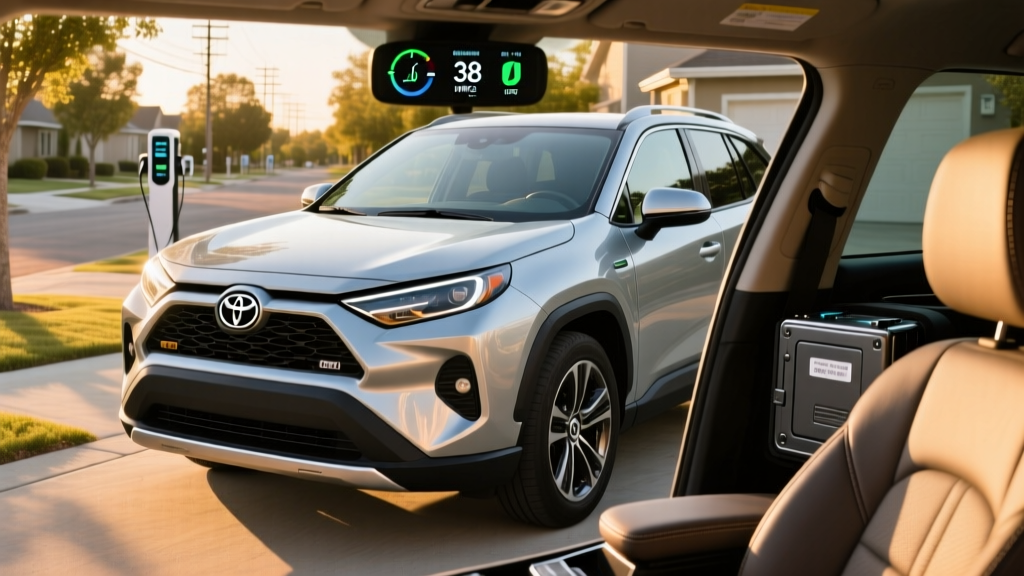
The 2019 Toyota RAV4 Hybrid remains one of the smartest used-SUV purchases in 2026. With an EPA-rated 41 city / 38 highway / 40 combined MPG, standard all-wheel drive, and Toyota's proven hybrid reliability, it delivers fuel savings that still rival or beat newer competitors — without requiring a plug, a home charger, or any change in driving habits. For buyers who want hybrid efficiency without the complexity of a plug-in hybrid or full EV, this generation RAV4 Hybrid is a data-backed winner.
This guide covers every number that matters: real-world MPG from owner data, battery longevity and replacement cost, powertrain specs, trim pricing on the used market, and how the RAV4 Hybrid stacks up against the PHEV (RAV4 Prime) and full EV alternatives.
HEV vs PHEV: What the 2019 RAV4 Hybrid Actually Is
Before diving into specs, it's critical to understand what you're buying. The 2019 RAV4 Hybrid is a conventional hybrid electric vehicle (HEV) — it does not plug in. It uses a small battery charged by regenerative braking and the gasoline engine to assist a 2.5-liter four-cylinder engine. You fuel it at any gas station and drive it exactly like a conventional car.
HEV vs PHEV vs BEV — At a Glance
| Feature | HEV (RAV4 Hybrid) | PHEV (RAV4 Prime)* | BEV (e.g., Tesla Model Y) |
|---|---|---|---|
| Plugs in? | No | Yes | Yes |
| Electric-only range | ~1 mile (low-speed) | 42 miles | 280–330 miles |
| Fuel/energy | Gasoline only | Gasoline + electricity | Electricity only |
| EPA combined | 40 MPG | 94 MPGe / 38 MPG (gas) | 117–127 MPGe |
| Home charging needed? | No | Recommended (Level 2) | Essential |
| Federal tax credit (new) | None | Expired (was up to $7,500) | Up to $7,500 (§30D, with caveats) |
*RAV4 Prime launched for the 2021 model year — not available as a 2019 model. Included for comparison only.
The key takeaway: the 2019 RAV4 Hybrid requires zero infrastructure. No Level 2 charger, no electrical panel upgrade, no charging apps. If you lack home charging access — apartment dwellers, street parkers — this HEV is the practical choice over a PHEV or BEV.
Fuel Economy: EPA Ratings vs Real-World MPG
| Driving Cycle | EPA Rating | Real-World Expectation |
|---|---|---|
| City | 41 MPG | 39–44 MPG |
| Highway | 38 MPG | 34–39 MPG |
| Combined | 40 MPG | 37–42 MPG |
Source: EPA / fueleconomy.gov
Why City MPG Beats Highway
Like all Toyota hybrids using the Hybrid Synergy Drive system, the RAV4 Hybrid excels in stop-and-go traffic. The electric motor handles low-speed propulsion, regenerative braking recaptures energy at each stop, and the gas engine shuts off at idle. In city driving, owners frequently report exceeding the 41 MPG EPA sticker — especially in warm weather with moderate acceleration.
Highway driving is where the advantage narrows. At sustained 70–80 mph speeds, the gasoline engine does most of the work, and aerodynamic drag dominates. Expect 34–37 MPG on flat interstate runs at 75 mph, dropping further in cold weather or mountainous terrain.
Cold-Weather and Seasonal Impact
Hybrid fuel economy drops in winter, though less dramatically than EV range loss. Expect a 5–10% reduction in combined MPG during freezing temperatures due to increased engine idling (for cabin heat), thicker fluids, and reduced battery efficiency. Owners in northern climates typically see 36–38 MPG combined in winter versus 40–43 MPG in summer.
Powertrain and Performance Specs
| Specification | 2019 RAV4 Hybrid |
|---|---|
| Engine | 2.5L Dynamic Force 4-cylinder (176 hp, 163 lb-ft) |
| Front electric motor | 88 kW (118 hp, 149 lb-ft) |
| Rear electric motor (AWD-i) | 40 kW (54 hp, 89 lb-ft) |
| Net combined horsepower | 219 hp |
| Transmission | eCVT (electronically controlled continuously variable) |
| Drivetrain | Electronic On-Demand AWD (standard on all trims) |
| 0–60 mph | 7.8 seconds |
| Hybrid battery | 1.6 kWh (sealed NiMH), ~245V nominal |
| Towing capacity | 1,750 lbs |
| Cargo volume (behind rear seats) | 37.5 cu ft |
| Fuel tank | 14.5 gallons |
| Total driving range (est.) | ~540–580 miles |
The eCVT Advantage
Toyota's eCVT is not a belt-driven CVT like those in some competitors. It uses a planetary gearset to seamlessly blend power from the gasoline engine and electric motors. There are no belts to wear, no fixed gear shifts to feel, and the result is a smooth, reliable powertrain that has proven durable well past 200,000 miles in fleet and owner data.
AWD-i: Electric Rear Axle
Every 2019 RAV4 Hybrid comes with electronic on-demand AWD. A dedicated 40 kW electric motor powers the rear wheels when the system detects front-wheel slip — during acceleration, wet roads, or light snow. There's no mechanical driveshaft connecting the front and rear axles, which reduces weight and drivetrain losses. This system provides confident traction in rain and moderate snow, though it is not a substitute for a dedicated off-road 4WD system.
Hybrid Battery Longevity, Warranty, and Replacement Cost
Toyota Hybrid Battery Warranty (Original)
- 2019 model year coverage: 8 years / 100,000 miles (whichever comes first)
- California-emission states (CARB states): 10 years / 150,000 miles
- Coverage threshold: Battery must retain sufficient capacity to function; Toyota covers repair or replacement if it fails to hold a charge
Source: Toyota Warranty Guide
Real-World Battery Degradation
The 2019 RAV4 Hybrid uses a 1.6 kWh nickel-metal hydride (NiMH) battery pack. Unlike the larger lithium-ion packs in EVs, this small battery operates within a narrow state-of-charge window (roughly 40–80% SoC), which significantly reduces stress and extends cycle life. Toyota's hybrid battery management system is conservative by design — it never fully charges or fully depletes the pack.
Based on owner reports and fleet data from earlier Toyota hybrid generations (which share similar battery management philosophy), the RAV4 Hybrid battery typically retains over 85% of its original capacity at 150,000 miles. Complete battery failure before 200,000 miles is uncommon, though individual cell degradation can occur.
Battery Replacement Cost
If the hybrid battery does require replacement out of warranty:
- New OEM battery from Toyota: $2,000–$3,500 (parts) + $500–$1,000 (labor) = approximately $3,000–$4,500 total
- Refurbished/remanufactured battery: $1,000–$2,000 installed
- Individual cell/module replacement (specialist shops): $500–$1,500 depending on the number of failed modules
For context, the average 2019 RAV4 Hybrid owner spends roughly $1,300–$1,500 less per year on fuel compared to the gas-only RAV4 (at 15,000 miles/year and $3.50/gallon). The fuel savings typically recoup any battery replacement cost within 2–3 years, making the long-term economics favorable even in a worst-case scenario.
Trim Levels, Pricing, and Tax Credit Eligibility
2019 RAV4 Hybrid Trims and Original MSRP
| Trim | Original MSRP (2019) | Key Features |
|---|---|---|
| LE | $29,470 | Toyota Safety Sense 2.0, 7" touchscreen, AWD-i |
| XLE | $30,970 | Dual-zone climate, blind-spot monitor, smart key |
| XSE | $32,270 | Sport-tuned suspension, 18" black alloy wheels |
| Limited | $35,070 | SofTex seats, JBL audio, 8" screen, heated front seats |
Used Market Pricing (2026 Estimates)
As of early 2026, used 2019 RAV4 Hybrid pricing depends on mileage, condition, and trim:
- LE/XLE (80,000–120,000 miles): $18,000–$23,000
- XSE/Limited (60,000–100,000 miles): $22,000–$28,000
- Low-mileage examples (under 50,000 miles): $25,000–$30,000+
Federal Tax Credit Status
The 2019 Toyota RAV4 Hybrid does not qualify for the federal §30D tax credit — neither when new nor as a used purchase. The §30D credit applies only to plug-in electric vehicles (PHEVs and BEVs) with a minimum battery capacity of 4 kWh. The RAV4 Hybrid's 1.6 kWh NiMH pack is far below this threshold.
For used buyers, the Used Clean Vehicle Credit (§25E) offers up to $4,000 (30% of sale price, max $4,000) for qualifying used PHEVs and BEVs purchased from a dealer for $25,000 or less. However, conventional HEVs like the RAV4 Hybrid are not eligible for this credit either. The tax advantages of electrification are reserved for vehicles that can operate on grid electricity. Consult IRS.gov guidance on §25E for full eligibility rules.
Who Should Buy the 2019 RAV4 Hybrid (and Who Shouldn't)
Decision Framework
Choose the 2019 RAV4 Hybrid if:
- You lack access to home or workplace charging (apartment, street parking, no garage)
- Your commute is city-heavy with frequent stops (where the hybrid system maximizes MPG)
- You want AWD for rain/snow without the fuel penalty of a conventional AWD SUV
- You plan to own the vehicle 5+ years and value Toyota's long-term reliability record
- You want lower fuel costs without any behavioral change — no plugging in, no route planning
Consider a PHEV or full EV instead if:
- You have Level 2 home charging and a commute under 40 miles (a PHEV like the RAV4 Prime can cover most trips on electricity alone)
- You want to minimize or eliminate gasoline use entirely (a BEV like the Tesla Model Y or Hyundai Ioniq 5 eliminates tailpipe emissions and fuel stops)
- You want to take advantage of the federal §30D tax credit on a new purchase (up to $7,500 for qualifying EVs/PHEVs, subject to IRS §30D income, MSRP, and sourcing requirements)
- You drive predominantly highway miles at high speeds (where the hybrid advantage shrinks and an EV's efficiency advantage grows)
Pros
- 40 MPG combined EPA — real-world city driving often exceeds 41 MPG
- Standard AWD on every trim (no FWD-only base model)
- No plug-in charging required — zero infrastructure investment
- Toyota Safety Sense 2.0 standard (pre-collision, lane departure, adaptive cruise, auto high beams)
- Proven hybrid powertrain with 200,000+ mile battery longevity track record
- Strong resale value — RAV4 Hybrid holds value better than most compact SUVs
- Spacious cargo area (37.5 cu ft) with no battery-pack intrusion
Cons
- Highway MPG drops to 34–37 at sustained 75+ mph speeds
- eCVT drone under hard acceleration (engine noise doesn't match vehicle speed)
- No federal tax credit eligibility (HEV exclusion)
- Infotainment system feels dated by 2026 standards (small screen, no wireless CarPlay on most trims)
- Towing limited to 1,750 lbs (below some turbo-gas competitors)
- NiMH battery (older chemistry vs. lithium-ion in newer hybrids)
- Cabin noise at highway speed is noticeable compared to luxury SUVs
2019 RAV4 Hybrid vs Alternatives: Quick Comparison
| Vehicle | Type | EPA Combined | AWD | Used Price (2026 est.) | Tax Credit |
|---|---|---|---|---|---|
| 2019 Toyota RAV4 Hybrid | HEV | 40 MPG | Standard | $18,000–$28,000 | None |
| 2019 Honda CR-V Hybrid | HEV | 38 MPG (AWD) | Available | $17,000–$25,000 | None |
| 2019 Ford Escape Hybrid | HEV | 41 MPG (FWD) | Not available | $14,000–$20,000 | None |
| 2021+ Toyota RAV4 Prime | PHEV | 94 MPGe / 38 MPG | Standard | $30,000–$40,000 | §25E (used, if eligible) |
| 2019 Tesla Model Y (LR) | BEV | 121 MPGe (280 mi range) | AWD available | $22,000–$30,000 | §25E (used, if eligible) |
The RAV4 Hybrid occupies a unique middle ground: better highway manners and AWD capability than the Escape Hybrid, more proven reliability than most competitors, and no charging requirement that eliminates apartment dwellers. The RAV4 Prime is the upgrade path if you can charge at home and find one in your budget.
Frequently Asked Questions
How many MPG does the 2019 Toyota RAV4 Hybrid get?
The EPA rates the 2019 RAV4 Hybrid at 41 MPG city, 38 MPG highway, and 40 MPG combined. In real-world driving, city-heavy commuters often see 41–44 MPG, while sustained highway driving at 75 mph yields 34–37 MPG. Cold weather reduces combined economy by roughly 5–10%.
Does the 2019 RAV4 Hybrid need to be plugged in?
No. The 2019 RAV4 Hybrid is a conventional hybrid (HEV). It charges its 1.6 kWh battery through regenerative braking and the gasoline engine. You never plug it in — you simply refuel at a gas station like any other car.
Is the 2019 RAV4 Hybrid reliable?
Yes. Toyota's hybrid powertrain has a two-decade reliability track record dating back to the original Prius. The eCVT transmission has no wear-prone belts or clutches, and the hybrid battery is conservatively managed to maximize lifespan. The 2019 RAV4 Hybrid earns strong reliability scores from owner surveys and is a common high-mileage fleet vehicle. The IIHS rated it a Top Safety Pick when equipped with specific headlights.
What does a RAV4 Hybrid battery replacement cost?
A new OEM hybrid battery from Toyota costs approximately $3,000–$4,500 installed. Refurbished batteries run $1,000–$2,000, and individual module replacement at a hybrid specialist can cost $500–$1,500. Complete battery failure before 150,000 miles is rare. The original warranty covers 8 years/100,000 miles (10 years/150,000 miles in CARB states).
Does the 2019 RAV4 Hybrid qualify for any tax credit?
No. The 2019 RAV4 Hybrid does not qualify for the federal §30D new vehicle credit or the §25E used vehicle credit. Both credits require a plug-in vehicle (PHEV or BEV) with minimum battery capacity. Conventional hybrids (HEVs) are not eligible for federal EV tax incentives.
How does the RAV4 Hybrid compare to the RAV4 Prime (PHEV)?
The RAV4 Prime (introduced for 2021) is a plug-in hybrid with a larger 18.1 kWh lithium-ion battery, 42 miles of electric-only range, 302 combined horsepower, and standard AWD. It achieves 94 MPGe when charged and 38 MPG on gasoline alone. The Prime is significantly more capable but commands a premium on the used market ($30,000–$40,000) and requires home charging to realize its full benefit. The 2019 RAV4 Hybrid is the right choice if you can't plug in or want a lower purchase price.
Is the 2019 RAV4 Hybrid good in snow?
Yes, for moderate winter conditions. The electronic on-demand AWD system (AWD-i) sends power to the rear wheels when front-wheel slip is detected, providing confident traction in snow and ice. Ground clearance is 8.1 inches, which handles most plowed-road conditions. For deep off-road snow, a dedicated 4WD system (like the RAV4 Adventure trim with mechanical AWD) would be more capable.