Quick Verdict: The Used Hybrid That Still Sets the Bar
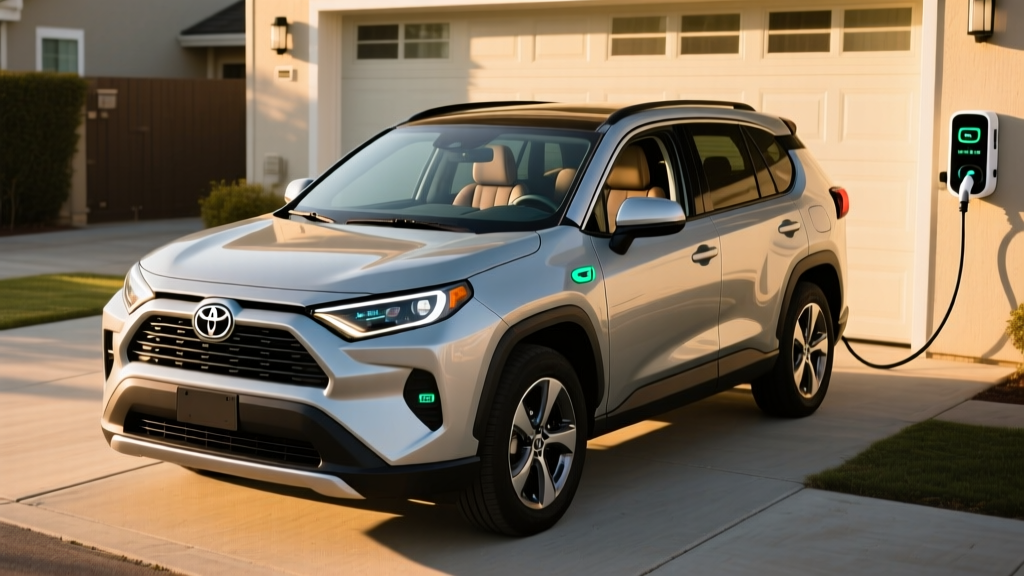
The 2019 Toyota RAV4 Hybrid launched the fifth-generation RAV4 on Toyota's TNGA-K platform, pairing a 2.5-liter Atkinson-cycle four-cylinder with front and rear electric motors for a combined 219 horsepower and standard electronic all-wheel drive. In 2026, it remains one of the smartest used-hybrid purchases on the market: EPA-rated at 41 city / 38 highway / 40 combined MPG, with a track record of battery longevity that few competitors can match. For buyers who want SUV practicality without plugging in, this generation delivers.
HEV vs. PHEV: What the 2019 RAV4 Hybrid Actually Is
Before examining specs, it's critical to distinguish the two electrified RAV4 variants that exist in this generation:
2019 RAV4 Hybrid (HEV)
- Type: Conventional self-charging hybrid
- Plug-in required: No — regenerative braking and the gas engine charge the battery
- Battery: ~1.6 kWh nickel-metal hydride (NiMH)
- Electric-only driving: Very short low-speed EV mode only (~1 mile)
- Fuel: Runs entirely on gasoline
- Federal tax credit: Not eligible (expired for Toyota hybrids years prior)
RAV4 Prime (PHEV, introduced 2021)
- Type: Plug-in hybrid
- Plug-in required: Yes — 120V or 240V charging
- Battery: 18.1 kWh lithium-ion
- Electric-only range: 42 miles EPA
- Fuel: Gasoline + electricity
- Federal tax credit: Was eligible for up to $7,500 under prior §30D rules (credit has since been restructured)
The 2019 model year offered only the conventional HEV. The RAV4 Prime PHEV didn't arrive until the 2021 model year. If you're shopping a 2019, you're buying a self-charging hybrid — no plug, no charging cable, no home charger installation needed.
Fuel Economy: EPA Ratings and Real-World MPG
The 2019 RAV4 Hybrid carries identical EPA ratings across all trims (LE, XLE, XSE, Limited):
| Metric | EPA Rating |
|---|---|
| City MPG | 41 |
| Highway MPG | 38 |
| Combined MPG | 40 |
| Fuel Tank Capacity | 14.5 gallons |
| Total Range | ~580 miles |
Real-world expectation: Toyota's hybrid system excels in stop-and-go city driving, where regenerative braking and electric-motor assist do the heavy lifting. Many owners report exceeding the 41 MPG city figure in moderate climates. Highway cruising at 70+ mph tends to yield 35-37 MPG — slightly below the EPA highway rating — because the 2.5L engine operates more frequently at sustained speeds. In cold weather (below 30°F), expect a 5-10% efficiency drop as the engine runs more often for cabin heat and battery warm-up. Source: fueleconomy.gov.
Powertrain and Performance Specs
| Specification | 2019 RAV4 Hybrid |
|---|---|
| Engine | 2.5L Atkinson-cycle 4-cylinder |
| Engine Power | 176 hp @ 5,700 rpm / 163 lb-ft torque |
| Front Electric Motor | 118 hp / 149 lb-ft |
| Rear Electric Motor | 54 hp / 89 lb-ft |
| Net Combined Horsepower | 219 hp |
| Drivetrain | Electronic AWD (eAWD) — standard |
| Transmission | Continuously Variable (eCVT) |
| 0-60 mph | ~7.8 seconds |
| Towing Capacity | 1,750 lbs |
| Cargo Volume (behind rear seats) | 37.5 cu ft |
| Cargo Volume (rear seats folded) | 69.8 cu ft |
The eAWD system uses the rear electric motor independently of the front axle — there's no mechanical driveshaft connecting them. This means the rear wheels engage on-demand during acceleration, low-traction starts, and cornering. It's not a rock-crawling system, but it handles rain, light snow, and gravel roads confidently. The 7.8-second 0-60 time is notably quicker than the gas-only RAV4's ~8.2 seconds, and the electric motor's instant torque makes the hybrid feel more responsive around town.
Battery Longevity, Warranty, and Replacement Cost
Hybrid Battery Warranty
Toyota covers the 2019 RAV4 Hybrid battery under its standard hybrid warranty:
- Duration: 8 years / 100,000 miles (whichever comes first)
- In California and states adopting CARB standards: 10 years / 150,000 miles
- Coverage: Battery capacity loss below a defined threshold or failure
Longevity reality: Toyota's NiMH hybrid batteries have a well-documented track record. Data from fleet operators and long-term owners shows that Gen-5 RAV4 Hybrid batteries routinely exceed 150,000 miles with minimal degradation — typically losing only 5-10% capacity over that span. The NiMH chemistry is less energy-dense than lithium-ion but more tolerant of daily shallow charge/discharge cycles, which is exactly how the RAV4 Hybrid operates (the battery cycles between roughly 40% and 80% state of charge, never fully depleting or fully charging).
Replacement cost if out of warranty: A new OEM hybrid battery from Toyota runs approximately $3,000-$4,000 including labor at a dealership. Refurbished or reconditioned NiMH battery packs are available from third-party suppliers for $1,500-$2,500 installed. Individual module replacement (if only a few cells degrade) can cost as little as $500-$800 at a hybrid-specialist shop. For a 2019 model in 2026, the original 8-year/100,000-mile warranty is expiring or has expired for most examples — factor potential battery service into your budget if buying one with high mileage.
Used Pricing in 2026 and Tax Credit Eligibility
Original MSRP (2019):
- LE: ~$28,350
- XLE: ~$30,050
- XSE: ~$32,250
- Limited: ~$35,050
2026 used market range: Depending on mileage (60,000-120,000 miles typical) and condition, expect to pay between $18,000 and $26,000 for a 2019 RAV4 Hybrid. Low-mileage Limited trims command the premium end; high-mileage LE models sit at the bottom.
Tax credit status: The conventional RAV4 Hybrid (HEV) does not qualify for the federal §30D new clean vehicle credit — that credit applies only to plug-in vehicles (BEVs and PHEVs) meeting battery-sourcing and MSRP requirements per IRS rules. However, if you purchase a used 2019 RAV4 Hybrid from a dealer for $25,000 or less, you may be eligible for the Used Clean Vehicle Credit (IRC §25E) — up to $4,000 or 30% of the sale price, whichever is less. Key requirements:
- Sale price must be $25,000 or less
- Buyer income caps: $75,000 single / $112,500 head of household / $150,000 joint
- Vehicle must be at least 2 model years old (2019 qualifies)
- Must purchase from a licensed dealer (private-party sales excluded)
- The vehicle must have a battery of at least 4 kWh (the RAV4 Hybrid's ~1.6 kWh battery does not meet this threshold)
Bottom line: The 2019 RAV4 Hybrid's small NiMH battery falls below the 4 kWh minimum for the used-vehicle credit. You will not receive a federal tax credit for this purchase. Some states offer their own incentives for used hybrids — check your state's energy office or department of revenue for current programs.
Reliability, Safety, and Ownership Costs
The 2019 RAV4 Hybrid benefits from Toyota's reputation for hybrid durability. The eCVT transmission has no conventional belts, clutches, or torque converter — it uses a planetary gearset that Toyota has refined since the original 1997 Prius. Brake wear is significantly reduced thanks to regenerative braking; owners commonly report 80,000-100,000 miles on original brake pads.
Safety ratings: The 2019 RAV4 earned the IIHS Top Safety Pick award with Good ratings across all crashworthiness tests. Standard Toyota Safety Sense 2.0 includes pre-collision braking with pedestrian detection, lane departure alert with steering assist, automatic high beams, and full-speed-range adaptive cruise control. Per IIHS, the headlight rating varied by trim — Limited models with LED projectors scored Acceptable, while lower trims with reflector halogens scored Marginal.
Insurance: The RAV4 Hybrid typically costs 5-10% more to insure than the gas-only RAV4 due to higher repair costs for the hybrid system. Average annual premiums in 2026 range from $1,400-$1,900 depending on state, driving record, and coverage level.
Maintenance: Toyota recommends synthetic oil changes every 10,000 miles. There is no transmission fluid to change on a regular interval (Toyota calls it "lifetime" fluid, though some hybrid specialists recommend a drain-and-fill at 120,000 miles). The hybrid battery cooling system air filter (located under the rear seat) should be cleaned every 10,000-15,000 miles to prevent overheating — a commonly overlooked maintenance item that can shorten battery life if neglected.
Who Should Buy the 2019 RAV4 Hybrid vs. a Full EV or Gas Car
Choose the 2019 RAV4 Hybrid If:
- You can't charge at home (apartment, street parking, no garage)
- You regularly drive 400+ miles in a day and can't plan around charging stops
- You want AWD and strong cargo space with minimal fuel cost
- You're buying on a used-car budget ($18K-$26K) and want low running costs
- You live in a region with extreme cold where EV range loss is a concern
Consider a Full EV Instead If:
- You can install a Level 2 home charger and most daily driving is under 80 miles
- You want zero tailpipe emissions and lower per-mile energy cost (~$0.04-$0.06/mile vs. ~$0.10-$0.12/mile for the hybrid)
- You want access to HOV lanes (available for EVs and some PHEVs in many states, not for conventional HEVs)
- You're eligible for the full §30D federal tax credit on a new EV purchase
Consider the gas-only RAV4 if: Your annual mileage is below 8,000 miles and the hybrid's fuel savings won't offset any price premium on the used market. At 30 MPG combined (gas AWD) vs. 40 MPG combined (hybrid), the hybrid saves roughly $450-$600 per year in fuel at 15,000 miles/year and $3.50/gallon. If the used price gap between a gas and hybrid model is less than $2,000, the hybrid pays for itself within 3-4 years.
Frequently Asked Questions
How many MPG does the 2019 RAV4 Hybrid actually get?
The EPA rates it at 41 city / 38 highway / 40 combined MPG. Real-world city driving often exceeds 41 MPG in mild weather. Highway driving at 75+ mph typically yields 35-37 MPG. Cold weather reduces efficiency by 5-10%.
Does the 2019 RAV4 Hybrid need to be plugged in?
No. It is a conventional self-charging hybrid (HEV). The battery charges through regenerative braking and the gasoline engine. There is no plug, no charging cable, and no need for a home charger.
How long will the hybrid battery last?
Toyota's NiMH hybrid batteries routinely last 150,000-200,000+ miles with normal use. The battery is warranted for 8 years/100,000 miles (10 years/150,000 miles in CARB states). For a 2019 model in 2026, most are at or past the standard warranty — check battery health via the hybrid system diagnostic before purchasing.
What does a replacement hybrid battery cost?
A new OEM battery from Toyota costs approximately $3,000-$4,000 installed. Refurbished packs run $1,500-$2,500 installed. Individual cell module replacement can cost $500-$800 at a hybrid specialist.
Does the 2019 RAV4 Hybrid qualify for any tax credit?
No federal tax credit applies. The conventional HEV doesn't meet the minimum 4 kWh battery requirement for the §25E used-vehicle credit, and the §30D new-vehicle credit applies only to plug-in vehicles. Check your state for any local hybrid incentives.
Is the 2019 RAV4 Hybrid AWD system good in snow?
The electronic AWD (eAWD) provides confident traction in light to moderate snow and rain. The rear electric motor engages automatically during low-triction starts and cornering. It's not designed for deep off-road use, but it outperforms most FWD crossovers in winter conditions. Pair it with winter tires for the best results.
How does it compare to the RAV4 Prime PHEV?
The RAV4 Prime (2021+) offers 42 miles of electric-only range, 302 combined horsepower, and 94 MPGe when charged. It's significantly more powerful and efficient if you can plug in daily — but it entered the market at a $39,000+ MSRP and commands higher used prices. The 2019 HEV is the budget-conscious choice for buyers who don't want or need plug-in capability.