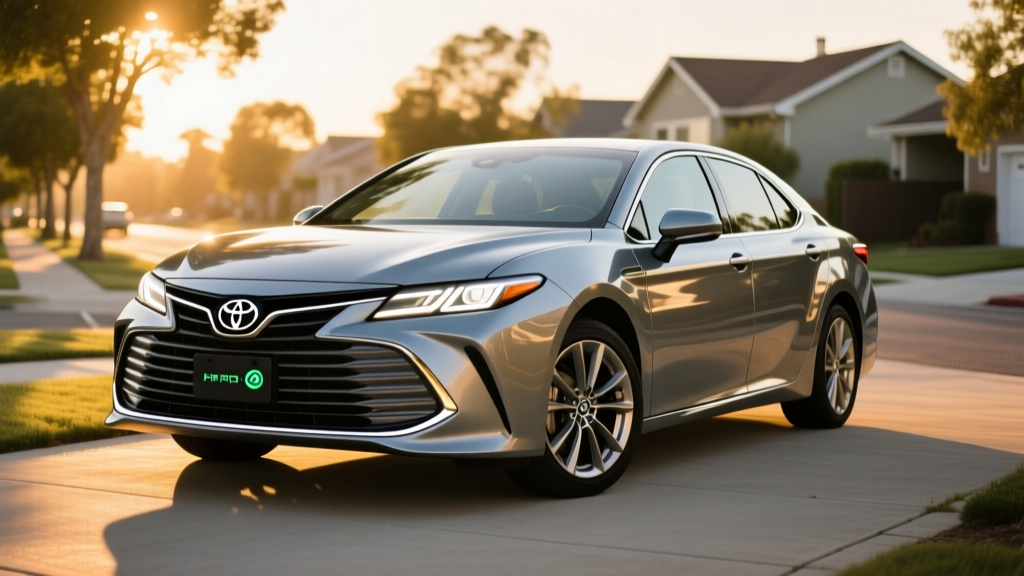
The 2019 Toyota Avalon Hybrid remains one of the most efficient full-size sedans ever sold in the United States, and in the used market it represents a compelling bridge for buyers who want electrified efficiency without plugging in. With an EPA-rated 44 MPG combined, a proven Toyota Hybrid System II powertrain, and a cabin that punches above its price class, the Avalon Hybrid is worth a serious look for commuters, road-trippers, and anyone wary of the charging-infrastructure gaps that still plague pure EVs in many regions.
This guide covers the 2019 Avalon Hybrid's real-world fuel economy, powertrain specs, battery longevity, ownership costs, and how it stacks up against plug-in hybrids and full EVs in today's market.
2019 Toyota Avalon Hybrid Fuel Economy: EPA and Real-World MPG
The headline number is what drew buyers to the Avalon Hybrid in the first place. The EPA rates the 2019 Avalon Hybrid at 43 MPG city / 44 MPG highway / 44 MPG combined for the XLE trim, while the sportier XSE and Limited trims drop slightly to 43/43/43 MPG due to larger 18-inch wheels and wider tires.
| Trim | City MPG | Highway MPG | Combined MPG |
|---|---|---|---|
| XLE | 43 | 44 | 44 |
| XSE | 43 | 43 | 43 |
| Limited | 43 | 43 | 43 |
| Touring | 43 | 43 | 43 |
Source: fueleconomy.gov
Like most Toyota hybrids, the Avalon Hybrid tends to exceed its EPA rating in city driving, where regenerative braking and low-speed electric-only operation do the heavy lifting. Owners frequently report 45–48 MPG in stop-and-go commuting. Highway driving at sustained 75+ MPH may yield 39–42 MPG, as the gasoline engine carries more of the load at higher speeds. In cold weather (below 35°F), expect a 5–10% reduction as the engine runs longer to warm the cabin and battery.
Powertrain Specs: Engine, Motor, and Combined Horsepower
The 2019 Avalon Hybrid pairs a 2.5-liter inline-4 Atkinson-cycle gasoline engine with Toyota's Hybrid System II, using two motor-generators and an electronically controlled continuously variable transmission (eCVT). There is no conventional gearbox — the eCVT uses planetary gearsets to blend power from the engine and electric motor seamlessly.
| Specification | Value |
|---|---|
| Gasoline Engine | 2.5L inline-4, Atkinson cycle |
| Engine Horsepower | 176 HP @ 5,700 RPM |
| Engine Torque | 163 lb-ft @ 3,600 RPM |
| Electric Motor Output | 118 HP (88 kW) |
| Net Combined System HP | 215 HP |
| Transmission | eCVT (planetary gearset) |
| Drivetrain | Front-wheel drive |
| 0–60 MPH | ~7.7 seconds |
| Hybrid Battery | Nickel-metal hydride (NiMH), ~1.6 kWh |
The 215 combined horsepower gives the Avalon Hybrid confident highway merging and passing ability. The electric motor's instant torque fills in the low-RPM gap that makes some four-cylinder engines feel sluggish off the line. Toyota's eCVT is one of the most durable transmissions in the industry — it has no belts, clutches, or bands to wear out.
This Is a Hybrid (HEV), Not a Plug-In Hybrid (PHEV)
A critical distinction for shoppers: the 2019 Avalon Hybrid is a conventional hybrid electric vehicle (HEV). It does not have a plug, cannot be charged from a wall outlet, and offers no meaningful electric-only driving range beyond brief low-speed maneuvers in parking lots.
- HEV (Hybrid Electric Vehicle): Small battery (~1–2 kWh) recharged by the engine and regenerative braking. No plug. Improves MPG by 30–50% over a gas-only equivalent. The Avalon Hybrid is this type.
- PHEV (Plug-In Hybrid Electric Vehicle): Larger battery (~8–20 kWh) that can be plugged in for 20–50 miles of electric-only range, then operates as a conventional hybrid once the battery is depleted. Examples: Toyota RAV4 Prime, Chrysler Pacifica Hybrid.
- BEV (Battery Electric Vehicle): No gasoline engine. 100% electric, 200–400+ mile range, requires charging access.
Toyota never offered a plug-in hybrid version of the Avalon. If you need electric-only commuting range, you'll need to look at a PHEV like the Toyota Prius Prime (25 miles electric-only) or step up to a full EV.
Hybrid Battery Warranty, Lifespan, and Replacement Cost
Toyota's hybrid battery warranty for the 2019 Avalon Hybrid covers 8 years or 100,000 miles (whichever comes first) in most states, and 10 years or 150,000 miles in California and states that follow CARB emissions standards (including CT, ME, MD, MA, NJ, NY, OR, RI, VT, and WA). This warranty guarantees the battery will retain sufficient capacity to function properly — typically defined as not dropping below a specified state-of-health threshold.
| Warranty (most states) | 8 years / 100,000 miles |
| Warranty (CARB states) | 10 years / 150,000 miles |
| Real-world battery lifespan | 150,000–200,000+ miles common |
| Dealer replacement cost | $3,500–$5,000 (OEM pack + labor) |
| Refurbished/reconditioned | $1,500–$2,500 |
| Individual module replacement | $300–$800 per failed module |
The 2019 Avalon Hybrid uses a nickel-metal hydride (NiMH) battery pack, not the lithium-ion chemistry found in most modern EVs. NiMH is less energy-dense but has a proven track record of extreme longevity in Toyota hybrids. Many Prius and Camry Hybrid owners have exceeded 200,000 miles on the original pack. The Avalon's hybrid battery is smaller and less stressed than an EV battery, which works in its favor for lifespan.
If a failure does occur out of warranty, you have options beyond a full dealer replacement. Independent hybrid-battery specialists can replace individual failed modules within the pack for a fraction of the cost, and refurbished packs are widely available.
Pricing in the Used Market and Tax Credit Eligibility
The 2019 Avalon Hybrid was originally priced from $36,550 MSRP (XLE) to approximately $42,950 (Limited). In the 2026 used market, expect to pay roughly:
- XLE (60,000–80,000 mi): $19,000–$23,000
- XSE (60,000–80,000 mi): $20,000–$24,000
- Limited (50,000–70,000 mi): $22,000–$27,000
- Touring (40,000–60,000 mi): $24,000–$28,000
Tax credit status: The 2019 Avalon Hybrid does not qualify for the federal §30D new clean vehicle credit, which applies only to new plug-in EVs and PHEVs with sufficient battery capacity. Conventional hybrids (HEVs) have never been eligible for §30D. There is currently no federal tax credit for purchasing a used conventional hybrid. Some states may offer modest incentives for hybrid purchases — check your state's energy office or department of environmental quality for current programs. Consult a tax professional for eligibility specifics, as rules vary by jurisdiction and change frequently.
Who Should Choose the Avalon Hybrid vs. a PHEV or EV?
The decision between a conventional hybrid, plug-in hybrid, and full EV depends on your driving patterns, charging access, and budget.
Choose the Avalon Hybrid (HEV) if:
- You lack home charging access (apartment, street parking)
- You take frequent long road trips and don't want to plan charging stops
- You want maximum simplicity — no plugs, no apps, no charging networks
- Your budget is under $28,000
- You want proven, low-risk reliability with minimal maintenance
Consider a PHEV or EV instead if:
- You have home Level 2 charging and a short commute (PHEV covers it on electricity alone)
- You want to eliminate gasoline for daily driving
- You qualify for the federal §30D credit on a new PHEV/EV (up to $7,500)
- You want one-pedal driving and instant EV torque
- Local HOV lane access matters to you (often requires PHEV or EV)
For a buyer who drives 30+ miles daily in mixed traffic without reliable charging at home or work, the Avalon Hybrid's 44 MPG combined and 600+ mile total range between fill-ups is hard to beat for stress-free ownership. A PHEV like the Toyota RAV4 Prime offers 42 miles of electric range but costs significantly more and requires a plug to realize its efficiency advantage.
Ownership Costs: Fuel, Maintenance, and Insurance
At 44 MPG combined and a national average gas price of approximately $3.20/gallon (early 2026), the Avalon Hybrid costs roughly $0.073 per mile in fuel. Compare that to a comparable gas-only full-size sedan averaging 26 MPG combined at $0.123 per mile. Over 15,000 annual miles, the hybrid saves approximately $750 per year in fuel costs.
Maintenance is straightforward and inexpensive. The eCVT has no fluid to change on a regular interval. Regenerative braking extends pad and rotor life significantly — many owners report original brake pads past 80,000 miles. Toyota's standard maintenance schedule applies: oil changes every 10,000 miles, coolant inspection, cabin air filter replacement.
Insurance rates for the Avalon Hybrid are typically in line with other midsize-to-full-size sedans — slightly higher than the gas Avalon due to the higher original MSRP, but not dramatically so. Expect quotes in the $1,400–$2,000/year range depending on your profile and location.
Safety Ratings and Driver-Assistance Features
The 2019 Avalon Hybrid earned the IIHS Top Safety Pick designation with good ratings across all crashworthiness tests. It comes standard with Toyota Safety Sense P (TSS-P), which includes:
- Pre-Collision System with Pedestrian Detection (PCS-PD)
- Full-Speed Range Dynamic Radar Cruise Control (DRCC)
- Lane Departure Alert with Steering Assist (LDA w/SA)
- Automatic High Beams (AHB)
Note that TSS-P is a Level 1–2 driver-assistance system under SAE automation definitions. The driver must remain fully engaged and in control at all times. This is not autonomous or self-driving capability — it is a support system that can reduce fatigue on long highway drives.
Frequently Asked Questions
How many MPG does the 2019 Toyota Avalon Hybrid get?
The EPA rates the XLE trim at 43 city / 44 highway / 44 combined MPG. Sportier trims (XSE, Limited, Touring) are rated at 43/43/43 MPG. Real-world city driving often exceeds the EPA rating, while sustained highway speeds above 75 MPH may reduce fuel economy to the high 30s.
Can I plug in the 2019 Avalon Hybrid to charge?
No. The Avalon Hybrid is a conventional hybrid (HEV), not a plug-in hybrid (PHEV). It has no charging port. The battery is recharged entirely through the gasoline engine and regenerative braking during deceleration. You never need to plug it in.
How far can the Avalon Hybrid drive on battery power alone?
Only a few hundred feet at very low speeds (under 25 MPH) in specific conditions, such as creeping through a parking lot. This is not a meaningful electric-only range. If you want 20–50 miles of electric-only driving, you need a PHEV or full EV.
Is the 2019 Avalon Hybrid reliable?
Yes. Toyota's Hybrid System II is one of the most proven electrified powertrains in the world, with decades of real-world data from millions of Prius, Camry Hybrid, and Highlander Hybrid vehicles. The eCVT has no wear components like clutches or belts. The NiMH hybrid battery routinely lasts 150,000–200,000+ miles. Toyota's hybrid warranty covers 8 years/100,000 miles (10 years/150,000 miles in CARB states).
What does a hybrid battery replacement cost?
A new OEM replacement from a Toyota dealer typically runs $3,500–$5,000 including labor. Refurbished packs cost $1,500–$2,500. Individual module replacement (if only one or two cells have failed) can cost $300–$800. Most owners never need a replacement during typical ownership periods.
Does the 2019 Avalon Hybrid qualify for any federal tax credit?
No. The federal §30D clean vehicle credit applies only to new plug-in electric vehicles (PHEVs and BEVs) with qualifying battery capacity and critical-mineral sourcing. Conventional hybrids have never been eligible for this credit, and used-vehicle hybrid purchases do not qualify for the §25E used clean vehicle credit either. Check with your state's energy office for any local hybrid incentives.
Is the 2019 Avalon Hybrid still in production?
No. Toyota discontinued the Avalon after the 2022 model year. The 2019 model represents the first year of the fifth and final generation. If you want a new Toyota hybrid sedan today, the Camry Hybrid (51 MPG combined for the 2025 LE) and the Crown (up to 41 MPG combined) are the closest current alternatives.