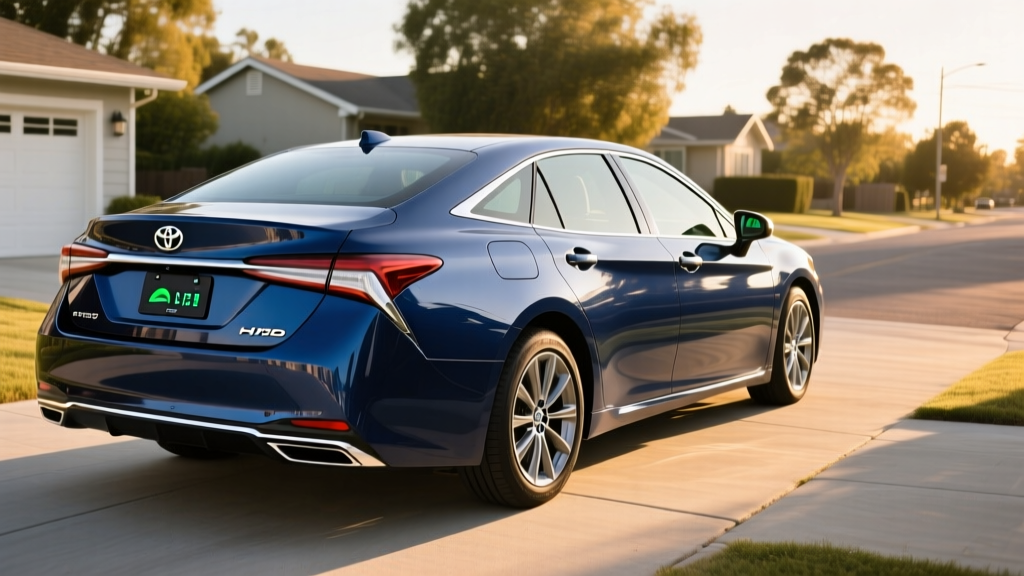
Quick Verdict: The 2019 Avalon Hybrid Still Holds Up in 2026
If you're shopping the used full-size sedan market and want serious fuel economy without plugging in, the 2019 Toyota Avalon Hybrid remains one of the most compelling options. Redesigned for the fifth generation on Toyota's TNGA-K platform, this hybrid pairs a 2.5-liter four-cylinder with a proven series-parallel hybrid system to deliver an EPA-estimated 44 MPG combined. In 2026, with used examples priced between roughly $18,000 and $27,000 depending on trim and mileage, it occupies a practical sweet spot: near-luxury comfort, low running costs, and Toyota's hybrid reliability track record.
This guide covers every spec that matters — EPA and real-world MPG, powertrain details, battery warranty and replacement cost, and how the Avalon Hybrid stacks up against PHEVs and full EVs for today's buyers.
| Spec | Value |
|---|---|
| Powertrain | 2.5L I4 + electric motor (series-parallel HEV) |
| Combined Horsepower | 215 hp |
| Hybrid Battery | Nickel-metal hydride (NiMH), ~1.6 kWh (not plug-in) |
| EPA MPG (City / Hwy / Combined) | 43 / 44 / 44 (XLE); 43 / 43 / 43 (Limited/Touring) |
| 0–60 mph | ~7.3 seconds |
| Fuel Tank | 13.2 gallons |
| Total Driving Range | ~580 miles (EPA combined estimate) |
| Drivetrain | Front-wheel drive, eCVT |
| Original MSRP (2019) | $36,550 (XLE) – $43,050 (Limited) |
| Typical Used Price (2026) | $18,000 – $27,000 |
| Hybrid Battery Warranty | 10 years / 150,000 miles (from original in-service date) |
HEV vs PHEV: Why the Avalon Hybrid Is a Conventional Hybrid
A common source of confusion among used-car shoppers is the difference between a conventional hybrid (HEV) and a plug-in hybrid (PHEV). The 2019 Toyota Avalon Hybrid is strictly an HEV — it does not have a charge port, cannot be plugged in, and has no meaningful electric-only driving range.
| Feature | HEV (e.g., Avalon Hybrid) | PHEV (e.g., Prius Prime) | BEV (e.g., Tesla Model 3) |
|---|---|---|---|
| Plug-in charging? | No | Yes | Yes |
| Electric-only range | ~1 mile at low speed | 25–44 miles typical | 250–360+ miles |
| Gas engine? | Yes | Yes | No |
| Regenerative braking? | Yes | Yes | Yes |
| Home charging needed? | No | Recommended (Level 2) | Essential |
| Federal tax credit (new)? | No | Up to $3,750 (§30D, varies) | Up to $7,500 (§30D, varies) |
The Avalon Hybrid's small NiMH battery (roughly 1.6 kWh) is charged entirely through regenerative braking and the gasoline engine. You never need to find a charger or install a Level 2 outlet. This is a key advantage for apartment dwellers, street parkers, or anyone without reliable home charging access. The tradeoff is that you don't get the 25–40 miles of zero-gas electric commuting that a PHEV like the Toyota RAV4 Prime or Prius Prime offers.
Fuel Economy: EPA Numbers and Real-World MPG
The 2019 Avalon Hybrid's headline number is its EPA-estimated fuel economy, which varies slightly by trim due to wheel size and equipment weight:
| Trim | City MPG | Highway MPG | Combined MPG |
|---|---|---|---|
| XLE (17-inch wheels) | 43 | 44 | 44 |
| XSE (18-inch wheels) | 43 | 43 | 43 |
| Limited (18-inch wheels) | 43 | 43 | 43 |
| Touring (19-inch wheels) | 43 | 43 | 43 |
Source: EPA fueleconomy.gov
Real-World MPG: What Owners Actually See
Toyota's hybrid system excels in city driving, where the electric motor handles low-speed acceleration and regenerative braking recaptures energy at every stop. In practice, many owners report exceeding the EPA city estimate — 46–48 MPG in stop-and-go traffic is common, especially in mild weather.
Highway driving tells a slightly different story. At sustained 70–80 mph speeds, the gasoline engine does most of the work, and aerodynamic drag reduces efficiency. Expect 40–43 MPG on the highway in real-world conditions. In cold weather (below 30°F), the engine runs more frequently to maintain cabin heat and battery temperature, which can drop observed MPG to the high 30s on short trips.
With the 13.2-gallon fuel tank, real-world total range typically falls between 520 and 580 miles depending on driving mix — enough for most drivers to go two weeks between fill-ups.
Powertrain and Driving Dynamics
The 2019 Avalon Hybrid uses Toyota's fourth-generation Hybrid Synergy Drive, pairing a 2.5-liter Dynamic Force four-cylinder engine (176 hp, 163 lb-ft torque on its own) with a front-mounted electric motor. Combined system output is 215 horsepower, routed through an electronically controlled continuously variable transmission (eCVT) to the front wheels.
The result is smooth, linear acceleration with no traditional gear shifts. The 0–60 mph time of approximately 7.3 seconds is adequate for merging and passing, though it won't feel sporty. The eCVT eliminates shift shock entirely, and the transition between electric and gas power is nearly imperceptible in normal driving.
Driving modes include Normal, Eco, Sport, and EV. The EV mode forces electric-only operation but is limited to very low speeds (under ~25 mph) and short distances (roughly one mile) — useful for creeping through a parking garage, not for neighborhood driving.
Battery Warranty, Lifespan, and Replacement Cost
Hybrid battery longevity is consistently the top concern for used hybrid buyers. Here's what you need to know about the 2019 Avalon Hybrid's battery:
Hybrid Battery Warranty Coverage
Toyota covers the 2019 Avalon Hybrid's battery with a 10-year / 150,000-mile warranty (in states that adopted California's emissions warranty rules, which covers most of the U.S. market). This warranty is transferable to subsequent owners, meaning a 2019 model purchased used in 2026 still has factory hybrid battery coverage through approximately 2029 or 150,000 miles — whichever comes first.
The warranty guarantees the battery will retain sufficient capacity for normal hybrid operation. If it fails or degrades below Toyota's threshold, replacement is covered at no cost.
Expected Battery Lifespan
Toyota's NiMH hybrid batteries have an excellent longevity track record. Data from Prius fleets and long-term Camry Hybrid ownership suggest these batteries routinely last 150,000–200,000+ miles before significant degradation. The NiMH chemistry is less energy-dense than the lithium-ion packs in modern EVs, but it's also less prone to the capacity-loss issues that affect early lithium-ion designs.
Replacement Cost If Out of Warranty
If the hybrid battery does need replacement after warranty expiration:
- New OEM battery from Toyota: approximately $3,000–$4,000 (parts and labor at a dealership)
- Refurbished/remanufactured battery: approximately $1,500–$2,500 from third-party specialists
- Individual module replacement: some independent hybrid shops can replace only the failed cells within the pack for $500–$1,200, extending the pack's life at lower cost
For a 2019 model with typical mileage (60,000–90,000 miles in 2026), the battery is likely still well within its service life and warranty window.
Pricing, Trims, and Tax Credit Eligibility
The 2019 Avalon Hybrid was offered in four trims when new: XLE, XSE, Limited, and Touring. Original MSRPs ranged from $36,550 to $43,050.
| Trim | 2019 MSRP | 2026 Used Range (est.) | Key Features |
|---|---|---|---|
| XLE | $36,550 | $18,000–$22,000 | Toyota Safety Sense P, 9" touchscreen, heated front seats |
| XSE | $38,050 | $19,000–$23,000 | Sport-tuned suspension, paddle shifters, 18" wheels |
| Limited | $42,250 | $21,000–$25,000 | Ventilated seats, JBL audio, navigation, rear sunshade |
| Touring | $43,050 | $22,000–$27,000 | Adaptive suspension, ambient lighting, premium interior |
Tax Credits for Used Hybrid Buyers
Here's the straightforward answer: the 2019 Toyota Avalon Hybrid does not qualify for any federal tax credit, whether purchased new or used. The IRS §30D new clean vehicle credit applies only to plug-in electric vehicles (PHEVs and BEVs) that meet battery sourcing and critical mineral requirements. Conventional hybrids like the Avalon HEV have never been eligible for this credit.
The IRS Used Clean Vehicle Credit (up to $4,000 or 30% of sale price, whichever is less) similarly applies only to used PHEVs and BEVs — not conventional hybrids. Some states may offer their own incentives for hybrid purchases, but these vary widely and are often expired or limited. Check your state's energy or DMV website for current programs.
Who Should Buy the 2019 Avalon Hybrid vs a PHEV or EV?
Choose the 2019 Avalon Hybrid If:
- You don't have access to home or workplace charging
- You want maximum fuel economy with zero behavior change — just fill up with gas
- You regularly take long road trips and want 550+ mile range without route planning
- You prefer a full-size sedan with a spacious rear seat and large trunk (16.1 cu ft)
- You want Toyota's hybrid reliability with remaining factory battery warranty
Choose a PHEV Instead If:
- You have home charging and a commute under 30–40 miles (a RAV4 Prime or Prius Prime covers most daily driving on electricity alone)
- You want to reduce gasoline consumption dramatically while keeping a gas engine for road trips
- You can find a used PHEV still within its battery warranty
Choose a Full EV Instead If:
- You have reliable Level 2 home charging
- Your daily driving is under 200 miles and you rarely road-trip beyond DC fast-charger coverage
- You want the lowest per-mile fuel cost (electricity at $0.13/kWh averages ~$0.04/mile vs. the Avalon's ~$0.08/mile at $3.50/gal)
- You want to take advantage of the used EV tax credit (up to $4,000 under IRS §25E)
Reliability, Safety, and Long-Term Ownership
The 2019 Avalon earned strong safety marks: a Top Safety Pick designation from the IIHS (with acceptable-rated headlights on certain trims) and a 5-star overall rating from NHTSA. Standard Toyota Safety Sense P includes pre-collision braking with pedestrian detection, full-speed adaptive cruise control, lane departure alert with steering assist, and automatic high beams.
Toyota's hybrid powertrains consistently rank at the top of long-term reliability surveys. The eCVT has no traditional clutch packs or bands to wear out — it's a planetary gearset that's mechanically simple and durable. Brake pads also last significantly longer than on gas-only cars because regenerative braking handles much of the deceleration, often pushing brake life to 80,000–100,000 miles.
Pros
- 44 MPG combined — exceptional for a full-size sedan
- Smooth, quiet hybrid powertrain with seamless gas/electric transitions
- Spacious cabin and 16.1 cu-ft trunk (no battery intrusion)
- Remaining hybrid battery warranty through ~2029
- Low maintenance costs (no plug-in, long brake life, proven eCVT)
- Strong IIHS and NHTSA safety ratings
Cons
- No plug-in or electric-only driving capability
- eCVT drone under hard acceleration
- Infotainment system feels dated vs. 2026 competitors (no wireless CarPlay on most trims)
- Full-size sedan segment is shrinking — limited new alternatives for comparison
- No federal tax credit eligibility (new or used)
- 19-inch wheels on Touring trim slightly reduce ride comfort
Frequently Asked Questions
How many MPG does the 2019 Toyota Avalon Hybrid get?
The EPA rates the XLE trim at 43 city / 44 highway / 44 combined MPG. Trims with larger wheels (XSE, Limited, Touring) are rated at 43/43/43. In real-world city driving, many owners report 46–48 MPG; highway driving typically yields 40–43 MPG.
Does the 2019 Avalon Hybrid need to be plugged in?
No. The Avalon Hybrid is a conventional hybrid (HEV), not a plug-in hybrid. Its small battery charges through regenerative braking and the gasoline engine. You simply fill it with gas like any other car.
How far can the 2019 Avalon Hybrid go on electric only?
Essentially one mile at very low speeds (under 25 mph) in EV mode. This is useful for parking garages or quiet neighborhood crawling, but it is not a practical electric commuting vehicle. For meaningful electric-only range, you'd need a PHEV.
Is the 2019 Avalon Hybrid reliable?
Yes. Toyota's Hybrid Synergy Drive is one of the most proven hybrid systems on the road, with millions of units in service globally. The NiMH battery pack typically lasts 150,000–200,000+ miles, the eCVT is mechanically simple, and regenerative braking extends brake pad life significantly.
What does it cost to replace the hybrid battery?
A new OEM replacement runs approximately $3,000–$4,000 at a dealership. Refurbished packs cost $1,500–$2,500, and individual cell module replacement can be done for $500–$1,200 at specialist shops. However, most 2019 examples still have factory warranty coverage through 2029 or 150,000 miles.
Does the 2019 Avalon Hybrid qualify for any tax credit?
No. Federal tax credits under IRS §30D (new vehicles) and §25E (used vehicles) apply only to plug-in electric vehicles — PHEVs and BEVs. Conventional hybrids like the Avalon HEV are not eligible. Some states may have separate hybrid incentives, but most have expired.
Is the 2019 Avalon Hybrid a good buy in 2026?
For buyers who want a comfortable, spacious sedan with excellent fuel economy and no charging hassle, yes. With used prices between $18,000–$27,000 and remaining hybrid battery warranty, it offers strong value. The main tradeoff versus a used PHEV or EV is that you'll always burn gasoline — but at 44 MPG, the cost per mile is roughly half that of a comparable gas-only sedan.