The 2019 RAV4 Hybrid at a Glance
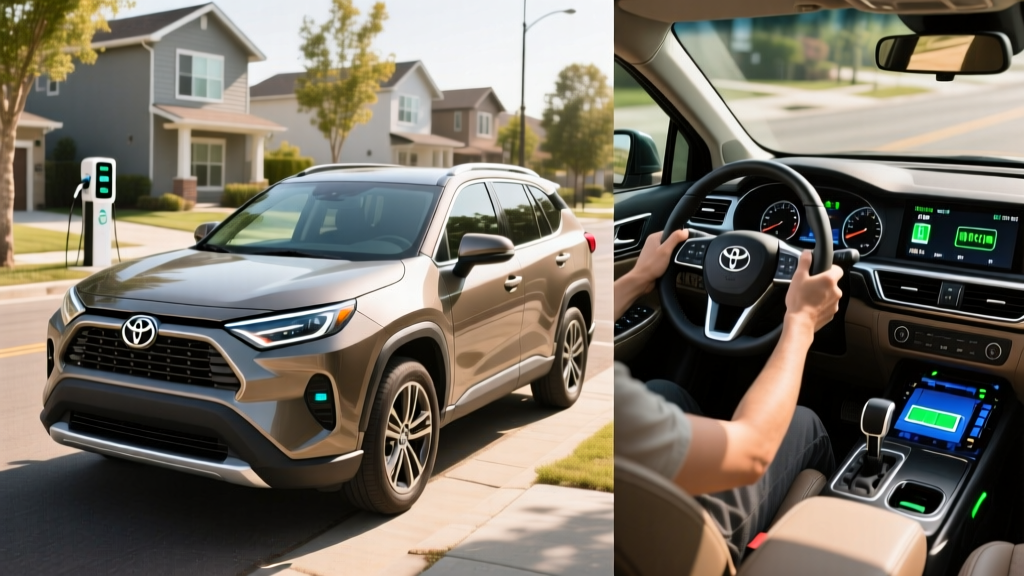
The 2019 Toyota RAV4 Hybrid marked a generational shift. Built on Toyota's TNGA-K platform, it paired a 2.5-liter four-cylinder engine with Toyota's fourth-generation hybrid system (THS II) to deliver a then-class-leading 41 MPG city EPA rating. For buyers in 2026 browsing the used market, this model year remains one of the most practical hybrid SUVs available — no plug required, no range anxiety, and a track record of durability that few competitors can match.
This guide covers every number that matters: EPA and real-world MPG, the hybrid battery's expected lifespan, what a replacement actually costs, and how the 2019 RAV4 Hybrid stacks up against the plug-in RAV4 Prime, a full EV, or a conventional gas SUV.
HEV vs PHEV: Understanding What the 2019 RAV4 Hybrid Is
Before diving into specs, it's essential to distinguish the conventional hybrid (HEV) from the plug-in hybrid (PHEV). The 2019 RAV4 Hybrid is a conventional HEV. It has no plug, no electric-only driving range to speak of, and no external charging capability. The battery recharges solely through regenerative braking and the gasoline engine.
Toyota introduced the RAV4 Prime (a PHEV) for the 2021 model year. The Prime features an 18.1 kWh battery, 42 miles of EPA-rated electric-only range, and a combined 302 horsepower. It qualifies (or qualified, depending on the purchase year and IRS sourcing rules) for the federal §30D tax credit. The 2019 RAV4 Hybrid does not.
| Attribute | 2019 RAV4 Hybrid (HEV) | RAV4 Prime (PHEV) |
|---|---|---|
| Plug-in capable | No | Yes |
| Battery capacity | ~1.6 kWh (NiMH) | 18.1 kWh (lithium-ion) |
| Electric-only range | N/A (<1 mi at low speed) | 42 mi EPA |
| Combined HP | 219 hp | 302 hp |
| EPA combined MPG / MPGe | 40 MPG | 94 MPGe (electric) / 38 MPG (gas) |
| DC fast charging | N/A | No (Level 2 AC only, ~2.5 hrs) |
| Federal tax credit | Not eligible | Up to $7,500 (subject to §30D rules) |
If you're cross-shopping the used market and see a "RAV4 Hybrid" listing, verify whether it's the conventional HEV (2019–current) or the Prime PHEV (2021–current). The price difference is significant, and so is the ownership experience.
Fuel Economy: EPA Ratings and Real-World MPG
The EPA rates the 2019 RAV4 Hybrid AWD at 41 MPG city / 38 MPG highway / 40 MPG combined (source: fueleconomy.gov). These numbers apply across all trims (LE, XLE, XSE, Limited) since the powertrain is identical.
| Driving Cycle | EPA Rating | Real-World Expectation |
|---|---|---|
| City | 41 MPG | 42–46 MPG (hybrids excel in stop-and-go) |
| Highway | 38 MPG | 35–38 MPG (aero drag and sustained ICE use) |
| Combined | 40 MPG | 38–43 MPG depending on driving mix |
Why Hybrids Often Beat EPA in the City
Unlike gasoline cars, hybrids recover energy during braking and can shut off the engine entirely at low speeds. If your commute involves frequent stops, school drop-offs, or suburban errands, expect to see 43–46 MPG regularly. Highway-heavy drivers will see numbers closer to 35–37 MPG, especially above 70 mph where aerodynamic drag dominates and the electric motor provides less benefit.
Cold-Weather Impact
In sub-freezing temperatures, expect a 5–12% drop in fuel economy. The engine runs more frequently to maintain cabin heat and bring the catalytic converter to operating temperature. Owners in northern climates typically report 36–38 MPG combined in winter versus 41–44 MPG in summer. This is normal hybrid behavior and far less severe than the 20–30% range loss a full EV experiences in cold weather.
Powertrain and Performance Specs
| Engine | 2.5L inline-4 (A25A-FXS, Atkinson cycle) |
| Engine output | 176 hp / 163 lb-ft torque |
| Front electric motor | 118 hp / 149 lb-ft |
| Rear electric motor (AWD) | 54 hp / 89 lb-ft |
| Net combined system HP | 219 hp |
| Transmission | eCVT (planetary gearset, no belt) |
| Drivetrain | Electronic AWD (eAWD) standard |
| 0–60 mph | 7.8 seconds |
| Towing capacity | 1,750 lbs |
| Cargo volume (rear seats up) | 37.6 cu ft |
| Cargo volume (rear seats folded) | 69.8 cu ft |
| Hybrid battery type | Nickel-metal hydride (NiMH) |
| Hybrid battery capacity | ~1.6 kWh (gross) |
The 219 combined horsepower figure deserves context. Toyota's hybrid system blends engine and motor output through a planetary gearset, so peak outputs don't simply add together. The result is smooth, linear acceleration with no shift shock — the eCVT isn't a traditional CVT with a steel belt and pulleys, but a robust gear-based power-split device that has proven extremely reliable over millions of Toyota hybrid vehicles.
The rear electric motor provides on-demand AWD without a mechanical driveshaft. It engages during acceleration, low-traction conditions, and cornering, but does not provide continuous rear-wheel drive. This system is adequate for rain, light snow, and gravel roads, but not intended for serious off-road use.
Hybrid Battery Longevity, Warranty, and Replacement Cost
2019 RAV4 Hybrid Battery Warranty
Original warranty: 8 years / 100,000 miles (10 years / 150,000 miles in CARB states including CA, CT, ME, MA, NJ, NY, OR, RI, VT, WA).
Hybrid system components covered: Battery pack, inverter, converter, ECU, and all hybrid-specific wiring.
Transferability: Warranty transfers to subsequent owners automatically — no paperwork required.
How Long Does the Battery Actually Last?
Toyota's NiMH hybrid batteries have an exceptional longevity record. Data from fleet operators, taxi services, and long-term owners consistently shows these packs lasting 150,000–250,000 miles before capacity degrades enough to warrant replacement. The 2019 model benefits from improved thermal management over earlier generations, and NiMH chemistry is inherently tolerant of the shallow charge-discharge cycles that hybrid systems use (typically operating between 40–80% state of charge).
For a 2019 model purchased in 2026, the original 8-year / 100,000-mile warranty is likely expiring or has expired depending on mileage. However, many Toyota dealerships offer extended hybrid battery coverage, and the battery itself often outlasts the vehicle's economic life.
Battery Replacement Cost
If replacement becomes necessary:
- New OEM battery (Toyota dealer): $2,500–$3,800 including labor
- Remanufactured battery: $1,500–$2,500 including labor
- Individual module replacement: $400–$900 (only failed modules replaced, viable for partial degradation)
These costs are dramatically lower than full EV battery replacements ($8,000–$20,000+) because the hybrid battery is small (~1.6 kWh) and uses mature NiMH technology. The 2019 RAV4 Hybrid's battery is not a financial time bomb — it's one of the most affordable electrified-vehicle batteries to replace in the industry.
Pricing in 2026: Used Market and Tax Credit Reality
The 2019 RAV4 Hybrid originally started at $28,350 MSRP (LE trim, including destination) and topped out around $38,000 for a fully loaded Limited. In the 2026 used market, expect to pay:
- LE / XLE (60,000–90,000 miles): $20,000–$25,000
- XSE / Limited (40,000–70,000 miles): $24,000–$29,000
- Low-mileage examples (<40,000 miles): $26,000–$32,000
Federal Tax Credit Eligibility
The 2019 RAV4 Hybrid is not eligible for the federal §30D new clean vehicle credit — that credit applies only to new plug-in vehicles (BEVs and PHEVs) meeting battery sourcing, MSRP caps, and buyer income requirements per current IRS guidelines.
For the used clean vehicle credit (§25E, up to $4,000 or 30% of sale price, whichever is less), the 2019 RAV4 Hybrid also does not qualify. This credit requires the vehicle to be a plug-in electric vehicle (BEV or PHEV) with at least 7 kWh of battery capacity. The RAV4 Hybrid's 1.6 kWh NiMH pack falls well short of this threshold.
If tax credit eligibility is a priority, consider the RAV4 Prime (PHEV) on the used market, though its higher purchase price may offset the credit advantage.
Reliability and Ownership Costs
The 2019 RAV4 Hybrid benefits from Toyota's long-standing hybrid reliability advantage. Key ownership data points:
- NHTSA safety rating: 5 stars overall (source: NHTSA)
- IIHS rating: Top Safety Pick (with specific headlight trim)
- Toyota Safety Sense 2.0: Standard on all trims — includes pre-collision system with pedestrian detection, full-speed dynamic radar cruise control, lane departure alert with steering assist, and automatic high beams
- Average annual maintenance cost: $400–$550 (comparable to gas RAV4; no oil changes beyond standard intervals, no hybrid-specific maintenance required)
- Brake pad life: Often 80,000–120,000 miles thanks to regenerative braking reducing friction brake wear
The eCVT transmission is effectively maintenance-free. Unlike conventional automatic or CVT transmissions, Toyota's planetary gearset power-split device has no clutch packs, belts, or bands to wear out. Transmission fluid changes are recommended at 60,000-mile intervals but are not critical to longevity.
Who Should Choose the 2019 RAV4 Hybrid?
Choose the 2019 RAV4 Hybrid If:
- You want 40+ MPG without changing your fueling habits
- You lack access to home or workplace charging (no plug needed)
- You want proven reliability with minimal battery replacement risk
- You drive a city-heavy commute where hybrids excel
- You need AWD for weather but not serious off-roading
- Your budget is $20,000–$28,000 on the used market
Look Elsewhere If:
- You want electric-only driving for short commutes (consider RAV4 Prime PHEV)
- You need more than 1,750 lbs towing capacity
- You want federal tax credit eligibility (requires a PHEV or BEV)
- You drive 90%+ highway miles (a diesel or efficient gas SUV may match MPG)
- You want the latest infotainment (2019 system lacks wireless CarPlay/Android Auto)
HEV vs PHEV vs EV — Which Fits You?
Choose the 2019 RAV4 Hybrid (HEV) if you have no reliable charging access, want the lowest upfront cost, and prioritize simplicity. You'll save $600–$1,000/year in fuel versus a gas RAV4 without any infrastructure changes.
Choose a used RAV4 Prime (PHEV) if you can charge at home, have a sub-40-mile commute, and want to drive mostly on electricity while keeping a gas engine for road trips. Budget $28,000–$38,000 used.
Choose a full EV (like a used Tesla Model Y or Hyundai Ioniq 5) if you have reliable Level 2 home charging, rarely drive more than 250 miles in a day, and want zero tailpipe emissions with minimal maintenance. Budget $22,000–$40,000 used depending on model and mileage.
Frequently Asked Questions
How many MPG does the 2019 RAV4 Hybrid actually get?
The EPA rates it at 41 city / 38 highway / 40 combined MPG. In real-world driving, city-heavy commuters regularly see 42–46 MPG, while highway-dominant drivers should expect 35–38 MPG. Cold weather reduces these figures by 5–12%.
Does the 2019 RAV4 Hybrid need to be plugged in?
No. The 2019 RAV4 Hybrid is a conventional hybrid (HEV) with no plug. The battery charges entirely through regenerative braking and the gasoline engine. You fuel it like any other car at a gas station.
How far can the 2019 RAV4 Hybrid drive on electric only?
Effectively zero miles. The hybrid system uses the electric motor to assist the engine and enable brief engine-off coasting at low speeds, but it cannot sustain electric-only driving beyond a few hundred feet at parking-lot speeds. For meaningful electric-only range (42 miles EPA), you need the RAV4 Prime PHEV.
Is the hybrid battery reliable and what does replacement cost?
Toyota's NiMH hybrid batteries have a strong track record of lasting 150,000–250,000 miles. Replacement costs $2,500–$3,800 for a new OEM battery or $1,500–$2,500 for a remanufactured unit. The original warranty was 8 years/100,000 miles (10/150,000 in CARB states), which may be expiring on 2019 models in 2026–2027.
Does the 2019 RAV4 Hybrid qualify for any tax credit?
No. The federal §30D new vehicle credit and §25E used vehicle credit both require plug-in electric vehicles (BEVs or PHEVs) with minimum battery capacities. The 2019 RAV4 Hybrid's 1.6 kWh NiMH battery does not qualify. Some states or utilities may offer minor rebates for hybrid purchases — check your local programs.
How does the 2019 RAV4 Hybrid compare to the gas-only 2019 RAV4?
The gas-only 2019 RAV4 AWD is rated at 28 city / 35 highway / 30 combined MPG. The hybrid's 40 combined MPG represents a 33% improvement. At 12,000 miles/year and $3.50/gallon gas, the hybrid saves roughly $580 annually in fuel — enough to recoup the typical $1,500–$2,500 used-market price premium within 3–4 years.
Is the 2019 RAV4 Hybrid AWD system good in snow?
The electronic AWD system provides adequate traction for snow, ice, and rain by automatically engaging the rear electric motor when slip is detected. It's not a substitute for dedicated winter tires in severe conditions, but it outperforms front-wheel-drive vehicles and matches most competitive AWD crossovers in winter capability. The hybrid's low-speed electric torque also helps with smooth, controlled starts on slippery surfaces.