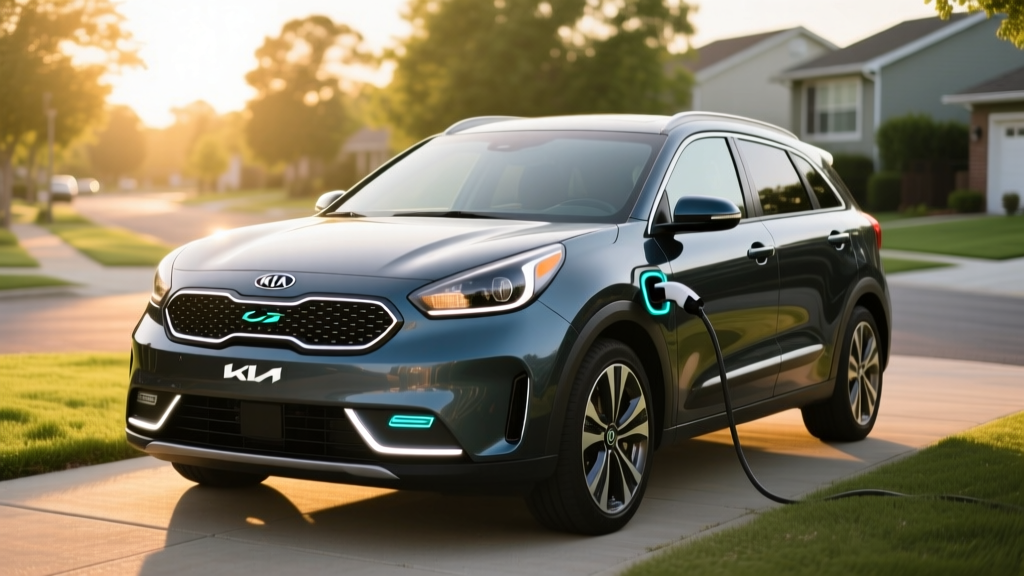
The 2019 Kia Niro Hybrid remains one of the most fuel-efficient compact crossovers on the used market in 2026. With an EPA-estimated 50 MPG combined in its FE trim, a spacious cabin, and Kia's proven hybrid powertrain, it draws buyers who want EV-like efficiency without plugging in. But with the Niro lineup spanning a conventional hybrid (HEV), a plug-in hybrid (PHEV), and a full battery-electric (EV) version, understanding exactly what you're getting — and what ownership looks like seven years after production — is essential before handing over cash.
This guide covers the 2019 Niro Hybrid (HEV) in depth, with comparisons to its PHEV sibling and the full EV variant so you can make the right powertrain call.
HEV vs PHEV vs EV: Which 2019 Niro Fits Your Driving?
Kia sold the 2019 Niro in three distinct electrified flavors. Confusing them is easy on the used lot — the body shells look nearly identical — but the powertrains and ownership experiences diverge sharply.
| Attribute | 2019 Niro Hybrid (HEV) | 2019 Niro Plug-In Hybrid (PHEV) | 2019 Niro EV |
|---|---|---|---|
| Powertrain Type | Conventional Hybrid | Plug-In Hybrid | Battery Electric |
| EPA Combined | 43–50 MPG | 46 MPG (gas) / 105 MPGe | 112 MPGe |
| Electric-Only Range | N/A (no plug) | 26 miles | 239 miles |
| Battery Capacity | 1.56 kWh | 8.9 kWh | 64 kWh |
| Plug Required? | No | Yes (Level 1/2) | Yes (Level 1/2/DC) |
| Combined HP | 139 hp | 139 hp | 201 hp |
| DC Fast Charging | No | No | Yes (CCS, ~75 kW peak) |
The conventional Niro Hybrid (HEV) generates all its electricity from the gasoline engine and regenerative braking. You never plug it in. The small 1.56 kWh lithium-ion battery acts as a buffer, enabling electric-only assist at low speeds and recapturing braking energy, but it cannot propel the car for meaningful distances on electricity alone.
The Niro Plug-In Hybrid (PHEV) pairs a larger 8.9 kWh battery with a charge port. Plug it in overnight on a standard 120V outlet or a 240V Level 2 charger, and you get an EPA-estimated 26 miles of electric-only driving before the gasoline engine kicks in. Total range exceeds 560 miles combined.
The Niro EV is a fully electric vehicle with a 64 kWh battery and 239 miles of EPA range. It's an entirely different ownership proposition — no gas engine, no oil changes, but a dependence on charging infrastructure.
2019 Kia Niro Hybrid MPG: EPA Estimates and Real-World Data
Fuel economy varies by trim because wheel size and equipment weight affect efficiency. Here's the official EPA data from fueleconomy.gov:
| Trim | City MPG | Highway MPG | Combined MPG |
|---|---|---|---|
| FE (base, 16" wheels) | 52 | 49 | 50 |
| LX / EX / Touring (18" wheels) | 46 | 40 | 43 |
The FE trim's 50 MPG combined is exceptional for a crossover — it matches or beats many compact sedans. The 7 MPG penalty on higher trims comes primarily from larger 18-inch alloy wheels, wider tires with higher rolling resistance, and added feature weight (power seats, sunroof, larger infotainment stack).
Real-World MPG vs. EPA Sticker
Hybrids like the Niro often exceed their EPA city estimates in real-world driving because stop-and-go traffic maximizes regenerative braking and electric-motor assist. Owners on fuel-tracking platforms consistently report 48–54 MPG in mixed city-heavy commutes with the FE trim.
Highway driving tells a different story. At sustained 70–80 mph speeds, the electric motor contributes less and the 1.6-liter Atkinson-cycle engine does the heavy lifting. Expect 38–43 MPG on the highway in the FE, and 34–38 in Touring trims. Cold weather (below 35°F) further reduces efficiency by roughly 5–10% as the engine runs more often to provide cabin heat and the battery's internal resistance increases.
For context: a driver covering 15,000 miles per year at 48 MPG average burns roughly 312 gallons annually. At $3.50/gallon, that's approximately $1,093 in fuel. A comparable gas-only crossover averaging 28 MPG would consume 536 gallons — about $1,876. The Niro Hybrid saves roughly $780 per year in fuel.
Powertrain and Driving Performance
| Specification | 2019 Kia Niro Hybrid |
|---|---|
| Engine | 1.6L 4-cyl Atkinson-cycle (104 hp, 109 lb-ft) |
| Electric Motor | 32 kW (43 hp, 125 lb-ft) |
| Combined System Output | 139 hp / 195 lb-ft torque |
| Transmission | 6-speed dual-clutch automatic (DCT) |
| 0–60 mph | ~9.7 seconds |
| Drivetrain | Front-wheel drive |
| Curb Weight | 3,139–3,274 lbs (trim dependent) |
| Cargo Volume | 19.4 cu ft (rear seats up) / 54.5 cu ft (folded) |
The Niro Hybrid uses a parallel hybrid architecture. The gasoline engine and electric motor can drive the wheels independently or together, managed through a 6-speed dual-clutch transmission rather than the continuously variable transmissions (CVTs) found in the Toyota Prius and Honda Insight. This gives the Niro a more natural, stepped acceleration feel — no rubber-band drone under hard throttle — at a minor cost to absolute efficiency smoothness.
Acceleration is adequate for commuting and highway merging but not quick. The 9.7-second 0–60 time trails turbocharged compact crossovers. The trade-off is worthwhile: this powertrain prioritizes thrift over punch, and the electric motor's instant torque provides responsive low-speed pull from stoplights.
Battery Warranty, Lifespan, and Replacement Cost
For any used hybrid buyer, the traction battery is the single biggest financial unknown. Here's what you need to know about the 2019 Niro's lithium-ion pack.
Kia Hybrid Battery Warranty (Original)
- Duration: 8 years / 100,000 miles (whichever comes first)
- Capacity threshold: Kia warrants against defects and significant capacity loss (typically below ~70% state of health)
- Transferability: The hybrid battery warranty transfers to subsequent owners — a 2019 model's coverage extends through the 2027 model year or 100,000 miles
- California/PZEV states: 10 years / 150,000 miles in states that adopted California emissions standards
As of 2026, a 2019 Niro Hybrid is seven years old. If the original warranty clock started in early 2019, standard coverage runs through early 2027. That leaves roughly a year of remaining factory battery protection on most examples — a meaningful safety net for used buyers.
How Long Do Niro Hybrid Batteries Last?
The 1.56 kWh pack in the Niro HEV is small and operates within a narrow state-of-charge window (roughly 40–80% SoC), which significantly reduces degradation stress. Kia's battery management system (BMS) never allows full charge or full discharge, preserving cell health. Real-world data from high-mileage Niro and Hyundai Ioniq Hybrid owners (which share the same powertrain family) shows minimal capacity loss — typically 5–10% after 150,000+ miles.
Catastrophic battery failure is rare. The more common aging symptom is a gradual reduction in electric-motor assist duration, which manifests as slightly lower MPG over time rather than a warning light.
Battery Replacement Cost
If the hybrid battery fails outside warranty:
- New OEM replacement: $2,500–$3,800 (parts + labor at a Kia dealer)
- Refurbished/remanufactured pack: $1,200–$2,000
- Individual cell/module repair: $500–$1,000 at a hybrid specialist shop
Given the Niro HEV's small battery and conservative BMS, outright replacement is uncommon before 200,000 miles. The cost is far lower than replacing an EV's large traction battery.
2019 Niro PHEV: Electric-Only Range and Charging
If you're cross-shopping the plug-in variant, here are the critical numbers:
| Specification | 2019 Kia Niro PHEV |
|---|---|
| Battery Capacity | 8.9 kWh (lithium-ion polymer) |
| EPA Electric-Only Range | 26 miles |
| Total Range (Electric + Gas) | ~560 miles |
| MPGe (Electric Mode) | 105 MPGe combined |
| MPG (Gas-Only Hybrid Mode) | 46 combined |
| Level 1 Charge (120V) | ~9 hours (0–100%) |
| Level 2 Charge (240V, 3.3 kW) | ~2.5 hours (0–100%) |
| DC Fast Charging | Not supported |
| Charge Port | J1772 (Level 2) |
The PHEV's 26-mile electric range covers most daily commutes. Plug in nightly at home, and you may burn gasoline only on longer weekend trips. The onboard charger maxes out at 3.3 kW, meaning even a faster Level 2 station won't charge the battery any quicker — a hardware limitation worth noting. DC fast charging is not available on any Niro PHEV.
For drivers without home or workplace charging access, the PHEV's advantage erodes. Running it purely as a hybrid without plugging in yields 46 MPG combined — excellent, but only 4 MPG better than the standard Niro HEV Touring trims, and at a higher purchase premium.
Used Pricing and Tax Credit Eligibility in 2026
The 2019 Niro Hybrid is no longer sold new. Here's what the used market looks like in early 2026:
- Original MSRP (2019): $23,490 (FE) to $31,990 (Touring Launch Edition)
- Used price range (2026): $14,000–$21,000 depending on trim, mileage, and condition
- Average asking price: ~$16,500–$18,000 for an EX with 60,000–80,000 miles
Does the 2019 Niro Hybrid Qualify for a Federal Tax Credit?
No — not the conventional HEV. Under current IRS §30D clean vehicle rules, only plug-in vehicles (PHEVs and BEVs) with sufficient battery capacity are eligible for federal purchase credits. The Niro HEV's 1.56 kWh battery does not meet the minimum 7 kWh threshold, and conventional hybrids have never qualified for §30D.
The 2019 Niro PHEV has an 8.9 kWh battery and originally qualified for up to $4,543 in federal tax credit when purchased new. However, for used purchases in 2026, the relevant provision is the §25E Previously-Owned Clean Vehicle Credit:
- Up to $4,000 or 30% of the sale price (whichever is less)
- Vehicle must be at least 2 model years old (2019 qualifies)
- Sale price must be $25,000 or less (most used Niros qualify)
- Buyer income caps: $75,000 single / $112,500 head of household / $150,000 joint
- Must purchase from a licensed dealer (private-party sales excluded)
- Credit can be applied at point of sale as a down payment reduction
The 2019 Niro EV (full electric) is also eligible for §25E under the same terms. The standard Niro Hybrid (HEV) is not eligible for any federal credit.
State incentives vary. Check your state's energy office or the Alternative Fuels Data Center for local rebates that may cover used hybrids.
Reliability and What Owners Report
The 2019 Niro Hybrid benefits from Kia's mature hybrid system, which debuted with the 2017 model year and saw minimal changes through 2019. This second-year-of-production stability typically means early-production bugs have been resolved.
Key reliability notes:
- Powertrain: The 1.6L Atkinson-cycle engine is lightly stressed and proven durable. The 6-speed DCT has drawn occasional complaints about low-speed hesitation in stop-and-go traffic, but major failures are rare.
- Hybrid system: Kia's hybrid components (inverter, electric motor, BMS) have a strong track record shared with the Hyundai Ioniq. No widespread failure patterns have emerged through NHTSA complaint databases.
- 12V auxiliary battery: Like many hybrids, the Niro uses a standard 12V battery for electronics. Expect replacement every 4–5 years — a routine maintenance item, not a hybrid-specific concern.
- Infotainment: The 2019 model year uses Kia's UVO system, which is responsive but dated by 2026 standards. Apple CarPlay and Android Auto are standard on most trims.
The 2019 Niro earned an IIHS Top Safety Pick rating when equipped with optional LED headlights and automatic emergency braking, which became standard on EX trims and above.
Decision Framework: Who Should Buy the 2019 Niro Hybrid?
Choose the 2019 Niro Hybrid (HEV) if:
- You want maximum MPG without any change to your fueling routine — just fill up with gas
- You lack access to home or workplace charging (apartment, street parking, no outlet)
- Your budget is $14,000–$19,000 for a reliable, efficient daily driver
- You drive 10,000–18,000 miles/year in mixed city/highway conditions
- You want crossover cargo space (19.4 cu ft) with sedan-like fuel costs
Choose the 2019 Niro PHEV if:
- You can charge at home nightly (even a standard 120V outlet works)
- Your daily round-trip commute is under 26 miles
- You want to minimize gasoline use without range anxiety on road trips
- You qualify for the §25E used-EV credit (up to $4,000 at point of sale)
Choose a Full EV (Niro EV or newer BEV) if:
- You have reliable Level 2 home charging
- Your daily driving stays within ~200 miles and you road-trip infrequently
- You want to eliminate oil changes, spark plugs, and emissions testing entirely
- You want the lowest per-mile fuel cost (electricity at $0.13/kWh ≈ $3.50/gallon equivalent)
Choose a Gas-Only Crossover if:
- Upfront purchase price is the primary constraint (gas models run $2,000–$4,000 cheaper used)
- You drive fewer than 8,000 miles/year, where hybrid fuel savings take years to recoup a price premium
Pros
- 50 MPG combined (FE trim) is among the best of any crossover ever sold
- Practical hatchback cargo space with a comfortable ride height
- Hybrid battery warranty partially transferable; replacement cost is manageable
- Dual-clutch transmission avoids the CVT drone common in competitors
- Strong standard safety features (AEB, lane-keep assist on EX+)
Cons
- 9.7-second 0–60 time feels slow for highway on-ramps
- No all-wheel-drive option (FWD only)
- Touring trims lose 7 MPG to larger wheels — a steep penalty
- Dated infotainment by 2026 standards; no wireless CarPlay
- HEV does not qualify for any federal tax credit
Frequently Asked Questions
How many MPG does the 2019 Kia Niro Hybrid actually get?
The EPA rates the FE trim at 52 city / 49 highway / 50 combined. Higher trims (LX, EX, Touring) with 18-inch wheels drop to 46/40/43. In real-world mixed driving, owners of the FE trim commonly report 48–54 MPG, with city-heavy commutes often exceeding the EPA city number thanks to aggressive regenerative braking.
Does the 2019 Niro Hybrid need to be plugged in?
No. The conventional Niro Hybrid (HEV) charges its small 1.56 kWh battery entirely through the gasoline engine and regenerative braking. You fuel it like any gas car. Only the Niro PHEV and Niro EV require plug-in charging.
How far can the 2019 Niro PHEV go on electric only?
The EPA rates the Niro PHEV at 26 miles of electric-only range on a full charge of its 8.9 kWh battery. Real-world range varies from 22–30 miles depending on temperature, speed, and terrain. Once the battery depletes, the car operates as a conventional hybrid at 46 MPG combined.
Is the 2019 Kia Niro Hybrid reliable?
Yes. The Niro's hybrid powertrain has proven durable, with no widespread failure patterns in NHTSA data or owner forums. The 1.6L engine is lightly stressed, the DCT is robust, and the hybrid battery's conservative management system preserves longevity. The original 8-year/100,000-mile hybrid battery warranty provides partial coverage through 2027 on most examples.
What does a Niro Hybrid battery replacement cost?
A new OEM hybrid battery runs $2,500–$3,800 installed at a Kia dealer. Refurbished packs cost $1,200–$2,000. However, because the HEV's battery is small and never deeply cycled, outright replacement before 200,000 miles is uncommon. This is a far lower risk than EV battery replacement, which can exceed $10,000.
Does the 2019 Niro Hybrid qualify for any tax credit in 2026?
The conventional HEV does not qualify for any federal tax credit. The Niro PHEV and Niro EV may qualify for the §25E used clean vehicle credit of up to $4,000 (or 30% of sale price, whichever is less) when purchased from a dealer for $25,000 or less, subject to buyer income caps. Consult a tax professional and review current IRS §25E guidance before purchasing.
Is the 2019 Niro Hybrid better than a Toyota Prius?
They trade strengths. The Prius achieves 52–56 MPG combined (similar or slightly better), but the Niro offers 2–3 inches more rear headroom, a higher seating position, and a more conventional driving feel with its DCT. Cargo volume is comparable. If crossover styling and ride height matter, the Niro wins. If maximum MPG is the only metric, the Prius edges ahead.