Quick Verdict: The 2019 Accord Hybrid in 2026
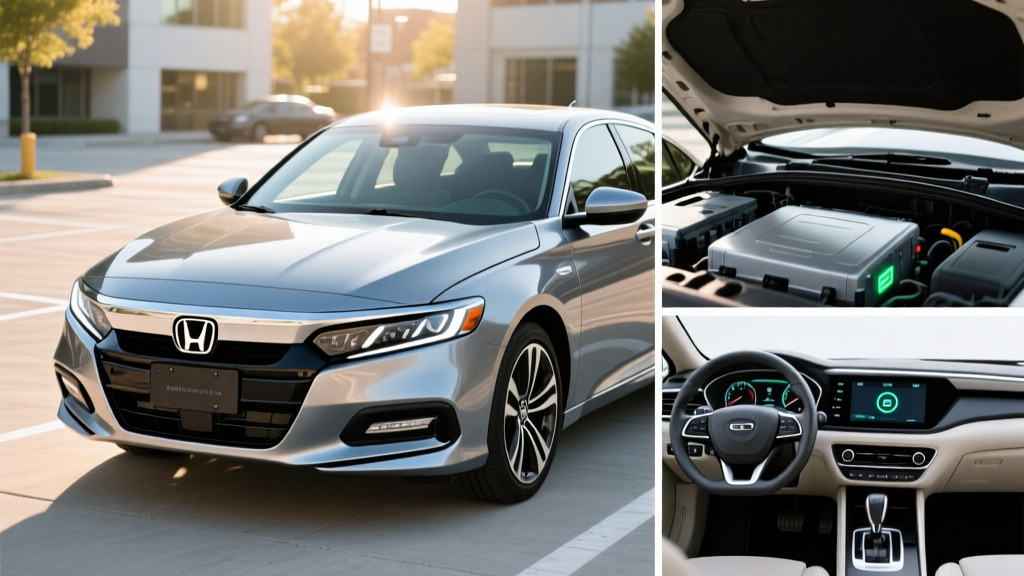
The 2019 Honda Accord Hybrid remains one of the most efficient midsize sedans you can buy on the used market. With an EPA-estimated 48 MPG combined, a proven two-motor hybrid powertrain, and Honda's 8-year/100,000-mile hybrid battery warranty, it offers a compelling entry point for buyers who want electric-like efficiency without plugging in. Seven years after its debut, the 10th-generation Accord Hybrid holds up remarkably well — but there are specific things to check before you buy one used.
| Spec | Value |
|---|---|
| EPA Fuel Economy (Combined) | 48 MPG |
| EPA City / Highway | 48 city / 47 highway |
| Powertrain | 2.0L Atkinson-cycle 4-cyl + 2 electric motors |
| Combined System Output | 212 hp |
| Transmission | e-CVT (no traditional gears) |
| Hybrid Battery | 1.3 kWh lithium-ion |
| 0–60 mph | ~7.1 seconds |
| Drivetrain | Front-wheel drive |
| Original MSRP (Base Hybrid) | $26,240 |
| Typical Used Price (2026) | $16,000–$23,000 |
| Hybrid Battery Warranty (Original) | 8 years / 100,000 miles |
How Many MPG Does the 2019 Accord Hybrid Get?
The EPA rates the 2019 Accord Hybrid at 48 MPG city, 47 MPG highway, and 48 MPG combined for the Hybrid, Hybrid EX, Hybrid EX-L, and Hybrid Touring trims. The base Hybrid trim with smaller 17-inch wheels achieves these numbers; trims with 19-inch wheels (Touring) are rated slightly lower at 47/46/47 MPG in some EPA documentation, though the difference is minimal in practice.
| Trim | City | Highway | Combined | Annual Fuel Cost* |
|---|---|---|---|---|
| Hybrid / EX / EX-L (17" wheels) | 48 MPG | 47 MPG | 48 MPG | ~$1,150 |
| Touring (19" wheels) | 47 MPG | 46 MPG | 47 MPG | ~$1,175 |
*Based on 15,000 miles/year, 55% city driving, $3.30/gallon regular unleaded. Source: fueleconomy.gov. Your costs will vary with local fuel prices and driving habits.
Real-World MPG vs. EPA Estimates
Here's where the Accord Hybrid shines: real-world owners frequently exceed EPA estimates in city driving. Honda's two-motor i-MMD (Intelligent Multi-Mode Drive) system operates primarily in electric-drive mode at low speeds, with the gas engine acting as a generator rather than directly turning the wheels. This means stop-and-go traffic — where conventional gas cars waste the most fuel — is exactly where the Accord Hybrid performs best.
In aggregated owner data from Fuelly and real-world testing by automotive outlets, the 2019 Accord Hybrid averages between 44 and 52 MPG in mixed driving. City-heavy commutes regularly yield 50+ MPG, while sustained highway driving at 75+ mph may dip to 42–44 MPG. Cold weather (below 30°F) can reduce efficiency by 5–10%, as the engine runs more frequently to provide cabin heat and maintain battery temperature.
Hybrid vs. Plug-In Hybrid: Understanding the Accord's System
The 2019 Accord Hybrid is a conventional hybrid (HEV), not a plug-in hybrid (PHEV). This is a critical distinction that buyers sometimes confuse.
| Feature | HEV (Accord Hybrid) | PHEV (e.g., Clarity PHEV) |
|---|---|---|
| Plug-in charging? | No — never plug in | Yes — plug in for EV-only range |
| Electric-only range | ~1–2 miles at low speed | 25–50 miles typical |
| Battery size | 1.3 kWh | 15–20 kWh typical |
| Fueling | Gasoline only | Gasoline + electricity |
| Federal tax credit | Not eligible | Up to $7,500 (when new, model-dependent) |
| Best for | Drivers who can't charge at home | Drivers with home charging + short commutes |
Honda did offer a plug-in variant in the related Clarity Plug-In Hybrid (28 kWh battery, 47 miles EV-only range), but the Accord itself was never sold as a PHEV in the US market. If you see "Accord Plug-In" referenced online, that was a limited 2014 model sold only in California and Oregon — a completely different generation.
Powertrain: How Honda's Two-Motor System Works
The 2019 Accord Hybrid pairs a 2.0-liter Atkinson-cycle four-cylinder engine (143 hp, 129 lb-ft torque) with two electric motors. Combined system output is 212 horsepower. Unlike Toyota's planetary-gear hybrid system, Honda's i-MMD uses a clutch-based approach:
- EV Drive: Battery powers the drive motor; engine is off. Used at low speeds and light loads.
- Hybrid Drive: Engine spins a generator motor that produces electricity for the drive motor. The engine does not mechanically connect to the wheels. This covers most driving scenarios.
- Engine Drive: At steady highway cruising speeds, a lock-up clutch directly connects the engine to the front wheels for maximum efficiency.
The result is a driving feel closer to an EV than a traditional hybrid. Acceleration is linear and immediate, with no rubber-band CVT drone. The 0–60 mph time of roughly 7.1 seconds is competitive with the Accord's 1.5L turbo non-hybrid sibling.
Battery Health, Warranty, and Replacement Cost
2019 Accord Hybrid — Battery Warranty
Original coverage: 8 years / 100,000 miles (10 years / 150,000 miles in CARB states including CA, CT, ME, MA, NJ, NY, OR, RI, VT, WA)
What's covered: Hybrid battery pack, hybrid control unit, and related hybrid system components.
Capacity threshold: Honda does not publish a specific degradation percentage trigger, but dealers typically replace batteries that show significant capacity loss affecting drivability or trigger the IMA (Integrated Motor Assist) warning light.
Transferability: The hybrid battery warranty transfers to subsequent owners — important for used buyers in 2026.
Is the Hybrid Battery Reliable?
Honda's lithium-ion hybrid battery in the 10th-generation Accord has a strong reliability record. Unlike the larger batteries in full EVs that degrade with charge cycles, the Accord's 1.3 kWh pack operates in a narrow state-of-charge window (roughly 20–80%), which dramatically extends cell life. The battery is also relatively small, meaning thermal management is less challenging.
By 2026, most 2019 Accord Hybrids are 7 years old with 70,000–110,000 miles. Battery failures at this age are uncommon but not unheard of. The most frequent hybrid-system complaints involve the hybrid system warning light due to sensor or inverter issues rather than cell-level battery degradation.
Battery Replacement Cost
If the hybrid battery does fail outside warranty, replacement costs for the 2019 Accord Hybrid are:
- Dealer OEM replacement: $3,000–$4,500 (parts + labor)
- Refurbished/aftermarket battery: $1,500–$2,500
- Individual cell replacement: $800–$1,500 at specialized hybrid repair shops
For context, this is significantly less than a full EV battery replacement (which can exceed $10,000–$15,000) because the Accord's hybrid battery is small and modular.
Does the 2019 Accord Hybrid Qualify for Any Tax Credit?
No. The 2019 Accord Hybrid is a conventional hybrid (HEV) and does not qualify for the federal §30D Clean Vehicle Credit. That credit is reserved for plug-in vehicles (BEVs and PHEVs) with battery capacities of at least 7 kWh.
When purchased new, the Accord Hybrid also did not qualify for the federal credit — it was never eligible. Some states offered (and may still offer) minor incentives for hybrid purchases, but these vary widely by jurisdiction. Check your state's energy office or department of revenue for current programs.
For used buyers in 2026, the Used Clean Vehicle Credit (§25E) also does not apply, as it requires the vehicle to be a qualified plug-in EV or fuel-cell vehicle. Conventional hybrids are excluded from all current federal EV tax incentives. See IRS.gov for complete eligibility rules.
Pricing and Value in the 2026 Used Market
When new, the 2019 Accord Hybrid started at $26,240 for the base Hybrid trim and climbed to approximately $35,800 for the Touring. In the 2026 used market, expect to pay:
- Base Hybrid (80k–120k miles): $16,000–$18,500
- Hybrid EX-L (60k–90k miles): $19,000–$22,000
- Hybrid Touring (40k–70k miles): $21,000–$23,000
Compared to a 2019 Accord 1.5T (non-hybrid) at similar mileage, the Hybrid commands a $1,500–$3,000 premium on the used market — a premium that's typically recouped in fuel savings within 2–3 years of average driving.
Who Should Choose the 2019 Accord Hybrid vs. a Full EV or Gas Car?
Choose the 2019 Accord Hybrid If:
- You don't have access to home or workplace charging
- You regularly take long road trips and don't want to plan around charging stops
- You want 45+ MPG without changing your fueling habits
- You live in an area with extreme cold that significantly reduces EV range
- Your budget is $16,000–$23,000 and you want a reliable, spacious sedan
Choose a Full EV (BEV) Instead If:
- You have reliable Level 2 home charging
- Your daily commute is under 250 miles round-trip
- You want zero tailpipe emissions and minimal maintenance
- You want to take advantage of the federal §30D credit on a new EV (up to $7,500 with eligibility requirements)
- You prefer the latest tech, one-pedal driving, and instant torque
Choose the Gas Accord 1.5T Instead If:
- You drive predominantly highway miles at high speeds (the MPG advantage narrows)
- Your budget is under $15,000
- You want simpler long-term maintenance with no hybrid system complexity
Pros
- 48 MPG EPA combined; often exceeds in city driving
- Smooth, EV-like acceleration feel
- Spacious interior with 16.7 cu-ft trunk (only 0.6 cu-ft less than gas model)
- Strong Honda Sensing safety suite standard on all trims
- Hybrid battery warranty transfers to used buyers
- Low cost of ownership: no plug-in infrastructure needed
Cons
- No plug-in option — cannot drive on electric-only for meaningful distance
- Road noise at highway speeds (common Accord complaint)
- Infotainment system feels dated by 2026 standards
- No all-wheel-drive option
- Federal tax credits do not apply to conventional hybrids
- 19-inch wheels on Touring reduce MPG slightly and ride quality noticeably
Frequently Asked Questions
How many MPG does the 2019 Accord Hybrid get in real-world driving?
Owners report 44–52 MPG in mixed driving. City-heavy commutes often yield 50+ MPG thanks to the electric-dominant powertrain, while sustained 75+ mph highway driving may return 42–44 MPG. Cold weather can reduce efficiency by 5–10%. The EPA rates it at 48 MPG combined, and real-world results cluster closely around that figure.
How far can the 2019 Accord Hybrid go on electric only?
Only about 1–2 miles at very low speeds (under 25 mph). The Accord Hybrid is a conventional HEV, not a plug-in hybrid. The 1.3 kWh battery is too small for meaningful EV-only driving. If you need 25–50 miles of electric-only range, you'd need a PHEV like the discontinued Honda Clarity Plug-In Hybrid or a current PHEV such as the Toyota Prius Prime.
Is the 2019 Accord Hybrid reliable, and what does a battery replacement cost?
Yes — the 10th-generation Accord Hybrid has above-average reliability ratings. The hybrid battery operates in a narrow charge window that extends cell life, and failures before 150,000 miles are uncommon. If replacement is needed out of warranty, expect $3,000–$4,500 at a dealer or $1,500–$2,500 for a refurbished unit. The original 8-year/100,000-mile hybrid battery warranty may still cover some 2019 models or has recently expired, depending on mileage.
Does the 2019 Accord Hybrid qualify for any tax credit?
No. The Accord Hybrid is a conventional hybrid (HEV), which is not eligible for the federal §30D Clean Vehicle Credit or the §25E Used Clean Vehicle Credit. These credits apply only to plug-in electric vehicles (BEVs and PHEVs) with qualifying battery capacities. Some states may offer minor hybrid incentives — check your state energy office for details.
Hybrid vs. PHEV vs. EV — which should I choose?
Choose a conventional hybrid (HEV) like the Accord Hybrid if you can't charge at home and want maximum MPG with zero behavior change. Choose a PHEV if you have home charging and a short commute (under 40 miles) — you'll drive mostly on electricity with a gas backup. Choose a full EV if you have reliable charging access, want the lowest per-mile energy cost, and are ready to plan longer road trips around DC fast-charging stops.
What should I check when buying a used 2019 Accord Hybrid?
Verify the hybrid battery warranty status (check remaining time/mileage against the 8yr/100k threshold). Look for any hybrid system warning lights on the dash. Check maintenance records for regular oil changes (the engine still needs them). Confirm the 12V auxiliary battery has been replaced — it's a common failure point around years 4–5. Test-drive in EV mode at low speed to verify smooth motor operation. Check NHTSA for open recalls at nhtsa.gov/recalls.
How does the 2019 Accord Hybrid compare to the Toyota Camry Hybrid?
The 2019 Camry Hybrid is rated at 52 MPG combined (LE trim) — slightly higher than the Accord's 48 MPG. However, the Accord Hybrid offers more rear legroom (40.8 vs 38.0 inches), a larger trunk, and a more engaging driving feel. The Camry Hybrid uses Toyota's proven planetary-gear system with an equally strong reliability record. Both are excellent choices; the Accord wins on space and driving dynamics, the Camry on peak fuel economy.