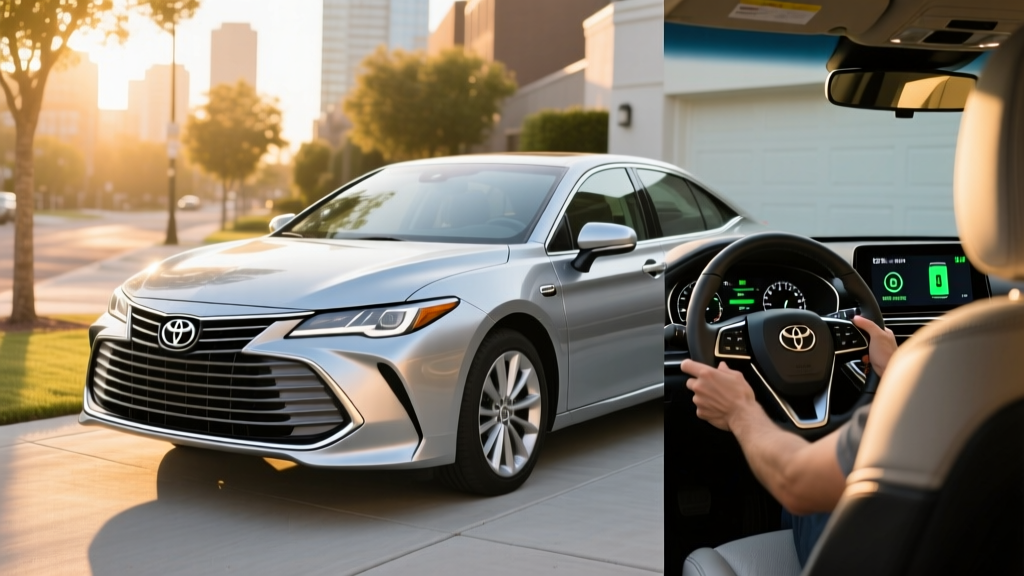
The 2019 Toyota Avalon Hybrid at a Glance
The 2019 Toyota Avalon Hybrid is a conventional hybrid electric vehicle (HEV) — not a plug-in. It pairs a 2.5-liter four-cylinder engine with an electric motor and a compact nickel-metal hydride (NiMH) battery pack that recharges through regenerative braking and engine operation. You never plug it in. Toyota redesigned the Avalon for 2019 on the TNGA-K platform, and the hybrid variant became the efficiency leader in the full-size sedan segment.
Now in 2026, the Avalon is discontinued (production ended after the 2022 model year), but used examples remain popular among buyers who want sedan comfort with hybrid fuel economy and zero charging hassle. Here's what the numbers actually look like.
| Specification | 2019 Avalon Hybrid |
|---|---|
| Powertrain | 2.5L I4 + electric motor (HEV) |
| Combined Horsepower | 215 hp |
| EPA MPG (City / Hwy / Combined) | 43 / 44 / 44 (XLE); 43 / 43 / 43 (Limited/Touring) |
| Fuel Tank | 13.2 gallons |
| Total Range | ~580 miles (XLE) |
| 0–60 mph | ~7.3 seconds |
| Battery Type | NiMH (sealed, ~1.6 kWh) |
| Plug-In Required? | No — self-charging HEV |
| Drivetrain | Front-wheel drive (eCVT) |
| Hybrid Battery Warranty | 8 years / 100,000 miles (10/150,000 in CARB states) |
How Many MPG Does the 2019 Avalon Hybrid Get?
The EPA rates the 2019 Avalon Hybrid XLE at 43 city / 44 highway / 44 combined MPG. Higher trims (Limited, Touring) lose 1 MPG across the board due to larger 18-inch wheels and additional equipment weight, landing at 43 city / 43 highway / 43 combined.
| Trim | City | Highway | Combined |
|---|---|---|---|
| XLE | 43 | 44 | 44 |
| Limited | 43 | 43 | 43 |
| Touring | 43 | 43 | 43 |
Source: EPA Fuel Economy
Real-World MPG vs. EPA Sticker
Toyota's hybrid system excels in stop-and-go driving, where the electric motor handles low-speed propulsion and regenerative braking recovers energy. In real-world city driving, many owners report matching or slightly exceeding the EPA city figure — 44–46 MPG is common on suburban commutes. Highway driving at sustained 70–80 mph speeds typically yields 39–42 MPG, slightly below the sticker, because aerodynamic drag dominates and the gasoline engine carries the full load.
In cold weather (below 35°F), expect a 5–10% fuel economy drop. The engine runs longer to heat the cabin and bring the catalytic converter to operating temperature, reducing electric-only assist time. This is normal for all hybrids and far less severe than the 20–30% range loss battery-electric vehicles experience in winter.
HEV vs. PHEV vs. EV: Where Does the Avalon Hybrid Fit?
The Avalon Hybrid is a conventional HEV. Understanding the distinction matters before you buy.
Conventional Hybrid (HEV) — Like the Avalon Hybrid
- No plug required. The battery charges via regenerative braking and the gasoline engine.
- Small battery (~1–2 kWh usable). Electric-only driving is limited to low speeds for short distances (~1 mile).
- Gasoline is the sole energy input. You fuel up at any gas station.
- Best for: Drivers without home charging access who want better fuel economy with zero behavior change.
Plug-In Hybrid (PHEV) — Like the Toyota RAV4 Prime
- Plugs in to charge. Larger battery (typically 15–20 kWh) provides 25–45 miles of electric-only range.
- Gasoline engine kicks in after battery depletes, functioning as a conventional hybrid.
- Requires home or workplace charging to realize full efficiency benefit.
- Best for: Drivers with charging access who want electric commuting with gas-powered road-trip flexibility.
Battery Electric Vehicle (BEV) — Like the Tesla Model 3
- 100% electric. No gasoline engine. Battery capacity typically 60–100 kWh.
- Range of 250–400 miles depending on model; requires charging planning on long trips.
- Lowest fueling cost per mile but highest upfront price and dependence on charging infrastructure.
- Best for: Drivers with reliable home charging who want zero tailpipe emissions and minimal maintenance.
Choose the 2019 Avalon Hybrid if: You want a comfortable full-size sedan with excellent fuel economy, you can't install a home charger, or you want zero change to your fueling routine.
Choose a PHEV instead if: You have home Level 2 charging and a commute under 40 miles — you'll drive mostly on electricity and rarely visit a gas station.
Choose a full EV instead if: You want the lowest per-mile energy cost, have home charging, and are ready to plan DC fast charging stops on road trips.
Powertrain and Driving Performance
The 2019 Avalon Hybrid uses Toyota's fourth-generation Hybrid Synergy Drive system. A 2.5-liter Dynamic Force inline-four engine (176 hp, 163 lb-ft torque) pairs with a permanent-magnet electric motor integrated into the transaxle. Combined system output is 215 horsepower. Power routes to the front wheels through an electronically controlled continuously variable transmission (eCVT) — not a belt-driven CVT, but a planetary gearset that blends engine and motor power seamlessly.
The 0–60 mph time of approximately 7.3 seconds is adequate for merging and passing. The eCVT eliminates shift shock, and the transition between electric and gasoline propulsion is nearly imperceptible in normal driving. Toyota's hybrid system allows electric-only propulsion at low speeds (typically under 25 mph for short bursts), which contributes heavily to the strong city MPG figure.
Four driving modes are available: Normal, Eco, Sport, and EV. EV mode forces electric-only operation at low speeds when battery state of charge permits — useful in parking garages or residential streets, but range is limited to roughly one mile given the small ~1.6 kWh NiMH pack.
Battery Longevity, Warranty, and Replacement Cost
2019 Avalon Hybrid Battery Warranty
Standard coverage: 8 years / 100,000 miles
CARB-state coverage: 10 years / 150,000 miles (California, New York, Massachusetts, and other states adopting CARB emissions standards)
Coverage threshold: Toyota warrants the hybrid battery against failure and excessive capacity loss (typically below ~60% of original capacity).
How Long Does the Avalon Hybrid Battery Last?
Toyota's NiMH hybrid batteries have an exceptional longevity track record. The Avalon Hybrid's pack is relatively small and operates within a conservative state-of-charge window (roughly 40–80%), which dramatically reduces stress on the cells. Real-world data from high-mileage Toyota hybrids — including the Prius, Camry Hybrid, and Avalon Hybrid — shows battery packs routinely lasting 150,000 to 200,000+ miles before significant degradation.
For a 2019 model in 2026, most examples will have 60,000–120,000 miles on the odometer. The battery is likely in good health, but you should verify this through a hybrid battery health check at a Toyota dealer or via an OBD-II scanner that reads individual module voltages. Significant voltage variance between modules indicates aging.
Battery Replacement Cost
If the hybrid battery does fail outside warranty, replacement options include:
- New OEM battery from Toyota: $3,000–$4,000 (parts and labor at a dealer)
- Refurbished/remanufactured battery: $1,500–$2,500 from aftermarket suppliers
- Individual module replacement: $300–$800 if only one or two modules are weak (independent hybrid specialists offer this service)
The gasoline engine's 12V auxiliary battery is a separate, standard component that typically needs replacement every 4–6 years at a cost of $150–$250.
Does the 2019 Avalon Hybrid Qualify for a Tax Credit?
No. The 2019 Avalon Hybrid is a conventional HEV, not a plug-in vehicle. It does not qualify for the federal IRS §30D Clean Vehicle Credit, which is reserved for battery electric vehicles (BEVs) and plug-in hybrids (PHEVs) with sufficient battery capacity and compliant critical-mineral/battery-component sourcing.
When new, the Avalon Hybrid also did not qualify for the now-expired Alternative Fuel Vehicle Refueling Property Credit or any federal plug-in incentive. Some states offered modest hybrid rebates at the time of purchase, but these have largely expired.
For used purchases in 2026, the IRS §25E Used Clean Vehicle Credit (up to $4,000 or 30% of sale price, whichever is less) also does not apply — that credit requires a qualifying BEV or PHEV with at least 7 kWh of battery capacity. The Avalon Hybrid's ~1.6 kWh pack falls well below this threshold.
Bottom line: you pay the full negotiated used-market price with no federal tax incentive.
Pricing and Value in 2026
The 2019 Avalon Hybrid originally started at an MSRP of approximately $36,500 (XLE) and climbed to roughly $43,000 for the Touring trim. In the 2026 used market, expect the following approximate ranges depending on mileage, condition, and region:
- XLE (60K–90K miles): $20,000–$24,000
- Limited (50K–80K miles): $22,000–$27,000
- Touring (40K–70K miles): $24,000–$29,000
These prices reflect the broader used-car market stabilization through 2025–2026. Hybrid sedans hold value well due to strong reliability reputations, and the Avalon Hybrid typically commands a $1,500–$3,000 premium over its gasoline-only counterpart at equivalent mileage.
Pros and Cons
Pros
- 44 MPG combined — among the best for any full-size sedan ever sold
- No plug-in charging required — zero lifestyle change from a gas car
- Toyota hybrid reliability with proven long-term battery durability
- Spacious cabin with 16.1 cu-ft trunk (hybrid battery under rear seat, no cargo compromise)
- Smooth, quiet eCVT powertrain with seamless engine/motor transitions
- Standard Toyota Safety Sense P (pre-collision, lane departure, adaptive cruise, auto high beams)
Cons
- Discontinued — no new examples available; limited certified pre-owned inventory
- No plug-in capability — cannot drive on electric alone for meaningful distances
- FWD only — no all-wheel-drive option (the Camry Hybrid offers AWD)
- Infotainment feels dated by 2026 standards (no wireless CarPlay on 2019 models)
- No federal or state tax credit eligibility for used purchase
- Modest 215 hp — adequate but not quick for a 3,500-lb sedan
Frequently Asked Questions
How many MPG does the 2019 Avalon Hybrid get in real driving?
The EPA rates it at 44 MPG combined (XLE trim). In real-world use, city and suburban drivers often see 44–46 MPG thanks to frequent regenerative braking. Sustained highway driving at 75 mph typically yields 39–42 MPG. Cold weather reduces fuel economy by 5–10%.
Can I plug in the 2019 Avalon Hybrid to charge?
No. The Avalon Hybrid is a conventional HEV with no plug-in capability. Its small NiMH battery recharges exclusively through regenerative braking and the gasoline engine. If you want plug-in capability, look at a PHEV like the Toyota Prius Prime or RAV4 Prime.
Is the 2019 Avalon Hybrid reliable?
Yes. Toyota's hybrid powertrain is among the most reliable in the industry. The eCVT has no traditional transmission clutches or bands to wear out, and the hybrid battery operates in a conservative charge window that maximizes lifespan. The Avalon Hybrid consistently earns strong reliability ratings, and the TNGA-K platform received top safety marks from both NHTSA and IIHS (Top Safety Pick+ for 2019).
What is the hybrid battery replacement cost?
A new OEM replacement runs $3,000–$4,000 at a Toyota dealer. Refurbished packs cost $1,500–$2,500, and individual module repair can be as low as $300–$800. In practice, most Toyota NiMH hybrid batteries last 150,000–200,000+ miles, making replacement uncommon for typical ownership periods.
Does the 2019 Avalon Hybrid qualify for any tax credit in 2026?
No. As a conventional HEV with a ~1.6 kWh battery, it does not qualify for the federal §30D new-vehicle credit or the §25E used-vehicle credit (which requires at least 7 kWh). Some states previously offered hybrid incentives, but most have expired or shifted to plug-in vehicles only.
How does the Avalon Hybrid compare to the Camry Hybrid?
The 2019 Camry Hybrid LE achieves 52 MPG combined (vs. 44 for the Avalon Hybrid XLE) and is lighter, more affordable, and offers AWD on certain trims. The Avalon Hybrid trades some efficiency for a larger cabin, quieter ride, more rear legroom (40.3 vs. 38.0 inches), and a more premium feel. If maximum MPG is your priority, the Camry Hybrid wins. If full-size sedan comfort matters, the Avalon Hybrid is the pick.
Should I buy the 2019 Avalon Hybrid or a full EV?
If you lack reliable home charging or regularly drive 400+ miles between fuel stops in rural areas, the Avalon Hybrid is the pragmatic choice — you get 44 MPG with zero charging infrastructure dependency. If you have Level 2 home charging and want the lowest per-mile energy cost (~$0.04/mile on electricity vs. ~$0.08/mile on gas at 44 MPG and $3.50/gallon), a used BEV like the Chevrolet Bolt EV or Tesla Model 3 may save more over five years despite a higher purchase price.