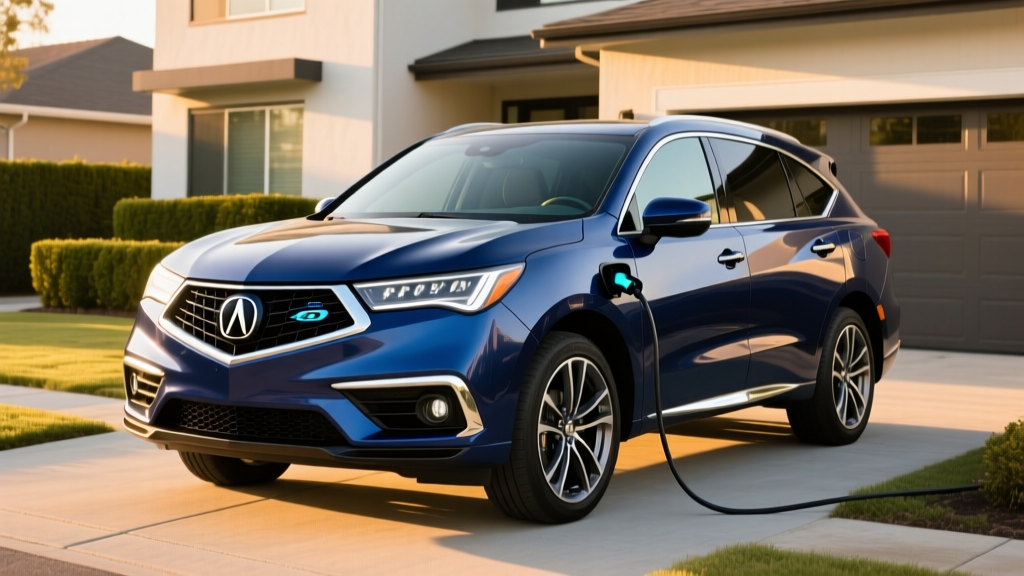
The 2019 Acura MDX Sport Hybrid occupies a specific niche: a three-row luxury SUV that uses electrification not primarily for eco-cred, but for performance and refinement. With 321 combined horsepower and a 27 MPG EPA combined rating, it promised a compelling alternative to the standard V6 MDX — and to German rivals that hadn't yet embraced hybridization in this segment. Now several years into its lifecycle on the used market, buyers are asking practical questions: What real-world fuel economy can you expect? How reliable is the hybrid system? And does it still make sense versus a modern PHEV or full EV? Let's break down the numbers.
HEV vs. PHEV: What the MDX Sport Hybrid Actually Is
The 2019 Acura MDX Sport Hybrid is a conventional hybrid (HEV), not a plug-in hybrid (PHEV). This distinction matters enormously for ownership expectations:
Conventional Hybrid (HEV) — MDX Sport Hybrid
- No plug, no external charging required
- Small battery (1.3 kWh) recharged by regenerative braking and engine
- No electric-only driving range to speak of
- Eligible for no federal tax credit under current §30D rules
- Fuel economy improvement comes from regenerative braking and engine optimization
Plug-In Hybrid (PHEV)
- Requires plug-in charging (Level 1 or Level 2)
- Larger battery (typically 15-30 kWh) for 20-40 miles of electric-only range
- Can operate as a pure EV for short commutes
- May qualify for federal §30D tax credit if purchased new (income/MSRP/sourcing rules apply)
- Operates as a conventional hybrid once electric range is depleted
Acura's three-motor Sport Hybrid SH-AWD system uses its 1.3 kWh lithium-ion battery pack as a buffer — capturing braking energy and deploying it for acceleration assist and low-speed electric creep. You'll never plug it in, and you'll never see a meaningful electric-only range. The system is closer in philosophy to Toyota's hybrid synergy drive than to a BMW X5 xDrive50e or Volvo XC90 Recharge.
Fuel Economy: EPA Ratings and Real-World MPG
The EPA rates the 2019 Acura MDX Sport Hybrid at the following figures:
| Cycle | EPA Rating | Real-World Expectation |
|---|---|---|
| City | 26 MPG | 25–28 MPG |
| Highway | 27 MPG | 24–26 MPG |
| Combined | 27 MPG | 25–27 MPG |
Source: fueleconomy.gov
For context, the conventional 2019 MDX with the 3.5L V6 and 9-speed automatic achieves 19 city / 27 highway / 22 combined with SH-AWD. The Sport Hybrid's advantage is most pronounced in city driving, where regenerative braking and electric motor assist reduce fuel consumption significantly. On the highway, where the engine is doing most of the work at steady speeds, the hybrid system's benefit narrows — and real-world highway MPG can dip below the EPA estimate at sustained 75+ mph speeds.
Owners who drive primarily in stop-and-go urban or suburban conditions frequently report matching or slightly exceeding the 26 MPG city estimate. Highway-heavy commuters should plan for 24–25 MPG. This is a meaningful improvement over the gas-only MDX in mixed driving — roughly 20–25% better fuel economy overall — but it's not transformative in the way a modern PHEV with 30 miles of electric range can be for short commutes.
Powertrain: 321 HP From Three Motors and a V6
| Specification | Detail |
|---|---|
| Engine | 3.0L SOHC V6, 257 hp / 218 lb-ft |
| Front Motor | 47 hp / 109 lb-ft (integrated with 7-speed DCT) |
| Rear Motors (Twin) | 36 hp each / 54 lb-ft each (torque-vectoring SH-AWD) |
| Combined System Output | 321 hp / 289 lb-ft |
| Transmission | 7-speed dual-clutch (front); direct-drive (rear motors) |
| Battery | 1.3 kWh lithium-ion (buffer-type, not plug-in) |
| Drivetrain | Sport Hybrid SH-AWD (standard) |
| 0–60 mph | ~6.1 seconds |
| Curb Weight | ~4,622 lbs |
The Sport Hybrid SH-AWD system is genuinely sophisticated. The twin rear motors enable torque vectoring — they can independently apply positive or negative torque to each rear wheel, improving cornering response and stability. This isn't just a fuel-economy play; it's a performance and handling enhancement that makes the MDX Sport Hybrid feel more planted than its gas-only sibling. The 7-speed dual-clutch transmission on the front axle is paired with the front electric motor, and the system seamlessly blends engine and motor power. In practice, the result is smooth, responsive acceleration with none of the CVT drone associated with some Toyota hybrids.
Battery Warranty, Lifespan, and Replacement Cost
Acura Hybrid Battery Warranty
Original coverage: 8 years / 100,000 miles (10 years / 150,000 miles in CARB states including CA, NY, MA, and others)
What's covered: Hybrid battery pack defects and capacity loss below functional thresholds
Current status for 2019 models: Federal warranty coverage has expired for most original owners as of 2027; CARB-state coverage may still apply through 2029 depending on mileage
The 1.3 kWh battery in the MDX Sport Hybrid is small and operates within a narrow state-of-charge window — it rarely charges to full capacity or depletes completely, which significantly reduces degradation stress. This buffer-type operation is why Honda/Acura hybrid batteries tend to last well beyond their warranty periods. Real-world reports from high-mileage Honda and Acura hybrid owners suggest these packs commonly last 150,000–200,000+ miles before any meaningful capacity loss.
If replacement is needed out of warranty, expect the following cost range:
- OEM hybrid battery pack: $2,000–$3,500 (parts)
- Labor: $500–$1,000
- Total replacement: $2,500–$4,500 at a dealership
Because the pack is small (1.3 kWh vs. 75+ kWh in a full EV), replacement costs are manageable compared to battery-electric vehicles. Some independent hybrid specialists offer refurbished packs for $1,500–$2,500 installed. This is a fundamentally lower-risk battery ownership proposition than a full EV.
Pricing and Tax Credit Eligibility (2026 Used Market)
The 2019 Acura MDX Sport Hybrid was originally offered in Technology, Advance, and Entertainment Package trims, with MSRPs ranging from approximately $53,000 to $61,000 when new.
On the used market in 2026, expect pricing in the following range depending on mileage and condition:
- 60,000–80,000 miles: $28,000–$34,000
- 80,000–110,000 miles: $22,000–$28,000
- 110,000+ miles: $18,000–$22,000
Tax Credit Reality
The 2019 Acura MDX Sport Hybrid does not qualify for the federal §30D clean vehicle tax credit in any scenario:
- As a conventional hybrid (HEV), it is ineligible for the new-vehicle credit (which requires plug-in capability and minimum battery capacity)
- The §30D credit was never available for this model even when new, as it lacks plug-in functionality
- The used-EV credit (§25E, up to $4,000) also does not apply, as it requires a plug-in electric vehicle or fuel cell vehicle
- No state-level EV/PHEV incentives apply to conventional hybrids in most jurisdictions
For current federal incentive rules, consult IRS.gov §30D guidelines. If tax incentives are a priority, you'd need to look at a plug-in hybrid or full EV.
Reliability: What the Data Shows
The 2019 MDX Sport Hybrid's reliability profile is generally positive, with some caveats specific to the hybrid powertrain:
- Engine: The 3.0L V6 (J30Y1) is a proven Honda/Acura powerplant with a strong track record. Timing chain-driven, no major systemic failures reported.
- 7-speed DCT: The dual-clutch transmission has been generally reliable, though some owners report occasional low-speed hesitation — a characteristic of DCT designs rather than a defect.
- Hybrid system: The three-motor system and power electronics have proven durable. Honda's hybrid components share architecture with the Accord Hybrid and NSX, both of which show strong longevity.
- SH-AWD rear motors: The twin rear electric motors and their associated power control units have not shown widespread failure patterns, though they add complexity vs. a mechanical AWD system.
- Infotainment: The dual-screen setup in the 2019 MDX is a common complaint — slow response, dated interface, and Apple CarPlay/Android Auto connectivity quirks. This is the most frequent owner frustration.
For safety context, the 2019 MDX earned the IIHS Top Safety Pick+ designation when equipped with AcuraWatch (standard on all trims) and LED headlights. IIHS ratings show Good ratings across all crashworthiness categories.
Who Should Choose the MDX Sport Hybrid vs. Alternatives
Pros
- 27 MPG combined in a 3-row luxury SUV — 20%+ better than gas MDX
- 321 hp with smooth, responsive torque-vectoring SH-AWD
- No plug-in charging required — zero infrastructure dependency
- Small battery = low replacement cost ($2,500–$4,500)
- Proven Honda hybrid reliability with strong longevity data
- Standard AcuraWatch safety suite, IIHS Top Safety Pick+
Cons
- No electric-only range — always burning fuel
- No federal or state tax credit eligibility
- Dated dual-screen infotainment system
- Highway MPG advantage over gas model is modest
- Heavier than gas MDX (~200 lbs penalty from hybrid hardware)
- Original hybrid warranty nearing expiration for most used examples
The Decision Framework
Choose the 2019 MDX Sport Hybrid if: You want a used three-row luxury SUV with better fuel economy than gas alternatives, you don't have access to home charging (making a PHEV or EV impractical), you value the SH-AWD torque-vectoring for all-weather confidence, and you want a low-risk hybrid system with manageable battery replacement costs.
Choose a PHEV instead if: You have Level 2 home charging, your daily commute is under 30 miles, and you want to drive primarily on electricity while retaining gas flexibility for road trips. Consider the Volvo XC90 Recharge (35 miles electric range), BMW X5 xDrive50e (38 miles), or the newer Lexus TX 550h+ (33 miles).
Choose a full EV instead if: You have reliable home charging, your daily driving is under 250 miles, you want zero tailpipe emissions, and you're ready to embrace the charging-network lifestyle. The Kia EV9 (279–304 miles range, three rows) or Tesla Model X are the closest electric alternatives in this segment.
Frequently Asked Questions
How many MPG does the 2019 Acura MDX Sport Hybrid get?
The EPA rates it at 26 city / 27 highway / 27 combined. Real-world results typically fall between 25–28 MPG depending on driving mix. City-heavy driving favors the hybrid system; sustained highway speeds above 75 mph may yield 24–25 MPG.
Does the MDX Sport Hybrid need to be plugged in?
No. It is a conventional hybrid (HEV), not a plug-in hybrid. The small 1.3 kWh battery charges exclusively through regenerative braking and the gasoline engine. There is no plug, no charging port, and no electric-only driving range.
How far can it go on electric power alone?
Effectively zero miles. The hybrid system can propel the MDX at very low speeds for short distances (parking lots, stop-and-go creep), but the battery is too small for any meaningful electric-only range. If electric-only driving matters, you need a PHEV or full EV.
Is the hybrid system reliable and what does battery replacement cost?
Honda/Acura hybrid systems have demonstrated strong long-term reliability. The 1.3 kWh battery operates in a narrow charge window that minimizes degradation, and most packs last 150,000+ miles. Replacement cost if needed out of warranty: approximately $2,500–$4,500 (OEM pack plus labor). The original 8-year/100,000-mile warranty has largely expired for 2019 models as of 2026–2027.
Does the 2019 MDX Sport Hybrid qualify for any tax credit?
No. As a conventional hybrid without plug-in capability, it does not qualify for the federal §30D new-vehicle credit, the §25E used-EV credit, or most state EV incentives. These programs require plug-in vehicles with minimum battery capacities. Consult IRS.gov for current eligibility rules.
How does it compare to the gas-only 2019 MDX?
The Sport Hybrid delivers approximately 5 more MPG combined (27 vs. 22), 31 more horsepower (321 vs. 290), and torque-vectoring SH-AWD for improved handling. The trade-offs are higher initial cost, slightly more weight, and added powertrain complexity. For high-mileage owners, fuel savings over 100,000 miles offset the used-market price premium.
Should I buy a used MDX Sport Hybrid in 2026?
It's a solid choice if you need three rows, all-wheel drive, and hybrid efficiency without plug-in charging. Verify the hybrid system's health via an Acura dealer diagnostic scan, check maintenance records (especially transmission fluid service), and factor in that the hybrid battery warranty is likely expired or expiring soon. At $22,000–$34,000 depending on mileage, it offers strong value in the used luxury hybrid SUV segment.