Quick Verdict: The 2018 Prius Still Delivers on Its MPG Promise
If you're researching the 2018 Toyota Prius hybrid MPG figures, you're likely evaluating a used purchase in 2026 — and the news is good. The 2018 Prius remains one of the most fuel-efficient vehicles ever sold without a plug, with EPA ratings between 52 and 58 MPG combined depending on trim. In real-world driving, owners routinely match or exceed those numbers in city conditions, making this fourth-generation Prius a compelling used-hybrid purchase even eight years after its model year.
This guide breaks down every efficiency figure, the hybrid powertrain specs, battery longevity expectations, and how the 2018 Prius stacks up against modern alternatives — including the current-generation Prius, plug-in hybrids, and full EVs.
2018 Toyota Prius MPG: EPA Ratings by Trim
The 2018 Prius was offered in several trims, and fuel economy varies slightly depending on wheel size and equipment weight. Here is the complete EPA breakdown sourced from fueleconomy.gov:
| Trim | City MPG | Highway MPG | Combined MPG | Annual Fuel Cost* |
|---|---|---|---|---|
| Prius Two / Two Eco | 58 / 58 | 53 / 53 | 56 / 56 | ~$950 |
| Prius Three / Four | 54 | 50 | 52 | ~$1,025 |
| Prius Four Touring | 54 | 50 | 52 | ~$1,025 |
| Prius Prime (PHEV) | 54 (hybrid mode) | 50 (hybrid mode) | 52 / 133 MPGe | ~$750 |
*Annual fuel cost based on 15,000 miles/year, 55% city driving, and $3.50/gallon regular unleaded (2026 estimate).
The 2018 Prius is one of the rare vehicles where real-world city MPG often exceeds the EPA rating. The hybrid system recovers energy during stop-and-go braking, so urban drivers regularly report 55-62 MPG on the Two Eco trim. Highway-only driving at 75+ MPH typically drops to 44-48 MPG because the electric motor assists less at sustained speed. In cold weather (below 30°F), expect a 5-10% reduction as the engine runs more frequently to maintain cabin heat and battery temperature. Annual mileage of 15,000 miles costs roughly $900-$1,050 in fuel — about $600-$800 less per year than a comparable 30 MPG compact sedan.
HEV vs. PHEV: 2018 Prius vs. 2018 Prius Prime Explained
The 2018 model year included two distinct vehicles sharing the Prius name. Understanding the difference is critical before you buy:
| Attribute | 2018 Prius (HEV) | 2018 Prius Prime (PHEV) |
|---|---|---|
| Powertrain Type | Conventional Hybrid — no plug | Plug-in Hybrid — charges from outlet |
| Electric-Only Range | ~1 mile at low speed | 25 miles (EPA) |
| Total Range | ~620 miles | ~640 miles (EV + gas) |
| Battery Capacity | 0.75 kWh (NiMH) / 0.95 kWh (Li-ion, Eco) | 8.8 kWh (Li-ion) |
| Charging Required? | No — self-charging via regen + engine | Yes — Level 1 (5.5 hr) or Level 2 (2 hr) |
| DC Fast Charge? | No | No |
| Combined MPG (hybrid mode) | 52-56 | 52 |
| MPGe (electric mode) | N/A | 133 MPGe |
| Combined Horsepower | 121 hp | 121 hp |
Key takeaway: The standard 2018 Prius is a conventional hybrid (HEV). It never needs to be plugged in — the gasoline engine and regenerative braking keep the small battery charged. The Prius Prime is a plug-in hybrid (PHEV) that offers 25 miles of electric-only driving before the gasoline engine takes over. If you cannot charge at home, the standard Prius HEV is the right choice.
Powertrain Specs: What Moves the 2018 Prius
| Engine | 1.8L 4-cylinder Atkinson cycle (95 hp, 105 lb-ft) |
| Electric Motor | Permanent magnet AC synchronous (71 hp, 120 lb-ft) |
| Combined Net Horsepower | 121 hp |
| Transmission | Electronically controlled CVT (eCVT) |
| Drivetrain | Front-wheel drive (AWD-e not available until 2019) |
| 0-60 MPH | ~10.5 seconds |
| Hybrid Battery (HEV) | 0.75 kWh NiMH (standard) / 0.95 kWh Li-ion (Eco trims) |
| Hybrid Battery (Prime PHEV) | 8.8 kWh Lithium-ion |
| Fuel Tank | 11.4 gallons (regular unleaded) |
| Curb Weight | 3,008-3,108 lbs (HEV) / 3,375 lbs (Prime) |
The 2018 Prius uses Toyota's fourth-generation Hybrid Synergy Drive. The eCVT is not a belt-driven CVT like those in conventional cars — it's a planetary gearset that seamlessly blends engine and motor power with no fixed gear ratios. This design is extremely durable, with no belts, clutches, or traditional friction components to wear out.
Battery Longevity, Warranty, and Replacement Cost
- Standard coverage: 8 years / 100,000 miles (whichever comes first)
- CARB states: 10 years / 150,000 miles in California and states adopting California emissions standards
- Capacity threshold: Warranty covers defects and abnormal capacity loss — Toyota replaces batteries that fall below a functional threshold
- Hybrid system warranty: 8 years / 100,000 miles (covers inverter, motor, eCVT)
What does this mean for a 2026 used buyer? A 2018 Prius purchased new had its standard 8-year/100,000-mile hybrid battery warranty expire in 2026. If the vehicle is registered in a CARB state (CA, CT, ME, MD, MA, NJ, NY, OR, RI, VT, WA, and others), the 10-year/150,000-mile coverage may still be active depending on the vehicle's mileage.
How Long Do Prius Hybrid Batteries Actually Last?
Real-world data is reassuring. Fourth-generation Prius batteries (2016-2022) have shown excellent longevity. Taxi fleet data and owner reports indicate most original batteries reach 150,000-200,000+ miles before needing replacement. The NiMH chemistry in non-Eco trims is particularly robust, with gradual capacity loss rather than sudden failure.
Battery Replacement Cost
If the hybrid battery does eventually need replacement:
- New OEM battery (Toyota dealer): $2,500-$3,500 including labor
- Refurbished/remanufactured battery: $1,200-$2,000 including labor
- Individual cell replacement (specialist shops): $500-$1,000
The Prius Prime's larger 8.8 kWh lithium-ion battery is more expensive to replace — expect $4,000-$6,000 at a dealer — but failures have been rare in Toyota's PHEV lineup.
Does the 2018 Prius Qualify for Any Tax Credit in 2026?
This is a used-vehicle purchase in 2026, so the relevant incentive is the Used Clean Vehicle Credit (IRS §25E), not the new-vehicle §30D credit.
- Credit amount: 30% of sale price, up to $4,000 maximum
- Vehicle must be purchased from a licensed dealer (private-party sales excluded)
- Sale price must be $25,000 or less (the 2018 Prius Prime typically qualifies at current used prices)
- Buyer income caps: $75,000 single / $112,500 head of household / $150,000 joint filers (modified AGI)
- Vehicle must have been previously titled — a first-time transfer qualifies
- The standard 2018 Prius HEV does NOT qualify — it has no plug and is not classified as a plug-in electric vehicle
- Point-of-sale transfer available — the dealer applies the credit as a discount at purchase
Source: IRS.gov Used Clean Vehicle Credit. Verify eligibility with a tax professional before purchase.
Bottom line: The standard 2018 Prius HEV qualifies for zero federal tax credits — it's a conventional hybrid. The 2018 Prius Prime PHEV may qualify for up to $4,000 under §25E if purchased from a dealer below $25,000, subject to buyer income limits. Check current IRS guidance as rules can shift.
2018 Prius vs. 2026 Alternatives: Hybrid, PHEV, or Full EV?
How does a used 2018 Prius compare to what you can buy new in 2026? Here's a practical decision framework:
| Metric | 2018 Prius HEV (Used) | 2026 Prius (New) | 2026 Prius Prime (New) | 2026 Tesla Model 3 RWD |
|---|---|---|---|---|
| Typical Price | $16,000-$22,000 | $29,445 MSRP | $34,395 MSRP | $39,990 MSRP |
| Combined MPG / MPGe | 52-56 MPG | 57 MPG | 52 MPG / 127 MPGe | 132 MPGe |
| Electric-Only Range | ~1 mi (low speed) | None (HEV) | 44 mi | 363 mi (EPA) |
| Annual Fuel Cost | ~$950 | ~$900 | ~$650 | ~$550 |
| Tax Credit Eligible? | No (HEV) / Up to $4K used (Prime) | Up to $7,500 (§30D) | Up to $7,500 (§30D) | Up to $7,500 (§30D) |
| Home Charging Needed? | No | No | Recommended | Essential |
- Choose the used 2018 Prius HEV if: Your budget is under $22,000, you lack home charging access, you want minimal maintenance, and you drive mostly city miles where the hybrid system shines.
- Choose the used 2018 Prius Prime if: You can charge at home (even a standard 120V outlet works overnight), your commute is under 25 miles, and you want to drive electrically most days with a gas backup for road trips.
- Choose a new 2026 Prius/Prime if: You qualify for the $7,500 §30D credit (which effectively brings the new Prius close to used pricing), want a full factory warranty, and value the latest safety tech.
- Choose a full EV if: You have reliable home Level 2 charging, your daily drive is under 250 miles, and you want to eliminate gasoline entirely — but understand that EVs cost more upfront and require charging infrastructure.
Reliability and What Owners Report at 100,000+ Miles
The fourth-generation Prius (2016-2022) carries an excellent reliability record. According to IIHS, the 2018 Prius earned a Top Safety Pick designation with Good ratings in all crashworthiness tests. Toyota's hybrid drivetrain has been in continuous production since 1997, and the major components — eCVT, inverter, and motor — rarely require service.
Common wear items at higher mileage include:
- 12V auxiliary battery: Replace every 4-6 years (~$200-$350)
- Brake pads: Last 60,000-100,000 miles thanks to regenerative braking doing most of the work
- Inverter coolant pump: Some units require replacement around 100,000-130,000 miles (~$400-$600)
- EGR valve and cooler: Carbon buildup can occur above 100,000 miles; cleaning or replacement costs $200-$500
Overall, the 2018 Prius is among the lowest-cost vehicles to own long-term. Annual maintenance typically runs $300-$500 — far below the industry average.
- 52-56 MPG combined — real-world city driving often exceeds 55 MPG
- Proven reliability with 200,000+ mile battery lifespan common
- Low annual maintenance and fuel costs (~$1,250 combined)
- No home charging infrastructure required (HEV)
- Hatchback cargo versatility (21.6 cu ft behind rear seats, 50.7 cu ft folded)
- Strong resale value retention for a used hybrid
- Slow acceleration: 0-60 in ~10.5 seconds
- 2018 model lacks Apple CarPlay (added in 2020 refresh)
- Road noise at highway speeds is noticeable
- Rear seat headroom is tight for tall passengers due to sloping roofline
- No AWD option (introduced in 2019 model year)
- Standard HEV does not qualify for federal tax credits
Frequently Asked Questions
How many MPG does the 2018 Toyota Prius actually get?
The EPA rates the 2018 Prius at 52-56 MPG combined depending on trim. The Two Eco trim achieves the highest rating at 58 city / 53 highway / 56 combined. In real-world driving, city commuters regularly report 55-62 MPG thanks to the regenerative braking system. Highway-only driving at 75+ MPH typically yields 44-48 MPG.
Does the 2018 Prius need to be plugged in?
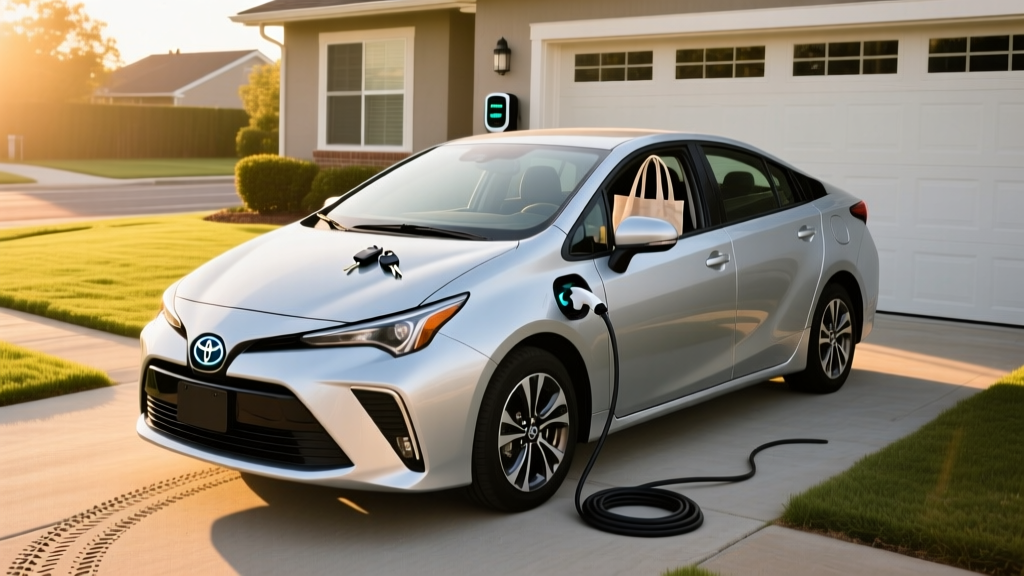
No. The standard 2018 Prius is a conventional hybrid (HEV) and never requires plug-in charging. The gasoline engine and regenerative braking system keep the hybrid battery charged automatically. Only the Prius Prime variant requires plug-in charging to access its 25-mile electric-only range.
How far can the 2018 Prius Prime go on electric power alone?
The 2018 Prius Prime has an EPA-rated 25 miles of electric-only range at speeds up to 84 MPH. In mild weather with gentle driving, some owners report 28-30 miles. Cold weather (below freezing) reduces this to approximately 18-22 miles. Once the battery is depleted, the Prime operates as a standard hybrid at 52 MPG combined.
Is the 2018 Prius hybrid battery reliable, and what does replacement cost?
Yes. Fourth-generation Prius hybrid batteries regularly last 150,000-200,000+ miles. The original warranty was 8 years/100,000 miles (10 years/150,000 miles in CARB states). If replacement is needed, a new OEM battery costs $2,500-$3,500 installed; refurbished units run $1,200-$2,000. Complete hybrid system failures are rare.
Does the 2018 Prius qualify for a tax credit in 2026?
The standard 2018 Prius HEV does not qualify for any federal tax credit — it has no plug and is not classified as an electric vehicle. The 2018 Prius Prime PHEV may qualify for the Used Clean Vehicle Credit (§25E) of up to $4,000 if purchased from a dealer for $25,000 or less, subject to buyer income limits. Verify current eligibility at IRS.gov.
Should I buy a used 2018 Prius or a new hybrid in 2026?
A used 2018 Prius at $16,000-$22,000 is an excellent value if you want proven efficiency without a new-car payment. However, the 2026 Prius starts at $29,445 and may qualify for up to $7,500 in federal tax credits (effective price ~$22,000), which narrows the gap significantly while adding a full warranty, modern infotainment with wireless CarPlay/Android Auto, and the latest Toyota Safety Sense 3.0. Run the numbers with your specific tax situation before deciding.
What is the difference between the Prius Eco trim and standard trims?
The Two Eco trim uses a lighter lithium-ion hybrid battery (0.95 kWh) instead of the nickel-metal hydride (NiMH, 0.75 kWh) found in other trims. It also has lighter wheels and low-rolling-resistance tires. These changes yield slightly better fuel economy (56 vs. 52 MPG combined) and reduce curb weight by about 60 pounds. The trade-off is a slightly firmer ride.