Quick Verdict: The 2018 Highlander Hybrid in 2026
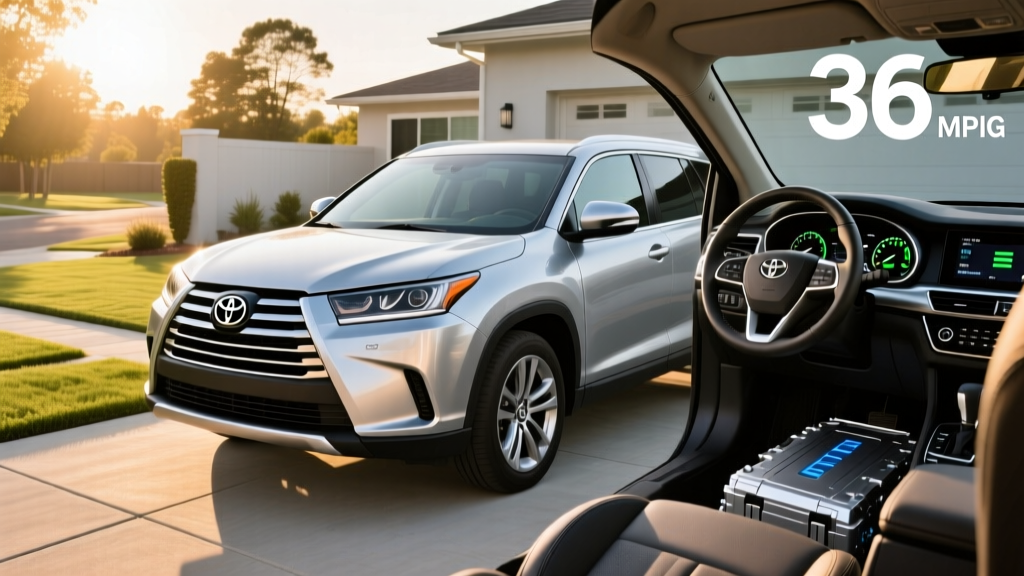
If you're shopping the used three-row SUV market and want hybrid efficiency without plugging in, the 2018 Toyota Hybrid Highlander remains one of the most rational choices available. Eight years after its model year, this conventional hybrid (HEV) delivers an EPA-estimated 29 MPG combined from a 306-horsepower V6 powertrain — figures that still compete with newer midsize crossovers. With Toyota's proven hybrid synergy drive and a battery warranty that may still have coverage remaining, the 2018 Highlander Hybrid occupies a sweet spot for families who need three rows, all-wheel drive, and low running costs without range anxiety or charging infrastructure dependence.
This guide covers everything a 2026 used buyer needs: exact fuel economy data, real-world MPG expectations, battery longevity and replacement costs, powertrain specs, and how this HEV stacks up against plug-in hybrids and full battery-electric alternatives.
HEV vs PHEV: What the 2018 Highlander Hybrid Actually Is
Conventional Hybrid (HEV) — 2018 Toyota Highlander Hybrid: This is a self-charging hybrid. It has no plug, no electric-only driving mode of meaningful distance, and no external charging capability. A small nickel-metal hydride (NiMH) battery pack captures energy from regenerative braking and the gasoline engine, then deploys it to assist acceleration and enable brief low-speed electric-only movement (typically under 1 mile at very low speeds). You fuel it exactly like a gas car — at the pump — and the hybrid system handles the rest.
Plug-in Hybrid (PHEV) — Not offered for 2018 Highlander: Toyota did not produce a plug-in hybrid Highlander in 2018. The first PHEV variant of Toyota's three-row SUVs arrived later with different nameplates. A PHEV would offer 20-40 miles of electric-only range, a larger battery (typically 13-18 kWh), and the ability to charge from a wall outlet or public charger. If you need electric-only commuting capability, the 2018 Highlander Hybrid is not it — you'd need to look at alternatives like the Chrysler Pacifica Hybrid (32 miles electric-only) or wait for newer PHEV three-row options.
The distinction matters because used-car listings sometimes conflate "hybrid" with "plug-in hybrid." The 2018 Highlander Hybrid is strictly an HEV. No plug. No kWh charging. No electric-only highway driving. Just excellent fuel economy from a seamlessly integrated gas-electric system.
Fuel Economy: EPA Ratings and Real-World MPG
The 2018 Toyota Highlander Hybrid comes exclusively with all-wheel drive (AWD-i, Toyota's electronic on-demand system with a rear electric motor). Here are the official EPA figures, sourced from fueleconomy.gov:
| Metric | Value |
|---|---|
| City MPG | 29 |
| Highway MPG | 27 |
| Combined MPG | 29 |
| Fuel type | Regular unleaded (87 octane) |
| Fuel tank capacity | 17.2 gallons |
| Total driving range (est.) | ~499 miles |
| Annual fuel cost (EPA est., 15k mi/yr) | ~$2,250 (varies with gas prices) |
Real-World MPG: What Owners Actually Report
Toyota hybrids tend to match or exceed their EPA city ratings in stop-and-go driving because regenerative braking recaptures energy that gas cars waste as heat. Highway driving is a different story — the aerodynamic drag of a 4,600-pound three-row SUV works against efficiency at sustained speeds above 70 mph.
Based on aggregated owner reports and independent testing:
- City / suburban driving: 28–32 MPG. Many owners report beating the 29 MPG city estimate in moderate traffic, especially in warm weather where the engine can shut off more frequently at stops.
- Highway (70-75 mph): 24–27 MPG. The EPA's 27 MPG highway figure is achievable at 65 mph on flat terrain, but sustained 75+ mph interstate driving with cargo will drop this to the mid-20s.
- Cold weather (below 32°F): Expect a 10–15% reduction, yielding roughly 24–26 MPG combined. The engine runs more often to provide cabin heat and maintain battery temperature.
- Towing: The Highlander Hybrid is rated for 3,500 lbs towing. Under load, expect 17–20 MPG — still better than the gas V6 Highlander under equivalent conditions, but not the hybrid's forte.
The honest takeaway: plan for 27–29 MPG combined in mixed driving, and you'll be pleasantly surprised rather than disappointed.
Powertrain Specs: 306 HP From a V6 Hybrid System
| Specification | Detail |
|---|---|
| Engine | 3.5L V6 (2GR-FXE), Atkinson cycle |
| Engine horsepower | 263 HP @ 6,000 RPM |
| Engine torque | 248 lb-ft @ 4,600 RPM |
| Front electric motor | 114 kW (153 HP) |
| Rear electric motor (AWD-i) | 50 kW (67 HP) |
| Net combined system output | 306 HP |
| Transmission | eCVT (planetary gearset, not a belt CVT) |
| Drivetrain | AWD-i (electronic on-demand AWD) |
| 0-60 mph | ~7.8 seconds |
| Hybrid battery type | Nickel-metal hydride (NiMH) |
| Hybrid battery capacity | ~1.9 kWh (gross) |
| Towing capacity | 3,500 lbs |
| Curb weight | ~4,635 lbs |
The 2018 Highlander Hybrid uses Toyota's proven Hybrid Synergy Drive with a 3.5-liter Atkinson-cycle V6. Unlike conventional continuously variable transmissions, Toyota's eCVT uses a planetary gearset with no belts or pulleys — it's one of the most durable transmission designs in the industry. The AWD-i system eliminates the mechanical driveshaft to the rear wheels; instead, a dedicated 50 kW rear electric motor engages when slip is detected or under hard acceleration.
The 306 HP combined output gives the Highlander Hybrid legitimate passing power and confident highway merging — a meaningful advantage over the non-hybrid 4-cylinder Highlander, which produced just 185 HP in its base configuration for 2018.
Battery Longevity, Warranty, and Replacement Cost
Hybrid Battery Warranty
Toyota warranted the 2018 Highlander Hybrid's NiMH battery pack for 8 years / 100,000 miles (whichever comes first) in most states. In California and states that adopted California Air Resources Board (CARB) emissions standards (including NY, MA, NJ, CT, RI, VT, ME, NH, OR, WA, MD, DE, CO, and others), the hybrid battery warranty extends to 10 years / 150,000 miles.
As of 2026, an original 2018 model is 8 years old. If you're in a CARB state and the vehicle has under 150,000 miles, original hybrid battery warranty coverage may still apply. Always verify with a Toyota dealer using the VIN.
How Long Do Highlander Hybrid Batteries Actually Last?
Toyota's NiMH hybrid batteries have an exceptional longevity track record. The Highlander Hybrid's pack is far smaller and less stressed than a full EV battery — it operates in a narrow state-of-charge window (roughly 40–80%) managed by the vehicle's computer, which prevents the deep cycling that accelerates degradation.
Real-world data points:
- Many first-generation Prius and Highlander Hybrid owners report 150,000–200,000+ miles on the original battery pack.
- Taxi and rideshare fleets using Toyota hybrids routinely reach 250,000+ miles before battery replacement.
- Individual cell failures are more common than full-pack failure; reconditioned packs can replace failed cells at lower cost.
Battery Replacement Cost (2026 Estimates)
- New OEM Toyota pack: $3,500–$5,000 installed at a dealership.
- Remanned / reconditioned pack: $1,800–$2,800 installed at an independent hybrid specialist.
- Individual cell replacement: $500–$1,200 if only a few cells have degraded (diagnostic required).
For context, a full EV battery replacement (e.g., a 75+ kWh pack) runs $10,000–$20,000+. The Highlander Hybrid's small NiMH pack is far cheaper to replace, and the likelihood of needing replacement before 200,000 miles is statistically low based on Toyota's hybrid track record.
Pricing in 2026: What You'll Pay on the Used Market
The 2018 Highlander Hybrid was offered in LE, XLE, Limited, and Limited Platinum trims. Original MSRP ranged from approximately $47,030 (LE) to $52,880 (Limited Platinum), including destination.
As of early 2026, used-market pricing for the 2018 Highlander Hybrid typically falls in these ranges depending on mileage, condition, and trim:
- LE (80k–110k miles): $21,000–$26,000
- XLE (60k–90k miles): $24,000–$29,000
- Limited / Limited Platinum (50k–80k miles): $27,000–$33,000
Lower-mileage examples (under 50,000 miles) command a premium and may push above $35,000 for top trims.
Tax Credit Eligibility
The 2018 Toyota Highlander Hybrid does not qualify for the federal §30D new clean vehicle credit — that credit applies only to new vehicle purchases and has specific MSRP caps, income limits, and battery-sourcing requirements detailed on IRS.gov.
However, if you purchase this vehicle from a licensed dealer for $25,000 or less, it may qualify for the Used Clean Vehicle Credit (§25E), which provides 30% of the sale price up to a maximum of $4,000. Key eligibility requirements for §25E:
- Sale price must be $25,000 or less.
- Buyer income caps: $75,000 single / $112,500 head of household / $150,000 joint filers (modified AGI).
- Vehicle must be at least 2 model years old (2018 qualifies in 2026).
- Must purchase from a licensed dealer (private-party sales do not qualify).
- The vehicle must be a qualified clean vehicle — the Highlander Hybrid, as a conventional HEV with a battery under 4 kWh, does not meet the minimum 7 kWh battery capacity requirement for §25E.
This is a critical point: the 2018 Highlander Hybrid's ~1.9 kWh NiMH battery is too small to qualify for either the new or used federal EV tax credit. You will not receive a federal tax incentive for this purchase. Some states offer their own hybrid incentives — check your state's energy office or department of revenue for current programs.
2018 Highlander Hybrid vs. Alternatives: HEV, PHEV, or EV?
Choose the 2018 Highlander Hybrid If:
- You need three rows and AWD in a proven, reliable package
- You can't charge at home (apartment, street parking, no garage)
- You want low fuel costs without changing your refueling habits
- You drive 12,000–18,000 miles/year in mixed city/highway conditions
- You value long-term reliability data over cutting-edge tech
- Your budget is $22,000–$33,000 for a used three-row SUV
Consider a PHEV or Full EV Instead If:
- You have home charging and a short commute (PHEV gives 20-40 electric miles)
- You want to maximize federal tax credits (§30D for new, §25E for qualifying used EVs)
- You prioritize silent, instant-torque electric driving experience
- You want the lowest possible per-mile energy cost (EVs at ~$0.04–0.06/mile vs. hybrid at ~$0.10–0.13/mile at $3.20/gal)
- You drive primarily in urban areas where EV efficiency shines
For buyers cross-shopping the 2018 Highlander Hybrid against electrified alternatives, the decision usually comes down to charging access. If you can install a Level 2 home charger, a newer PHEV like the Toyota RAV4 Prime (42 miles electric range) or a full EV like the Kia EV9 (270+ miles EPA range) may deliver lower operating costs. But if charging at home isn't feasible, the Highlander Hybrid's self-sufficient HEV system eliminates that barrier entirely while still cutting fuel consumption by 30–40% compared to the gas-only V6 Highlander (20 MPG combined).
Reliability and Safety Record
The 2018 Highlander Hybrid benefits from Toyota's strongest reliability reputation in the hybrid segment. The 2GR-FXE V6 engine has been in production since 2005 with incremental refinements, and the Hybrid Synergy Drive components have been proven across millions of Toyota vehicles globally.
Key reliability indicators:
- J.D. Power dependability: The Highlander consistently ranks above segment average in 3-year and 5-year dependability studies.
- NHTSA safety: The 2018 Highlander earned a 5-star overall safety rating from NHTSA.
- IIHS ratings: The 2018 Highlander received a Top Safety Pick designation when equipped with optional front crash prevention and acceptable headlights.
- Common issues: Minimal hybrid-specific complaints. Some owners report infotainment sluggishness (a 2018-era Toyota issue) and occasional 12V auxiliary battery drain if the vehicle sits unused for extended periods — a common trait in all modern vehicles, not hybrid-specific.
The hybrid system itself is among the least problematic components. Toyota's eCVT has no friction bands, torque converter, or clutch packs to wear out. The regenerative braking system actually extends the life of the friction brake pads — many Highlander Hybrid owners report 80,000–100,000+ miles on original brake pads.
Frequently Asked Questions
How many MPG does the 2018 Toyota Highlander Hybrid get?
The EPA rates it at 29 MPG city, 27 MPG highway, and 29 MPG combined. Real-world owners typically achieve 27–32 MPG combined depending on driving mix, with city driving often exceeding the EPA estimate and sustained highway driving falling slightly below.
Does the 2018 Highlander Hybrid need to be plugged in?
No. This is a conventional hybrid (HEV), not a plug-in hybrid (PHEV). It charges its small battery pack through regenerative braking and the gasoline engine. You never plug it in — you refuel at a gas station like any other vehicle.
How far can the 2018 Highlander Hybrid drive on electric power alone?
Effectively less than 1 mile, and only at very low speeds (under 25 mph) in ideal conditions. The ~1.9 kWh NiMH battery is designed to assist the gas engine and capture braking energy, not to provide meaningful electric-only range. If you need electric-only commuting, you need a PHEV or full EV.
Is the 2018 Highlander Hybrid reliable, and what does a battery replacement cost?
Yes — it's among the most reliable three-row SUVs from its era. Toyota's hybrid components are proven across millions of vehicles. The NiMH hybrid battery typically lasts 150,000–200,000+ miles. If replacement is needed, expect $3,500–$5,000 for a new OEM pack or $1,800–$2,800 for a remanned unit. The hybrid battery carried an 8-year/100,000-mile warranty (10-year/150,000-mile in CARB states), which may still have residual coverage on low-mileage examples in 2026.
Does the 2018 Highlander Hybrid qualify for any federal tax credit?
No. The federal §30D new vehicle credit and §25E used vehicle credit both require a minimum battery capacity of 7 kWh for eligibility. The 2018 Highlander Hybrid's ~1.9 kWh NiMH pack does not meet this threshold. There is no federal tax incentive for purchasing this vehicle. Check your state's energy office for any local hybrid incentives.
How does the 2018 Highlander Hybrid compare to the gas-only 2018 Highlander?
The gas-only 2018 Highlander V6 AWD is rated at 20 MPG combined (18 city / 24 highway). The Hybrid achieves 29 MPG combined — a 45% improvement. The Hybrid also produces 306 HP vs. 295 HP for the gas V6, and delivers smoother acceleration thanks to the electric motor's instant torque fill. The trade-off is a higher initial purchase price (typically $2,000–$4,000 more on the used market) and slightly less third-row cargo space due to the hybrid battery placement.
What should I check before buying a used 2018 Highlander Hybrid?
Prioritize these inspections: (1) Have a Toyota dealer run a hybrid battery health check — they can read the battery's state of health (SoH) via OBD-II. (2) Check whether the vehicle was registered in a CARB state, which may extend remaining hybrid battery warranty. (3) Review maintenance records for transmission fluid service and inverter coolant changes. (4) Test the AWD-i system by accelerating on a low-traction surface or requesting a drivetrain inspection. (5) Verify the 12V auxiliary battery age — these typically need replacement every 4–5 years.