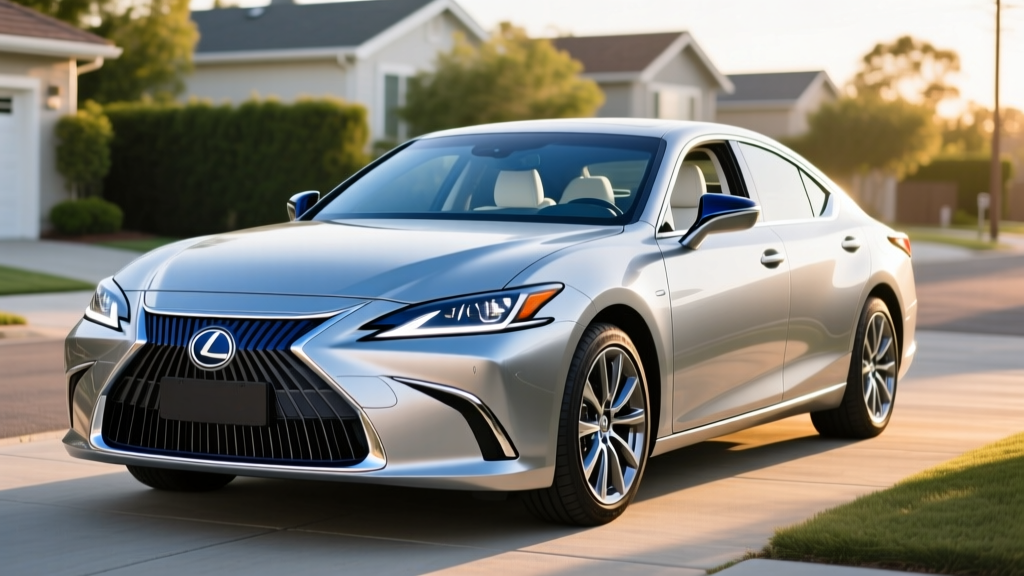
The 2018 Lexus ES 300h occupies a specific niche in the used-car market: a midsize luxury sedan that delivers genuine hybrid efficiency without requiring a plug, a charging routine, or any change in driving habits. As the final model year of the sixth-generation ES platform, the 2018 ES 300h represents a mature, well-debugged powertrain that Lexus has refined over multiple generations. For buyers in 2026 weighing a used hybrid against a new EV or a conventional gas sedan, this car demands a close look — not for its technology spectacle, but for its quiet competence and low running costs.
This guide breaks down the 2018 Lexus ES hybrid's real-world fuel economy, powertrain specs, battery longevity, ownership costs, and how it compares to the plug-in hybrid and full-electric alternatives now on the market.
HEV vs PHEV: What the 2018 Lexus ES 300h Actually Is
Before examining specs, it's essential to clarify what this car is — and what it isn't. The 2018 Lexus ES 300h is a conventional hybrid electric vehicle (HEV). It is not a plug-in hybrid (PHEV), and it has no electric-only driving range to speak of.
| Feature | Conventional Hybrid (HEV) | Plug-In Hybrid (PHEV) |
|---|---|---|
| Plug-in charging required? | No — self-charging via regen & engine | Yes — plugs into Level 1/2 charger |
| Electric-only range | <1 mile at very low speeds | Typically 20–50 miles |
| Battery size | Small (~1.6 kWh usable) | Larger (10–25 kWh) |
| Federal tax credit (§30D) | Not eligible | Up to $7,500 (if criteria met) |
| 2018 Lexus ES 300h | ✓ This vehicle | ✗ Not available in ES lineup |
The ES 300h's hybrid system recovers energy during braking and deceleration, stores it in a small nickel-metal hydride (NiMH) battery, and uses it to assist the gasoline engine or drive the car electrically at low speeds. You never plug it in. You fuel it like any other sedan at a gas station. The efficiency gains come from the engine shutting off at stops, the electric motor handling low-load driving, and regenerative braking capturing energy that would otherwise be lost as heat.
2018 Lexus ES 300h Fuel Economy: EPA and Real-World MPG
The EPA rates the 2018 Lexus ES 300h at the following fuel economy figures:
| Driving Condition | EPA MPG |
|---|---|
| City | 40 MPG |
| Highway | 39 MPG |
| Combined | 40 MPG |
Source: fueleconomy.gov
Real-World MPG Expectations
Hybrids typically meet or exceed their EPA city estimates in stop-and-go driving, where regenerative braking and engine-off coasting provide the biggest advantages. The ES 300h is no exception. In mixed suburban and city driving, owners commonly report 38–43 MPG. Highway driving at sustained speeds above 70 mph tends to yield slightly lower numbers — typically 35–38 MPG — because the aerodynamic drag of a midsize sedan overwhelms the hybrid system's electric assist at higher velocities.
For context, a comparable non-hybrid 2018 Lexus ES 350 with its 3.5L V6 is EPA-rated at 21 city / 30 highway / 24 combined. The ES 300h's 40 MPG combined represents a roughly 67% improvement in combined fuel economy — a substantial gain that directly reduces fuel expense over ownership.
Real-world fuel economy note: Expect 36–42 MPG in typical mixed driving. Cold weather (below 40°F) reduces efficiency by 5–10% as the engine runs longer to heat the cabin and warm the catalytic converter. Drivers who do mostly highway miles at 75+ mph should expect figures closer to 35–37 MPG.
Powertrain Specs: Engine, Motor, and Combined Output
The 2018 ES 300h pairs a 2.5-liter inline-four Atkinson-cycle gasoline engine with an electric motor integrated into the transaxle. Here's the breakdown:
| Specification | Value |
|---|---|
| Gasoline engine | 2.5L I4 Atkinson-cycle |
| Engine horsepower | 156 hp |
| Electric motor output | 105 kW (141 hp) |
| Net combined system horsepower | 200 hp |
| Transmission | eCVT (planetary gearset, not belt-driven) |
| Drivetrain | Front-wheel drive |
| 0–60 mph | ~7.8 seconds |
| Hybrid battery type | Nickel-metal hydride (NiMH) |
| Hybrid battery capacity | ~1.6 kWh (gross) |
| Fuel tank capacity | 17.2 gallons |
| Total driving range (est.) | ~688 miles (at 40 MPG combined) |
The eCVT in this car is Toyota/Lexus's planetary gearset design — not the rubber-belt CVT found in some economy cars. It's a proven, durable transmission with no belts to wear and no shift shock. The 200 combined horsepower provides adequate acceleration for merging and passing, though this is a comfort-oriented sedan, not a performance car. The powertrain prioritizes smoothness and efficiency over urgency.
Hybrid Battery Longevity, Warranty, and Replacement Cost
For any used hybrid buyer, battery health is the central concern. The 2018 ES 300h uses a NiMH battery pack — a chemistry that Lexus/Toyota has deployed in millions of hybrids over two decades with well-documented longevity.
Original hybrid battery warranty: Lexus covers the hybrid battery for 10 years or 150,000 miles (whichever comes first) in states that adopted California's emissions standards (including CA, NY, MA, NJ, CT, RI, VT, ME, NH, MD, OR, WA, and others). In all other states, coverage is 8 years or 100,000 miles. For a 2018 model in 2026, the battery is 8 model years old — it may still carry warranty coverage depending on your state and the vehicle's mileage.
Battery Degradation Reality
NiMH hybrid batteries in Toyota/Lexus vehicles have demonstrated excellent real-world longevity. Unlike the large lithium-ion packs in full EVs, the ES 300h's small NiMH battery is never deeply cycled — the hybrid system keeps it within a narrow state-of-charge window (roughly 40–80%) to maximize lifespan. Many Toyota/Lexus hybrids surpass 200,000 miles on their original hybrid batteries.
When degradation does occur, it typically manifests as slightly reduced fuel economy (2–4 MPG loss) and more frequent engine cycling, rather than a sudden failure. Individual cell replacement is sometimes possible, extending the pack's life at lower cost.
Replacement Cost
If the hybrid battery does require replacement outside of warranty:
- New OEM battery (Lexus dealer): $3,000–$4,500 installed
- Remanufactured/reconditioned battery: $1,500–$2,500 installed
- Individual cell replacement (specialist shop): $500–$1,200
Given the proven longevity of these packs and the availability of remanufactured options, battery replacement is a manageable — and statistically unlikely — expense for most buyers.
Used Pricing and Tax Credit Eligibility in 2026
As a used vehicle in 2026, the 2018 Lexus ES 300h typically trades in the $18,000–$27,000 range depending on mileage, condition, and trim level (base, Luxury, or Premium packages). Low-mileage examples under 60,000 miles command the higher end of that range.
Federal Tax Credit: Not Eligible
The 2018 Lexus ES 300h does not qualify for the federal §30D new clean vehicle tax credit (up to $7,500), as it is a conventional hybrid, not a plug-in electric vehicle. The §30D credit requires a battery capacity of at least 7 kWh and plug-in capability — criteria that only PHEVs and BEVs meet.
However, the Used Clean Vehicle Credit (§25E) offers up to $4,000 (30% of the sale price, capped at $4,000) for qualifying used plug-in electric vehicles. Since the ES 300h is a conventional hybrid with no plug, it also does not qualify for this credit. Per IRS guidelines, only used BEVs and PHEVs are eligible.
Some states offer rebates or incentives for used hybrids, but these vary significantly by jurisdiction. Check your state's energy or environmental agency for current programs.
2018 Lexus ES 300h vs. Alternatives: Hybrid, PHEV, or EV?
The right choice depends on your driving patterns, charging access, and budget. Here's a decision framework:
Choose the 2018 Lexus ES 300h (HEV) if:
- You lack access to home or workplace charging (apartment, street parking)
- You want luxury-car comfort with 40 MPG and zero behavior change
- Your budget is $18K–$27K for a reliable used sedan
- You drive 10,000–15,000 miles/year and want low fuel costs without plug-in logistics
Choose a PHEV (e.g., Toyota Prius Prime, Hyundai Tucson PHEV) if:
- You have home Level 2 charging and a commute under 40 miles
- You want electric-only daily driving with gas-engine flexibility for road trips
- You can access the §30D or §25E tax credit on a qualifying model
Choose a full EV (e.g., Tesla Model 3, Hyundai Ioniq 6) if:
- You have reliable home charging and your daily driving is under 250 miles
- You want the lowest per-mile energy cost (~$0.04–$0.06/mile on home electricity)
- You want to eliminate oil changes, spark plugs, and transmission fluid entirely
Pros
- 40 MPG combined — exceptional for a luxury midsize sedan
- No plug-in required — zero infrastructure dependency
- Proven, durable powertrain with deep Toyota/Lexus reliability data
- Quiet, comfortable ride with Lexus build quality
- ~688-mile total range eliminates any range concern
- Hybrid battery likely still under warranty at typical used mileage
Cons
- No electric-only driving range — always burns some gasoline
- Not eligible for any federal EV/PHEV tax credits
- Older infotainment system (no Apple CarPlay/Android Auto in 2018 ES — added in 2019 refresh)
- 200 hp is adequate, not quick — 0–60 in ~7.8 seconds
- Final year of this generation — 2019+ model is redesigned with updated tech
- Remote touchpad controller is widely disliked
Ownership Costs: What You'll Actually Spend
At 40 MPG combined and a national average gas price of roughly $3.20/gallon (early 2026), the ES 300h costs approximately $0.08 per mile in fuel. For comparison:
| Vehicle | MPG Combined | Cost/Mile (Fuel) | Annual Fuel (12K mi) |
|---|---|---|---|
| 2018 Lexus ES 300h (HEV) | 40 | $0.080 | $960 |
| 2018 Lexus ES 350 (gas) | 24 | $0.133 | $1,600 |
| 2025 Toyota Camry LE (gas) | 32 | $0.100 | $1,200 |
| Home-charged EV (avg $0.15/kWh) | ~120 MPGe | $0.040 | $480 |
The ES 300h saves roughly $640/year in fuel compared to the gas-only ES 350, and $240/year compared to a modern 4-cylinder gas sedan. Over a 5-year ownership period, that's $1,200–$3,200 in fuel savings — meaningful, though not as dramatic as switching to a home-charged EV.
Maintenance costs are modest. The Atkinson-cycle engine is lightly stressed, the eCVT requires no belt replacement, and regenerative braking extends brake pad life significantly (many owners report 80,000+ miles on original pads). Lexus maintenance plans and independent shop familiarity keep service costs reasonable.
Frequently Asked Questions
How many MPG does the 2018 Lexus ES 300h hybrid get?
The EPA rates the 2018 Lexus ES 300h at 40 MPG city, 39 MPG highway, and 40 MPG combined. In real-world mixed driving, expect 36–42 MPG depending on driving style, terrain, and ambient temperature. City-heavy routes tend to yield the best results thanks to regenerative braking.
Does the 2018 Lexus ES 300h need to be plugged in?
No. The ES 300h is a conventional hybrid (HEV), not a plug-in hybrid (PHEV). It charges its own small battery through regenerative braking and the gasoline engine. You fuel it exclusively at gas stations, like any conventional car.
How far can the 2018 Lexus ES 300h drive on electric only?
Effectively less than one mile, and only at very low speeds (under 25 mph) with light throttle input. The hybrid battery is too small (~1.6 kWh) to provide meaningful electric-only range. The electric motor's role is to assist the gas engine and enable engine-off coasting and stops — not to replace it. If electric-only commuting is your goal, you need a PHEV or a full BEV.
Is the 2018 Lexus ES 300h hybrid reliable?
Yes. The Toyota/Lexus hybrid system is among the most proven and reliable powertrains in the automotive industry. The NiMH battery, eCVT transmission, and hybrid control electronics have been deployed across millions of vehicles since 1997 (Prius). The ES 300h benefits from this extensive track record. Lexus consistently ranks at or near the top in J.D. Power and Consumer Reports reliability surveys, and the ES line is a core part of that reputation.
What does a replacement hybrid battery cost for the 2018 ES 300h?
A new OEM hybrid battery from a Lexus dealer costs approximately $3,000–$4,500 installed. Remanufactured batteries are available for $1,500–$2,500 installed, and individual cell replacement can cost $500–$1,200 at specialist shops. However, Toyota/Lexus NiMH hybrid batteries routinely last 200,000+ miles, making replacement a low-probability event for most owners.
Does the 2018 Lexus ES 300h qualify for any federal tax credit?
No. The ES 300h is a conventional hybrid without plug-in capability, so it does not qualify for the §30D new vehicle credit or the §25E used clean vehicle credit. Both credits require plug-in electric vehicles with battery capacities above specific thresholds. Check IRS.gov for current credit eligibility rules. Some state-level incentives may apply to hybrids — consult your state's energy office.
Should I buy the 2018 ES 300h or wait for the 2019 redesign?
The 2019 Lexus ES 300h is a full redesign on the new GA-K platform with significantly updated infotainment (including Apple CarPlay), improved driving dynamics, and a lithium-ion hybrid battery replacing the NiMH pack. If your budget allows ($25K–$35K for a used 2019+), the newer generation is a meaningfully better car. The 2018 model's advantage is price — it trades at a significant discount while delivering nearly identical fuel economy and powertrain reliability.
How does the ES 300h compare to a full EV for daily commuting?
A full EV (like a Tesla Model 3 or Hyundai Ioniq 6) will cost roughly half as much per mile to "fuel" if you charge at home, and eliminates all engine maintenance. However, an EV requires reliable charging access (home or workplace), a higher upfront purchase price (even used), and acceptance of charging logistics on road trips. The ES 300h offers 80% of the fuel-cost benefit of an EV with zero infrastructure requirements — a practical compromise for buyers without charging access or those who regularly drive beyond 300 miles between stops.
The 2018 Lexus ES 300h is not a technology showcase. It won't charge at a Supercharger, it won't drive itself, and its infotainment system shows its age. What it does — deliver 40 MPG in a quiet, comfortable luxury sedan with a bulletproof powertrain and no behavioral change required — it does exceptionally well. For used-car buyers in 2026 who want luxury efficiency without the complexity, cost, or infrastructure demands of a plug-in vehicle, the ES 300h remains one of the smartest choices on the market.