Quick Verdict: A Luxury Hybrid Sedan That Still Holds Up
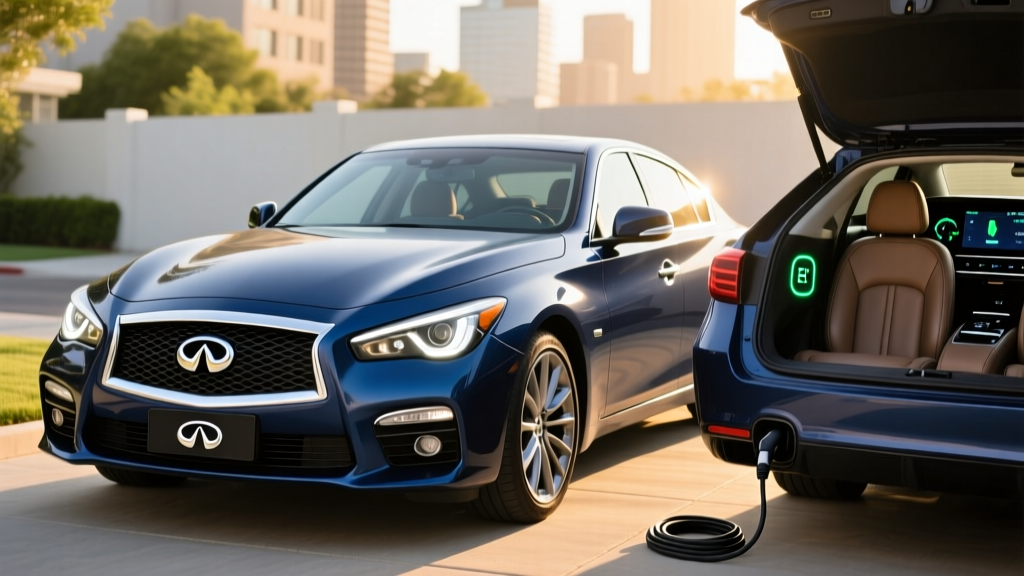
The 2018 Infiniti Q70 Hybrid sits in a niche that has largely evaporated from the new-car market: a rear-wheel-drive luxury sedan pairing a V6 with an electric motor for meaningful fuel savings without sacrificing power. Built on Nissan's Direct Response Hybrid system, the Q70 Hybrid uses a conventional hybrid (HEV) powertrain — no plug, no electric-only driving, just seamless gas-electric blending that returns an EPA-estimated 29 MPG combined while producing 360 horsepower.
For 2026 used-car shoppers, the Q70 Hybrid offers a compelling value proposition. Depreciation has been steep, meaning you can often find well-maintained examples in the $18,000–$25,000 range — a fraction of the original $56,000+ MSRP. The key question for any used hybrid buyer is battery health, and here the Q70 benefits from Nissan/Infiniti's proven hybrid architecture, which has demonstrated strong longevity when properly maintained.
Powertrain Specs: 360 HP from a V6-Electric Team
The Q70 Hybrid's powertrain is built around Nissan's 3.5-liter VQ35HR V6 engine, which produces 302 horsepower on its own. A 50-kW (67 hp) electric motor is sandwiched between the engine and the 7-speed automatic transmission, with two clutches allowing the motor to drive the wheels independently or in concert with the V6. Combined system output is rated at 360 horsepower.
| Component | Specification |
|---|---|
| Engine | 3.5L V6 (VQ35HR), 302 hp / 258 lb-ft |
| Electric Motor | 50 kW (67 hp) / 214 lb-ft |
| Combined System Output | 360 hp |
| Transmission | 7-speed automatic |
| Drivetrain | Rear-wheel drive (AWD not available on Hybrid) |
| Hybrid Battery | Lithium-ion, ~1.4 kWh (gross) |
| 0–60 mph | ~5.5 seconds (manufacturer est.) |
| Curb Weight | ~4,133 lbs |
The 1.4 kWh lithium-ion battery pack is mounted behind the rear seats, which does reduce trunk capacity to approximately 11.3 cubic feet compared to the gas-only Q70's 14.9 cubic feet. This is a noticeable trade-off if cargo space matters to you.
Fuel Economy: EPA Ratings and Real-World MPG
According to fueleconomy.gov, the 2018 Infiniti Q70 Hybrid earns the following EPA estimates:
| Metric | MPG |
|---|---|
| City | 27 MPG |
| Highway | 32 MPG |
| Combined | 29 MPG |
| Fuel Type | Premium gasoline (91 octane recommended) |
| Fuel Tank | 20.0 gallons |
| Total Range | ~580 miles |
Real-world expectations: The hybrid system's greatest advantage shows up in stop-and-go city driving, where regenerative braking recaptures energy and the electric motor handles low-speed acceleration. Many owners report matching or slightly exceeding the 27 MPG city figure in moderate climates. Highway driving at sustained 75+ mph speeds tends to land closer to 28–30 MPG, as the V6 does more of the work and the hybrid system's contribution diminishes. In cold weather (below 30°F), expect a 2–4 MPG drop due to extended engine warm-up cycles and reduced battery efficiency — typical for all hybrids.
For context, the gas-only 2018 Q70 with the 3.7L V6 rates at 20 city / 28 highway / 23 combined. The hybrid's 6 MPG combined improvement represents roughly a 26% fuel savings — meaningful over 15,000 annual miles, translating to approximately $400–$550 per year in fuel savings depending on local gas prices and your driving mix.
Battery Health, Warranty, and Replacement Cost
How long does the Q70 Hybrid battery actually last? Nissan/Infiniti's lithium-ion hybrid batteries have a strong track record. Unlike the much larger packs in full EVs that undergo deep charge/discharge cycles, the Q70's 1.4 kWh pack operates in a narrow state-of-charge window (roughly 40–80%) managed by the hybrid control system. This shallow cycling dramatically reduces degradation stress. Based on owner reports and the shared architecture with the Nissan Altima Hybrid and Infiniti M35h before it, these packs routinely exceed 150,000 miles without significant capacity loss.
Replacement cost: If the hybrid battery does fail outside warranty, a new OEM replacement from Infiniti typically runs $3,000–$5,000 including parts and labor. Refurbished or reconditioned packs from third-party hybrid specialists can reduce this to $1,500–$3,000. Individual cell replacement is sometimes possible at specialist shops for $800–$1,500 if only a portion of the pack has degraded. These costs are substantially lower than full EV battery replacements, which can exceed $10,000–$20,000.
Reliability and What to Watch For
The Q70 as a platform scores well in reliability surveys. The VQ35 engine family is one of Nissan's most durable powerplants, and the hybrid system adds relatively few failure-prone components. NHTSA records show no systemic hybrid-specific recalls for the 2018 Q70 Hybrid.
Key areas to inspect on a used example:
- Hybrid battery state of health: Ask for a diagnostic scan showing battery voltage balance across cells. Uneven cell voltages indicate degradation. A qualified Infiniti technician or hybrid specialist can perform this.
- Inverter/cooling system: The hybrid system has its own cooling circuit. Check for coolant leaks around the inverter housing and verify the electric water pump is functioning.
- Transmission behavior: The 7-speed automatic should shift smoothly. The transition between electric-motor drive and V6 engagement should be nearly imperceptible. Any clunking or hesitation during this handoff warrants further inspection.
- Regenerative braking feel: Brake pedal feel in the Q70 Hybrid is different from the gas model due to regen blending. Test-drive to ensure consistent pedal response — any grinding or pulsation could indicate worn friction brakes or a regen system fault.
- 12V auxiliary battery: Like all hybrids and EVs, the Q70 has a standard 12V battery that powers electronics. A weak 12V battery can cause hybrid system error codes even when the main hybrid pack is healthy.
Pricing and Tax Credit Reality for Used Buyers
The 2018 Infiniti Q70 Hybrid originally carried an MSRP starting around $56,550 (including destination), with the Technology Package pushing it past $60,000. In the 2026 used market, expect to pay:
- $18,000–$22,000 for examples with 80,000–120,000 miles
- $22,000–$27,000 for lower-mileage examples (40,000–70,000 miles) in excellent condition
- Below $16,000 for high-mileage or cosmetically challenged examples
Federal tax credit: The Q70 Hybrid never qualified for the federal plug-in EV tax credit (§30D) because it is a conventional hybrid with no plug-in capability. That remains unchanged — there is no federal tax credit available for purchasing a used conventional hybrid. The federal used clean vehicle credit (up to $4,000 or 30% of sale price, whichever is less) applies only to used EVs and PHEVs with plug-in capability, not to HEVs.
Some states offer modest incentives for hybrid purchases, but most state-level programs have shifted exclusively to plug-in vehicles. Check your state's energy or environmental agency for current programs. For definitive federal credit rules, consult the IRS clean vehicle credit page.
Who Should Choose the Q70 Hybrid — and Who Shouldn't
Choose the Q70 Hybrid If:
- You want a luxury sedan with V6 power and better-than-average fuel economy
- You lack access to home or workplace charging (no plug needed)
- You drive a mix of city and highway miles and want fuel savings without behavior change
- You value a smooth, quiet powertrain with strong passing acceleration
- You want to spend under $25,000 on a luxury sedan with proven reliability
Look Elsewhere If:
- You need a large trunk (the battery eats 3.6 cu ft of cargo space)
- You want electric-only driving or plug-in capability (consider a PHEV like the BMW 530e)
- You want the latest infotainment and driver-assist tech (the Q70's interior is dated for 2026)
- You prioritize all-wheel drive (the Hybrid was RWD only)
- You want maximum fuel savings — a full EV eliminates gas costs entirely if you can charge at home
Hybrid vs PHEV vs EV — the decision framework: The Q70 Hybrid makes sense as a bridge technology for drivers who want fuel savings but cannot commit to plugging in. If you have reliable Level 2 charging at home and a commute under 30 miles each way, a PHEV like the Toyota Prius Prime or a used BMW 530e lets you drive most daily miles on electricity alone while keeping a gas engine for road trips. If you have home charging and want to eliminate gas entirely, a used EV like the Tesla Model 3 or Hyundai Ioniq 5 will cost less per mile to operate — but requires charging infrastructure and acceptance of range planning on longer trips.
Frequently Asked Questions
How many MPG does the 2018 Infiniti Q70 Hybrid get?
The EPA rates it at 27 city / 32 highway / 29 combined MPG. Real-world results typically match or slightly exceed the city figure thanks to regenerative braking, while highway-heavy driving at high speeds may return 28–30 MPG. Cold weather reduces these numbers by 2–4 MPG.
Can I plug in the 2018 Q70 Hybrid?
No. The Q70 Hybrid is a conventional hybrid (HEV), not a plug-in hybrid (PHEV). It has no charging port and no electric-only driving range. The battery recharges solely through regenerative braking and the gasoline engine.
How far can the Q70 Hybrid drive on electric power alone?
It cannot. Unlike a PHEV, the Q70 Hybrid does not offer an electric-only driving mode. The electric motor assists the V6 and can propel the car at very low speeds for brief distances (typically under 1 mile at parking-lot speeds), but it is not designed for sustained electric-only travel.
Is the hybrid battery reliable, and what does replacement cost?
Nissan/Infiniti's lithium-ion hybrid battery packs have demonstrated strong longevity, often exceeding 150,000 miles. The original warranty was 8 years/100,000 miles (10 years/150,000 in CARB states). As of 2026, most 2018 models are out of warranty. OEM replacement runs $3,000–$5,000; refurbished packs cost $1,500–$3,000.
Does the 2018 Q70 Hybrid qualify for any tax credit?
No. Federal and most state clean-vehicle tax credits apply only to plug-in vehicles (EVs and PHEVs). The Q70 Hybrid, as a conventional HEV, does not qualify for the §30D federal credit or the used clean vehicle credit. Check your state energy office for any remaining hybrid-specific programs.
How does the Q70 Hybrid compare to the Lexus GS 450h?
The Lexus GS 450h (discontinued after 2020) offers a similar luxury-hybrid formula with a 3.5L V6 hybrid producing 338 hp and an EPA-estimated 29 MPG combined. The GS 450h tends to score higher in reliability surveys and retains value better, but commands a premium on the used market — typically $5,000–$10,000 more than a comparable Q70 Hybrid. The Lexus also uses a CVT, while the Infiniti uses a traditional 7-speed automatic, which some drivers prefer for its more natural shift feel.