Quick Verdict: A Practical Midsize Hybrid for the Used Market
The 2018 Hyundai Sonata Hybrid occupies a specific niche in 2026's used-car landscape: a midsize sedan that delivers genuinely strong city fuel economy without requiring any plug-in infrastructure or lifestyle change. With an EPA-estimated 39 MPG combined, a proven 2.0-liter hybrid powertrain, and Hyundai's generous battery warranty, it remains a rational choice for buyers who want hybrid efficiency without the complexity of a PHEV or the charging demands of a full EV.
This is a conventional hybrid (HEV), not a plug-in. You never plug it in — the gasoline engine and regenerative braking handle all battery charging. For buyers shopping the used market, the Sonata Hybrid's combination of low running costs, comfortable ride, and strong safety ratings makes it a compelling alternative to the Toyota Camry Hybrid and Honda Accord Hybrid of the same era.
HEV vs. PHEV: What the 2018 Sonata Hybrid Is (and Isn't)
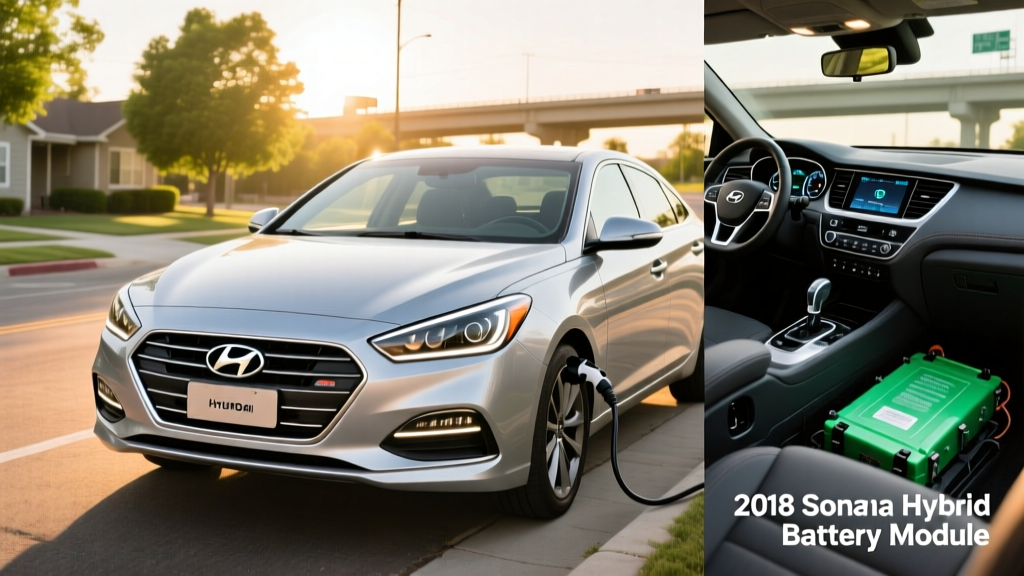
Conventional Hybrid (HEV) — This car: The 2018 Sonata Hybrid uses a small 1.76 kWh lithium-ion polymer battery paired with a 2.0L gasoline engine. The battery charges exclusively through regenerative braking and the engine. There is no plug, no electric-only driving range to manage, and no charging infrastructure needed. You simply fill up at a gas station like any conventional car.
Plug-in Hybrid (PHEV) — Not this car: Hyundai did not offer a plug-in version of the 2018 Sonata in the U.S. market. (The Sonata Plug-in Hybrid was available in 2016–2017 model years only, with approximately 27 miles of electric-only range and a 9.8 kWh battery.) If you need electric-only commuting capability, you'll need to look at a different model — such as the Toyota Prius Prime or a used Chevrolet Volt.
This distinction matters because many used-car listings blur the line between HEV and PHEV. The 2018 Sonata Hybrid is strictly an HEV. It cannot drive on electricity alone for meaningful distances (the electric motor assists the gas engine but doesn't propel the car independently at highway speeds). The payoff is simplicity: zero charging logistics, no range anxiety about depleted batteries, and a lower purchase price than comparable PHEVs.
Fuel Economy: EPA Ratings and Real-World MPG
| Driving Cycle | EPA Estimate | Real-World Expectation |
|---|---|---|
| City | 39 MPG | 40–44 MPG (hybrids excel in stop-and-go) |
| Highway | 43 MPG | 38–42 MPG (sustained speed reduces regen benefit) |
| Combined | 39 MPG | 37–42 MPG depending on driving mix |
Source: EPA Fuel Economy Guide — 2018 Hyundai Sonata Hybrid
The 2018 Sonata Hybrid's EPA numbers tell an interesting story. Unlike most vehicles, its highway rating (43 MPG) actually exceeds its city rating (39 MPG). This is somewhat unusual for a hybrid — most hybrids score higher in the city, where regenerative braking recaptures energy during frequent stops. Hyundai tuned the Sonata Hybrid's powertrain for strong highway efficiency through a low-drag aerodynamic profile (0.24 Cd) and a six-speed automatic transmission that avoids the efficiency losses common in some CVT-equipped competitors.
Real-world caveat: In mixed driving, owners typically report 37–42 MPG combined. Heavy city driving with frequent stops can push the car toward 44 MPG, as the regenerative braking system works overtime. Conversely, sustained highway driving at 75+ mph in cold weather can drop observed economy to 35–37 MPG. The Sonata Hybrid's battery thermal management system is passive (air-cooled), so extreme heat or cold will reduce the electric motor's contribution and shift more load to the gasoline engine.
For context, the 2018 Toyota Camry Hybrid LE achieves an EPA-estimated 52 MPG combined, making it notably more efficient. The Sonata Hybrid trades some fuel economy for a quieter ride, more spacious rear seats, and Hyundai's longer warranty coverage.
Powertrain Specs: Engine, Motor, and Combined Output
| Specification | 2018 Sonata Hybrid |
|---|---|
| Gasoline Engine | 2.0L 4-cylinder GDI (154 hp, 140 lb-ft) |
| Electric Motor | 38 kW permanent-magnet synchronous (51 hp, 151 lb-ft) |
| Combined System Output | 193 hp |
| Transmission | 6-speed automatic |
| Hybrid Battery | 1.76 kWh lithium-ion polymer |
| Drivetrain | Front-wheel drive |
| 0–60 mph | ~8.3 seconds |
| Curb Weight | ~3,527 lbs |
The 2018 Sonata Hybrid pairs a naturally aspirated 2.0-liter four-cylinder engine with a 38 kW electric motor sandwiched between the engine and transmission. The combined output of 193 horsepower is adequate for merging and passing, though it won't feel quick by modern EV standards. The six-speed automatic is a deliberate choice — Hyundai avoided the CVT that Toyota and Honda favor, resulting in a more traditional shift feel that some drivers prefer, though it sacrifices a few MPG points compared to CVT competitors.
The 1.76 kWh battery is small by modern standards (a 2026 PHEV typically carries 12–20 kWh), but it's appropriately sized for an HEV. It buffers enough energy for low-speed electric assist, smooth stop-start transitions, and regenerative braking capture — without adding excessive weight or cost.
Battery Warranty, Lifespan, and Replacement Cost
Hybrid Battery Warranty (Original): 10 years / 100,000 miles (whichever comes first) for the original owner. For subsequent owners, Hyundai's hybrid battery warranty transfers at 10 years / 100,000 miles in most states, though some states with California Air Resources Board (CARB) emissions rules may extend coverage further.
Hybrid System Components: 10 years / 100,000 miles (original owner), covering the electric motor, inverter, and related control electronics.
As of 2026: A 2018 model year vehicle is 8 years old. If the original owner's warranty is intact and the car has under 100,000 miles, some hybrid battery coverage may remain — but verify with a Hyundai dealer using the VIN, as warranty transferability varies.
Hyundai's hybrid battery track record is solid. The 1.76 kWh lithium-ion polymer pack in the Sonata Hybrid is conservatively engineered — it operates within a narrow state-of-charge window (roughly 40–80%), which significantly reduces degradation compared to full EVs that regularly cycle between 0–100%. Most owners report minimal capacity loss over 100,000+ miles.
Battery replacement cost: If the hybrid battery fails out of warranty, a refurbished replacement typically runs $2,000–$3,500 including labor. A new OEM battery from Hyundai can cost $3,500–$5,000 installed. Independent hybrid shops often offer refurbished units at the lower end of that range. Given the battery's conservative operating window and Hyundai's track record, premature failure is uncommon — but buyers of high-mileage examples (120,000+ miles) should budget for eventual replacement.
Compare this to the Toyota Camry Hybrid, whose replacement battery runs $2,500–$4,000 — similar territory. The Sonata Hybrid's battery cost is not a dealbreaker, but it's a factor for high-mileage used purchases.
Pricing and Tax Credit Eligibility in 2026
The 2018 Hyundai Sonata Hybrid was originally sold in two trims:
- Base (Blue trim): Original MSRP ~$26,100
- Limited trim: Original MSRP ~$31,100
On the used market in 2026, expect to pay roughly $12,000–$18,000 depending on mileage, condition, and trim. Well-maintained examples under 80,000 miles command a premium; high-mileage fleet vehicles sell at the lower end.
Federal tax credit: The 2018 Sonata Hybrid does not qualify for the federal §30D clean vehicle credit. That credit applies only to new plug-in vehicles (BEVs and PHEVs meeting battery-sourcing and critical-mineral requirements under current IRS rules). Conventional hybrids like this one have not qualified for federal purchase incentives since the early 2010s.
Used EV credit (§25E): This credit (up to $4,000 or 30% of sale price, whichever is lower) applies only to used BEVs and PHEVs — not conventional hybrids. The Sonata Hybrid is ineligible.
State incentives: A handful of states offer modest rebates or HOV lane access for hybrids, but these programs have largely shifted focus to plug-in vehicles. Check your state's energy office or DMV for current hybrid-specific benefits — they're increasingly rare.
Who Should Choose the Sonata Hybrid vs. a PHEV or Full EV?
Choose the 2018 Sonata Hybrid (HEV) if:
- You have no access to home or workplace charging (apartment dwellers, street parkers)
- You want better fuel economy without any behavioral change — just drive and fill up
- Your budget is $12,000–$18,000 for a reliable midsize sedan
- You drive 10,000–15,000 miles per year in mixed city/highway conditions
- You prefer a traditional driving feel with a conventional automatic transmission
Consider a used PHEV (e.g., Toyota Prius Prime, Chevrolet Volt) if:
- You can install a Level 2 charger at home and have a short commute (<25 miles)
- You want to drive mostly on electricity for daily trips but need gas flexibility for road trips
- You want to qualify for the used plug-in vehicle tax credit (up to $4,000 under §25E)
Consider a used full EV (e.g., Chevrolet Bolt EV, Nissan Leaf, Tesla Model 3) if:
- You have reliable home Level 2 charging
- Your daily driving is under 200 miles and you rarely road-trip to charging deserts
- You want to eliminate gasoline costs entirely and minimize maintenance (no oil changes, fewer brake replacements due to regen)
- You want the lowest per-mile energy cost — electricity at $0.14/kWh averages roughly $0.04/mile vs. the Sonata Hybrid's ~$0.09/mile at $3.50/gallon
The Sonata Hybrid's core value proposition is frictionless efficiency. There's no plug to manage, no charging app to download, no range planning for road trips. You get roughly 40% better fuel economy than a comparable gas-only Sonata (which rated around 28 MPG combined) without altering a single habit. For buyers in regions with unreliable public charging infrastructure or those who simply don't want to think about electrification logistics, this remains the most practical form of vehicle electrification available.
Reliability and Ownership Costs
The 2018 Sonata Hybrid rates well for reliability. The 2.0L naturally aspirated engine is a proven design with no turbocharger complexity, and Hyundai's hybrid system has fewer moving parts than a conventional automatic powertrain (the electric motor replaces the torque converter). Common maintenance items include standard oil changes, brake fluid, and cabin air filters — regenerative braking significantly extends brake pad life, often to 80,000+ miles.
The IIHS rated the 2018 Sonata as a Top Safety Pick when equipped with optional LED headlights, and NHTSA awarded it a 5-star overall safety rating. Standard safety features include a rearview camera; available features include blind-spot monitoring, rear cross-traffic alert, and lane departure warning. It does not include modern ADAS features like adaptive cruise control or lane-keeping assist — those became more common in the 2020+ redesign.
Insurance costs are moderate — typically $1,200–$1,600 annually for a clean-record driver, comparable to a gas Sonata. Hybrid-specific insurance surcharges are rare in 2026.
Pros
- 39 MPG combined without plugging in — true fill-up-and-forget efficiency
- Spacious rear seats and large trunk (13.3 cu ft) vs. compact hybrid competitors
- 6-speed automatic avoids the "drone" of CVTs under hard acceleration
- Strong original warranty; hybrid battery coverage may still apply on low-mile examples
- Quiet, comfortable ride quality suited to long highway commutes
- Low used-market pricing ($12K–$18K) for a car with sub-$1,200 annual fuel cost
Cons
- 39 MPG combined trails the 2018 Camry Hybrid (52 MPG) by a significant margin
- No plug-in option available for this model year — electric-only commuting is not possible
- Dated infotainment compared to 2020+ models; Apple CarPlay/Android Auto present but screen is small
- No adaptive cruise control or lane-keeping assist available on any trim
- Air-cooled hybrid battery may lose efficiency in extreme heat
- Modest 193 hp feels slow when merging onto fast-moving highways
Frequently Asked Questions
How many MPG does the 2018 Hyundai Sonata Hybrid get?
The EPA rates it at 39 MPG city, 43 MPG highway, and 39 MPG combined. In real-world mixed driving, expect 37–42 MPG. City-heavy routes can push it above 40 MPG thanks to regenerative braking, while sustained highway driving at high speeds in cold weather may drop it to 35–37 MPG.
Can I plug in the 2018 Sonata Hybrid to charge it?
No. This is a conventional hybrid (HEV), not a plug-in hybrid (PHEV). The battery charges exclusively through regenerative braking and the gasoline engine. There is no charging port, no plug, and no electric-only driving range. Hyundai's plug-in Sonata was only offered in 2016–2017 model years and is a separate vehicle.
How far can it go on electric only?
Effectively zero miles on electric-only power at meaningful speeds. The electric motor assists the gasoline engine during acceleration and can propel the car at very low speeds (parking lots, creeping traffic) for brief distances, but it cannot sustain highway or even neighborhood speeds without the engine engaging. This is normal for conventional hybrids.
Is the hybrid battery reliable, and what does replacement cost?
Yes. Hyundai's 1.76 kWh lithium-ion polymer battery is conservatively engineered and operates in a narrow charge window that minimizes degradation. Most units last well past 150,000 miles. If replacement is needed out of warranty, expect $2,000–$3,500 for a refurbished unit or $3,500–$5,000 for a new OEM battery, installed. The original 10-year/100,000-mile warranty may still partially apply on low-mileage 2018 examples — verify by VIN at a Hyundai dealer.
Does the 2018 Sonata Hybrid qualify for any tax credit?
No. Federal tax credits under §30D (new clean vehicles) and §25E (used clean vehicles) apply only to plug-in vehicles — battery-electric vehicles (BEVs) and plug-in hybrids (PHEVs) that meet battery-sourcing and income requirements. The Sonata Hybrid is a conventional HEV and does not qualify for any federal purchase incentive. Some states may offer minor hybrid benefits, but these are increasingly uncommon. Consult a tax professional or check IRS clean vehicle credit guidelines for current rules.
How does it compare to the Toyota Camry Hybrid?
The 2018 Camry Hybrid LE achieves 52 MPG combined — 13 MPG more than the Sonata Hybrid. The Camry also has a more modern infotainment system and Toyota Safety Sense as standard. The Sonata Hybrid counters with a quieter ride, more rear legroom, a conventional automatic transmission (no CVT), and typically lower used-market pricing. If maximum fuel economy is your priority, the Camry wins. If comfort and value matter more, the Sonata Hybrid is competitive.
What should I check when buying a used 2018 Sonata Hybrid?
Prioritize: (1) hybrid battery state of health — a Hyundai dealer can run a diagnostic showing capacity retention; (2) service records confirming regular oil changes and inverter coolant maintenance; (3) remaining hybrid warranty by VIN; (4) brake pad thickness (regen extends pad life, but they still wear); (5) standard pre-purchase inspection for suspension, tires, and accident history. Avoid examples with warning lights on the dash — hybrid system faults can be expensive to diagnose and repair.