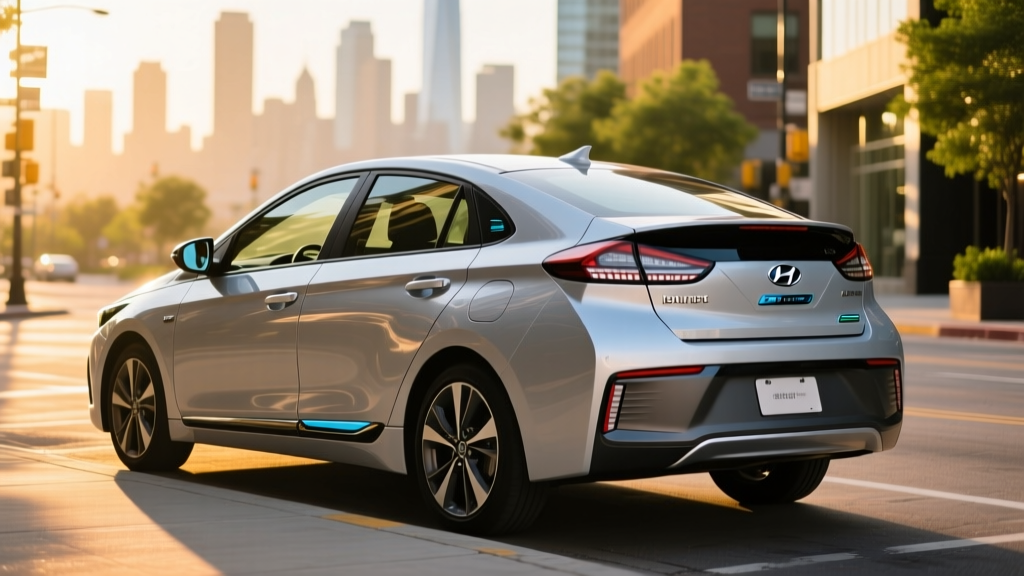
The 2018 Hyundai Ioniq Hybrid occupies a specific niche in the used-car market: it delivers Prius-rivaling fuel economy with a more conventional driving feel, and it can be found today for well under $15,000. For buyers who want maximum MPG without plug-in infrastructure or range-anxiety calculations, this compact liftback remains one of the most efficient non-plug-in vehicles ever sold in the United States.
This guide covers the conventional hybrid (HEV) version of the 2018 Ioniq. Hyundai also sold the Ioniq as a Plug-In Hybrid (PHEV) and a full Battery Electric Vehicle (BEV) in 2018, but those are mechanically distinct powertrains with different specs, pricing, and use cases. We address all three briefly in the comparison section below, but our deep-dive data focuses on the HEV — the variant most buyers encounter on the used market.
2018 Hyundai Ioniq Hybrid: EPA Fuel Economy and Real-World MPG
The headline number is what draws most buyers to this car. According to fueleconomy.gov, the 2018 Hyundai Ioniq Hybrid achieves:
| Driving Cycle | EPA Rating |
|---|---|
| City | 57 MPG |
| Highway | 59 MPG |
| Combined | 58 MPG |
Those numbers apply to the Blue and SEL trim levels equipped with 15-inch wheels and low-rolling-resistance tires. The Limited trim, which adds 17-inch alloy wheels and additional equipment, drops slightly to 55 city / 53 highway / 54 combined MPG.
Real-World MPG: What Owners Actually See
Hybrids tend to perform close to — or even above — their EPA city ratings because regenerative braking recaptures energy in stop-and-go traffic. The Ioniq Hybrid is no exception. Owner-reported data on Fuelly and similar tracking platforms clusters around 52–56 MPG combined in mixed driving, with some drivers consistently hitting 60+ MPG in warm-weather city commutes.
Highway driving at sustained 75–80 mph speeds will pull the figure down to roughly 48–52 MPG, as the electric motor assists less at constant velocity and aerodynamic drag dominates. Cold weather (below 35°F) typically costs 3–6 MPG as the engine runs more frequently to provide cabin heat and maintain catalyst temperature.
HEV vs. PHEV vs. BEV: Which 2018 Ioniq Is Which?
Hyundai sold the 2018 Ioniq in three distinct powertrains under one body style. Confusing them is easy on the used lot — all three look nearly identical from the outside. Here is the mechanical breakdown:
| Specification | Ioniq Hybrid (HEV) | Ioniq Plug-In Hybrid (PHEV) | Ioniq Electric (BEV) |
|---|---|---|---|
| Powertrain | 1.6L GDI + 32 kW motor | 1.6L GDI + 45 kW motor | 88 kW electric motor only |
| Combined Horsepower | 139 hp | 164 hp | 118 hp (88 kW) |
| Battery | 1.56 kWh (Li-ion polymer) | 8.9 kWh (Li-ion polymer) | 28 kWh (Li-ion polymer) |
| Plug Required? | No — self-charging | Yes — Level 1 or Level 2 | Yes — Level 2 or DC fast |
| EPA Combined MPG / MPGe | 58 MPG (Blue/SEL) | 52 MPG (gas) / 119 MPGe (elec) | 136 MPGe |
| Electric-Only Range | N/A (motor assists only) | 29 miles | 124 miles |
| DC Fast Charging | N/A | No | Yes (CCS, ~50 kW peak) |
The HEV (conventional hybrid) never plugs in. Its small 1.56 kWh battery recharges through regenerative braking and the gasoline engine. You simply fill it with gas and drive.
The PHEV has a larger 8.9 kWh battery that delivers an EPA-rated 29 miles of electric-only driving before the gasoline engine engages. It charges via a standard J1772 connector at Level 1 (120V, ~9 hours) or Level 2 (240V, ~2.5 hours). It does not support DC fast charging.
The BEV is a full electric vehicle with no gasoline engine, a 124-mile EPA range, and CCS DC fast-charging capability up to approximately 50 kW.
Powertrain and Driving Dynamics
The 2018 Ioniq Hybrid pairs a 1.6-liter Atkinson-cycle four-cylinder engine (104 hp, 109 lb-ft torque) with a 32 kW permanent-magnet synchronous electric motor (43 hp, 125 lb-ft). Combined system output is 139 horsepower. Power flows through a 6-speed dual-clutch automatic transmission (DCT) — a deliberate engineering choice that sets the Ioniq apart from the Toyota Prius, which uses a continuously variable transmission (CVT).
The DCT gives the Ioniq Hybrid a more direct, stepped-acceleration feel that drivers accustomed to conventional automatics find natural. The tradeoff is occasional low-speed hesitation from stoplights as the clutch engages, a characteristic of most dual-clutch designs. In Sport mode, the transmission holds lower gears longer for more responsive acceleration, at a modest fuel-economy penalty.
The 0–60 mph time is approximately 9.4 seconds — adequate for merging and passing but not quick. This is a vehicle optimized for efficiency, not performance.
| Specification | 2018 Ioniq Hybrid (Blue/SEL) |
|---|---|
| Engine | 1.6L Atkinson-cycle GDI I4 |
| Electric Motor | 32 kW (43 hp) |
| Combined Output | 139 hp |
| Transmission | 6-speed dual-clutch automatic |
| Battery Capacity | 1.56 kWh lithium-ion polymer |
| 0–60 mph | ~9.4 seconds |
| Curb Weight | ~3,033 lbs (Blue) |
| Drag Coefficient | 0.24 Cd |
| Cargo Volume | 26.5 cu ft (rear seats up) |
Battery Warranty, Lifespan, and Replacement Cost
Hybrid battery longevity is the top concern for used-hybrid buyers, and for good reason — a traction battery replacement is one of the most expensive repairs a hybrid can require.
- Hybrid Battery: 10 years / 100,000 miles (original owner, CARB states); 8 years / 100,000 miles (federal emissions states)
- Hybrid System Components: 10 years / 100,000 miles (original owner)
- Powertrain: 10 years / 100,000 miles (original owner); 5 years / 60,000 miles (second owner)
For a 2018 model purchased used in 2026, the original 10-year / 100,000-mile hybrid battery warranty may still be active if the vehicle has remained under that mileage threshold, because Hyundai's hybrid battery warranty transfers to second owners in CARB-adopting states (California, New York, Massachusetts, and others that follow California emissions standards). In federal- emissions states, the warranty for second owners drops to the remaining balance of the 5-year / 60,000-mile powertrain coverage. Always verify warranty status with a Hyundai dealer using the VIN before purchasing.
Real-World Battery Degradation
The Ioniq Hybrid's 1.56 kWh battery is small and operates within a narrow state-of-charge window (roughly 40–80% SoC), which minimizes stress on the cells. Hyundai's lithium-ion polymer chemistry has proven durable in real-world use. High-mileage Ioniq Hybrids used in taxi and rideshare fleets have logged well over 200,000 miles on original batteries with minimal capacity loss, because the hybrid system's buffer management prevents deep cycling.
Battery Replacement Cost
If the hybrid battery does fail outside of warranty, expect to pay between $2,500 and $4,500 for a replacement, depending on whether you source a new OEM unit, a refurbished pack, or a used unit from a salvage yard. Independent hybrid specialists can often perform the swap for less than a dealership. Given the Ioniq Hybrid's modest battery size, this cost is significantly lower than a full EV battery replacement.
Used Pricing and Tax Credit Eligibility
The 2018 Hyundai Ioniq Hybrid originally started at an MSRP of approximately $22,050 (Blue trim) and topped out near $29,000 (Limited trim with navigation and premium features).
In the current used market, 2018 Ioniq Hybrids typically trade between $11,000 and $17,000, depending on mileage, condition, trim level, and regional demand. Low-mileage Blue and SEL examples in good condition cluster around $13,000–$15,000.
Federal Tax Credit for Used Hybrids
Under current IRS rules for the Used Clean Vehicle Credit (§25E), qualifying used vehicles can earn buyers up to $4,000 (or 30% of the sale price, whichever is less) if specific conditions are met:
- Sale price cap: Vehicle must sell for $25,000 or less (the Ioniq Hybrid qualifies easily at current used prices)
- Vehicle age: Must be at least 2 model years old (a 2018 model qualifies)
- Buyer income limits (2026): Modified AGI ≤ $75,000 (single), ≤ $112,500 (head of household), ≤ $150,000 (joint)
- Eligible vehicle type: Must be a qualifying hybrid, PHEV, or EV — the Ioniq Hybrid qualifies
- Dealer requirement: Must be purchased from a licensed dealer (private-party sales do not qualify)
- Frequency limit: One used-vehicle credit per taxpayer every 3 years
At a typical sale price of $14,000, the 30% calculation yields $4,200, but the credit is capped at $4,000. This effectively reduces a $14,000 Ioniq Hybrid to a net cost of $10,000 for income-eligible buyers — an exceptional value for a 58-MPG vehicle. Consult a tax professional to confirm eligibility, as IRS rules are subject to change.
Hybrid vs. PHEV vs. EV: Which 2018 Ioniq Should You Buy?
All three 2018 Ioniq variants are still available on the used market. The right choice depends entirely on your charging access and driving pattern:
Choose the Ioniq Hybrid (HEV) if: You have no access to home or workplace charging, you drive a mix of city and highway miles, you want the lowest purchase price and simplest ownership experience, or you regularly take long road trips where charging infrastructure is sparse.
Choose the Ioniq Plug-In Hybrid (PHEV) if: You can install a Level 2 charger at home, your daily commute is under 30 miles round-trip (covering most days on electric only), but you still want gasoline flexibility for longer trips. Expect to pay $2,000–$4,000 more than the HEV on the used market.
Choose the Ioniq Electric (BEV) if: You have reliable home charging, your daily driving stays within ~100 miles, you want the lowest per-mile fuel cost, and you don't mind the 124-mile EPA range limitation on road trips. The BEV is the cheapest to operate but the most range-constrained.
Reliability, Safety, and Common Issues
The 2018 Ioniq Hybrid has a strong reliability record. The 1.6L GDI engine and 6-speed DCT are proven components shared with other Hyundai/Kia products, and the hybrid system adds minimal mechanical complexity compared to a conventional powertrain. The most commonly reported issues are minor:
- 12V auxiliary battery drain: Like many hybrids, the Ioniq can drain its 12V battery if left unused for extended periods. A trickle charger or regular driving prevents this.
- DCT low-speed hesitation: Not a defect, but a characteristic of dual-clutch designs. Some owners note a brief pause when accelerating from a stop.
- Infotainment quirks: The 2018 system is functional but dated by current standards. Apple CarPlay and Android Auto are standard on SEL and Limited trims.
Safety ratings are strong. The IIHS named the 2018 Ioniq a Top Safety Pick when equipped with LED headlights (Limited trim). The NHTSA awarded it an overall 5-star safety rating. Standard safety features include a rearview camera; blind-spot monitoring and rear cross-traffic alert are available on SEL and standard on Limited.
Pros and Cons at a Glance
Pros
- 58 MPG EPA combined (Blue/SEL) — among the highest of any non-plug-in vehicle
- Strong used-market value, often under $15,000
- Up to $4,000 used-vehicle federal tax credit for eligible buyers
- Natural DCT driving feel vs. CVT drone in competitors
- Generous original hybrid battery warranty (10 yr / 100k mi)
- IIHS Top Safety Pick (with LED headlights)
- Hatchback cargo versatility (26.5 cu ft)
Cons
- Modest 139 hp — slow acceleration (9.4 sec 0–60)
- Tight rear seat legroom (35.7 inches)
- Dated infotainment and driver-assist tech by 2026 standards
- Low-speed DCT hesitation in stop-and-go traffic
- Limited trim MPG drops to 54 combined (17-inch wheels)
- No all-wheel-drive option
Frequently Asked Questions
How many MPG does the 2018 Hyundai Ioniq Hybrid get?
The EPA rates the Blue and SEL trims at 57 city / 59 highway / 58 combined MPG. The Limited trim with 17-inch wheels rates at 55 city / 53 highway / 54 combined. Real-world combined driving typically yields 52–56 MPG, with city-heavy routes in warm weather occasionally exceeding the EPA sticker.
Does the 2018 Ioniq Hybrid need to be plugged in?
No. The Ioniq Hybrid (HEV) is a conventional, self-charging hybrid. Its small 1.56 kWh battery recharges through regenerative braking and the gasoline engine. You never plug it in — you simply refuel with gasoline. Only the Ioniq Plug-In Hybrid (PHEV) and Ioniq Electric (BEV) variants require charging.
How far can the 2018 Ioniq Plug-In Hybrid go on electric only?
The 2018 Ioniq PHEV has an EPA-rated electric-only range of 29 miles on its 8.9 kWh battery. After that, the gasoline engine takes over and the car operates as a conventional hybrid rated at 52 MPG combined. Total combined range (electric + gas) exceeds 600 miles. Note that the PHEV does not support DC fast charging; Level 2 charging takes approximately 2.5 hours from empty.
Is the 2018 Ioniq Hybrid reliable, and what does a battery replacement cost?
The 2018 Ioniq Hybrid has a strong reliability record. The hybrid battery is covered by Hyundai's original 10-year / 100,000-mile warranty (for original owners in CARB states; terms vary for second owners). Real-world data shows these batteries lasting well beyond 150,000 miles with minimal degradation. If replacement is needed out of warranty, expect to pay $2,500–$4,500 depending on parts sourcing.
Does the 2018 Hyundai Ioniq Hybrid qualify for any tax credit?
When purchased new, the 2018 Ioniq Hybrid did not qualify for the federal §30D new-vehicle tax credit (it was only available for PHEVs and BEVs). However, when purchased used from a dealer in 2026, it may qualify for the §25E Used Clean Vehicle Credit of up to $4,000 (30% of sale price, capped at $4,000), provided the buyer meets income limits ($75,000 single / $150,000 joint) and the sale price is $25,000 or less. Confirm eligibility with a tax professional.
How does the Ioniq Hybrid compare to a 2018 Toyota Prius?
The 2018 Prius Eco rates at 56 MPG combined — 2 MPG less than the Ioniq Blue. The Prius offers more cargo space, a more spacious rear seat, and an available AWD-e variant (later model years). The Ioniq counters with a more natural-feeling DCT transmission (vs. the Prius's CVT), a slightly lower used purchase price, and a more conventional driving feel. Both are excellent choices; the Ioniq wins on pure MPG and cost, the Prius on practicality.