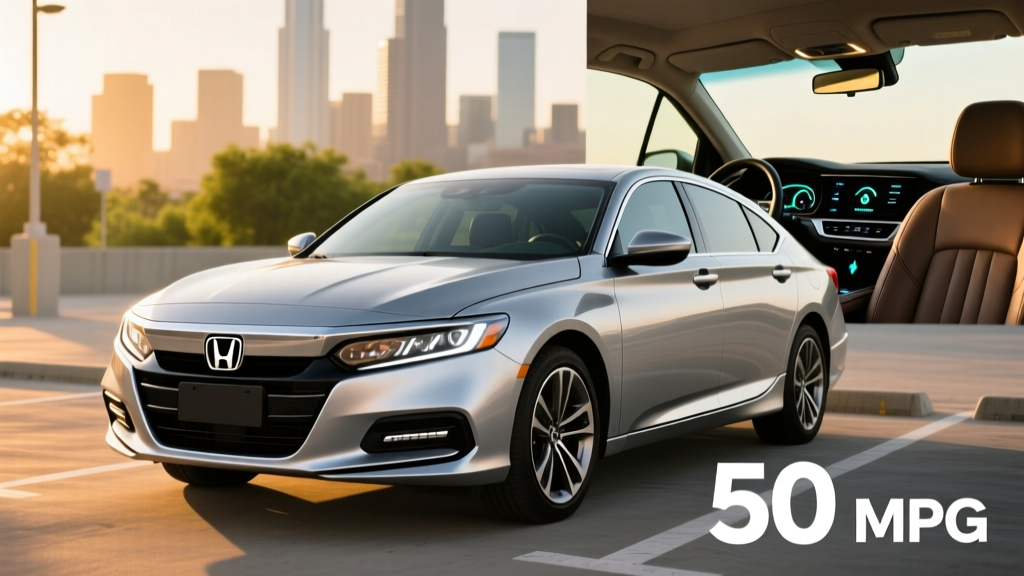
The 2018 Honda Accord Hybrid arrived as part of the tenth-generation Accord redesign, pairing a 2.0-liter Atkinson-cycle engine with a two-motor hybrid system that prioritized efficiency without sacrificing the driving dynamics the Accord nameplate is known for. In 2026, it remains one of the most compelling used hybrid sedans on the market — a practical midsize car that delivers genuine fuel savings with Honda's reputation for powertrain durability. This guide covers everything a used buyer needs to know: real-world MPG, hybrid battery longevity, ownership costs, and how it stacks up against plug-in hybrids and full EVs.
HEV vs PHEV: Where the 2018 Accord Hybrid Fits
Before diving into specs, it's critical to understand what the 2018 Accord Hybrid is — and what it isn't. This is a conventional hybrid electric vehicle (HEV), not a plug-in hybrid (PHEV). That distinction matters for your daily routine and expectations.
| Feature | HEV (2018 Accord Hybrid) | PHEV (e.g., Toyota Prius Prime) | BEV (e.g., Tesla Model 3) |
|---|---|---|---|
| Plug-in charging required? | No — self-charging via regen & engine | Yes — plugs into Level 1/2 | Yes — Level 2 or DC fast charge |
| Electric-only range | ~1-2 miles at low speed | 25-44 miles typical | 250-350+ miles |
| Gasoline engine | Yes (primary power + charging) | Yes (backup after battery depletes) | No |
| Fuel for long trips | Gasoline only | Gasoline after EV range depletes | Electricity only (charging stops) |
| Federal tax credit (§30D) | Not eligible | Up to $7,500 (new, subject to rules) | Up to $7,500 (new, subject to rules) |
| Home charging install needed | No | Recommended (Level 2) | Essential (Level 2) |
The 2018 Accord Hybrid generates all its electricity internally. The gasoline engine and regenerative braking charge the small lithium-ion battery pack. You never plug it in — you simply fill up at a gas station like any conventional car, but the hybrid system significantly reduces how much fuel you burn, especially in city driving.
Fuel Economy: EPA Ratings and Real-World MPG
The headline number for any hybrid buyer is fuel economy, and the 2018 Accord Hybrid delivers competitive figures for a midsize sedan.
| Driving Condition | EPA Rating (MPG) | Real-World Expectation |
|---|---|---|
| City | 47 MPG | 45-50 MPG (hybrids excel in stop-and-go) |
| Highway | 47 MPG | 42-46 MPG (less regen benefit at steady speed) |
| Combined | 48 MPG | 44-48 MPG |
Source: EPA Fuel Economy Guide — 2018 Honda Accord Hybrid
Why Real-World City MPG Often Exceeds EPA
Unlike conventional gas cars, hybrids thrive in city traffic. Every stop becomes an opportunity for regenerative braking to recapture kinetic energy and feed it back into the battery. The engine shuts off at stops, eliminating idle fuel burn. In our experience and owner reports, drivers doing predominantly urban and suburban commuting regularly see 48-52 MPG — sometimes exceeding the EPA sticker. Highway-only driving at 75+ mph will pull that number down to the low-to-mid 40s, as aerodynamic drag dominates and there's less regenerative braking opportunity.
With a 12.8-gallon fuel tank, the 2018 Accord Hybrid offers a theoretical range of roughly 614 miles per tank at the EPA combined figure. Realistically, expect 550-600 miles between fill-ups in mixed driving — a genuine road-trip advantage over most EVs that require charging stops on long routes.
Powertrain Specs: Two-Motor Hybrid System
Honda's hybrid architecture in the 2018 Accord is fundamentally different from Toyota's planetary-gear hybrid system. Honda uses a two-motor setup that operates primarily as a series hybrid at most speeds — meaning the gasoline engine generates electricity that feeds the drive motor, rather than directly turning the wheels.
| Specification | 2018 Honda Accord Hybrid |
|---|---|
| Engine | 2.0L DOHC Atkinson-cycle 4-cylinder |
| Engine horsepower | 143 HP @ 6,200 RPM |
| Engine torque | 129 lb-ft @ 3,500 RPM |
| Electric drive motor | 181 HP / 232 lb-ft |
| Combined system output | 212 HP |
| Transmission | Electronic CVT (e-CVT, no belt) |
| 0-60 MPH | ~7.1 seconds |
| Drivetrain | Front-wheel drive |
| Hybrid battery | 1.3 kWh lithium-ion (NMC chemistry) |
| Curb weight | ~3,300 lbs |
At highway cruising speeds (roughly 65-80 mph), a lock-up clutch engages and the gasoline engine directly drives the front wheels — this is more efficient than converting mechanical energy to electrical and back again. The result is seamless operation that most drivers never notice transitioning between modes.
The 212 combined horsepower gives the Accord Hybrid confident passing power and adequate acceleration for highway merging. It's not a sports sedan, but it's notably quicker than many hybrid competitors from the same era.
Hybrid Battery: Longevity, Warranty, and Replacement Cost
The lithium-ion hybrid battery in the 2018 Accord Hybrid is small — just 1.3 kWh usable capacity — because it doesn't need to store energy for extended electric-only driving. It buffers energy between regenerative braking events and engine-generated electricity. This small capacity and moderate cycling actually works in favor of longevity.
Battery Warranty & Expected Lifespan
- Original factory warranty: 8 years / 80,000 miles (10 years / 150,000 miles in California and CARB-adopting states)
- Capacity retention threshold: Honda covers the battery if it drops below approximately 60-70% of original capacity
- Expected practical lifespan: 150,000-200,000+ miles with normal use based on owner data
- Replacement cost (2026 estimate): $2,000-$4,000 for a refurbished or aftermarket pack; $4,000-$6,000 for a new OEM unit installed at a dealer
For a 2018 model in 2026, the original 8-year/80,000-mile federal warranty has expired for most vehicles. However, if the car was originally sold in California, New York, Massachusetts, or other CARB states, the 10-year/150,000-mile emissions-related hybrid component warranty may still provide coverage depending on mileage.
Hybrid Battery Health Checks for Used Buyers
When evaluating a used 2018 Accord Hybrid, request a hybrid battery state-of-health (SoH) report from a Honda dealer or qualified independent shop. Key indicators to watch:
- Fuel economy trending: If the previous owner tracked MPG and it has dropped significantly below 42 MPG combined, the battery may be degrading.
- Engine running frequency: A degraded hybrid battery forces the engine to run more often to maintain charge, increasing fuel consumption and noise.
- Diagnostic scan: A Honda-specific OBD-II scan can reveal individual cell voltage imbalances — a sign of uneven degradation.
The good news: the 1.3 kWh pack in this generation Accord Hybrid has proven quite robust. Failures before 150,000 miles are uncommon, and the replacement cost is far lower than a full EV battery swap.
Pricing in 2026: What a Used Accord Hybrid Costs
The 2018 Accord Hybrid was offered in four trims: Hybrid (base), EX, EX-L, and Touring. Original MSRPs ranged from approximately $25,990 to $34,990. In the 2026 used market, pricing reflects age, mileage, and trim level.
| Trim | Original MSRP (2018) | Typical Used Price (2026, 60K-90K mi) |
|---|---|---|
| Hybrid (base) | $25,990 | $15,000-$17,500 |
| Hybrid EX | $28,990 | $17,000-$19,500 |
| Hybrid EX-L | $31,490 | $18,500-$21,000 |
| Hybrid Touring | $34,990 | $20,000-$23,500 |
Prices vary by region, condition, accident history, and whether the hybrid battery has been replaced. Touring trims hold value well due to Honda Sensing (standard on all trims), leather, navigation, and premium audio.
Tax Credit Eligibility
The 2018 Honda Accord Hybrid does not qualify for the federal §30D new clean vehicle tax credit — it is a conventional HEV, not a plug-in vehicle. The IRS restricts §30D credits to battery electric vehicles (BEVs) and plug-in hybrids (PHEVs) with a minimum battery capacity of 7 kWh (source: IRS Clean Vehicle Credits).
However, depending on your state, there may be smaller incentives for purchasing a used hybrid or for registering a fuel-efficient vehicle. Check your state's energy or environmental agency for current programs. Some states offer HOV lane access for hybrids, though these perks have largely been phased out or restricted to PHEVs and BEVs.
Reliability Ratings and Ownership Costs
The tenth-generation Accord platform (2018-2022) has earned strong reliability marks across the board. The hybrid variant shares the same fundamental architecture with the added complexity of the two-motor system, which Honda has refined over multiple generations dating back to the early 2000s Insight and Civic Hybrid.
Key reliability notes:
- NHTSA overall safety rating: 5 stars (source: NHTSA 2018 Accord)
- IIHS rating: Top Safety Pick+ when equipped with specific headlights
- Common issues: Some owners report 12V auxiliary battery drain if the car sits for extended periods — a known quirk of hybrid systems that rely on the 12V battery to boot the hybrid control system. Infotainment system responsiveness can lag, a software issue shared with non-hybrid Accords of this generation.
- Maintenance advantage: Hybrids often experience less brake wear due to regenerative braking handling much of the deceleration. Brake pads lasting 80,000-100,000 miles is common. The engine also runs less overall, reducing oil degradation — though Honda still recommends oil changes at the maintenance minder intervals.
Annual maintenance costs for the Accord Hybrid are typically $400-$600, comparable to the gasoline Accord and lower than most European alternatives. Insurance premiums tend to be modestly higher than the gas Accord (roughly 5-10%) due to the hybrid system's repair cost in collision scenarios.
Who Should Choose the 2018 Accord Hybrid Over an EV or PHEV?
Choose the 2018 Accord Hybrid if:
- You don't have access to home or workplace charging (apartment, street parking, no garage)
- You regularly drive 400+ miles in a single day and don't want to plan charging stops
- Your budget is $15,000-$23,000 and you want maximum fuel efficiency in that range
- You want a proven, low-risk ownership experience with widely available service
- You live in a region with extreme cold where EV range loss is a concern
Choose a PHEV (e.g., Prius Prime, Accord's successor PHEV) if:
- You can charge at home and want 25-45 miles of electric-only commuting
- You want to reduce gasoline consumption to near-zero on short daily trips
- You're buying new and can leverage the §30D federal tax credit
Choose a full BEV (e.g., Tesla Model 3, Hyundai Ioniq 6) if:
- You have reliable home Level 2 charging
- Your daily driving is under 250 miles and you're comfortable with road-trip charging planning
- You want to eliminate gasoline entirely and minimize moving parts
- You want access to the latest ADAS features and over-the-air updates
Pros
- 48 MPG EPA combined — real-world city driving often exceeds this
- No charging infrastructure needed — works like a regular gas car
- 212 HP provides confident acceleration for a hybrid sedan
- 600+ mile range per tank eliminates road-trip charging anxiety
- Honda Sensing safety suite standard on all trims
- Spacious cabin with 16.7 cu-ft trunk (hybrid battery doesn't compromise cargo)
- Strong reliability track record and low maintenance costs
Cons
- No electric-only driving range beyond very low-speed creeping
- No federal tax credit eligibility (HEV, not PHEV)
- Infotainment system feels dated by 2026 standards
- Road noise at highway speeds is noticeable (tenth-gen Accord trait)
- Used hybrid battery replacement is a $2,000-$6,000 eventual expense
- No Apple CarPlay/Android Auto on base Hybrid trim (added on EX and above)
Frequently Asked Questions
How many MPG does the 2018 Honda Accord Hybrid get?
The EPA rates the 2018 Accord Hybrid at 47 MPG city, 47 MPG highway, and 48 MPG combined. In real-world driving, city-dominant commuters often see 48-52 MPG thanks to frequent regenerative braking. Highway-only driving at 75+ MPH typically yields 42-46 MPG.
Does the 2018 Accord Hybrid need to be plugged in?
No. The 2018 Accord Hybrid is a conventional hybrid (HEV). It charges its own 1.3 kWh battery through regenerative braking and the gasoline engine. There is no plug and no electric-only driving range to speak of — you fuel it exclusively at gas stations.
Is the 2018 Accord Hybrid reliable, and what does battery replacement cost?
The 2018 Accord Hybrid has a strong reliability record. The hybrid battery typically lasts 150,000-200,000+ miles. If replacement is needed, expect $2,000-$4,000 for a refurbished pack or $4,000-$6,000 for a new OEM battery installed at a Honda dealer. The original 8-year/80,000-mile hybrid warranty has expired for most 2018 models by 2026, though CARB-state vehicles may have extended coverage up to 10 years/150,000 miles.
Does the 2018 Accord Hybrid qualify for any tax credit?
No. The federal §30D clean vehicle tax credit applies only to plug-in vehicles (BEVs and PHEVs) with at least 7 kWh of battery capacity. The Accord Hybrid's 1.3 kWh pack makes it ineligible. Some states may offer minor incentives for fuel-efficient used vehicles — check your state's energy office.
How does the Accord Hybrid compare to a full EV for daily commuting?
If you can charge at home, a full EV will cost less per mile to "fuel" (roughly $0.04-$0.06/mile on electricity vs. $0.08-$0.10/mile on gasoline at 48 MPG with $3.50/gal). However, the Accord Hybrid eliminates charging dependency entirely, offers 600+ mile range, and costs significantly less upfront on the used market. For apartment dwellers or high-mileage road-trippers, the hybrid's convenience advantage is substantial.
What's the difference between the 2018 Accord Hybrid and the newer Accord Hybrid (2023+)?
The 2023+ Accord Hybrid uses Honda's fourth-generation two-motor system with improved refinement, slightly better fuel economy (up to 51 MPG combined on some trims), and updated infotainment. However, used 2023+ models command $28,000-$38,000+, making the 2018 model a strong value proposition at roughly half the price with similar core efficiency.