Quick Verdict: A Mature Midsize Hybrid Sedan Worth Considering Used
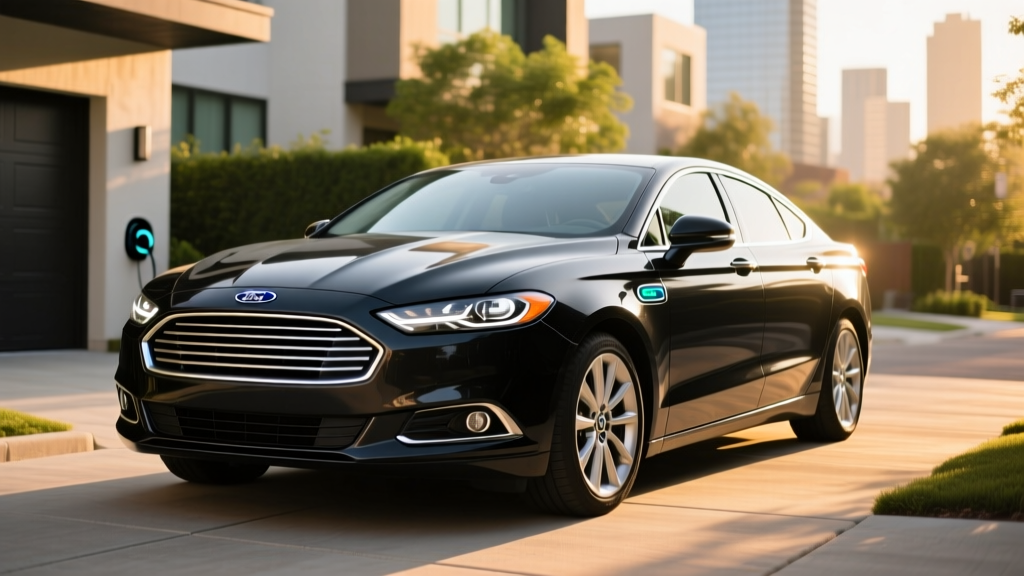
The 2018 Ford Fusion Hybrid Titanium sits near the top of Ford's hybrid sedan lineup — a well-equipped, comfortable midsize sedan that prioritizes fuel efficiency without sacrificing the premium touches buyers expect from a Titanium trim. With an EPA-rated 42 MPG combined, a proven 2.0L Atkinson-cycle powertrain, and a relatively simple 1.4 kWh battery pack, this is one of the lower-risk used hybrids on the market in 2026.
But before you pull the trigger on a used example, you need the real numbers: actual fuel economy in mixed driving, the state of the high-voltage battery after 7–8 years of service, what a replacement costs, and how this car stacks up against newer hybrids and full EVs. This guide covers all of it.
2018 Ford Fusion Hybrid Titanium: Core Specifications
| Spec | Value |
|---|---|
| Powertrain | 2.0L Atkinson-cycle I4 + electric motor (eCVT) |
| Combined Horsepower | 188 hp (net system) |
| Engine Output | 141 hp @ 6000 rpm / 129 lb-ft torque |
| Electric Motor Output | 118 hp / 117 lb-ft torque |
| Hybrid Battery | 1.4 kWh lithium-ion (NMC chemistry) |
| EPA Fuel Economy | 43 city / 41 highway / 42 combined MPG |
| Fuel Tank | 13.5 gallons |
| Total Range | ~567 miles (EPA est.) |
| 0–60 mph | ~8.5 seconds (est.) |
| Drivetrain | Front-wheel drive |
| Cargo Volume | 12.0 cu ft (trunk; battery intrudes slightly) |
| Original MSRP (Titanium) | ~$33,120 (before options) |
| 2026 Used Price Range | $11,000–$17,500 (depending on mileage/condition) |
Sources: fueleconomy.gov, Ford Motor Company 2018 specifications.
Fuel Economy: EPA Ratings vs Real-World MPG
The EPA rates the 2018 Fusion Hybrid at 43 city / 41 highway / 42 combined MPG. That city-heavy advantage is typical of conventional hybrids — regenerative braking recovers energy in stop-and-go driving that a gas car simply wastes as heat.
| Driving Scenario | EPA Rating | Real-World Expectation |
|---|---|---|
| City | 43 MPG | 42–47 MPG (hybrids often exceed EPA in city) |
| Highway (70+ mph) | 41 MPG | 36–40 MPG (aero drag reduces regen benefit) |
| Combined (mixed) | 42 MPG | 38–44 MPG |
| Cold Weather (below 32°F) | — | 33–38 MPG (engine runs more for cabin heat) |
Owner-reported data on forums and fuel-tracking apps consistently shows real-world combined figures in the 39–44 MPG range. Drivers who do mostly suburban and city driving at moderate speeds often report exceeding the EPA city number. Sustained highway driving at 75+ mph, however, will pull the average down to the mid-to-high 30s — this is physics, not a flaw. Hybrids lose their regenerative advantage when there's little braking to do.
Cold weather hits all hybrids harder than gas-only cars. The engine must run more frequently to provide cabin heat (there's no electric resistance heater powerful enough to warm the cabin alone in deep cold), and the battery's charge/discharge efficiency drops. Expect a 10–15% fuel economy penalty in sub-freezing conditions.
Powertrain Deep Dive: How the Fusion Hybrid Drives
The 2018 Fusion Hybrid pairs a 2.0-liter Atkinson-cycle inline-four (141 hp, 129 lb-ft) with a permanent-magnet electric motor (118 hp, 117 lb-ft) through Ford's eCVT — an electronically controlled continuously variable transmission that uses a planetary gearset rather than a belt or chain. Net system output is 188 hp.
The Atkinson cycle is key to hybrid efficiency: it keeps the intake valve open slightly longer during the compression stroke, effectively reducing pumping losses and improving thermal efficiency at the cost of peak power density. The electric motor fills in the low-end torque gap that the Atkinson cycle creates, resulting in smooth, linear acceleration from a stop.
In practice, the Fusion Hybrid Titanium feels composed and adequate for daily driving. The 0–60 mph time of approximately 8.5 seconds won't win any drag races, but it's competitive with other midsize hybrid sedans and perfectly sufficient for highway merging. The eCVT eliminates shift shock entirely — acceleration is a smooth, continuous ramp. Engine noise under hard acceleration is the typical CVT drone, but Ford's sound insulation in the Titanium trim keeps it reasonable.
The Titanium trim adds features over the lower SE Hybrid: standard leather-trimmed seats, a 12-speaker Sony audio system, navigation, heated front seats, ambient lighting, and Ford's SYNC 3 infotainment system with an 8-inch touchscreen. It's a genuinely well-appointed cabin for a used hybrid sedan.
Hybrid Battery: Size, Degradation, Warranty, and Replacement Cost
The Fusion Hybrid uses a 1.4 kWh lithium-ion battery pack (NMC chemistry). That's a small pack by modern standards — for context, a PHEV like the Fusion Energi used 7.6 kWh, and a full BEV like the Ford Mustang Mach-E uses 70–91 kWh. But for a conventional hybrid, 1.4 kWh is appropriate. The battery never fully charges or fully depletes; the hybrid system keeps it in a narrow state-of-charge window (roughly 40–60%) to maximize longevity.
This shallow-cycling strategy is why hybrid batteries tend to last far longer than phone or laptop batteries. Real-world data from fleet operators and high-mileage owners shows the Fusion Hybrid battery typically retains 85–92% of its original capacity at 100,000 miles. Capacity loss of this magnitude is virtually imperceptible in daily driving — the hybrid system simply adjusts its charge/discharge strategy.
If the battery does fail outside warranty, replacement costs in 2026 run approximately:
- OEM replacement (Ford dealer): $3,000–$4,000 (battery + labor)
- Aftermarket/remanufactured: $1,500–$2,500 (battery + labor)
- Individual cell/module repair: $500–$1,200 (specialist hybrid shops can replace only degraded modules)
The good news: outright hybrid battery failure on the 2018 Fusion Hybrid is uncommon. The more typical age-related issue is gradual capacity fade that slightly reduces the time the car can spend in EV-only mode at low speeds — but this rarely affects overall fuel economy by more than 1–2 MPG.
Does the 2018 Fusion Hybrid Qualify for Any Tax Credit?
No. The 2018 Ford Fusion Hybrid does not qualify for the federal §30D new clean vehicle credit — that credit applies only to new vehicle purchases, and the Fusion Hybrid was never eligible even when new because conventional HEVs (non-plug-in) do not meet the §30D battery capacity and plug-in requirements.
For used buyers in 2026, the relevant credit is the §25E previously owned clean vehicle credit, which offers up to $4,000 (or 30% of the sale price, whichever is less) on eligible used EVs and PHEVs. However, conventional hybrids (HEVs) are not eligible for §25E either. Only plug-in vehicles (BEVs and PHEVs with at least 7 kWh of battery capacity) qualify.
If tax credits are a priority, you'd need to look at a used PHEV (like the Fusion Energi, if you can find one with sufficient battery capacity and that meets the §25E requirements) or a used BEV. Always verify current credit eligibility on irs.gov and consult a tax professional — income caps and vehicle eligibility rules apply.
Fusion Hybrid vs Fusion Energi vs Full EV: Which Fits You?
Ford sold three electrified Fusion variants in 2018. Here's how they compare and who each one serves:
| Attribute | Fusion Hybrid (HEV) | Fusion Energi (PHEV) | Full EV (e.g., Tesla Model 3) |
|---|---|---|---|
| Plugs in? | No | Yes (Level 1/2 only) | Yes (Level 1/2/DC) |
| Battery Size | 1.4 kWh | 7.6 kWh | 50–82 kWh |
| EV-Only Range | ~1 mile (low speed) | 22 miles (EPA) | 250–350 miles |
| Combined MPG/MPGe | 42 MPG | 42 MPG (gas) / 97 MPGe (electric) | 120–140 MPGe |
| Total Range | ~567 miles | ~610 miles | 250–350 miles |
| Home Charging Needed? | No | Recommended (to use EV range) | Essential |
| 2026 Used Price | $11K–$17.5K | $10K–$15K | $18K–$30K+ |
Decision Framework
Choose the Fusion Hybrid (HEV) if: You want maximum simplicity — no plug, no charging infrastructure, no range planning. You drive 10,000–15,000 miles per year in mixed city/highway conditions and want 40+ MPG without changing any habits. You rent or live somewhere you can't install a charger.
Choose the Fusion Energi (PHEV) if: Your daily commute is under 20 miles round-trip and you can charge at home overnight. You'll do most daily driving on electricity (cheap, smooth) but still want the gas engine for road trips. Note: the Energi's smaller trunk (8.2 cu ft vs 12.0) is a real compromise.
Choose a full EV if: You have reliable home charging, your daily driving is under 250 miles, and you want the lowest per-mile fuel cost and minimal maintenance. A used Model 3, Chevy Bolt, or Hyundai Ioniq 5 offers dramatically lower running costs — but requires charging infrastructure.
Reliability, Ownership Costs, and What to Watch For
The 2018 Fusion Hybrid has a solid reliability record. The 2.0L Atkinson-cycle engine is a low-stress design that avoids the complexity of turbocharging, direct injection (it uses port injection, which avoids carbon buildup issues), and high-compression ratios. The eCVT planetary gearset has no belts, clutches, or friction bands to wear out — it's one of the most durable transmission designs in the industry.
Common issues reported by owners and tracked by NHTSA include:
- 12V battery drain: Like many modern cars, the Fusion Hybrid can drain its 12V accessory battery if left sitting for extended periods. This is the conventional under-hood battery, not the hybrid pack — replacement is a standard ~$200 affair.
- SYNC 3 infotainment glitches: Occasional touchscreen freezes or Bluetooth connectivity drops. Usually resolved with software updates or a master reset.
- Brake actuator recall: Ford issued a recall for certain 2013–2018 Fusion Hybrids related to the brake system's hydraulic control unit. Verify all recalls have been performed by checking the VIN at nhtsa.gov/recalls.
- Coolant intrusion (2.0L engine): Some 2.0L EcoBoost engines from this era had coolant intrusion issues, but the Hybrid's naturally aspirated Atkinson-cycle version is not affected by this specific problem.
Maintenance costs are lower than a comparable gas-only sedan. Regenerative braking significantly extends brake pad life (many owners report 80,000+ miles on original pads). There's no conventional automatic transmission fluid to change at short intervals. Oil changes are still required but the engine runs less frequently, so some owners stretch intervals slightly (follow Ford's oil-life monitor).
Pros and Cons of the 2018 Fusion Hybrid Titanium
Pros
- 42 MPG combined EPA; real-world city often exceeds 43 MPG
- Titanium trim is well-equipped: leather, Sony audio, nav, heated seats
- Smooth, quiet eCVT with no shift shock
- No plug-in required — zero behavior change from a gas car
- Proven, low-stress powertrain with low maintenance costs
- Extended brake pad life from regen braking
- Competitive 2026 used pricing ($11K–$17.5K)
Cons
- No federal or state tax credit eligibility (HEV)
- Trunk reduced to 12.0 cu ft (battery pack intrusion)
- Highway MPG drops to mid-30s at sustained 75+ mph
- Cold-weather fuel economy penalty of 10–15%
- ~8.5 second 0–60 is adequate, not quick
- Discontinued model — no new parts pipeline growth
- Most 2018 examples now past 8-year hybrid battery warranty
- SYNC 3 infotainment feels dated vs 2026 systems
Frequently Asked Questions
How many MPG does the 2018 Ford Fusion Hybrid actually get?
The EPA rates it at 43 city / 41 highway / 42 combined MPG. In real-world driving, expect 38–44 MPG combined depending on your driving mix. City-heavy commutes often push above 43 MPG thanks to regenerative braking. Sustained highway driving at high speeds pulls it into the mid-to-high 30s. Cold weather (below freezing) typically drops it to 33–38 MPG due to increased engine runtime for cabin heating.
How far can the Fusion Hybrid go on electric power alone?
Not far — approximately 0.5 to 1 mile at very low speeds (under 25 mph) on a fully charged hybrid battery. This is a conventional HEV with a 1.4 kWh battery; it's not designed for meaningful electric-only driving. The electric motor's primary role is to assist the gas engine, smooth acceleration, and enable engine-off coasting — not to replace the engine. If you want real electric-only range, look at the Fusion Energi PHEV (22 miles EV) or a full BEV.
Is the 2018 Fusion Hybrid reliable, and what does a battery replacement cost?
Yes, reliability is a strong point. The 2.0L Atkinson-cycle engine and planetary-gear eCVT are both low-stress, proven designs with minimal failure points. The hybrid battery is designed to last the life of the vehicle under normal use, with most packs retaining 85–92% capacity at 100,000 miles. If replacement is needed outside warranty, expect $1,500–$4,000 depending on whether you use an aftermarket/remanufactured unit or go OEM through a Ford dealer. Module-level repair at a hybrid specialist can cost as little as $500–$1,200.
Does the 2018 Fusion Hybrid qualify for any tax credit in 2026?
No. Conventional hybrids (HEVs) are not eligible for the federal §30D new vehicle credit or the §25E used vehicle credit — both require plug-in capability and minimum battery capacity thresholds. The Fusion Hybrid was never eligible for federal credits even when new. Some states offered their own hybrid incentives historically, but most have expired or shifted to plug-in vehicles. Check your state's energy office for any remaining programs, but don't count on it.
Should I buy the Fusion Hybrid or the Fusion Energi (PHEV)?
It depends on your charging access. If you can install a Level 2 charger at home and your daily commute is under 20 miles, the Energi's 22-mile electric-only range means you'll do most daily driving on electricity (~4¢/mile vs ~10¢/mile on gas). The trade-off: the Energi's trunk is only 8.2 cu ft (vs 12.0 for the Hybrid), and its larger battery adds weight. If you can't charge at home, the standard Hybrid is the clear choice — a PHEV you never plug in is just a heavier, less efficient hybrid.
How long will the hybrid battery last?
Ford designed the 1.4 kWh pack for a 10–15 year service life under normal driving. The hybrid system's shallow-cycling strategy (keeping the battery between ~40–60% state of charge) minimizes degradation. Many Fusion Hybrids have reached 150,000–200,000 miles on the original battery. Heat is the primary degradation accelerator — if you live in a very hot climate (Arizona, Texas), the battery may degrade slightly faster, but the active thermal management system mitigates this.
What should I check before buying a used 2018 Fusion Hybrid?
Have a pre-purchase inspection done by a mechanic familiar with hybrids. Key items: (1) Check the hybrid battery state of health via an OBD-II scanner that reads Ford hybrid parameters — look for capacity above 80%. (2) Verify all open recalls have been completed, especially the brake system recall. (3) Check the 12V battery age — if it's over 4 years old, budget for replacement. (4) Test the regenerative braking feel — it should be smooth and progressive, not grabby or inconsistent. (5) Confirm the maintenance history, particularly oil change intervals.
For official fuel economy data, always cross-reference at fueleconomy.gov. For recall and safety information, check your specific VIN at nhtsa.gov.