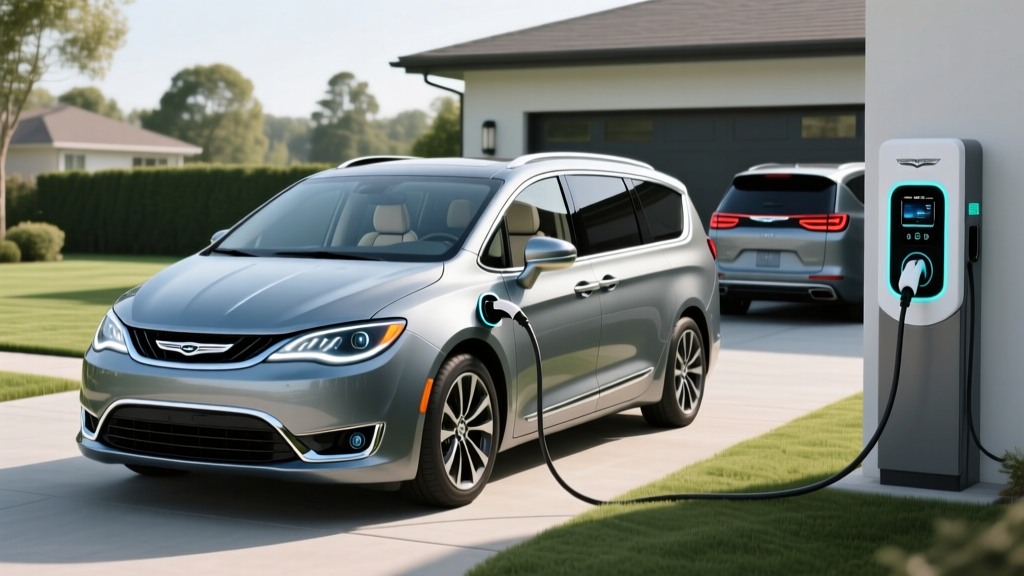
The 2018 Chrysler Pacifica Hybrid occupies a specific niche that still matters in 2026: it's a three-row minivan that can handle school runs and grocery trips on electricity alone, then burn gasoline on a 500-mile road trip without a single charging stop. As a plug-in hybrid electric vehicle (PHEV), it bridges the gap between a conventional hybrid and a full battery-electric vehicle — and for families without reliable home charging access or those who regularly exceed 200 miles in a day, that bridge is still the most practical option on the used market.
This guide covers the 2018 Pacifica Hybrid's real-world efficiency, battery longevity, used-market pricing, and whether it still makes financial sense compared to newer PHEVs or full EVs in 2026.
HEV vs PHEV: Where the Pacifica Hybrid Fits
The 2018 Pacifica Hybrid is a plug-in hybrid (PHEV), not a conventional hybrid (HEV). The distinction matters for daily driving and fuel costs:
| Feature | Conventional Hybrid (HEV) | Plug-In Hybrid (PHEV) |
|---|---|---|
| Plugs in to charge? | No — charges via regenerative braking and engine | Yes — has a larger battery you plug in |
| Electric-only range | 0–2 miles at low speed | 20–40+ miles (Pacifica: 32 mi EPA) |
| Battery size | 1–2 kWh | 16 kWh (Pacifica Hybrid) |
| Daily short-trip fuel use | Still burns some gas | Zero gas if trips stay within EV range |
| Long-trip fallback | Gasoline engine | Gasoline engine (no range anxiety) |
The Pacifica Hybrid's 16 kWh battery pack gives it a meaningful electric-only envelope. Most families' daily driving — school drop-off, errands, commute — falls under 30 miles. Charge it overnight and you may not visit a gas station for weeks. When you do need the 3.6-liter V6, it's there, giving the Pacifica Hybrid a total combined range of roughly 566 miles (32 electric + 534 gasoline).
EPA Fuel Economy and Real-World MPG
The EPA rates the 2018 Chrysler Pacifica Hybrid as follows:
| Mode | City | Highway | Combined |
|---|---|---|---|
| Charge-depleting (EV mode) | 84 MPGe combined | ||
| Charge-sustaining (hybrid/gas mode) | 29 MPG | 30 MPG | 30 MPG |
One advantage PHEVs share with all electrified vehicles: city driving often beats the EPA estimate because regenerative braking recaptures energy in stop-and-go traffic. If your commute is mostly urban, expect gas-mode MPG to lean toward the higher end of the range.
Powertrain, Battery, and Charging Specs
| Specification | 2018 Chrysler Pacifica Hybrid |
|---|---|
| Engine | 3.6L V6 Atkinson-cycle |
| Electric motors | Dual motor eFlite EVT (2 motors) |
| Combined system horsepower | 260 hp |
| Battery capacity | 16 kWh lithium-ion (NMC chemistry) |
| Usable battery capacity | ~12.5 kWh (buffer protects longevity) |
| EPA electric-only range | 32 miles |
| Total combined range | ~566 miles (EV + gas) |
| Fuel tank | 16.5 gallons |
| Level 1 charging (120V) | ~14 hours (0–100%) |
| Level 2 charging (240V) | ~2 hours (0–100%) at 6.6 kW |
| DC fast charging | Not supported |
| 0–60 mph | ~8.1 seconds |
| Towing capacity | Not rated (PHEV trims do not support towing) |
| Cargo volume (behind 3rd row) | 32.3 cu ft (battery reduces under-floor storage) |
Charging reality: The Pacifica Hybrid tops out at 6.6 kW on Level 2 AC charging and has no DC fast-charge capability. This is standard for PHEVs — the battery is small enough that overnight Level 2 charging is sufficient. On a 240V home charger (the kind you'd install for any EV), a full charge takes about 2 hours. On a standard 120V household outlet, expect roughly 14 hours, meaning you'd need to plug in every evening to guarantee a full battery by morning.
The 16 kWh battery uses NMC (nickel manganese cobalt) chemistry, which offers higher energy density than LFP but is more sensitive to sustained high-state-of-charge storage. Chrysler's software buffer — only allowing access to roughly 12.5 kWh of the 16 kWh pack — is a deliberate degradation-mitigation strategy.
Battery Warranty, Lifespan, and Replacement Cost
Is the 2018 Pacifica Hybrid reliable? The Pacifica Hybrid's powertrain has proven generally durable, but there are known issues worth investigating on a used example:
- High-voltage battery recall (2020): Chrysler recalled certain 2017–2019 Pacifica Hybrids for a potential battery cell defect that could cause a fire risk, even when parked. Verify that any used 2018 model has had recall repair T20 (or applicable TSB) completed. Check the VIN at NHTSA.gov/recalls.
- 12V auxiliary battery: Like many PHEVs and EVs, the Pacifica Hybrid has had reports of 12V battery drain issues. The 12V battery powers electronics and must be healthy for the high-voltage system to engage.
- EVT transmission: The dual-motor electrically variable transmission is simpler than a conventional automatic, but repairs are specialized and costly if needed.
Battery replacement cost: If the high-voltage battery fails out of warranty, replacement runs approximately $5,500–$8,000 for the battery pack alone, with total installed cost potentially reaching $9,000–$12,000 including labor at a dealer. Independent EV shops may offer refurbished pack replacements for less. This is a meaningful cost on a used minivan and should factor into any purchase decision — a pre-purchase inspection by a technician familiar with Chrysler PHEV systems is strongly recommended.
Used Pricing in 2026 and Tax Credit Eligibility
The 2018 Pacifica Hybrid originally started at an MSRP of approximately $41,995 (Touring L Hybrid) and could reach $48,000+ in Limited or Platinum trims. When new, it qualified for the full $7,500 federal tax credit under pre-2023 rules.
In the 2026 used market, expect to pay:
- Touring L Hybrid (base): $14,000–$19,000 depending on mileage and condition
- Limited Hybrid: $17,000–$23,000
- Platinum Hybrid (top trim): $20,000–$26,000
Federal used-EV tax credit (§25E): Under current IRS rules, a used 2018 Pacifica Hybrid purchased from a licensed dealer may qualify for a used clean vehicle credit of up to $4,000 (30% of the sale price, capped at $4,000). Key requirements from the IRS used-vehicle credit page:
- Sale price must be $25,000 or less
- Buyer adjusted gross income: ≤$75,000 single / $112,500 head of household / $150,000 joint
- Vehicle must be purchased from a licensed dealer (private sales excluded)
- Vehicle must be at least 2 model years old (2018 qualifies in 2026)
- Credit is non-refundable but can be transferred to the dealer as a point-of-sale discount
- You cannot have claimed the used-EV credit more than once in the prior 3 years
At typical used prices, a well-equipped 2018 Pacifica Hybrid Limited priced at $20,000 from a dealer could yield a $4,000 credit, bringing the effective cost to $16,000 — a significant value for a three-row PHEV minivan.
Who Should Buy This PHEV vs a Full EV or Gas Minivan
- 32 miles electric covers most daily family driving
- No range anxiety — gas engine provides 534+ additional miles
- Three-row seating with Stow 'n Go second-row seats (though PHEV loses under-floor storage)
- Used prices have dropped significantly; potential $4,000 federal credit
- Smooth, quiet EV-mode driving in town
- No DC fast-charging dependency — Level 2 at home is sufficient
- No DC fast charging limits road-trip EV-mode utility
- Battery recall history — must verify repair completion
- Battery is 8 years old; out-of-warranty replacement is $5,500–$12,000
- Cannot tow (PHEV variant is not tow-rated)
- Reduced under-floor cargo space vs gas Pacifica (battery occupies the spare-tire well)
- Older infotainment and fewer ADAS features vs 2024+ minivans
- You have home Level 2 charging and most daily driving is under 30 miles
- You need three rows but can't commit to a full EV due to road-trip frequency or charging-desert concerns
- You want to reduce fuel costs without the $45,000+ price of a new PHEV or EV minivan
- You're in a CARB state where battery warranty may still have 2 years remaining
- You want zero gasoline maintenance and have reliable charging
- Your daily driving is predictable and within EV range
- You want the latest safety tech and infotainment
- You can't charge at home (a PHEV you never plug in is just a heavy, less-efficient hybrid)
- You tow regularly (the Sienna Hybrid tows up to 3,500 lbs; the Pacifica Hybrid tows 0)
- You want to avoid the battery-replacement risk of an 8-year-old PHEV pack
Ownership Costs: 5-Year Outlook for a Used 2018 Pacifica Hybrid
Assuming a purchase price of $18,000 (after potential $4,000 credit), 12,000 miles/year, and 70% of daily driving within electric range, here's a realistic 5-year cost sketch:
| Cost Category | Estimated 5-Year Total |
|---|---|
| Purchase price (after credit) | $18,000 |
| Electricity (charging ~70% of miles at $0.14/kWh) | $2,100 |
| Gasoline (~30% of miles, 30 MPG, $3.40/gal avg) | $2,450 |
| Maintenance (oil changes, brakes, tires, fluids) | $3,500 |
| Insurance (PHEV minivan avg) | $7,500 |
| Potential battery replacement risk | $0–$10,000 (warranty-dependent) |
| Total (without battery failure) | ~$33,550 |
The biggest variable is battery health. If the pack retains adequate capacity (check via an OBD-II scanner tool like an OBDLink MX+ paired with an app such as Hybrid Assistant), the Pacifica Hybrid is an economical family hauler. If the battery degrades significantly or fails, the replacement cost can erase years of fuel savings.
Frequently Asked Questions
How many MPG does the 2018 Chrysler Pacifica Hybrid get?
The EPA rates it at 84 MPGe in charge-depleting (electric) mode and 30 MPG combined (29 city / 30 highway) in charge-sustaining hybrid mode. Real-world gas-mode MPG typically falls between 27–31 depending on driving style and conditions.
How far can the 2018 Pacifica Hybrid go on electric only?
The EPA estimates 32 miles of electric-only range. In real-world warm-weather driving, expect 25–30 miles. In cold weather (below 35°F), expect 18–22 miles due to battery resistance and cabin heating demand.
Hybrid vs PHEV vs EV — which fits my family?
A PHEV like the Pacifica Hybrid suits families who can charge at home and drive under 30 miles daily but also take regular long road trips. A conventional HEV (like the Toyota Sienna Hybrid) is better if you can't plug in at home. A full EV makes sense if your daily range needs are predictable, you have reliable charging, and you want to eliminate gasoline costs and maintenance entirely.
Is the 2018 Pacifica Hybrid reliable and what does a battery replacement cost?
The powertrain is generally reliable, but verify the high-voltage battery recall (NHTSA recall T20) has been addressed. The battery is warranted for 8–10 years / 100,000 miles depending on state. Out-of-warranty replacement runs $5,500–$12,000 installed. A pre-purchase inspection and battery health check are essential.
Does a used 2018 Pacifica Hybrid qualify for any tax credit in 2026?
It may qualify for the federal used clean vehicle credit (§25E) of up to $4,000 if purchased from a licensed dealer for $25,000 or less, and if your income falls within IRS limits ($75K single / $150K joint). Consult a tax professional or the IRS to confirm eligibility, as rules are subject to change.
Can I DC fast-charge the Pacifica Hybrid on a road trip?
No. The 2018 Pacifica Hybrid supports only Level 1 (120V) and Level 2 (240V, up to 6.6 kW) AC charging. There is no DC fast-charge port. On road trips, the vehicle operates in hybrid mode using the gasoline engine.
Does the Pacifica Hybrid have Stow 'n Go seating?
Second-row seats fold flat (Stow 'n Go), but the under-floor storage bins in the rear are eliminated by the battery pack. Third-row seats still fold flat. Cargo capacity behind the third row is 32.3 cu ft — competitive but slightly reduced versus the gas Pacifica.