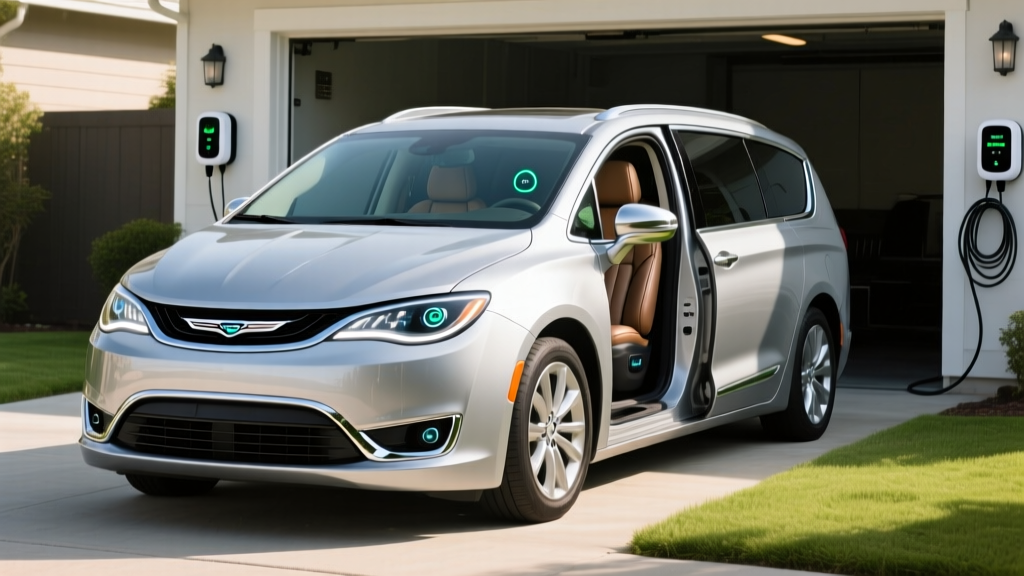
The 2018 Chrysler Pacifica Hybrid holds a unique position in the minivan segment: it remains the only plug-in hybrid minivan ever sold in the United States. For families shopping the used market, understanding the 2018 Chrysler Pacifica Hybrid fuel economy — both its EPA ratings and what you'll actually see in daily driving — is critical before signing on the dotted line. This guide breaks down every efficiency number, battery spec, and ownership cost you need to evaluate this PHEV minivan in 2026.
| Spec | 2018 Pacifica Hybrid |
|---|---|
| Powertrain | 3.6L V6 + dual-motor e-CVT (PHEV) |
| Combined Horsepower | 260 hp |
| Battery Capacity | 16 kWh (usable ~13 kWh), NMC lithium-ion |
| EPA Electric-Only Range | 33 miles |
| EPA Combined MPGe (EV mode) | 84 MPGe |
| EPA MPG (gas-only, combined) | 32 MPG (29 city / 30 hwy) |
| Total Combined Range | ~566 miles |
| Level 2 Charge Time (0–100%) | ~2 hours at 6.6 kW |
| Level 1 Charge Time (0–100%) | ~14 hours at 120V |
| DC Fast Charging | Not supported |
| Fuel Tank | 14.0 gallons |
| Battery Warranty (original) | 10 years / 100,000 miles |
HEV vs PHEV: What the Pacifica Hybrid Actually Is
Before digging into the numbers, it's essential to clarify a common point of confusion. The Chrysler Pacifica is available in two distinct forms: a conventional gas-only model (which Chrysler discontinued after 2023) and the Pacifica Hybrid, which is a plug-in hybrid electric vehicle (PHEV). These are fundamentally different powertrains.
| Feature | Conventional Hybrid (HEV) | Plug-In Hybrid (PHEV) |
|---|---|---|
| Plugs in to charge? | No — charges via regen & engine | Yes — plug in for full battery |
| Electric-only driving? | Very short, low-speed only | Yes, 20–40+ miles typical |
| Battery size | 1–2 kWh | 10–25 kWh typical |
| Example | Toyota Sienna Hybrid | Chrysler Pacifica Hybrid |
The Pacifica Hybrid is a PHEV. That means you can plug it in to charge the 16 kWh battery and drive up to 33 miles on electricity alone. If you never plug it in, it still operates as a hybrid using its gasoline engine and regenerative braking — but you'd be leaving its best efficiency on the table.
2018 Chrysler Pacifica Hybrid Fuel Economy: EPA Numbers vs Real World
According to fueleconomy.gov, the 2018 Pacifica Hybrid carries these official EPA ratings:
| Mode | City | Highway | Combined |
|---|---|---|---|
| Electric-only (MPGe) | 84 MPGe | 84 MPGe | 84 MPGe |
| Gasoline-only (MPG) | 29 MPG | 30 MPG | 32 MPG |
Real-world expectations: PHEVs are highly sensitive to driving habits and charging discipline. Owners who plug in nightly and commute under 30 miles round-trip report routinely using zero gasoline for weeks, with the engine only kicking on for longer trips or when the HVAC demands extra heat in winter. In gas-only mode — once the battery is depleted — expect roughly 27–30 MPG in mixed suburban driving and closer to 25–27 MPG on sustained highway trips at 70+ mph. The minivan's 4,800+ lb curb weight and boxy aerodynamics work against it at speed.
Range Reality Check: EPA rates the Pacifica Hybrid at 33 miles electric-only. In warm weather with moderate speeds, 30–35 miles is achievable. In cold weather (below 35°F), expect that to drop to 22–26 miles as the battery loses efficiency and cabin heating draws additional energy. Total range of ~566 miles assumes a full charge plus a full 14-gallon tank — a realistic road-trip figure is closer to 470–510 miles.
Battery, Charging, and Powertrain Details
The 2018 Pacifica Hybrid pairs a naturally aspirated 3.6-liter Pentastar V6 (running an Atkinson cycle for efficiency) with a dual-motor e-CVT transmission. Combined output is 260 horsepower. The two electric motors can drive the front wheels independently in EV mode or assist the gas engine during hybrid operation.
The 16 kWh lithium-ion battery pack (NMC chemistry, with roughly 13 kWh usable) is mounted under the second-row floor. This placement preserves the Stow 'n Go third-row seating but eliminates the ability to fold the second-row seats into the floor — a notable trade-off versus the gas-only Pacifica.
Charging options are limited to AC:
- Level 1 (120V household outlet): ~14 hours from empty to full at roughly 1.2 kW. Practical only for overnight top-offs if you drive short distances.
- Level 2 (240V, J1772 connector): ~2 hours from empty to full at 6.6 kW. This is the practical daily charging method and easily replenishes the battery overnight or during a workday.
- DC Fast Charging: Not available. The Pacifica Hybrid has no CCS or CHAdeMO port. You cannot use DC fast chargers.
For a PHEV with a 16 kWh battery, the lack of DC fast charging is a minor limitation. Most PHEV owners charge at home or work, and the 6.6 kW Level 2 rate is generous for this battery size — faster than many competing PHEVs of the same era.
Battery Longevity, Warranty, and Replacement Cost
Original Battery Warranty: 10 years / 100,000 miles (whichever comes first), with a capacity retention threshold of 70%. This warranty was federally mandated and applies to the original vehicle regardless of ownership transfers in most states. California and states adopting CARB standards extended this to 10 years / 150,000 miles.
As of 2026, a 2018 model is 8 years old, meaning most examples still carry some remaining factory battery warranty — a critical factor for used buyers. Chrysler's PHEV battery degradation has generally been modest; owner reports on forums and NHTSA complaint databases show relatively few battery-related failures for this generation.
Battery replacement cost: If the battery fails outside of warranty, a new OEM replacement pack for the Pacifica Hybrid typically runs between $5,500 and $8,500 including parts and labor. Some independent hybrid-battery shops offer refurbished packs for $3,000–$4,500. Before buying used, request a battery state-of-health (SoH) readout from a Chrysler dealer — this diagnostic shows remaining capacity as a percentage of original.
Is the Pacifica Hybrid reliable? The 2018 model year was the second year of the PHEV variant (introduced for 2017), and early-production units had more software-related issues than mechanical ones. Chrysler issued several recalls and technical service bulletins (TSBs) addressing inverter cooling system leaks and software calibration for the powertrain control module. Verify that all recall work has been completed — check the VIN on nhtsa.gov/recalls before purchasing.
Tax Credit Eligibility for Used Buyers in 2026
When new, the 2018 Pacifica Hybrid qualified for the full $7,500 federal tax credit under the previous §30D rules. That ship has sailed for new purchases. However, used buyers in 2026 can potentially benefit from the Used Clean Vehicle Credit (IRS §25E), which offers up to $4,000 or 30% of the sale price (whichever is less) for qualifying pre-owned EVs and PHEVs.
§25E Used EV Credit Requirements:
- Sale price must be $25,000 or less
- Buyer income caps: $75,000 single / $112,500 head of household / $150,000 joint (modified AGI)
- Vehicle must be at least 2 model years old (2018 qualifies)
- Must purchase from a licensed dealer (private-party sales excluded)
- Vehicle must have a battery capacity of at least 7 kWh (Pacifica's 16 kWh qualifies)
- Credit is 30% of sale price, up to $4,000 maximum
- Can be claimed once per vehicle VIN (check if prior owner already claimed it)
For a used 2018 Pacifica Hybrid selling in the $18,000–$24,000 range in 2026, the credit could amount to $4,000 (if priced at or above ~$13,334). This is claimed as a nonrefundable tax credit on your federal return. Consult a tax professional and review current IRS guidance on §25E to confirm your eligibility, as rules can shift.
Note: There is no federal tax credit for conventional (non-plug-in) hybrids. The Pacifica Hybrid's PHEV status is what unlocks this benefit.
Who Should Buy This PHEV — and Who Shouldn't
Pros
- Only PHEV minivan available — no direct competitor offers plug-in capability
- 33-mile EV range covers most school runs, grocery trips, and commutes
- 32 MPG combined in gas mode is strong for a 5,000-lb family hauler
- Level 2 charging in ~2 hours is fast for a PHEV
- Stow 'n Go third row preserved (unlike some aftermarket conversions)
- Remaining factory battery warranty on most 2018 examples
- Used EV tax credit potential up to $4,000
Cons
- No DC fast charging — road trips run on gas only
- Second-row seats do not fold into the floor (PHEV battery occupies that space)
- Cold weather reduces EV range by 20–30%
- Early model-year recalls require verification
- Battery replacement cost ($5,500–$8,500) is significant post-warranty
- Heavier than gas Pacifica, slightly affecting handling and tire wear
Choose the Pacifica Hybrid if:
- You need minivan space but want to minimize daily fuel use
- You can charge at home (Level 2 strongly recommended)
- Your daily driving is under 40 miles, with occasional longer trips
- You want EV-like commuting without range anxiety on road trips
Look at a full EV (like a used Tesla Model X or upcoming electric minivans) if:
- You never want to buy gasoline
- You have reliable home and destination charging
- You don't need the Pacifica's specific minivan features
Stick with a conventional hybrid (Toyota Sienna) if:
- You can't charge at home or work
- You want second-row Stow 'n Go capability
- You prefer simpler ownership with no plug-in routine
2018 Chrysler Pacifica Hybrid Fuel Economy FAQ
How many MPG does the 2018 Chrysler Pacifica Hybrid get?
The EPA rates it at 32 MPG combined (29 city / 30 highway) in gasoline-only mode after the battery is depleted. In electric-only mode, it achieves 84 MPGe combined. Real-world gas-only driving typically yields 27–30 MPG in mixed conditions.
How far can the 2018 Pacifica Hybrid go on electric only?
The EPA rates it at 33 miles of electric-only range. In warm weather with moderate driving, expect 30–35 miles. In cold weather, that drops to approximately 22–26 miles. Once the battery depletes, the gas engine takes over seamlessly.
Does the 2018 Pacifica Hybrid qualify for a tax credit in 2026?
Not as a new vehicle. However, used buyers may qualify for the IRS §25E Used Clean Vehicle Credit of up to $4,000, provided the sale price is $25,000 or less, the buyer meets income limits, and the vehicle is purchased from a licensed dealer. Confirm eligibility with a tax professional.
Is the 2018 Pacifica Hybrid reliable?
Generally yes, with caveats. The 2017–2018 model years had several recalls related to the inverter cooling system and powertrain software. Ensure all recalls have been addressed by checking the VIN on nhtsa.gov. The high-voltage battery has shown modest degradation in most owner reports, and the 10-year/100,000-mile warranty may still provide coverage.
What does it cost to replace the Pacifica Hybrid battery?
An OEM replacement battery pack costs approximately $5,500–$8,500 including labor at a Chrysler dealer. Refurbished packs from independent hybrid specialists run $3,000–$4,500. Most 2018 models still have partial factory battery warranty remaining as of 2026.
Can I charge the Pacifica Hybrid at a DC fast charger?
No. The 2018 Pacifica Hybrid only supports AC charging via a J1772 connector. Level 2 (240V) charging takes about 2 hours for a full charge. Level 1 (120V) takes about 14 hours. There is no CCS or CHAdeMO port.
How does the Pacifica Hybrid compare to the Toyota Sienna Hybrid?
The Toyota Sienna Hybrid is a conventional HEV (not plug-in) rated at 36 MPG combined. It cannot drive on electric power alone for meaningful distances, but it never needs plugging in and retains full Stow 'n Go-style second-row folding. The Pacifica Hybrid offers a more EV-like daily experience if you can charge, but the Sienna is simpler if you can't.
The 2018 Chrysler Pacifica Hybrid remains a compelling used buy for families who want plug-in efficiency without sacrificing minivan utility. Its 33-mile electric range and 32 MPG gas-mode efficiency are genuine strengths — just verify recall status, check battery health, and make sure you have a place to plug in.