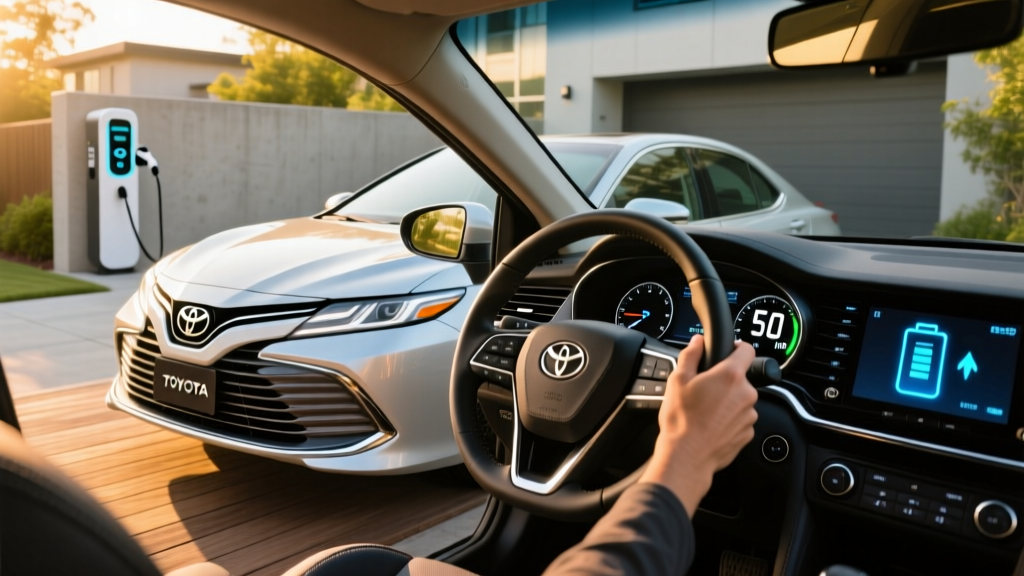
The eighth-generation Toyota Camry Hybrid arrived for the 2018 model year on Toyota's TNGA-K platform, bringing a significant leap in efficiency, handling, and interior quality over its predecessor. For used-car shoppers in 2026 evaluating midsize hybrid sedans, the 2018 Camry Hybrid remains a benchmark — delivering over 50 MPG combined without ever needing to plug in. This guide covers every number that matters: real-world fuel economy, battery longevity, replacement costs, and how this conventional hybrid (HEV) compares to plug-in hybrids and full EVs.
2018 Camry Hybrid MPG: EPA Numbers and Real-World Results
The EPA rates the 2018 Toyota Camry Hybrid across three trim levels, with the fuel-economy leader being the LE trim on 16-inch wheels. The SE and XLE trims, equipped with 18-inch wheels and slightly different tuning, see a small efficiency penalty.
| Trim | City MPG | Highway MPG | Combined MPG | Annual Fuel Cost* |
|---|---|---|---|---|
| LE (16" wheels) | 51 | 53 | 52 | ~$1,150 |
| SE (18" wheels) | 44 | 47 | 46 | |
| XLE (18" wheels) | 44 | 47 | 46 |
*Based on 15,000 miles/year at $3.50/gallon. Source: fueleconomy.gov
HEV vs PHEV: What the 2018 Camry Hybrid Is (and Isn't)
A critical distinction for buyers: the 2018 Camry Hybrid is a conventional hybrid electric vehicle (HEV), not a plug-in hybrid (PHEV). It has no charging port, no electric-only driving range to speak of, and requires no change to your fueling habits. You simply fill it with regular 87-octane gasoline.
| Feature | HEV (2018 Camry Hybrid) | PHEV (e.g., Prius Prime) | BEV (e.g., Tesla Model 3) |
|---|---|---|---|
| Plugs in to charge? | No | Yes | Yes |
| Electric-only range | <1 mile at low speed | 25–44 miles (typical) | 250–360+ miles |
| Gas engine | Yes — primary power | Yes — backup/range extender | None |
| Fuel/energy source | Gasoline only | Gasoline + grid electricity | Grid electricity only |
| Home charging needed? | No | Recommended (120V or 240V) | Yes (240V Level 2 ideal) |
| Federal tax credit (new) | None | Up to $7,500 (§30D) | Up to $7,500 (§30D) |
| Best for | No charging access; simplicity | Short commute + road trips | Home charging; low running cost |
Toyota did not offer a Camry plug-in hybrid in 2018. If you want Toyota plug-in capability in a similar footprint from that era, the closest option is the Prius Prime (PHEV, ~25 miles EV range on 2018 models). For a Camry PHEV, you'd need to look at newer generations or consider the RAV4 Prime.
Powertrain Specs: Engine, Motor, and Combined Output
The 2018 Camry Hybrid pairs a 2.5-liter Dynamic Force four-cylinder engine with Toyota's Hybrid Synergy Drive system. This was the first year of the A25A-FXS engine, which runs on the high-efficiency Atkinson cycle.
| Specification | Value |
|---|---|
| Gas engine | 2.5L 4-cyl Atkinson (A25A-FXS) |
| Engine horsepower | 176 hp @ 5,700 rpm |
| Engine torque | 163 lb-ft @ 5,200 rpm |
| Electric motor output | 118 hp (88 kW) |
| Net combined system horsepower | 208 hp |
| Transmission | eCVT (planetary gearset, not belt-driven) |
| Hybrid battery (traction) | 245V NiMH (nickel-metal hydride), ~1.6 kWh |
| Drivetrain | Front-wheel drive |
| 0–60 mph | ~7.5 seconds (independent testing) |
| Curb weight | ~3,572–3,638 lbs (trim-dependent) |
Two technical notes worth highlighting. First, Toyota's eCVT is not a traditional continuously variable transmission with a steel belt and pulleys — it uses a planetary gearset that seamlessly blends engine and motor power. This design has proven extremely durable, with virtually no reported eCVT failures in the field. Second, the hybrid battery uses NiMH chemistry, not lithium-ion. While NiMH is heavier and less energy-dense than modern lithium packs, it has a long track record of reliability in Toyota hybrids, with many original packs lasting well beyond 150,000 miles.
Battery Lifespan, Warranty, and Replacement Cost
Battery longevity is the number-one concern for used hybrid buyers, and it's the area where the Camry Hybrid has the strongest track record in the midsize sedan segment.
According to data from hybrid battery remanufacturers and Toyota dealer service records, the NiMH pack in the 2018 Camry Hybrid typically retains sufficient capacity well past 150,000 miles. Complete failures before 100,000 miles are uncommon; gradual capacity loss (resulting in slightly lower MPG and more frequent engine engagement) is more typical after 120,000–180,000 miles.
If replacement is needed, here's what to budget in 2026:
- New OEM Toyota battery: $3,000–$4,000 (parts + dealer labor)
- Remanufactured/reconditioned battery: $1,500–$2,500 (from reputable suppliers like Green Bean Battery or Dorman)
- Individual module replacement: $500–$1,200 (if only a few cells are degraded — requires a specialist shop)
For context, a $2,000 remanufactured battery replacement at 160,000 miles still makes the Camry Hybrid significantly cheaper to own than a comparable gas-only Camry over the same mileage, given the fuel savings accumulated.
2018 Camry Hybrid: Trims, Pricing, and Tax Credit Eligibility
When new, the 2018 Camry Hybrid was offered in three trims. Here are the original MSRPs and approximate 2026 used-market values:
| Trim | Original MSRP | 2026 Used Range (est.) |
|---|---|---|
| Hybrid LE | $28,690 | $17,000–$22,000 |
| Hybrid SE | $30,190 | $18,000–$23,000 |
| Hybrid XLE | $33,190 | $19,500–$25,000 |
Used pricing varies significantly by mileage, condition, and region. Values based on 2026 Kelley Blue Book and dealer listings.
Who Should Buy the 2018 Camry Hybrid vs a PHEV or EV?
Choose the 2018 Camry Hybrid if:
- You have no access to home or workplace charging
- You want 50+ MPG with zero behavior change
- Your budget is under $25,000 for a reliable used sedan
- You take frequent long road trips and don't want to plan around chargers
- You value Toyota's long-term reliability track record
Consider a PHEV or EV instead if:
- You have Level 2 charging at home and a short commute (<40 miles)
- You want to drive on electricity daily and cut gas consumption 60–100%
- You qualify for tax credits on a new or newer used plug-in vehicle
- You want one-pedal driving and instant electric torque
- You're in a state with low electricity rates and high gas prices
The decision framework is straightforward: if you can plug in at home, a PHEV like the RAV4 Prime or a BEV like the Hyundai Ioniq 5 will deliver lower per-mile energy costs and a more refined electric driving experience. If you can't plug in — or you want the simplest, most proven path to 50 MPG — the 2018 Camry Hybrid is still one of the best answers available in the used market.
Pros and Cons at a Glance
Pros
- 52 MPG combined (LE) — among the best of any midsize sedan ever sold
- No plug-in required; zero lifestyle change vs a gas car
- Proven NiMH battery with 150,000+ mile typical lifespan
- eCVT planetary gearset — extremely durable, no belt wear
- Strong safety scores (IIHS Top Safety Pick+)
- Comfortable, spacious interior with 15.1 cu-ft trunk
- Low annual fuel cost (~$1,150/year at 15K miles)
Cons
- SE/XLE trims drop to 46 MPG combined (18" wheel penalty)
- NiMH battery is heavier and less efficient than modern Li-ion
- No EV-only driving mode beyond low-speed parking maneuvers
- Infotainment system feels dated vs 2024+ competitors
- No all-wheel-drive option (AWD-e arrived in 2020+ Camry Hybrid)
- No federal tax credit eligibility (new or used)
- Original battery warranty expiring in 2026–2028 window
Frequently Asked Questions
How many MPG does the 2018 Camry Hybrid actually get?
The LE trim is EPA-rated at 51 city / 53 highway / 52 combined. The SE and XLE trims are rated at 44 city / 47 highway / 46 combined. In real-world city driving, many owners report exceeding EPA estimates, with 53–57 MPG achievable on the LE in stop-and-go conditions. Highway driving at 75+ mph typically yields 44–48 MPG for the LE.
Does the 2018 Camry Hybrid need to be plugged in?
No. The 2018 Camry Hybrid is a conventional HEV (hybrid electric vehicle). It charges its small NiMH battery entirely through regenerative braking and the gas engine. There is no charging port and no plug-in capability. You fuel it exclusively with gasoline.
How long does the hybrid battery last, and what does replacement cost?
Toyota's NiMH hybrid battery typically lasts 150,000–200,000+ miles with normal use. Original warranty was 8 years/100,000 miles (10 years/150,000 miles in CARB states). Replacement costs range from $1,500–$2,500 for a remanufactured pack to $3,000–$4,000 for a new OEM unit. Individual cell module repairs can cost $500–$1,200 at a hybrid specialist.
Is the 2018 Camry Hybrid reliable compared to the gas Camry?
Yes — the hybrid variant has historically matched or exceeded the gas Camry in long-term reliability. The eCVT transmission has no belts or clutches to wear out, the regenerative braking system reduces wear on the friction brakes (many owners report original brake pads past 80,000 miles), and the Atkinson-cycle engine operates under less thermal stress. Toyota's hybrid system has accumulated billions of real-world miles across the fleet with very low failure rates. IIHS gave the 2018 Camry a Top Safety Pick+ rating.
Does the 2018 Camry Hybrid qualify for any tax credit?
No. The federal §30D clean vehicle credit and the §25E used clean vehicle credit both require plug-in vehicles (PHEVs or BEVs) with minimum battery capacity thresholds. The Camry Hybrid, as a conventional HEV, does not qualify for any federal purchase incentive. Some states or municipalities may offer minor benefits such as HOV lane access or reduced registration fees — check your local regulations.
How does the 2018 Camry Hybrid compare to newer Camry Hybrids?
The 2025–2026 Camry Hybrid (now exclusively hybrid in its ninth generation) offers an updated 2.5L hybrid system rated at 225 hp, available AWD, and a lithium-ion traction battery that's lighter and more efficient. EPA ratings for the 2025 LE reach 53 city / 50 highway / 51 combined. If buying used, the 2018 model delivers nearly identical MPG at a significantly lower price. The main upgrades in newer models are the Li-ion battery, AWD availability, updated infotainment, and Toyota Safety Sense 3.0.